OSHA respirator medical evaluation questionnaire
The OSHA respirator medical evaluation questionnaire is the mandatory health for...

3
Last Updated: Oct 15, 2026

North Carolina limits ownership of the entity that practices medicine to the licensee combinations named in General Statute 55B-14.
A physician may own the practice alone, a physician assistant may own one alone, and a registered nurse may not own it at all.
The NC Medical Board has to approve a medical PC or PLLC before the Secretary of State will accept the filing.
A layperson cannot hire a physician to practice medicine in North Carolina, which rules out the usual hire-a-medical-director structure.
A registered nurse or LPN may administer on a prescriber’s order, while a medical assistant or phlebotomist may not start the line.
IV hydration business requirements in North Carolina start with a question about ownership, not paperwork. Only the licensees named in General Statute 55B-14 may hold shares in an entity that practices medicine. A registered nurse is not one of them.
That catches founders out, because a vitamin drip feels like wellness rather than medicine. North Carolina disagrees. Ordering the infusion is a medical act, so the license behind that order decides your structure.
Settle it before you sign a lease and the rest is filings and protocols. Leave it until later and the entity may have to be rebuilt. Ownership comes first below, because staffing, oversight, and every filing follow from it.
No North Carolina agency licenses IV hydration as a business category. Five bodies each govern a piece of it, and you check them one at a time:
The Board of Nursing is the one that names your business model out loud. Its position statement on IV hydration and nutrient therapies covers walk-in clinics and drip bars directly.
That statement requires an individualized order before a nurse starts any infusion. The order has to come from a physician, nurse practitioner, or physician assistant with prescriptive authority. Which board licenses that prescriber then decides who may hold the shares.
Only physicians and physician assistants may own a North Carolina IV hydration practice outright. A nurse practitioner may co-own one, but only alongside a physician.
General Statute 55B requires a licensed professional opening a formal business to form a professional corporation or a professional limited liability company. Shares in that entity may only be held by a licensee. General Statute 55B-2(2) defines a licensee as a person licensed to render the same service the entity renders.
The NC Medical Board puts the consequence bluntly in its guidance on professional corporations. Non-licensees may not be a shareholder in a PC or a member of a PLLC.
A non-licensee may still work there as an employee, but not on pay tied to fees collected from patients. The Board calls that fee-splitting, and North Carolina doesn’t permit it.
Wellness infusions get no exception from any of this. General Statute 90-1.1(5) reaches offering to prescribe, order, give, or administer any drug or medicine. It never asks whether the substance needs a prescription. A bag of saline and a B-complex push both need an order, and writing that order is practicing medicine.
Nursing has its own ceiling. The NC Board of Nursing states that licensed practical nurses may not own professional nursing businesses, in whole or in part. That leaves the two licenses founders confuse most often, the PA and the NP.
A physician assistant may own a North Carolina practice alone. A nurse practitioner may only co-own one alongside a physician.
The asymmetry surprises people, because the two roles look similar from the outside. The difference comes down to which board issues the license, and to what General Statute 55B-14(c) lists.
The NC Medical Board licenses physician assistants, so a PA answers to the same board as a physician. Its practice-ownership guidance says a licensed PA may form a PC or PLLC as sole shareholder. General Statute 55B-14(c)(3) also allows a physician and a PA to co-own one, with no rule on how the shares split.
Sole PA ownership carries one catch. A practice owned only by PAs may not hire or contract with physicians to practice medicine on its behalf, per the same NCMB guidance. A PA also needs a primary supervising physician and an accepted Intent to Practice form before performing any medical act, under 21 NCAC 32S.
Nurse practitioners sit under the NC Board of Nursing rather than the Medical Board. General Statute 55B-14(c)(5) allows a physician and a nurse practitioner to form a professional corporation together. The statute names the physician as a required party, so an NP cannot hold the medical entity alone.
North Carolina is not a full-practice-authority state either. Every NP works under a collaborative practice agreement with a primary supervising physician. That agreement is signed, dated, reviewed yearly, and kept on site. The rules sit in 21 NCAC 32M and 21 NCAC 36 .0800, administered jointly by both boards.
One pairing trips up co-founders. The NCMB states that a PA licensee and an NP licensee may not own a professional entity together, because 55B-14 does not list that combination. Treat any pairing missing from 55B-14(c) as closed, and check it before anyone drafts an operating agreement.
A management services organization is the route North Carolina leaves open to a founder who cannot own the medical entity. The licensed provider owns the practice. The founder owns a separate company that sells it non-clinical services.
That company can handle billing and collection, front-office staffing, vendor contracts, marketing, and the premises. It charges the practice a management fee for the package.
North Carolina puts one specific limit on that fee. The NC Medical Board says a non-licensee may not be paid based on fees collected from patients, and calls it fee-splitting. A management fee set as a percentage of practice collections runs straight into that rule.
Attorneys advising on North Carolina med spa structures report that regulators have been looking harder at MSO arrangements. No dated enforcement action or board rule is cited for that claim, so read it as a direction of travel rather than settled law. How you set the fee itself is a question for counsel.
For a registered nurse, the picture is better than the ownership rule alone suggests. An RN asking how to start an IV hydration business in North Carolina has two structures available, not one.
The first is a nursing professional corporation or PLLC. General Statute 55B-14(c)(2) lets registered nurses and advanced practice nurses co-own an entity that renders nursing and related services. The NC Board of Nursing runs that registration itself, and confirms an RN may establish one.
The second is the MSO above, paired with a clinical entity someone else owns. Neither route moves the clinical decisions, though. Every infusion still needs an order from a physician, NP, or PA, and the RN owner cannot write it.
Six structures come up for North Carolina IV hydration businesses, and General Statute 55B-14 permits four of them outright.
The matrix below sorts them by the license you hold, which is the axis that decides the rest.
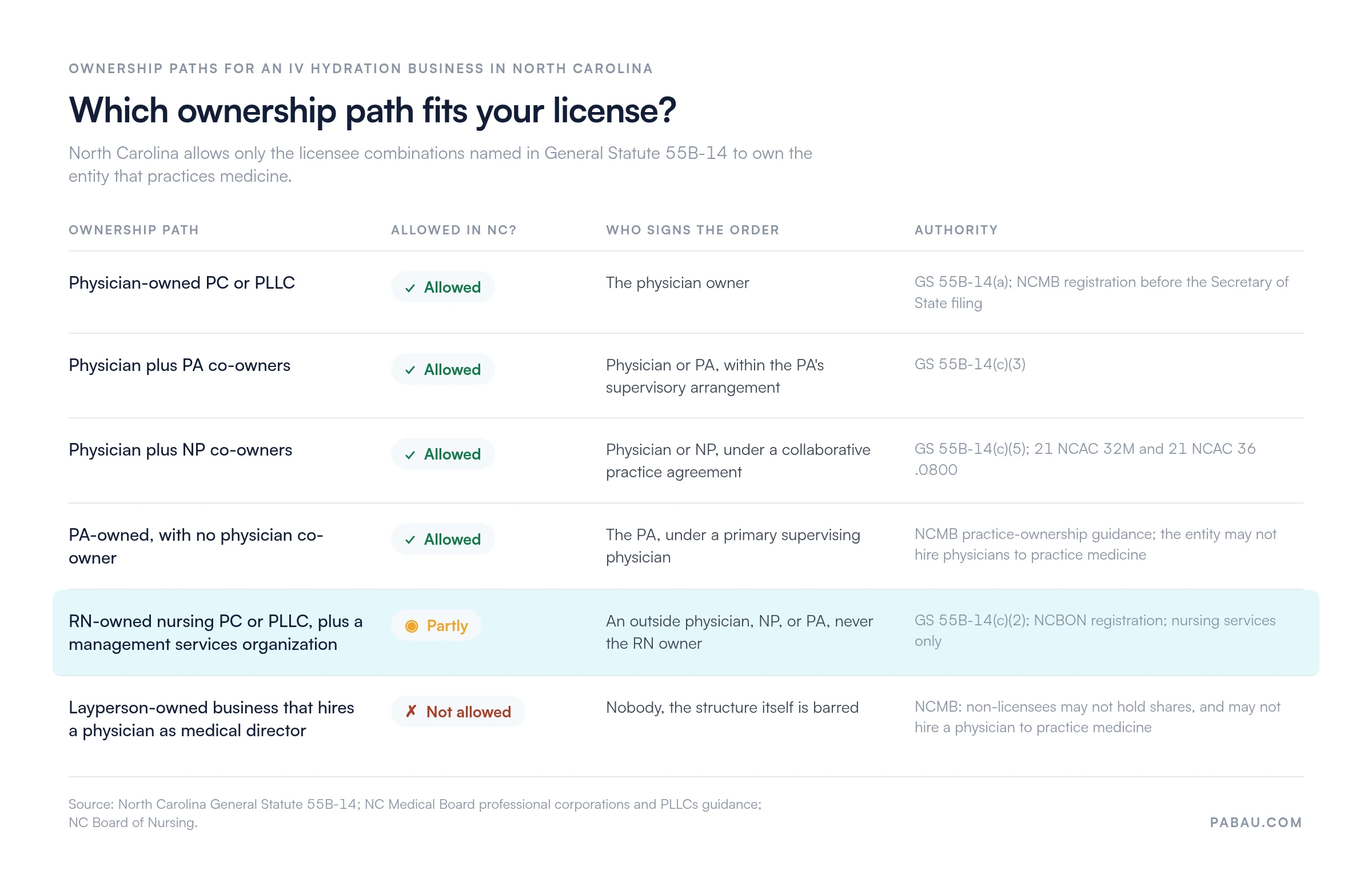
The table adds the supervision each path carries and the founder it suits.
Row six is the one worth reading twice. The NC Medical Board answers that question directly, and says no. A layperson may not hire a physician to practice medicine, because that creates an employment relationship a non-licensee is not qualified to supervise.
North Carolina does not license a medical director role, and hiring one will not legitimize an unlicensed owner.
Search results treat a medical director for IV hydration compliance as a hire you make. In North Carolina, the role works more like a clinical relationship you build inside a properly owned entity.
Two roles get mixed up here. A supervising or collaborating physician is the named clinician a PA or NP works under, required by rule and documented in a signed agreement. A medical director is an operational title covering protocol approval, standing orders, chart review, and clinical accountability.
The state does set a standard for that oversight. NCMB position statement 9.1.1 says a physician supervising other licensed professionals must maintain ultimate responsibility for the quality of care every patient receives. It expects the arrangement to be written down as an agreement, a protocol, or other written guidelines.
So a physician who signs standing orders and never reviews a chart falls short. Ultimate responsibility for care is not a signature, and it is the physician’s license that answers for it. South Carolina’s IV rules are stricter on this point. A physician there who signs standing orders without seeing the patient can be aiding unlicensed practice.
In the IV and wellness practices we onboard, the medical director relationship is usually documented last. The branding and the booking page tend to go live first.
Medical-director matching services advertise malpractice coverage inside the collaboration, but that is one vendor’s offer rather than a market norm. Price the oversight against what the arrangement has to evidence, not against a headline.
Ownership therefore comes before hiring. If a licensee named in 55B-14 owns the entity, the oversight arrangement is straightforward to document. If a layperson owns it, no medical director repairs it.
North Carolina issues no IV hydration business license. The licensing work is entity registration with a professional board, plus the permits any business needs.
That sequence runs the opposite way to a normal business filing. Your board approves the PC or PLLC first, and only then does the Secretary of State accept the articles.
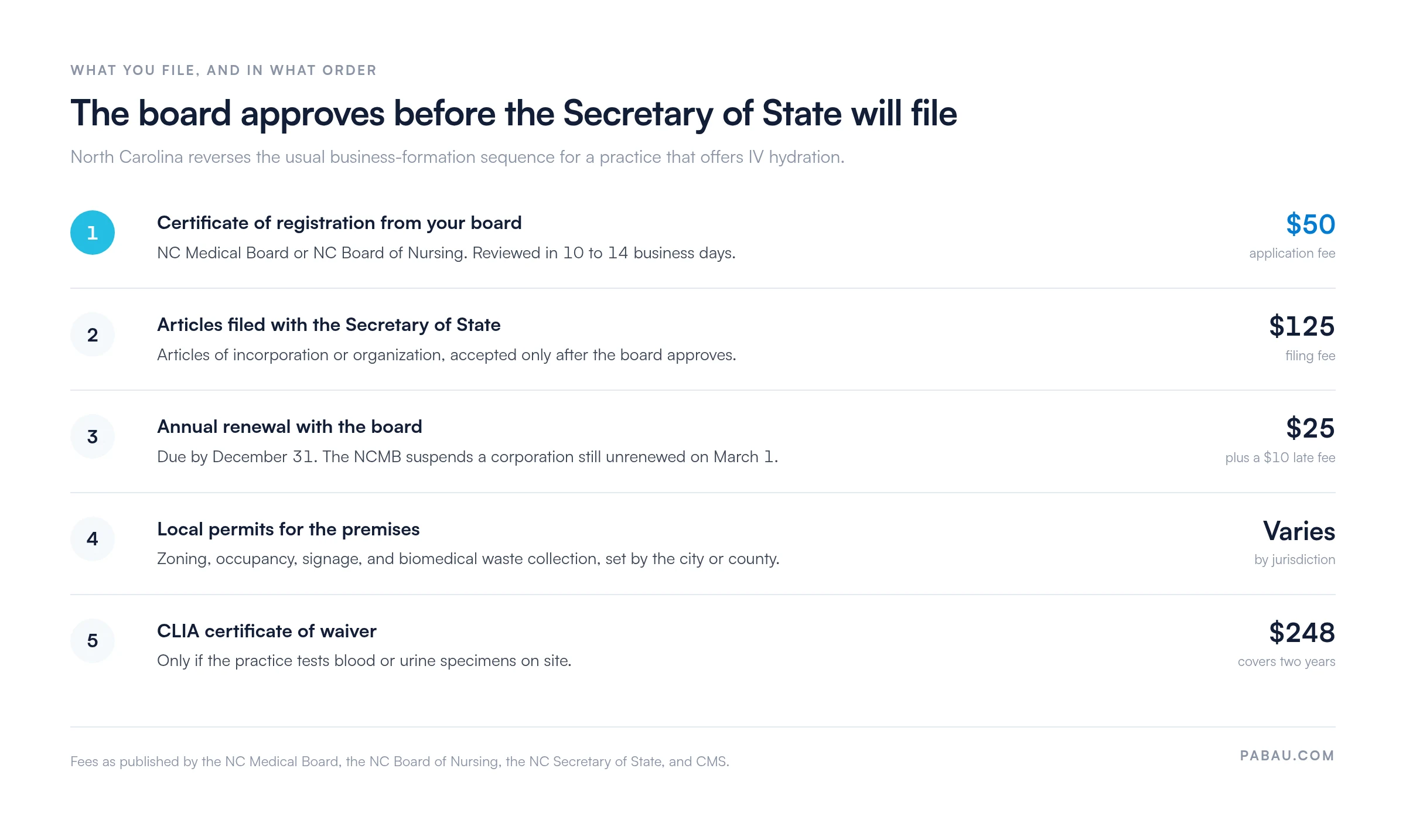
Each step in turn, with what it costs:
The renewal deadline has teeth. Miss it and the NCMB suspends any corporation still unrenewed on March 1, then notifies the Secretary of State. A suspended entity is supposed to stop providing professional services, even though the physician or PA keeps practicing.
Board approval isn’t instant either. The NCMB reviews submitted corporation documents within 10 to 14 business days, and offers no expedited route, because the legislature sets the fee schedule.
The board reviews what you send it, so the packet is worth a second pass before it goes in. Five things to confirm:
Registered nurses and LPNs may administer IV hydration in North Carolina on a prescriber’s order. Unlicensed staff may not start or access the line.
Two NC Board of Nursing position statements settle this, and both are more specific than the state-by-state summaries circulating online.
The fourth item is worth checking against whatever you read elsewhere, because the Board of Nursing states it plainly. An RN does not require the on-site presence of a physician, NP, or PA to perform an ordered infusion.
Two conditions travel with that freedom. The order has to be individualized for the patient, and a client evaluation for procedure appropriateness has to be completed before administration.
Some state guides list North Carolina as allowing medical assistants with IV training to administer therapy. The Board of Nursing’s infusion position statement says the opposite, in a table.
Unlicensed assistive personnel may perform four infusion tasks and no more. Delegating medication administration by the intravenous route to unlicensed personnel is not permitted within current standards of practice. Medical assistants sit inside that category, because North Carolina neither licenses them nor defines a scope for them.
Rules on who may administer IV vitamin therapy differ enough between states that a protocol written for one does not transfer. Check the roster you plan to hire against North Carolina’s own position statements before you post the job.
Nothing in this section is specific to North Carolina. Federal rules and insurance cover work the same way in Charlotte as anywhere else, and each has a named source worth reading in full.
Three policies come up, and each covers a different failure.
Four federal sources then set the operating standard for an infusion service.
HIPAA sits over all of it, because an IV hydration practice creates protected health information from the first intake form.
A practice offering IV hydration through licensed providers has to be a professional corporation or a professional limited liability company. A plain LLC will not do.
Choosing between the two is largely a tax question. The NC Medical Board says as much, and refers licensees to their own attorney or CPA. A plain LLC can still hold the lease, the equipment, or the MSO, because the ownership rule binds the clinical entity only.
Two mechanical items follow. An EIN from the IRS lets you open the bank account and run payroll. A registered agent has to be named for the Secretary of State, and that agent may be you, though the role carries no ownership.
Written protocols are where compliance stops being paperwork and turns clinical. The NC Board of Nursing requires the business to keep policies and procedures on site for administration, for the therapies offered, and for emergency intervention.
Standing orders take a specific form here. The Board of Nursing describes them as signed, dated, written instructions from a provider authorized to prescribe. They set out the situations in which a nurse may act on them.
They don’t move the diagnostic line, though. An RN or LPN working from a standing order still may not make a medical diagnosis. Nor may they develop a treatment plan or declare a patient free of illness.
Screening comes before the drip, not after the sale. The Board of Nursing requires a client evaluation for procedure appropriateness, alongside the individualized order.
Where a nurse practitioner writes the order, the Board of Nursing sets out what the record should show.
Protocols, orders, consents, and staff credentials all have to be findable a year later. That record-keeping load is why founders shortlist longevity clinic software early rather than after opening.
The compliance stack is only half the build, though. Our guide on how to open an IV clinic covers the premises, the equipment, and the first hires.
Treating patients in their homes can pull a North Carolina IV business into home care agency licensure. A storefront practice never touches it. The same split applies to IV hydration in Virginia, where only home-based service needs a home care organization license.
General Statute 131E-136(3) defines home care services to include infusion nursing services delivered in a place used as someone’s home. A home care agency is an organization that provides those services, and 131E-138 requires a license to operate one.
The NC Board of Nursing points nurses at that licensure directly, in the same position statement that covers hydration clinics and drip bars.
Whether a given mobile model needs the license depends on the detail. The statute excludes incidental health care provided by an employee of a physician in the normal course of that physician’s practice. Where a mobile service sits against that exclusion is a question for counsel, not one this page can settle.
Ownership, medical direction, and staffing work the same way whichever model you pick. The operational side of a mobile IV therapy business, from routing to on-board storage, is covered separately.
North Carolina’s requirements share one feature. Nearly all of them are proved by a document rather than by a policy. The individualized order, the evaluation, the signed standing order, the consent, and the nursing note all have to exist and be findable.
Those documents usually start life in three different places. Standing orders live in a shared drive, consents come back as signed PDFs, and the nursing note is typed somewhere else again. Proving that a specific order covered a specific infusion then means opening three systems.
Practice management software like Pabau keeps them on one patient timeline instead. Digital forms carry the consent and the screening questionnaire, and the answers land in the patient record rather than an inbox. Treatment notes attach to the appointment that produced them, so the order, the consent, and the note read as one sequence.
Staff records sit in the same place, which matters when a roster mixes RNs, LPNs, and a supervising physician. Each staff profile holds the services that member is set up to deliver. Online booking then won’t offer a treatment unless someone cleared for it is available.
Still choosing a system? Our comparison of the best EMR for IV therapy sets out what a drip practice needs from its clinical records.

Pabau ties the prescriber’s order, the client evaluation, the consent form and the nursing note to one patient timeline. Staff profiles carry the services each member may deliver. Your oversight is evidenced the moment a board asks for it.

In North Carolina, the license you already hold decides your structure, and it does so before you pick a name. Work the ownership question first and the rest of the plan is filings and protocols. Work it last and the entity may have to be rebuilt.
The structure to walk away from is the one advertised most often. A layperson who owns the business and hires a physician as medical director has built the arrangement the NC Medical Board rejects. An MSO alongside a properly owned clinical entity does the same commercial job legally.
The trade-off worth remembering is control. Every legal route for a non-physician founder leaves the clinical decisions, and the order behind every drip, with a licensed prescriber. Building the relationship with that prescriber deserves as much attention as the lease.
Take the ownership answer and the staffing list to a North Carolina healthcare attorney before you file anything. Book a demo to see how Pabau keeps the order, the consent, and the nursing note on one patient record.

Comparing states before you incorporate? IV hydration business requirements in Arizona shows how differently a neighboring market splits ownership and supervision.
Writing the standing order itself? Myers cocktail protocol covers the formulation and the monitoring a nurse works from.
Need the intake paperwork drafted? IV therapy patient intake template gives you the screening questions to ask before a first infusion.
Writing the emergency section of your protocols? IV therapy complications sets out what staff have to recognize and escalate.
Checking scope in another state? Who can administer IV vitamin therapy compares the rules practitioners work under across the US.
Not for standard hydration and vitamin infusions. A DEA registration covers controlled substances, and saline, electrolytes and B vitamins are not controlled. The prescriber still needs North Carolina prescriptive authority for the order itself. Add a controlled drug to the menu and the DEA registration becomes necessary.
Only with a North Carolina license. The NC Medical Board treats medicine as practiced where the patient is, so a remote prescriber needs a license here. Narrow exceptions cover irregular provider-to-provider consultations, and episodic follow-up for a patient who is only temporarily in the state.
No. The state issues no IV certification, because infusion therapy already sits inside the RN and LPN scope. The Board of Nursing expects documented knowledge, skill and competency instead. The safer route is to validate infusion training in-house and keep the record on file.
Wellness drips are usually self-pay. Payers reimburse infusion when it is medically necessary and documented, which a hydration menu rarely is. Most drip practices price per bag and take payment at the visit, so insurance credentialing is rarely the first job on the list.
Only with evidence behind the claim. The FTC expects competent and reliable scientific evidence for a health benefit, which usually means human clinical study. An unsupported immunity or hangover claim is the exposure here, rather than the infusion itself.