Professional development record
A professional development record is a structured log of a healthcare practition...

8
Last Updated: Oct 8, 2026

An IV drip business in Dubai needs two licenses, one from the Dubai Health Authority and one from the Department of Economy and Tourism.
Mainland or Dubai Healthcare City is the first decision, and both routes now allow full foreign ownership.
DHA’s published fees for a one-year specialty clinic license total AED 9,000, before professional licenses and commercial costs.
Home visits need home healthcare licensing, and DHA’s home healthcare standard describes homebound patients referred by a physician.
A standalone mobile facility license costs AED 18,000 a year, three times the AED 6,000 base activation fee for a specialty clinic.
An IV drip business in Dubai needs two licenses, one clinical and one commercial, plus a mainland-or-free-zone decision made before you sign a lease. Budget about AED 13,000 in published Dubai Health Authority fees for year one.
Search for a Dubai drip clinic and you find treatment menus. Those pages carry price lists and booking buttons, but they name no regulator, no facility category, and no fee schedule.
This guide assembles the Dubai IV licensing stack in the order a founder meets it. That stack runs from the ownership route to the facility license, then the medical director and the scope-of-practice rules. Home visits and mobile units add a layer on top.
Every figure comes from a regulator’s own schedule or a provider’s own price list, dated where it matters.
A Dubai IV drip business needs two licenses. The Dubai Health Authority licenses the facility, and the Department of Economy and Tourism licenses the company.
The Dubai Health Authority, known as DHA, licenses every health facility on the Dubai mainland. Applications run through Sheryan, the DHA online licensing system. DHA states that manual applications, or applications received by email, are not acceptable.
No DHA facility category is called IV therapy. The category follows the service you propose, so your facility proposal decides your license and your fee. DHA’s Manual for Licensing Health Facility spells out what belongs in it. The proposal covers the facility type, the services provided, your professionals’ specialties and the clinical program.
Three outpatient categories in the manual’s Appendix 1 cover most drip businesses. A Specialty Clinic provides a single health service. A Polyclinic covers a minimum of two different specialties. A General Clinic is built around one or more general practitioners.
The category then sets the money. Initial approval costs AED 1,000 for a Specialty Clinic and AED 2,000 for a Day Surgery Center, on DHA’s own New Facility License fee schedule. Pick the category before you build a budget, not after.
Dubai Healthcare City sits outside all of this. The free zone is governed by Dubai Healthcare City Authority, and its regulatory arm licenses facilities inside the cluster. DHA does not license a unit in Dubai Healthcare City, and DHA is an emirate-level authority rather than a federal one.
Both routes allow full foreign ownership. Mainland means a trade license from the Department of Economy and Tourism plus a DHA facility license, while Dubai Healthcare City issues both itself.
Older setup guides still claim a mainland practice needs a UAE national partner or service agent. Federal Decree-Law No. 26 of 2020 amended the Commercial Companies Law, and the Ministry of Economy applied the ownership change from June 1, 2021.
Activities of strategic impact are the exception. Confirm the position for your activity codes with the Department of Economy and Tourism.
Dubai Healthcare City makes the same promise in plainer language. Its own setup pages state that because Dubai Healthcare City is a free zone, you wholly own your business, clinical or non-clinical. Registration runs in three steps through MASAAR, the free zone’s online services system.
| Setup route | Foreign ownership | Who licenses the company | Who licenses the facility | Where the premises may sit |
|---|---|---|---|---|
| Dubai mainland | Full ownership permitted | Department of Economy and Tourism | DHA, through Sheryan | Any mainland unit with Ejari registration and a Makani number |
| Dubai Healthcare City | Full ownership permitted | Dubai Healthcare City Authority | The free zone’s regulatory arm | Inside the Dubai Healthcare City cluster only |
The free zone is not a small pond. Dubai Healthcare City Authority reported 487 active facilities and 12,941 professionals across the cluster in February 2026, with new projects up 26% year on year. Two days later it announced an expansion of its longevity and preventive care portfolio, which is the segment a drip business sells into.
One decision is harder to reverse than it looks. Section 10.7 of the DHA manual treats a move out of a free zone as a fresh start, not a transfer. You request a no objection certificate from the free zone authority, then register the facility as a new entity on the mainland.
So location and catchment decide the route, rather than shareholding. A drip business chasing walk-in and hotel demand across Dubai wants a mainland unit it can choose freely. A business built around medical tourism referrals may prefer the cluster.
Yes. DHA will not activate a facility license without an appointed medical director, and that person must hold an active DHA license.
The requirement sits in Chapter Three of the DHA manual, alongside a valid trade license, an electronic medical record meeting NABIDH standards, and passing inspection. Appointing the director also appears on the list of items the facility must have ready for the inspector.
A signature-only arrangement does not survive that reading. Section 19.1.9 states that the appointed medical or clinical director governs, oversees and is responsible for the clinical care and privileging provided within the facility. The same clause makes the director responsible for passing DHA regulatory messages to the right people and seeing them implemented.
Chapter Nine then limits who can hold the role.
That last point is the practical one for a group. A second site inside the same registered group can share your director. A second site owned separately cannot, which quietly changes how you structure a two-location rollout.
DHA publishes the professional license fee, not the retainer. A full-time physician license costs AED 3,000 for one year, AED 5,000 for two and AED 7,500 for three. What a director charges on top is a commercial negotiation, and no regulator publishes a figure for it.
Only a DHA-licensed physician or registered nurse may administer an IV drip in Dubai, inside a licensed facility and within their own scope of practice.
DHA’s Manual for Licensing Healthcare Professionals is blunt about the first half. All health professionals must be licensed in order to provide healthcare services in the emirate of Dubai. Each professional must also comply with the limitations printed on their registration or license card, and with their scope of service.
Getting there takes several steps in a fixed order. A clinician creates a Sheryan account and completes a self-assessment. Next come the qualification and experience requirements, then a positive Primary Source Verification result. Last is the assessment DHA sets for that title. Only then does registration issue.
One timing detail saves weeks. Professional licenses can be filed while your facility license is still inactive, and they activate automatically when DHA activates the facility. Recruit and file in parallel with your fit-out rather than after it.
Assistant nurses cannot fill a shortage of registered nurses here. DHA’s supervision appendix requires an assistant nurse to work under a full-time registered nurse.
DHA’s Standards for Home Healthcare Services took effect on February 19, 2025. That standard puts the preparation and administration of medications with physicians and registered nurses. Assistant nurses support the nurse’s role under supervision.
Two documents decide whether a session is defensible afterwards. The same DHA standard requires specialized consent forms for specialized services such as IV therapy. The standard also requires every medication to be recorded in the patient’s record each time it is given. Our guide on who may administer IV vitamin therapy compares the roles in more detail.
Insurance is part of the same picture. DHA requires facility management to maintain malpractice insurance for every licensed professional, and a copy of the third-party insurance contract is an activation document.
Home visits need home healthcare licensing, and a mobile unit needs its own permission. Neither one is covered by a standard clinic license in Dubai.
DHA defines a Home Healthcare Agency as a facility service that arranges and provides medical care at the patient’s home. The manual allows it either as an independent license or as a sub-service attached to a hospital, polyclinic or specialty clinic. That gives you two routes with very different price tags.
The Mobile Facility category carries one condition worth reading twice. DHA’s own description says the unit must be owned by another licensed health facility operating within the health authority’s geographical scope. A van cannot be your only license.
DHA’s patient selection criteria are stricter than the home-drip market assumes. The Standards for Home Healthcare Services describe a clinical patient rather than a wellness customer.
Home healthcare services are offered to patients referred by a physician. The patient should be homebound or semi-homebound, meaning they cannot leave the house without assistance because of illness or injury.
Read that against how home drips are sold today. Two of the four Dubai provider menus we read advertise at-home IV therapy to healthy customers. Neither page mentions a referral or a homebound criterion. A hotel-room hangover drip is a long way from the patient the standard describes.
We will not call the model unlawful, because the standard does not say so. Get DHA’s own reading of those criteria in writing before you build a delivery business on them. The economics of home visits sit in our guide to the mobile IV therapy business.
DHA’s published fees for a one-year specialty clinic license come to AED 9,000. Fit-out, rent, staffing and stock are quoted rather than published.
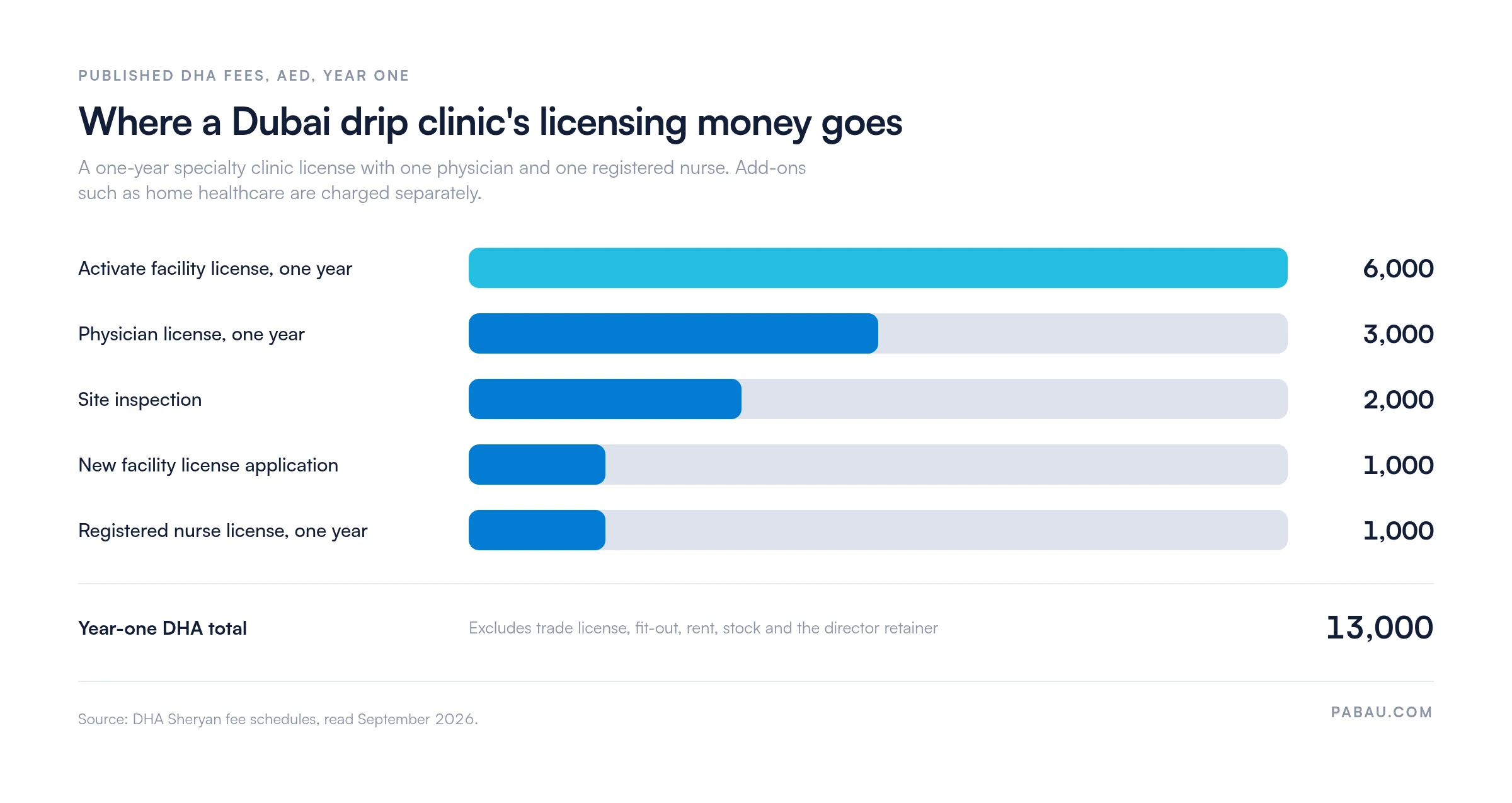
Add one physician and one registered nurse and DHA’s own bill reaches roughly AED 13,000 in year one. That total is knowable to the dirham before you commit to a unit. The table below carries only figures a regulator publishes, and marks the lines nobody publishes.
| Cost line | Published fee (AED) | Source | Notes |
|---|---|---|---|
| New Facility License, Specialty Clinic | 1,000 | DHA New Facility License fees | Non-refundable. The inactive license it buys lasts 12 months |
| Activate Facility License, one year | 6,000 | DHA Activate Facility License fees | Two years costs 10,500 and three years 15,000 |
| Site inspection | 2,000 | DHA Activate Facility License fees | Re-inspection after a failed visit costs 1,000 |
| Physician professional license, one year | 3,000 | DHA New Professional License fees | Two years costs 5,000 and three years 7,500 |
| Registered nurse license, one year | 1,000 | DHA New Professional License fees | Two years costs 1,500 and three years 2,500 |
| Home healthcare add-on, per year | 2,000 | DHA Amend Facility License fees | Available on an active license only |
| Mobile unit add-on, per year | 2,000 | DHA Amend Facility License fees | A standalone Mobile Facility license is 18,000 a year instead |
| Knowledge and Innovation fees | 10 plus 10 | DHA Sheryan checkout | Added to every DHA transaction |
| Late renewal penalty, Specialty Clinic | 1,200 per month | DHA Renew Facility License fees | Renewal opens before expiry, so put the date in the calendar |
| Trade license | Not published | None | DET calculates it per application from your codes, legal form and Ejari rent |
| Fit-out, rent, equipment, stock, director retainer | No figure we could source | None | Quote these locally. The ranges in circulation trace back to no regulator |
The shape of that spend is worth seeing. Five published lines make up the year-one total, and activation alone accounts for nearly half. Founders leave it out of a first budget because the bill arrives months after initial approval.
Four unpriced requirements still have to be met before inspection. Each one sits with a supplier rather than on a fee schedule.
The layout is another cost with no published price. DHA requires the floor plan to be designed and approved by prequalified health facility design consultants, with room counts matching its own facility guidelines. The design work is a consultant fee, quoted per project.
One clock matters more than any of these numbers. The inactive license lasts one year, and failing to complete the requirements inside that window cancels the licensing process and forces a fresh application. During initial approval you may not treat patients, receive patients or advertise.
Published Dubai list prices run from AED 250 for a single vitamin injection to AED 2,850 for a top-tier multi-vitamin drip. Those menus are easy to find, and none of them explains how the price was built.
The list below is a market benchmark for setting your own price list, not a recommendation. Figures come from two Dubai providers that publish a full menu, Medcare and Skin111, read in September 2026. Your margin depends on cost to deliver, so treat these as the ceiling the market has already tested.
Two pricing architectures are competing in this market, and you have to pick one. Medcare publishes a starting-from price per package. Skin111 publishes a list price and a session ladder, discounting 15% at one session, 25% at two and 35% at five.
That ladder is more aggressive than it first reads. A drip listed at AED 900 sells for AED 585 to a customer who buys five, which is a 35% haircut on your headline number. Decide whether you are running a package business or a single-session business before you print anything.
Tax treatment is the next line to settle. Skin111 states that an additional 5% VAT applies to its prices, and the reason sits in tax law rather than marketing. Article 41 of Cabinet Decision No. 52 of 2017 zero-rates healthcare services that the medical profession generally accepts as necessary for treatment, including preventive treatment.
The same article then carves out elective treatment for cosmetic reasons. The exception is where a doctor or medical professional prescribes it to treat or prevent a medical condition. A skin-brightening drip sold from a menu looks a lot like the carve-out. A physician-prescribed infusion for a diagnosed deficiency may not.
So the same bag can carry two different tax treatments depending on why it was given and who ordered it. Get a tax adviser to rule on each menu line before you publish prices, because the answer changes your net revenue by 5%.
One more number decides whether any of this works. Dubai menus put a session at 30 to 60 minutes, which caps how many chairs you can turn in a day. Utilization is what makes the unit economics land, more than the headline price.
Each step below unlocks the next, so the order matters more than the list. Work down it and you will hold the documents a DHA inspector asks for.
Steps four through twelve have to fit inside 12 months, because that is how long the inactive license lasts. Our guide to opening an IV clinic covers the build-out sequence in more depth.
Most new drip businesses launch on a stack that cannot answer an inspector. Consent forms print and get signed, then sit in a drawer. The physician’s order lives in a binder at reception. Batch numbers go on a whiteboard. Practice management software like Pabau replaces that patchwork with one client record.
In the practices we onboard, the order and the signed consent are the two records that go missing first. Pabau’s digital forms capture the screening questionnaire and the consent signature before the appointment, and file both against the client timeline automatically.
The treatment note, the batch and lot detail and the practitioner who administered the drip all land in the same place.
That matters most where DHA ties an act to a named person. Pabau’s treatment notes stay attached to the clinician who wrote them. A medical director reviewing a session sees who assessed, who ordered and who administered. Every subscription includes every feature, so the documentation tooling is never a paid upgrade.
Pabau’s calendar also carries the home-visit problem. Mobile appointments book against the practitioner rather than a room, and the same client record travels to the visit. The nurse documents at the bedside instead of retyping notes that evening.
If you are still choosing a system, our roundup of the best IV therapy EMR narrows the field. The wider category of longevity clinic software is worth reading too.

Pabau holds the screening questionnaire, the signed consent, the batch detail and the treatment note against one client timeline. A Dubai drip clinic can show an inspector who assessed, who ordered and who administered each infusion.

Licensing decides whether this business opens. Dubai has no shortage of customers for a drip, and DHA’s published fees are modest against a fit-out. What stops founders is picking a route and a delivery model in the wrong order.
Decide mainland or free zone first, then the facility category, then whether you will ever go to the patient’s home. Get that sequence right and the licensing work is a few weeks of DHA turnaround inside a 12-month window. Get it wrong and you are requesting a no objection certificate and starting again.
The trade-off worth remembering is that a drip is easy to sell and hard to document. Your records are what turn a wellness menu into a defensible medical service. Book a demo to see how Pabau keeps every order, consent and treatment note audit-ready for a Dubai IV drip clinic.

Licensing a drip clinic in another country? IV therapy clinic in Canada sets out the provincial rules and the published CAD prices.
Worried about what can go wrong mid-infusion? IV therapy complications covers the reactions to plan for and the emergency equipment to keep in the room.
Building your first formulation protocol? Myers cocktail protocol walks through the components, dosing and documentation for the formula most menus open with.
Ready to fill the chairs? IV therapy marketing covers the channels that work without making claims a regulator would query.
Need the paperwork to match? IV therapy patient intake is a ready-made form covering screening, history and consent before the first drip.
Margin comes from utilization, not the headline price. Dubai menus put a session at 30 to 60 minutes, and published prices run from AED 290 to AED 2,850. Against that, an IV drip business in Dubai carries roughly AED 13,000 in DHA fees in year one. Rent, fit-out, stock and a medical director sit on top. The fixed clinical cost is what a five-session discount ladder has to survive.
Published Dubai prices start around AED 290 for a hydration bag and reach AED 2,850 for a double-dose multi-vitamin package. A glutathione or skin drip sits between AED 330 and AED 1,400, and high-dose vitamin C between AED 1,400 and AED 1,600. What IV drips should cost also depends on tax, because an elective cosmetic infusion is standard-rated at 5% VAT rather than zero-rated.
Owning the company is a commercial question, and DHA’s licensing manual does not make facility ownership conditional on holding a clinical license. Running the clinical side is different. The facility must appoint a medical or clinical director who holds an active DHA license, meets DHA’s director requirements and governs privileging. Confirm with DHA whether a nurse can hold that role for your facility category before you structure the business.
Both. On the mainland, the Department of Economy and Tourism issues the trade license. DHA issues the health facility license for the premises. Inside Dubai Healthcare City, the free zone issues both. Every physician and nurse also needs an individual professional license. A valid trade license is also one of the documents DHA requires before activation.