Professional development record
A professional development record is a structured log of a healthcare practition...

4
Last Updated: Oct 8, 2026

Only a licensed physician, or a PLLC or PC owned entirely by physicians, may own a New York IV hydration business.
New York licenses both medicine and nursing through one body, NYSED’s Office of the Professions.
LPNs administering IV therapy need initial and annual training, and cannot IV push, give a first dose, or transfuse blood.
The medical director requirement comes down to a signed order or standing protocol behind every drip, not a job title.
A mobile service running several nurses risks tripping New York’s home care agency licensure threshold under Public Health Law.
Practice management software like Pabau keeps orders, consents, and staff training dates on one record an inspector can follow.
New York’s IV hydration business requirements start with ownership. Only a licensed physician, or a PLLC or PC owned entirely by physicians, may own the practice. However, an RN, an NP, or a PA can run the drip. None of them can hold the equity.
That split catches owners out, because the clinical rules and the ownership rules sit in different statutes. In fact, New York defines the practice of medicine at Education Law §6521 and restricts it to licensees at §6522. The professional-entity statutes then require every owner of a medical PLLC or PC to hold that same license.
This guide covers the compliance side of the launch. It runs through ownership, who may administer, medical direction, entity structure, licensing, and the mobile model. However, revenue, pricing, and profit modeling sit outside its scope.
New York runs medicine and nursing through the same regulator, which is unusual. The State Board for Medicine and the State Board for Nursing both sit under NYSED’s Office of the Professions, with Board of Regents oversight. Most states put nursing in its own independent agency.
As a result, that saves you a step. Check any requirement against a primary source and you deal with one department. NYSED covers the physician’s license, the nurse’s license, and the LPN’s IV training. The statutory ground is Education Law Title 8, Article 130, with medicine at Article 131 and nursing at Article 139.
New York law does not name IV hydration as its own regulated service. Instead, an IV hydration business in New York is a medical practice that happens to sell drips. The general rules on medicine and nursing carry the whole load. There is no drip-bar exception, and wellness branding does not create one.
Importantly, Education Law §6512 makes unauthorized practice of a licensed profession a class E felony. That provision turns an ownership shortcut or a staffing shortcut into criminal exposure rather than a fine.
Only a licensed physician, or a professional entity whose every member is a licensed physician, may own an IV hydration business in New York.
In fact, New York has no single statute that bans lay ownership of a medical practice. The rule is assembled from the practice-of-medicine provisions and the professional-entity statutes, and the result is the same either way.
So can an RN start an IV hydration business in New York? Not as the owner of the clinical entity. For example, a registered nurse can staff it, manage it, and even own a company that supplies it with premises, software, and administration. The medical practice itself has to sit in physician hands.
Neither a nurse practitioner nor a physician assistant may own a medical PLLC or PC in New York, whatever their clinical autonomy.
The NP confusion comes from the NP Modernization Act. Education Law §6902(3)(b) lets a nurse practitioner with more than 3,600 hours of qualifying experience practice without a written practice agreement or written protocols. That provision governs clinical practice authority and nothing else.
Practice autonomy is not ownership authority. Section 6902 says nothing about who may hold equity, and the PLLC and PC statutes still require an Article 131 license. An NP may own a nursing-only PLLC formed around Article 139 licensees, which is a different entity from the physician-scope practice a drip business needs.
Do not treat NP independence as permanent, either. The current text of §6902(3)(b) is marked effective until July 1, 2030. After that date, an NP past 3,600 hours must maintain an informal collaborative relationship, though still not a written agreement.
That 2030 date arrived through the FY2026-27 state budget, Chapter 57 of the Laws of 2026. A separate bill to remove the sunset outright, S2360, stalled in committee and was never enacted.
In contrast, physician assistants have no carve-out at all. PLLC and PC ownership requires licensure under Education Law Article 131, which covers physicians. PAs are licensed separately under Article 131-B, and that article contains no ownership provision for them.
The matrix below puts ownership and administration side by side. Competing guides and the NYSED pages split those two questions across separate pages.
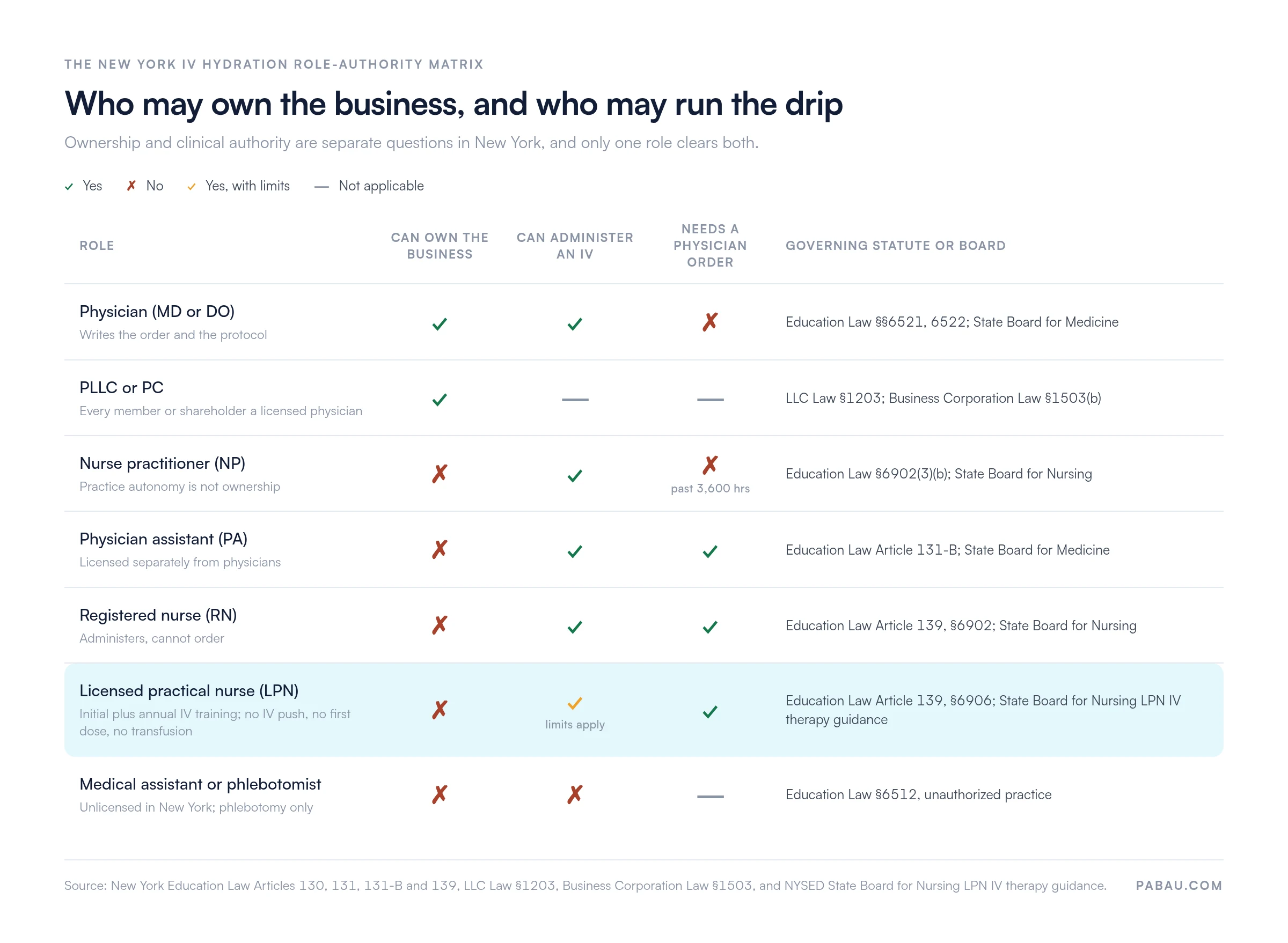
Read the matrix as two separate questions and the route through it gets clearer. The table below turns it into a starting position, based on who is writing the check.
| Who is starting the business | Can own the practice outright? | The structure that usually works | What breaks the rule |
|---|---|---|---|
| Physician (MD or DO) | Yes | Sole proprietorship, PLLC, or PC | Admitting a non-physician member later |
| Two or more physicians | Yes | PLLC or PC with every member licensed | Letting one member’s NYSED registration lapse |
| Nurse practitioner (NP) | No | Employment or a clinical lead role inside a physician-owned entity | Holding equity in the medical PLLC or PC |
| Physician assistant (PA) | No | Employment under physician supervision | Holding equity in the medical PLLC or PC |
| Registered nurse (RN) | No | Employment, or owning a management company that serves the practice | Taking a percentage of clinical revenue |
| Non-clinician investor | No | A management services organization on a flat, service-based fee | Paying itself a share of patient fees |
The last two rows are where the fee-splitting rule bites, and that has its own section below.
Physicians, nurse practitioners, physician assistants, and registered nurses may administer IV hydration in New York, and trained LPNs may too under an order.
Ordering and administering are separate jobs, and the same person rarely does both in an IV hydration practice. A physician or an experienced NP writes the order. Then, a nurse hangs the bag.
A registered nurse administers under a valid order for that patient, or under a standing order the ordering provider has signed for that protocol. In fact, registered nurses cannot write the order themselves, and Article 139 does not give them prescriptive authority.
A nurse practitioner past 3,600 hours may both order and administer within their own practice authority. A physician assistant orders and administers under physician supervision, under Article 131-B. Both routes still need the protocol on file.
Those role boundaries are New York’s. Rules on administering IV vitamin therapy differ from state to state, so do not carry this section across a border.
New York requires an LPN to complete IV therapy training before administering IV hydration, and to complete additional IV training at least annually.
The settings named in law are institutional ones. They run from hospitals and nursing homes through diagnostic and treatment centers, ambulatory surgery centers, and dialysis facilities, to home care agencies and hospice programs. Consequently, a storefront IV hydration center is not on that list.
The State Board for Nursing closed that opening itself. Its guidance determines that all LPNs complete IV therapy training regardless of practice setting, so the annual refresher follows your LPN into a drip bar. The annual refresher is a staffing calendar item, not a one-off onboarding task.
Can LPNs start IVs in New York? Yes, once trained and under an order, in a superficial peripheral vein of the arm, hand, leg, foot, or scalp. Midline and long peripheral catheters fall outside that scope. So does any femoral, jugular, or umbilical insertion.
Whether an LPN can give IV meds has a narrower answer. New York bars an LPN from giving any drug or solution by IV push, other than flushes. First doses of any drug are excluded too. Can LPNs give injections? Yes, within their training, but an IV push is never one of them.
Owners shopping for IV certification classes should check the curriculum against the Board’s published essential course content for LPN IV therapy. Instead, a generic infusion certificate does not satisfy a New York requirement written around specific devices and specific exclusions.
| Device or setting | What an LPN may do | What an LPN may not do |
|---|---|---|
| Short peripheral IV catheter | Insert into a superficial arm, hand, leg, foot, or scalp vein. Set up equipment, adjust flow, and flush. Change the dressing, draw blood, and remove the catheter. | Insert a midline or long peripheral catheter. Insert any femoral, jugular, or umbilical line. |
| Central line, non-dialysis setting | Assemble and set up equipment, solutions, and drugs. Monitor or verify flow rates for the RN who is administering. | Insert or remove the device. Access the port, change the dressing, or draw blood from the line. |
| Central line, dialysis facility | Start and end hemodialysis and adjust flow. Give boluses solely for plasma volume expansion. Change dressings and heparin lock caps, draw blood, and flush lines. | Give any drug by IV push. Give a first dose, or a blood transfusion. |
| Any device or setting | Give IV solutions and permitted IV drugs under an order, after training. Monitor the patient and report complications. | IV push, other than flushes. First doses. Antineoplastic, experimental, or non-FDA-approved drugs. Blood transfusions. |
Scope is stated by device and by setting, which is why a blanket answer about LPNs and IVs is always wrong. Source for this table is the NYSED State Board for Nursing guidance for LPNs who provide IV therapy services.
Neither a medical assistant nor a phlebotomist may start an IV in New York, because New York licenses neither role.
Medical assistant is not a licensed or otherwise recognized title in New York State. A national certification changes nothing here, because the holder is still an unlicensed person. NYSED guidance on unlicensed persons in clinical settings bars them from inserting or removing IVs or catheters of any kind. That guidance also bars administering injections of any kind.
NYSED’s list also rules out drawing up any medication in a syringe. That closes the prep step as well as the infusion, which surprises owners who planned to have an assistant mix the vitamin cocktail. Can medical assistants start IVs under a nurse’s supervision? No, and supervision does not change the answer.
Phlebotomists are not licensed in New York either. Unlicensed staff may perform phlebotomy if properly trained and working in a CLIA-waived facility. So can a phlebotomist start an IV in your drip room? No, and phlebotomy training is not a step toward that authority.
Drawing blood and starting an infusion look similar and sit on opposite sides of the line. A phlebotomist who starts an IV is practicing nursing without a license under Education Law §6512. Can an LPN draw blood instead? Yes from a peripheral IV catheter, but not from a central line outside a dialysis facility.
Yes, in substance: every IV in a New York IV hydration business runs on an order from a licensed physician, nurse practitioner, or physician assistant.
New York requires authorization rather than a job title. No statute names a medical director for an IV hydration business the way some states do. The requirement arrives sideways, through the rule that a nurse administers only on a provider’s order.
As a result, that distinction changes what you are shopping for. A retainer agreement with a physician who never signs a protocol does not meet the requirement. Instead, what works is a physician who owns or contracts with the practice, signs each protocol, and issues the orders.
NP practice autonomy does not change the nurse side either. Even where an experienced NP writes the orders under §6902, RNs and LPNs still administer under that order or a signed standing protocol.
Oversight, in the form an inspector can see, comes down to four artifacts:
Two vehicles are available, and both are physician-only. A professional service limited liability company sits under Article 8 of the Limited Liability Company Law. Section 1203 requires every member to be licensed under Education Law Article 131.
A professional corporation sits under Article 15 of the Business Corporation Law. Section 1503(b) adds a filing step the PLLC route does not have. You need a certificate from the licensing authority confirming that every proposed shareholder, director, and officer is authorized to practice.
Either entity is then filed with the New York Department of State. Put that choice in your IV hydration business plan before you sign a lease. Retrofitting an entity across signed patient records is slow and expensive.
The management services organization route is where non-clinical money usually enters. An MSO owns the premises, the brand, the software, and the administrative staff, and contracts with the physician-owned entity for those services. In contrast, the clinical entity keeps the patients, the charts, and the medical decisions.
New York treats fee-splitting by a physician as professional misconduct under Education Law §6530(19). The parallel rule for the other licensed professions sits at 8 NYCRR §29.1(b). Section 6530(19) bars sharing professional fees with anyone who is not a partner, employee, associate, subcontractor, or consultant authorized to practice medicine.
That provision reaches further than a straight fee split. It also covers any payment for space, facilities, equipment, or personnel that is calculated as a percentage of the physician’s receipts.
So structure any MSO management fee as compensation for services the MSO genuinely delivers, rather than a share of revenue. Have a compliance lawyer review the fee structure before you sign it. That review costs a fraction of unwinding the arrangement later.
New York issues no dedicated IV hydration business license, so compliance runs through entity registration and the physician’s own professional registration instead. Colorado also issues no IV-specific license, and Colorado’s IV hydration requirements run through the entity filing and each practitioner’s own license instead.
New York regulates IV hydration services through the professions rather than through a facility license. In short, three registrations do the work. The PLLC or PC is filed with the New York Department of State, the PC only after the NYSED certificate under BCL §1503(b). Every practicing physician, NP, PA, RN, and LPN holds a current NYSED registration alongside their license.
New York City issues no separate medical-practice license for an IV hydration business. State licensure and NYSED registration apply statewide, New York City included. In other words, a Manhattan drip bar faces the same clinical rules as one in Buffalo.
Three launch items sit outside professional licensing and still belong on the checklist.
A mobile IV hydration business faces the same ownership and administration rules as a storefront, plus one more risk around home care licensure.
Anyone working out how to start a mobile IV therapy business should settle that risk first, before buying a vehicle or a kit. The extra risk is a licensed home care services agency, known as an LHCSA.
Public Health Law §3602 defines a home care services agency broadly. The definition reaches an organization primarily engaged in arranging or providing nursing services and other related services. Section 3605 requires such an agency to be licensed.
Section 3605 does carry an exemption for sole practitioners licensed under Education Law §6905 and §6906. A solo nurse who occasionally visits patients under those sections falls outside LHCSA licensure. Virginia’s IV hydration rules draw a similar line, exempting one practitioner who treats patients at home until a second person delivers the care.
However, a business that employs or contracts several nurses for in-home IV hydration visits is a different proposition. On the statute’s plain text, it looks like the kind of organization §3605 requires to be licensed. No Department of Health guidance was found addressing occasional physician-ordered IV visits against a licensable agency, so treat this as an open risk.
Confirm your model against current DOH guidance before you launch a multi-nurse mobile service. The LHCSA question is not a settled yes or no. An IV hydration company that scales from one nurse to five can cross the threshold, without changing how it operates.
Delivering IV hydration at home does not change who may write the order. Otherwise, the rest of the mobile model mirrors the fixed site. The ordering provider still signs the protocol, and the nurse still works from an order. The treatment note still lands on the patient’s record before the next visit.
An IV therapy franchise changes the branding and the supply chain, not New York’s rules on ownership, administration, or licensure.
Instead, franchise models are often built around states that permit lay ownership of a medical practice. In New York the franchisee still needs a physician or a physician-owned entity holding the clinical side, whatever the franchise agreement assumes. The same holds in California, where IV hydration business requirements reserve at least 51% of the medical corporation for a licensed physician.
Read the royalty and revenue-share terms against Education Law §6530(19) and 8 NYCRR §29.1(b) before signing. A percentage-of-collections royalty flowing out of a medical entity is exactly the arrangement those provisions cover.
Compliance in this field is a paperwork discipline, and the records are checked months after the treatment. Five documents carry the weight for every patient who sits down for an infusion.
In the practices we onboard, the training date is the record that goes stale first. A protocol sits in a binder for years and nobody notices that an LPN’s IV refresher expired eleven months ago.
The expiry date is the operational half of New York’s annual-training rule. The requirement is not just to train once, so the refresher date belongs on a compliance calendar with an owner’s name against it.
Fold the refresher into the same calendar as license renewals and equipment checks. As a result, any EMR for IV therapy worth shortlisting will report on those dates for you.
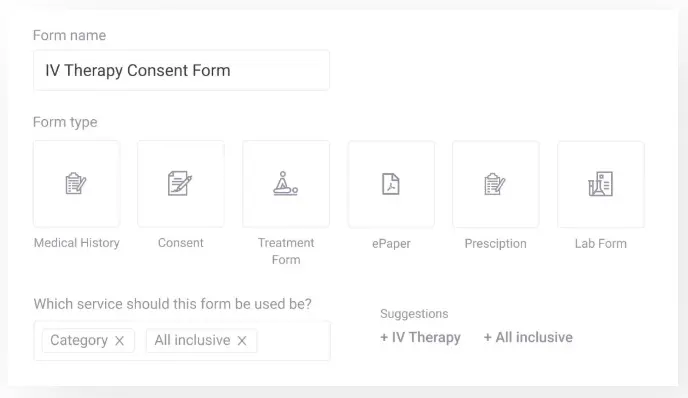
Most IV hydration practices start with the protocol in a shared drive, the consents in a folder, and the nursing certificates in someone’s inbox. That works until an inspector asks which order authorized a specific bag on a specific afternoon.
Practice management software like Pabau puts that chain on one client record. The consent form goes out with the booking confirmation and comes back signed to the patient’s file. The protocol and the treatment note sit on the same timeline, so the order and the infusion are one click apart.
Pabau’s staff profiles hold each clinician’s documents, which is where New York’s annual LPN training rule stops being a memory test. You store the license and the IV training certificate against the person. An expiry becomes a record you can report on rather than a surprise.
Many New York drip businesses add peptides, hormone therapy, or other longevity services later. Our software for longevity practices keeps those visits on the same client record as the infusions, so one chart covers the whole menu.
Checkout, invoicing, and reporting run from the same record, so you are not reconciling a payment system against a clinical one. Pabau is used across IV therapy practices of every size, from a single treatment room to multi-location groups.
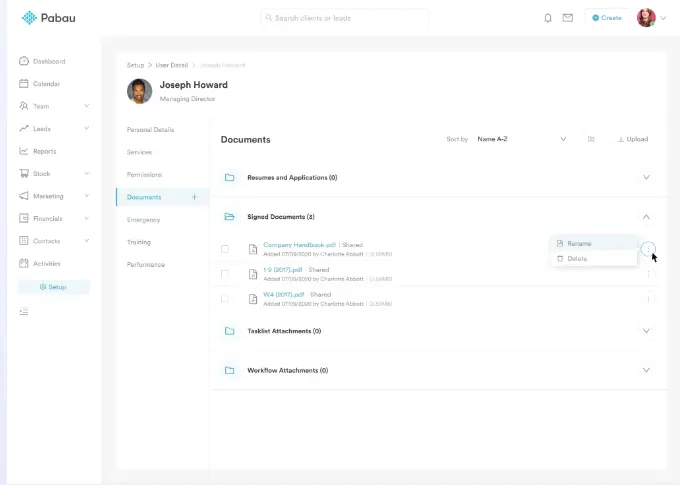

Pabau holds the signed protocol, the provider order, the patient consent, and the treatment note on one client record. Staff profiles carry each nurse’s license and IV training dates, so an expiry surfaces before a treatment does.

Opening an IV hydration business in New York is straightforward. Owning one in the wrong name is where founders get hurt, because the ownership rule has no workaround and no wellness exception.
So settle two questions before you spend anything. Decide whose license the clinical entity sits on, and decide who signs the protocols. Those answers shape the entity, the lease, the staffing plan, and the insurance, and they are painful to change once patients are booked.
The trade-off worth remembering is that the ownership rule and the LPN training rule fail in opposite ways. One fails loudly at formation, the other fails quietly eleven months in. Book a demo to see how Pabau keeps New York orders, consents, and nurse training records on one patient timeline.

Comparing states before you commit? IV hydration business requirements in Arizona runs the same ownership and administration questions for a state with different answers.
Ready to map the whole launch? How to open an IV therapy clinic walks the build-out, equipment, and hiring sequence that sits underneath these New York requirements.
Taking the service on the road? Mobile IV therapy business covers routing, pricing, and the operational trade-offs of treating patients away from a fixed site.
Writing your emergency protocol? IV therapy complications lists the adverse events worth training your nurses against, and how each one presents.
Need the first form in the chain? IV therapy patient intake template gives you a starting intake form to adapt before your consent workflow goes live.
No. Ownership is restricted to a licensed physician, or to a PLLC or PC whose every member is a licensed physician. An RN may administer IV hydration under a valid order, and may own a management company that supplies non-clinical services. In short, holding equity in the medical entity itself is not permitted.
No, not as the owner of the medical entity. Education Law section 6902 gives an experienced nurse practitioner practice autonomy, which covers clinical decisions rather than business ownership. However, an NP can order and administer IV hydration within that authority. The PLLC or PC still needs physician owners.
No. An LPN may administer IV hydration under an order once trained, but ownership sits with a physician or a physician-owned PLLC or PC. New York also requires initial and annual IV training for LPNs. It bars them from IV push, first doses, and blood transfusions.
Physicians, nurse practitioners, physician assistants, and registered nurses may administer IV vitamin therapy within their scope. LPNs may too, once trained and working under an order, short of IV push, first doses, and transfusions. Medical assistants and phlebotomists may not administer it at all.
No. NYSED guidance on unlicensed persons bars a medical assistant from inserting or removing IVs of any kind, and from administering injections of any kind. Instead, a medical assistant may greet the patient, collect history, and handle scheduling. Only a licensed practitioner may start and run the infusion.