Professional development record
A professional development record is a structured log of a healthcare practition...

4
Last Updated: Oct 8, 2026

Michigan does not license a walk-in or mobile IV hydration business as a health facility, because MCL 333.20106 does not list one.
Equity is the real restriction, and it comes from the state LLC Act rather than from any statute naming IV therapy.
MCL 450.4904 requires every member and manager of a professional LLC to hold the license that entity’s service needs.
A management services organization is the workable route for an RN, an NP, a paramedic, or a non-clinician founder.
No Michigan rule names an IV hydration medical director, so that requirement is inferred from the physician delegation framework.
The IV hydration business requirements in Michigan come down to one question. Who may hold equity in the entity that renders the medical service? Physicians and physician assistants may. Registered nurses, nurse practitioners, paramedics, and outside investors generally may not.
The odd part is that no Michigan statute names an IV hydration business at all. The restriction comes from the Michigan Limited Liability Company Act, MCL 450.4904, plus a 1989 Attorney General opinion. Call it the PLLC membership test, because that section decides who may sit on the membership roll.
This guide works through the IV hydration business requirements that decide your structure. It names the statutes, the agencies, and the staffing rules behind each one. Michigan is not a permissive state, and the sections below show exactly where the line sits.
Michigan’s Department of Licensing and Regulatory Affairs licenses the practitioners inside an IV hydration business, not the business itself, through its Bureau of Professional Licensing.
LARA is the acronym Michigan uses for that department, and it appears on every license lookup you will run. The legal framework sits above LARA in the Public Health Code, Act 368 of 1978.
MCL 333.20106 is the section that lists the facility and agency types needing a LARA facility license:
A walk-in drip bar does not appear on that list, and neither does a mobile IV service. That absence is why founders read Michigan as permissive, and it is where the ownership question starts to go wrong.
Only people licensed to render the service may hold equity in the clinical entity, which in Michigan means physicians and, alongside them, physician assistants.
Michigan enforces the corporate practice of medicine doctrine, usually shortened to CPOM. A 1989 Attorney General opinion, No. 6592, held that a for-profit business corporation may not perform acts reserved to a learned profession such as medicine. The same doctrine shapes California’s IV hydration requirements, which reserve at least 51% of the medical corporation for a licensed physician.
MCL 450.4904 is where that doctrine bites in practice. A professional limited liability company rendering a Public Health Code service must have every member and manager licensed to render that service. An infusion ordered by a physician is a Public Health Code service.
The statute carves out one narrow multidisciplinary group. Doctors of medicine, doctors of osteopathic medicine, podiatrists, chiropractors, and physician assistants may sit in one professional entity together. Registered nurses and nurse practitioners are not in that group, and neither is a layperson with capital.
Enforcement attention is rising too. In October 2023 the Michigan State Medical Society asked Attorney General Dana Nessel to investigate CPOM violations across the state. Treat the absence of an IV-specific statute as silence rather than as permission.
The management services organization, or MSO, is the structure founders use around this. A non-physician founder owns the MSO, which contracts with the physician-owned clinical entity for marketing, billing, staffing, premises, and equipment. The MSO holds no equity in the clinical entity and makes no clinical decisions.
An RN can own the business side of a Michigan IV hydration company, but not the clinical entity that orders and renders the infusion.
MCL 450.4904 is the reason. An RN license authorizes nursing, and ordering an infusion is a medical act rather than a nursing one. Michigan therefore splits the question in two: an RN can start an IV hydration business, just not the entity that writes the order.
The same logic applies to an LPN, with one extra limit on top. Part 172 of the Public Health Code has an LPN practicing under the supervision of a registered nurse, a physician, or a dentist.
Run the PLLC membership test against your own license and the answer stops being abstract. The matrix below sorts all six licenses by whether they open the clinical entity.
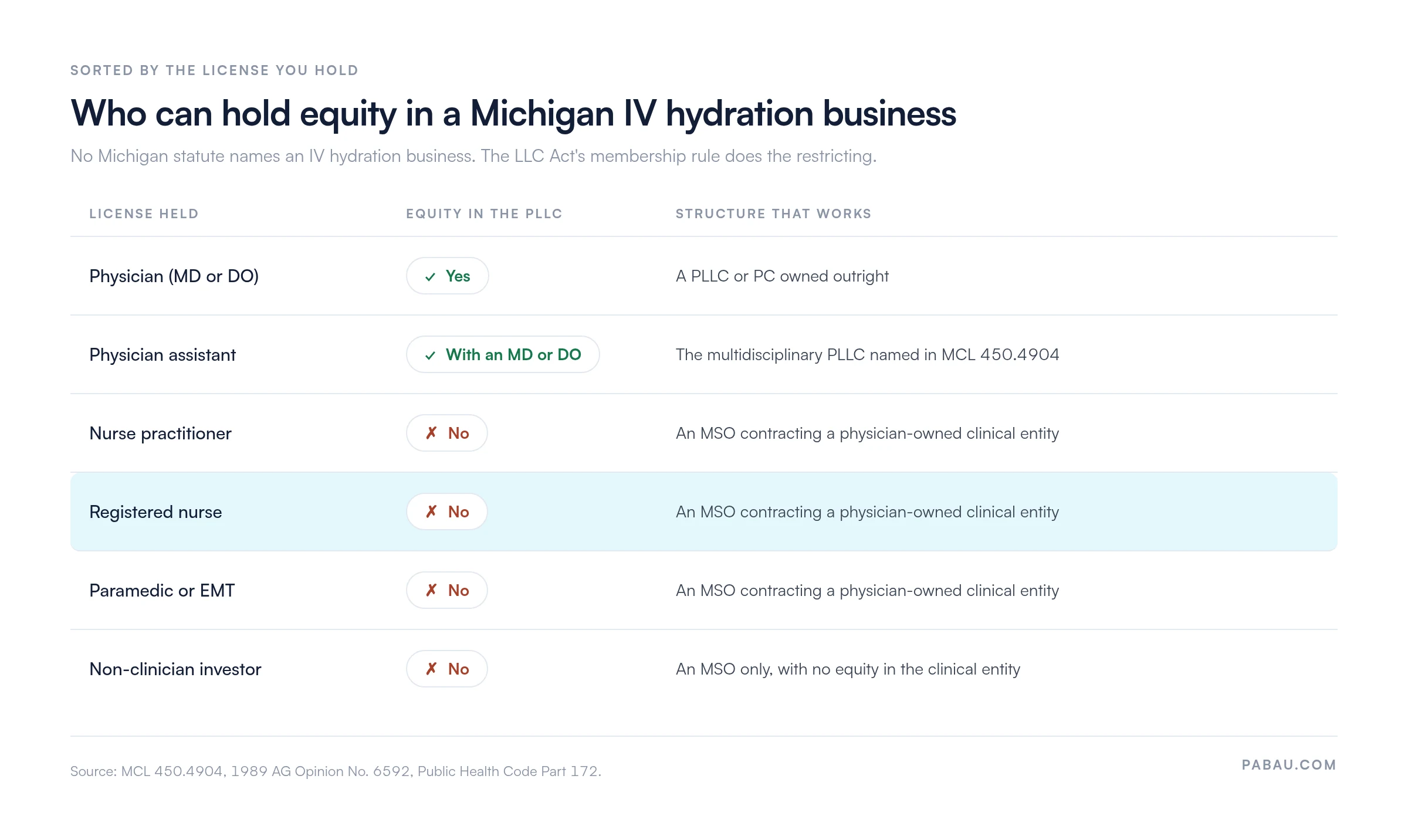
The table below adds the authorization column and the statute behind each row. Read the source column closely, because the rule that blocks most founders is a corporate statute rather than a health one.
Four of the six rows land on a no, which is the opposite of how Michigan gets described in state-by-state round-ups. Nextech’s 50-state page says anyone can own an IV therapy clinic in Michigan, subject to unnamed procedures. MCL 450.4904 says otherwise for the clinical entity, and it names the rule.
A Michigan IV hydration business needs a licensed physician to authorize the infusion, because Michigan treats that infusion as a delegated medical act.
No Michigan statute or board rule that we could read names an IV hydration business and requires a medical director by that title. The requirement is inferred from the general delegation framework, and it is worth saying so plainly. Anyone quoting you a Michigan medical-director rule number should be asked to name it.
What the delegation framework does require is concrete. A Michigan-licensed MD or DO has to authorize the task. A physician assistant may authorize it under a practice agreement, which MCL 333.17548 governs. A non-physician cannot exercise medical judgment, direct clinical care, or take responsibility for the medical act.
In the practices we onboard, that authorization shows up as four documents rather than one signature:
Start with physicians who already delegate infusion work. Urgent care, anesthesia, emergency medicine, and functional medicine are the specialties where standing orders are routine paperwork rather than a new project.
Michigan sets no fixed provider-to-medical-director ratio that we could verify in statute, and the compliance explainers covering the state say the same. That silence pushes the detail into your contract. Four clauses are worth arguing over before anyone signs:
The exit clause is worth drafting before you need it. A medical director who leaves takes the authorization with them. A drip administered on lapsed standing orders is a delegation problem rather than a paperwork one.
In Michigan, a registered nurse administers the infusion under a physician’s order, and an LPN works under the supervision of an RN, physician, or dentist.
Part 172 of the Public Health Code, which starts at MCL 333.17201, sets those scopes. Part 172 defines an RN’s practice to include the teaching, direction, and supervision of less skilled personnel performing delegated nursing activities. The same part defines an LPN as practicing under the supervision of a registered professional nurse, a physician, or a dentist.
Neither definition names IV push or infusion. Michigan has no standalone IV-therapy carve-out, so the infusion sits inside the general delegated-medical-act framework instead. Both the ownership answer and the staffing answer trace back to that framework.
Michigan nurse practitioners hold independent prescribing authority for non-controlled drugs under MCL 333.17211a. That statute is a prescribing rule. MCL 333.17211a does not create a separate right to administer an infusion, and it does not change the ownership answer above. A physician assistant administers or delegates under a practice agreement, per MCL 333.17548.
Our own article on administering IV vitamin therapy goes deeper into how these scopes differ from one state to the next.
A phlebotomist cannot independently start IV therapy in Michigan, because the infusion is a delegated medical act that needs a physician’s authorization first.
Whether a physician may delegate that task to an unlicensed assistant is a judgment the delegating physician makes. Put the question in writing before you hire, and keep the answer with the protocol it relates to.
The same question decides whether medical assistants start IV lines. Nextech’s Michigan section says supervised medical assistants may administer IV therapy in the state. The general section of that same page says medical assistants typically may not initiate IV therapy at all.
That contradiction sits uncorrected on their page, and neither claim carries a statute. We found no Michigan statute or board rule naming medical assistants or phlebotomists in an IV-therapy scope. Staff the drip with an RN or an LPN and the question never arises.
No separate IV hydration business license exists in Michigan, so what you need is individual practitioner licensure through LARA plus state and local business registration.
MCL 333.20106 is the list that settles this, and no walk-in or mobile infusion service appears on it. LARA’s health facility licensing runs off that list, so a drip bar sits outside the facility regime entirely. Colorado’s facility licensing statute omits a fixed-site drip bar too, as our guide to Colorado IV hydration requirements sets out.
What you do register, roughly in this order:
The absence of a facility license is not the absence of regulation. A complaint investigation would look at the physician’s authorization, the nurse’s scope, and the record of both.
An IV hydration business plan in Michigan has to answer the ownership question before it answers the market question. Two entities usually end up on the page. A physician-owned PLLC or PC renders the clinical service, and an MSO owned by the founder runs the rest.
An RN planning a launch should design around that pair from the first draft. Retrofitting it later means unwinding a filed entity, which is slower and more expensive than getting it right once.
Both entities file through LARA’s Corporations, Securities and Commercial Licensing Bureau, the agency Michigan calls CSCL. The professional entity is the one MCL 450.4904 constrains, so its membership roll is what an attorney will scrutinize first.
The clinical documents come next, and they take longer to assemble than the filings do. Your IV therapy business plan needs the drip menu, the protocol behind each item, and the standing orders that authorize them.
Patient screening sits underneath all of it. A contraindication intake completed before the line goes in is what connects the physician’s standing order to the specific patient in the chair.
In practices we onboard, the order and the signed consent usually start life in two different systems. Reuniting them at audit time takes hours no launch budget accounted for. Practices running drips alongside longevity and wellness programs tend to consolidate onto one platform, and software for longevity practices is built around that mix.
No verified Michigan-specific startup figure exists for an IV hydration business, so plan against the published national ranges and price the Michigan line items yourself.
Two ranges circulate, and both are national estimates rather than Michigan ones. Medical Director Co. puts startup cost at $50,000 to $250,000 in its body copy. The FAQ on that same page says $50,000 to $200,000. Cohen Healthcare Law Group puts a session at $100 to $300, with no date or region attached.
We will not restate either figure as a Michigan number. Neither one traces to a survey, a filing, or a dated dataset. What you can price precisely are the four costs Michigan actually imposes:
Most pages on this topic open with a market-size figure. Three incompatible versions circulate, each credited to a different research house, so we have left the number out rather than pick one.
Software is one of the few startup lines you can price before you sign a lease. Our comparison of the best EMR for IV therapy sets out what each system covers and where the costs land.
A mobile IV hydration business in Michigan follows the same ownership and authorization rules as a storefront, because licensing attaches to people rather than premises.
MCL 333.20106 is the reason the model works at all. A mobile infusion service does not appear on the facility-license list, and neither does a fixed drip bar. The PLLC membership test still decides who owns the clinical entity.
What changes off-site is operational rather than legal:
Local permits are the one item worth checking city by city, because Michigan’s state framework does not settle them. Routing, pricing, and the day-to-day trade-offs of a mobile IV therapy business sit outside this page’s scope.
Michigan’s requirements all resolve to one chain of records. A physician’s standing order authorizes a protocol, a screening form clears the patient, a nurse administers, and a note records what happened. On paper that chain lives in four places.
Practice management software like Pabau holds the whole chain against a single client record. The protocol, the signed consent, the intake answers, the treatment note, and the photos attach to the same patient timeline. Nobody has to reunite them at audit time.
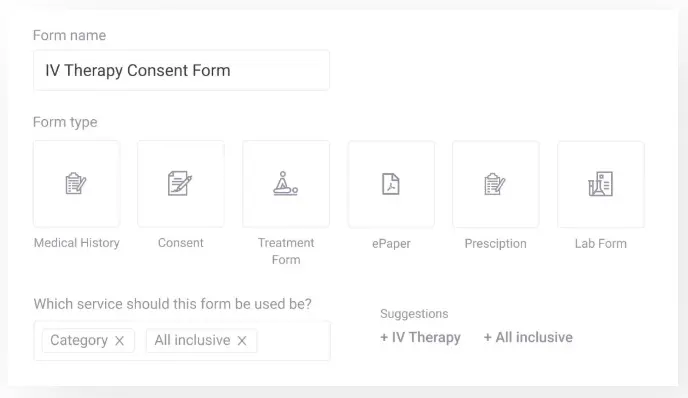
Pabau’s digital forms let you build the IV therapy consent and the contraindication screen once, then tie both to the service itself. Pabau’s client records keep the medical director’s countersignature beside the note it approves. Pabau GO, our iOS app for practitioners, does the same job in a patient’s living room.
For a mobile service, Pabau’s calendar and online booking handle the routing and the deposits. A nurse driving between appointments is then not also chasing paperwork. Pabau’s IV therapy EMR software is built around that record chain.

Pabau ties standing orders, consent forms, and treatment notes to one client record. An IV hydration practice can then show the full authorization chain for any Michigan patient in seconds.

Michigan reads permissive until you open the LLC Act. No statute names an IV hydration business, no facility license exists for one, and that silence is exactly what misleads founders into the wrong entity.
The PLLC membership test is the rule that decides your structure. If you hold an RN, an NP, a paramedic license, or no clinical license at all, plan on an MSO alongside a physician-owned clinical entity.
If you hold an MD, a DO, or a PA license with a physician partner, you can own the clinical entity outright.
The trade-off worth remembering is that the MSO route protects your economics. It also adds a contract, a second entity, and a set of clinical documents somebody has to maintain.
Take the ownership answer to a Michigan healthcare attorney before you sign a lease, because an entity is harder to unwind than a fit-out. Book a demo to see how Pabau keeps the order, the consent, and the note on one Michigan patient record.

Ready to map the whole launch? How to open an IV therapy clinic walks the build-out, equipment, and hiring sequence that sits underneath these Michigan rules.
Comparing states before you commit? IV hydration business requirements in Arizona shows how differently a neighboring market handles facility licensing and medical orders.
Need the first form in the chain? IV therapy patient intake template gives you a screening form to adapt before your standing orders go live.
Writing your emergency protocol? IV therapy complications lists the adverse events worth training your nurses against, and how each one presents.
Filling the chairs once you open? IV therapy marketing covers the channels that bring wellness patients through the door without discounting the menu.
A paramedic can own the management services organization but not the clinical entity, because MCL 450.4904 limits membership to people licensed to render that service. Whether a paramedic may administer elective infusions outside an emergency medical services system is a separate question. Put it to the delegating physician and to LARA before you hire.
An LPN faces the same ownership limit as an RN under MCL 450.4904, so the workable route is a management services organization. Michigan’s Part 172 adds a second limit on practice. An LPN works under the supervision of a registered nurse, a physician, or a dentist, which shapes how you staff the treatment room.
Margins depend on session price and chair utilization rather than on the state you operate in. Cohen Healthcare Law Group publishes a $100 to $300 range per session, with no date or region attached. Build your IV therapy business plan on your own drip costs, staffing hours, and medical director retainer instead.