Ethical consent form: free template and what to add
An ethical consent form is a written record that a patient or participant agreed...

3
Last Updated: Oct 26, 2026

Colorado issues no license specific to IV hydration, and the state has no general business license to apply for either.
A fixed-site clinic needs no CDPHE facility license, because Colorado’s Division of Professions and Occupations licenses practitioners rather than facilities.
A mobile, in-home service is a different question, because C.R.S. § 25-27.5-102(7) counts in-home infusion as a skilled home health service.
You still need an order from a Colorado-licensed prescriber, documented clinical oversight, and an entity filed with the Secretary of State.
Both 2026 Colorado med spa bills died in committee, and HB 25-1024’s delegation disclosure duty has been in force since August 2025.
The IV hydration business requirements Colorado enforces are assembled from general law, not from an IV-specific license. No agency licenses an IV hydration clinic as a facility, and Colorado has no statewide business license to apply for.
What Colorado regulates is the people. The Department of Regulatory Agencies, known as DORA, licenses practitioners through its Division of Professions and Occupations. It does not license, inspect or discipline the business they work inside.
Most guides on IV hydration business requirements in Colorado cite no Colorado statute at all. This one names the statute, rule or board policy behind every requirement, so you can read the source before you spend money on it.
Rocky Mountain PBS reported in February 2026 that more than 100 IV hydration clinics now operate in Colorado. It also quoted DORA saying these clinics are not regulated by the state, which is accurate about facilities and misleading about the practitioners.
Seven Colorado bodies touch an IV hydration business, and not one of them licenses it as a facility. The Colorado Medical Board and the State Board of Nursing govern the practitioners, and the rest govern the drugs, the entity and the waste.
That split is the whole story of IV therapy business requirements Colorado operators have to satisfy. Each row below names what that body controls, the authority it acts under, and what it changes for you.
Katie O’Donnell of DORA gave Rocky Mountain PBS the reason. Both boards license people, and neither holds statutory authority over a facility. As she put it, “The agencies don’t determine what is regulated, the legislators do.”
Read that as a limit on the boards, not as an absence of law. The Medical Practice Act, the Nurse Practice Act and both rule sets apply in full to the practitioners doing the work.
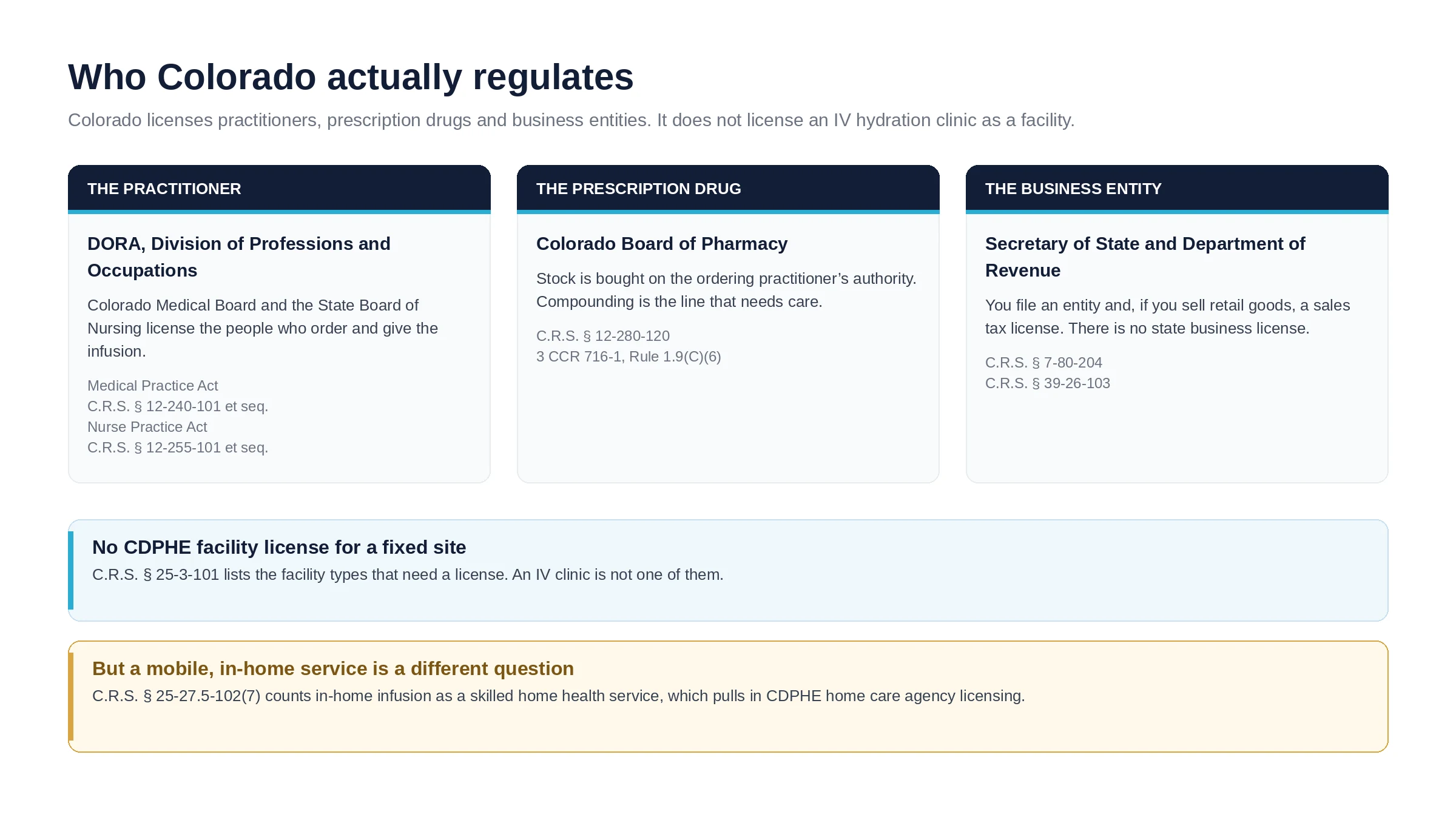
No. There is no IV hydration license Colorado issues, no med spa license, and no statewide general business license. You file an entity, register for the taxes that apply to you, and make sure your practitioners hold the right individual licenses.
For a fixed-site clinic the facility answer is settled. C.R.S. § 25-3-101(1) lists the facility types that need a CDPHE license, and an IV clinic is not among them.
Two further sentences in the same statute close it off. Section 25-3-101(2)(a)(III)(C) excludes from “community clinic” any facility functioning only as an office for the practice of medicine. Section 25-3-101(4) says the statute permits regulation of a physician’s office only where that office is a community clinic.
A mobile service that infuses people at home does not inherit that answer. It runs into a separate CDPHE licensing regime, covered further down under mobile requirements.
The paperwork is short, and none of it is an IV hydration business license. In dependency order it looks like this.
Neither Denver nor Colorado Springs licenses a medical clinic. Colorado Springs says only the business types on its published list need a city license. No medical, clinic or infusion category appears there.
Denver works the same way, licensing enumerated activities rather than business in general. Both cities do run tax registrations, and Denver’s occupational privilege tax is the one operators miss, so check with each city’s own licensing office.
You also do not need a Board of Pharmacy registration to stock and administer prescription IV fluids. C.R.S. § 12-280-120 lets a wholesaler or manufacturer supply a practitioner authorized to prescribe, and administering under an order is not dispensing.
Compounding is the exception worth advice. Only a registered prescription drug outlet may compound a prescription, except that a practitioner may personally compound for a patient under their care. A nurse mixing custom bags does not obviously fit that carve-out.
Colorado restricts the corporate practice of medicine indirectly, through the physician’s license rather than a direct ban on who may own a business. So the enforcement risk in a badly structured IV clinic lands on your physician, not on you.
The operative provision is C.R.S. § 12-240-121(1)(g)(I). It makes it unprofessional conduct for a physician to practice medicine as the partner, agent or employee of an unlicensed person. The same applies to practicing as an employee of any corporation other than a professional service corporation formed under C.R.S. § 12-240-138.
C.R.S. § 12-240-138 is often described as the ban itself, and that misreads it. The section is permissive and conditional, letting physicians form a professional service corporation if they meet its terms.
Those terms matter for an IV business. All shareholders must be board-licensed, and physician assistants may hold shares only while physicians keep majority ownership. The statute also says corporations shall not practice medicine.
One more sentence in § 12-240-138(1)(f) does a lot of work. Lay directors, officers and heirs “shall not exercise any authority whatsoever over the independent medical judgment” of the licensed physicians.
Section 12-240-138(7)(b) sweeps limited liability companies and registered partnerships into the definition of corporation. So a physician-owned professional LLC works in Colorado, and any guide telling you only a PC will do is wrong.
The General Assembly also confirmed that the doctrine runs wider than the statute. C.R.S. § 12-240-121(1)(g)(II)(B) says that subsection creates no exception to the corporate practice of medicine doctrine.
The statutory exceptions do not help a retail IV clinic. Employment by a health-care facility under C.R.S. § 25-3-103.7 is limited to hospitals, hospices and similar defined providers. The provider network route in C.R.S. § 6-18-303(2) needs an organized provider network, which a cash-pay drip bar is not.
Colorado also has no general fee-splitting ban in the Medical Practice Act. The unprofessional conduct section contains none, and the only nearby limit sits in § 12-240-138(5), which restricts sharing identifiable fees with lay employees.
Where the line sits for any particular ownership structure is genuinely unsettled. No Colorado statute, board rule or published enforcement action draws it, so this is the point in the project to pay a Colorado healthcare attorney.
Yes, a registered nurse can own the business, but the medical side cannot simply sit inside it. No provision of the Nurse Practice Act or 3 CCR 716-1 restricts business ownership by a nurse.
The constraint operates on the physician the clinic has to engage. If the nurse’s company employs or joint-ventures with that physician, C.R.S. § 12-240-121(1)(g)(I) is engaged against the physician’s license.
A nurse also cannot supply the missing order. A registered nurse administering prescription IV fluids executes a delegated medical function. That function implements a plan prescribed by an authorized prescriber.
Rocky Mountain PBS reported that registered nurses do own Colorado clinics under physician supervision, and that is a fair description of practice. It is not a legal safe harbor, because the statute the arrangement has to survive admits no nurse-ownership exception.
No Colorado statute or rule requires a management services organization, known as an MSO. Neither the Medical Practice Act, the Nurse Practice Act nor either board’s rules use the term at all.
It is a response to the risk in § 12-240-121(1)(g), not a codified requirement. The clinical entity stays physician-owned, and the management company holds the lease, the marketing, the billing and the staff who never touch clinical judgment.
Colorado law does at least acknowledge the arrangement exists. C.R.S. § 25-3-101(4) says a facility is not licensable simply because it engages outside vendors to perform nonclinical management services.
What Colorado has never done is say how much control a management company may hold, or whether a percentage-of-revenue fee is acceptable. Anyone promising you a compliant template is selling confidence rather than authority.
Colorado has no statute requiring an IV clinic to appoint a medical director. What it requires is an order from a Colorado-licensed prescriber before anyone runs a line. The job title is a business convention built around that requirement.
The authority is C.R.S. § 12-255-104(4). A registered nurse (RN) or licensed practical nurse (LPN) administering prescription IV fluids is executing a delegated medical function. That function implements a medical plan prescribed by a physician, podiatrist or dentist.
That distinction changes how you shop for the role. The IV hydration medical director requirements that matter concern who can lawfully write the order and stand behind it. A name on a website is not one of them.
An advanced practice registered nurse, or APRN, with full prescriptive authority can be that prescriber. C.R.S. § 12-255-112 requires 750 documented hours of prescribing mentorship to move from provisional to full authority, and no ongoing physician supervision after that.
If secondary sources told you Colorado requires a permanent collaborative practice agreement for nurse practitioners, they were wrong. The mentorship is transitional, can be served with another APRN, and its mentor cannot demand payment or employment as a condition.
Colorado writes no job description for the role, so the content comes from the duties the prescriber and the clinic already owe. In practice it covers this ground.
Colorado sets no IV-specific emergency equipment or certification rule. The duty arrives through the standard of care instead, and C.R.S. § 12-240-121(1)(j) makes any act or omission failing generally accepted standards unprofessional conduct.
A signature-only arrangement collapses the moment unlicensed staff perform the infusions. Colorado Medical Board Rule 1.17 requires the delegating physician to be actively performing that service in their own practice, not exclusively by delegating it.
Rule 1.17 then makes on-premises presence the default. It relaxes that only where detailed written protocols and written emergency protocols exist. Even then the physician must be physically present in Colorado and reachable.
The rule also requires quality monitoring at least every two weeks, at the site where the delegated services happen. A physician outside the state must name a covering physician who is in it.
Rule 1.17(J) supplies the teeth. Where delegatees fail to work within generally accepted standards, the delegating physician may be found to have committed unprofessional conduct themselves.
One important limit: Rule 1.17 does not govern delegation to nurses. Staffing with RNs and staffing with unlicensed technicians are two different regimes, with different paperwork, and competitor guides collapse them into one.
Your prescriber’s insurance matters too. C.R.S. § 13-64-301 conditions active Colorado licensure on carrying $1,000,000 per incident and $3,000,000 a year. Rule 1.17 separately requires the delegating physician to be insured for the delegated service.
Before an IV goes in, an authorized prescriber must have ordered the therapy and someone must have assessed the patient against it. Colorado has no rule using the phrase good faith exam, and the duty comes from three other places instead.
The first is the ordering requirement in C.R.S. § 12-255-104(4). The second is the standard of care. C.R.S. § 12-240-121(1)(u)(I) makes it unprofessional conduct to administer, without clinical justification, treatment that is demonstrably unnecessary.
For an elective wellness infusion business, that sentence is the exposure in one line. So the good faith exam Colorado operators talk about is a standard-of-care obligation wearing an industry name.
The third source is Colorado Medical Board policy. Policy 40-03 defines the provider-patient relationship, and Policy 40-27 says an appropriate medical evaluation should be performed before treatment, electronically or otherwise.
Policy 40-27 also draws the line on remote screening. Treatment, including a prescription, based solely on an online questionnaire “does not constitute an acceptable standard of care.”
Telehealth assessment is otherwise fine. Telemedicine is the practice of medicine under C.R.S. § 12-240-107(1)(g), and the practice happens where the patient is. A provider-patient relationship can be established remotely, in conformance with generally accepted standards.
Standing orders IV hydration clinics rely on are more permissive in Colorado than most guides suggest. Section 12-255-104(4) allows the medical plan to be “a written plan, verbal order, standing order, or protocol, whether patient specific or not.”
Read that carefully before you use it at an event. The order can cover the menu without naming each customer, but the individual assessment still has to happen for each person you infuse.
In Colorado a physician, physician assistant, APRN, registered nurse or licensed practical nurse may administer IV hydration, each within their own scope. Unlicensed staff may do it only as a physician’s delegatee, and an EMS certificate does not authorize it in a wellness clinic.
The table sets out who may order the therapy and who may put the line in. Colorado Board of Nursing IV therapy rules govern the nursing rows, and Medical Board rules govern the delegation rows.
Three points in that table contradict what most Colorado guides still say, and each is worth stating on its own.
Colorado removed it during a run of 2025 amendments to 3 CCR 716-1. The current Rule 1.9 sets no application, fee or approved course for it. The rule is now titled in relation to IV therapy, and IV Authority is no longer a defined term.
What an LPN may do is set out in Rule 1.9(D)(2). That includes peripheral access with a short catheter and administering pre-mixed intravenous fluids containing electrolytes and vitamins, which is a standard vitamin drip.
The limits are where the money usually is. Rule 1.9(E)(1)(a) bars administering IV medications, and Rule 1.9(E)(1)(j) bars any direct injection of an IV medication lasting five minutes or less.
So an LPN can hang your pre-mixed vitamin bag but cannot give the IV push boosters most menus sell. Rule 1.9(E)(1) also rules out parenteral nutrition, blood products and accessing implanted ports.
C.R.S. § 12-255-104(4) defines the medical plan as a written plan, verbal order, standing order or protocol, whether patient specific or not. A properly executed protocol from your prescriber therefore satisfies the statute.
Delegating the cannulation itself to unlicensed staff under the nursing rules is harder. 3 CCR 716-1 Rule 1.13 requires a delegated task to be routine and repetitive, and limited to a specific delegatee, client and time frame.
A blanket authorization for a technician to cannulate every walk-in does not sit comfortably in that language. Physician delegation under C.R.S. § 12-240-107(3)(l) is the better-mapped route, and it is the one Rule 1.17 was written for.
Colorado’s EMS rules operate in two settings only. 6 CCR 1015-3 § 2.42 defines the prehospital setting as the site of an emergency, emergency transport or interfacility transport.
The other is a clinical setting, which § 2.7 defines as a health care facility licensed or certified by CDPHE. A retail or mobile IV clinic is neither, since it is not an emergency scene and it holds no CDPHE license.
An EMT or paramedic can still work in your clinic, just not on their EMS certificate. They work as a physician’s unlicensed delegatee under C.R.S. § 12-240-107(3)(l), which pulls in every condition in Rule 1.17.
That means over-the-shoulder observation before unsupervised practice, plus a written agreement on the board’s Appendix D form. It also means on-site monitoring every two weeks, and patient disclosures naming the delegating physician.
Their paramedic training is strong evidence of the qualification the statute asks for. The legal authority is still delegation, and the paperwork that comes with it is not optional.
Colorado draws one more line that surprises people. Rule 1.17 treats phlebotomy and vital signs as data gathering outside the delegation rules, while injecting any substance is a medical service inside them.
Finally, a negative finding nobody else reports. The Colorado State Board of Nursing has published no position statement or advisory on IV hydration or wellness infusion, while several other state boards have.
A mobile service faces one Colorado requirement a fixed site never meets, and the van is not the issue. Colorado’s home care agency law names in-home infusion expressly.
C.R.S. § 25-27.5-102(7) defines skilled home health services to include “in-home infusion services” and “medication administration.”
Both phrases are statutory text rather than interpretation. C.R.S. § 25-27.5-102(3)(a) then defines a home care agency broadly.
It reaches any commercial entity that manages and offers those services, directly or by contract. The consumer has to receive them in a temporary or permanent home or place of residence.
The penalty is the part worth reading twice. C.R.S. § 25-27.5-103(1) makes it unlawful to conduct an unlicensed home care agency providing those services. The penalty is a misdemeanor, plus a civil penalty of up to $10,000 for each violation.
One exclusion might help, and it is narrow. Section 25-27.5-102(3)(b)(III) excludes an individual who acts alone, without employees or contractors. A staffed or contractor-based mobile company does not fit it.
Now the honest part. No CDPHE guidance, declaratory ruling or enforcement action applies this article to IV hydration businesses. Treat it as a licensing exposure to settle with CDPHE and Colorado counsel before you launch, not as a settled requirement.
There is also an unresolved question about where the regime stops. The statute reaches a temporary or permanent home or place of residence. That arguably captures a hotel room, and arguably excludes an office, a gym or a festival. No Colorado authority answers it.
Anyone researching how to start a mobile IV therapy business will find plenty of advice on vans and route planning, and almost none on this. Get the licensing question answered first, because the operational work is the easy half.
Set against the IV hydration clinic requirements Colorado imposes on a fixed site, the mobile model changes the logistics rather than the clinical rules.
Charting is the quiet risk. A nurse working out of a car owes the same note, consent and order trail as a nurse in a clinic room.
For a conventional nurse-staffed IV clinic, almost no requirement changed, and the two bills that would have changed it both died. Colorado IV therapy laws today look the same as they did a year ago, with three dated exceptions.
Most coverage of the two 2026 bills was written from February and March snapshots, and it has their scope inverted. Getting this the right way round tells you which risk to plan for.
SB 26-130 was the one that would have reached IV hydration. Its medical spa definition named intravenous delivery expressly, and listed wellness, longevity and parenteral nutrient therapies among the services it covered.
It would have required a designated licensed prescriber to provide clinical oversight of the prescription drugs used. It would also have required internal documentation of serious adverse events. The Attorney General or a district attorney would have enforced it under the Colorado Consumer Protection Act.
HB 26-1249 would not have touched IV hydration at all. It would have let estheticians, cosmetologists, LPNs, RNs, APRNs and physician assistants hold shares in a corporation organized solely for medical-aesthetic services.
That phrase is the reason it stopped short. C.R.S. § 12-240-104(7) defines medical-aesthetic services as therapeutic procedures used in aesthetics, and a hydration or immunity drip is not one.
So the physician-majority ownership rule in § 12-240-138 stands unamended. Any medical spa laws Colorado watchers expected from the 2026 session did not arrive, and no successor bill passed.
The sunset process did not fill the space either. DORA’s own 2025 sunset review of the Medical Practice Act runs 67 pages and contains no occurrence of medical spa, aesthetic, intravenous or medical director.
The “regulation has not kept pace” framing invites a comfortable conclusion, and it is the wrong one. Colorado already holds enough practitioner-level authority to act, and the advertising rule is the sharpest piece of it.
C.R.S. § 12-240-121(1)(z) makes misleading, deceptive or false advertising unprofessional conduct. 3 CCR 713-1 Rule 1.24 applies that to all media, including the internet. Its list of what to avoid names unsubstantiated testimonials and guarantees of a cure.
Rule 1.24(E) is the sentence to read before you write a drip menu. At the time an advertisement is placed, the licensee must already possess information that would substantiate every claim in it.
Set that against what the sector actually publishes. A 2025 study in JAMA Internal Medicine reviewed 255 IV hydration spa websites. Every one made health claims, and two cited a source.
Add the clinical justification provision in § 12-240-121(1)(u)(I) and the picture is complete. What Colorado lacks is facility oversight, not the authority to discipline a licensee whose marketing outruns the evidence.
The realistic next vehicle for change is dated and public. The Nurse Practice Act sunsets on September 1, 2027, and DORA’s review of the Board of Nursing is under way now. A continuation bill is due in the 2027 session.
Colorado’s own filings come to under $200 in year one. The prescriber relationship, insurance, premises and supplies decide the rest, and no source publishes Colorado figures for those that stand up to checking.
So this table splits the two. Every line with a number carries its source. The last line is the one competitor guides fill with invented ranges, and we would rather leave it empty than make one up.
Two Colorado line items catch people out. Denver charges an occupational privilege tax per employee and per owner, and the paid family leave registration starts at your first qualifying employee.
The clinical side is where a Colorado budget diverges from a template. Your prescriber has to carry the statutory cover, and where unlicensed staff infuse, the delegating physician also has to be insured for that specific service.
Each step below unlocks the next, which is why the order matters more than the list. Work down it and you will have the documents a Colorado board or a plaintiff’s attorney would ask for.
Colorado gives you no facility inspection to prepare for, which means the only evidence you will ever have is the patient record. If the order, the assessment, the signed consent and the practitioner’s note sit in four places, you have no file to produce.
Practice management software like Pabau puts them on one timeline. The signed consent form, the intake answers behind the assessment and the practitioner’s note all attach to one client record. So does the batch and lot detail for the bag.
Staff credentials sit on the team profile with their renewal dates. That is the file you need when someone asks who was licensed to do what. Online booking and reminders run from the same system, so a customer’s whole history stays in one place instead of a DM thread.
Notes are the part clinicians put off. Pabau Scribe, our AI scribe, drafts them from the consultation, so the record is finished before the next patient. The Colorado Medical Board recommends keeping records for at least seven years after the last treatment. So the file has to be complete the day it is made.
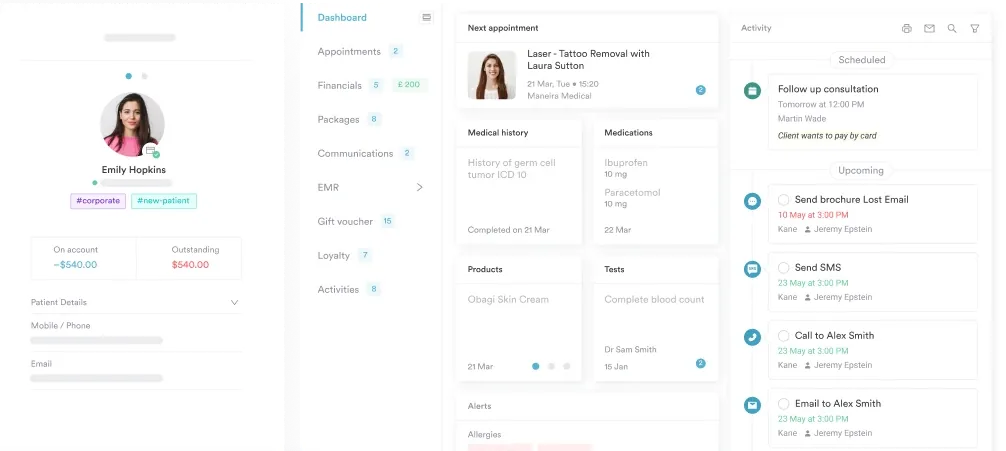

Pabau ties every order, consent form, batch record and treatment note to one client timeline, and tracks staff licenses with their renewal dates. Your oversight file is ready before anyone asks for it.

Colorado’s requirements are hard to find because they were never written for this industry. You assemble them from a medical practice act, a nurse practice act, a home care statute and a tax code. That is exactly why operators get them wrong.
Two decisions carry most of the risk. Where the clinical entity sits, and who writes the order. Both are cheap to get right at the start and expensive to unwind once you have patients on the books.
If you plan to infuse people in their homes, treat the home care agency question as the first item on the list, not the last. A five-figure civil penalty per violation is an expensive surprise to meet after launch.
Where the ownership structure, a protocol or the mobile licensing position is genuinely unclear, a Colorado healthcare attorney is the right call. Book a demo to see how Pabau keeps orders, consents and treatment notes audit-ready in one system.

Comparing Colorado with a state that regulates harder? IV hydration business requirements Georgia sets out a regime built on filed nurse protocols and board position statements.
Want the Ohio position for contrast? Ohio IV hydration business requirements covers the ownership and supervision rules a multi-state operator has to reconcile.
Looking at Arizona next? IV hydration business requirements Arizona walks through the licensing and delegation questions in another western state.
Adding aesthetic services to the menu? Colorado cosmetology license requirements explains which of your staff need a state license before they treat skin.
Colorado requires an order from a licensed prescriber, not a job title. The medical director for IV hydration Colorado operators appoint is the business convention built around that ordering requirement in C.R.S. § 12-255-104(4).
No provision of the Nurse Practice Act stops a nurse from owning a business. The constraint sits on the physician instead. Corporate practice of medicine Colorado rules make it unprofessional conduct for a physician to work as an unlicensed owner’s employee. Take counsel on the structure.
The practitioners are, the facility is not. Colorado IV therapy laws sit in the Medical Practice Act, the Nurse Practice Act and both boards’ rules. No state agency licenses or inspects the clinic itself.
No. There is no IV hydration license Colorado issues, and C.R.S. § 25-3-101 does not list an IV clinic among the facilities needing one from CDPHE. A mobile in-home service raises a separate home care agency question.
Yes, but not on an EMS certificate in a wellness clinic. Colorado confines EMS authority to emergencies, transport and CDPHE-licensed facilities. Who can administer IV hydration in Colorado outside nursing therefore comes down to physician delegation under Rule 1.17.
There is no licensing wait for a fixed site, because there is no license to wait for. The prescriber agreement, insurance and, for a mobile service, CDPHE’s answer on home care licensing set the timeline. The same items drive IV hydration business startup costs in Colorado.