Vitamin C protocol: Free template for oral and IV treatment
A vitamin C protocol is a written clinical framework for giving vitamin C to pat...

7
Last Updated: Oct 16, 2026

Three Ohio boards issued a joint regulatory statement on May 15, 2025, and it treats retail IV therapy as the practice of medicine.
Only a physician, a physician assistant with prescriptive authority, or a certified nurse practitioner, nurse-midwife, or clinical nurse specialist may order IV therapy.
Adding vitamins to a saline bag counts as compounding, so the business needs a terminal distributor of dangerous drugs license.
Standing orders are not an option, because OAC 4729:5-3-12 lists five permitted protocol scenarios and retail IV hydration is not one of them.
Ohio limits who controls clinical decisions rather than who owns the company, so a medical director in title only fails the test.
Ohio’s IV hydration business requirements are split across three state boards, and no single license covers them. The state licenses the people, the drugs, and the premises separately, then expects all three to line up.
Two rules sit underneath the rest. A physician, physician assistant, or advanced practice registered nurse has to evaluate each client personally and write the order. And once a vitamin goes into the saline bag, you need a terminal distributor of dangerous drugs license.
Get either one wrong and the Board of Pharmacy can suspend your license to hold drugs at all. Below is what each board expects, and the order to work through it in.
Ohio’s list starts with a prescriber, a pharmacy license, and a staff list that matches the scope rules. The rest of the checklist hangs off those three.
Every item below comes from statute, from Board of Pharmacy rules, or from the joint statement itself.
Not one item asks what qualification the owner holds. Ohio regulates the clinical decision, the drug, and the premises, and it leaves the cap table alone. That split comes straight from the statement the three boards signed.
All three regulate the same room, and on May 15, 2025 they said so together. The State Medical Board of Ohio, the Ohio Board of Pharmacy, and the Ohio Board of Nursing issued a joint regulatory statement. Its subject is retail IV therapy clinics.
The statement does not create new law. It is the three boards agreeing, in public, on how existing law already applies to this business model. Their opening line is the whole argument: selecting, prescribing, preparing, and administering IV therapy is the practice of medicine, nursing, and pharmacy.
The trigger was scale. Ohio Capital Journal, reporting on the statement, put the count at 201 retail IV clinics operating in the state. The figure came from a Board of Pharmacy spreadsheet. That is a lot of venous access, governed by rules nobody had gathered in one place.
What the boards describe is a recognizable business. A client walks in, reads a menu, and fills in a health screening questionnaire. Then comes a quick check of pulse oximetry, heart rate, blood pressure, medications, and allergies. In the boards’ words, that check is done “with an employee who is not a prescriber, usually a registered nurse or a paramedic.”
That employee then recommends a cocktail from a protocol, prepares it, runs it, monitors the client, and discharges them. The boards note that in many rooms the nurse or paramedic is the only licensed professional the client ever meets. Almost every problem in the statement follows from that one sentence.
You can read the full statement on the Board of Pharmacy’s IV therapy page. It runs 15 pages, and the footnotes carry more operational detail than the body text does.
No statute reserves ownership to physicians, to nurses, or to any licensed profession at all. What Ohio restricts is control of the clinical decision, and that is a different rule with different consequences.
The joint statement is unusually blunt about it. Regardless of the ownership structure, the boards write, neither the business nor the owner may control how licensed professionals deliver care. That covers medical, nursing, and pharmacy services alike.
The same sentence adds a second limit that owners tend to miss. Owners cannot interfere with the responsible person’s duty to keep the business compliant. Nor can they lean on the medical judgment of the prescribers they employ.
Guides written for a national audience tend to import California’s framing here. They tell you to split the business into a physician-owned entity and a management company, on the corporate-practice-of-medicine doctrine. Ohio does not require that split.
ORC 4731.226 is the reason. It lets a physician deliver professional services through a corporation, a limited liability company, a partnership, or a professional association. It then says that list does not preclude other forms of business entity either.
Ohio does know how to write an ownership restriction when it wants one. ORC 4729.552(B)(1) requires a pain management clinic’s license holder to run a facility owned and operated solely by physicians. Chapter 4729 contains no equivalent line for retail IV therapy.
So a nurse, a paramedic, or an outside investor can own the entity. Every clinical decision inside it still belongs to a licensed prescriber. The responsible person on the pharmacy license still answers to the Board of Pharmacy. Ownership buys you the business, not the judgment.
This is general information, not legal advice. Have an Ohio healthcare attorney review your structure and your prescriber agreements before you sign a lease or take investment.
Ohio’s rules do not create a medical director credential, which is why the hire alone changes very little. Search the joint statement and the phrase appears exactly once, in quotation marks, as an example of the arrangement the boards are warning about.
Here is what they wrote. Some businesses have a physician owner, co-owner, investor, or associate who never evaluates the client. A prescriber gets described as “a medical director,” “on staff,” or “available,” while only the nurse or paramedic meets the client.
The boards call that insufficient to establish a valid practitioner-patient relationship. And that relationship has to exist before any prescribed drug is administered. So the title on the org chart is not the test. The question is whether a prescriber personally evaluated this client, today, before this bag was hung.
Read that way, the medical director conversation changes shape. What you are buying is a prescriber’s attention, one client at a time, so the schedule has to be built to deliver it.
Start by working out how many client evaluations you need each week, then find a prescriber who can commit to that number. Availability is the specification here, not the credential. Two questions sort the candidates fast.
Can you evaluate every client we book, at the hours we open? And can you be on site while my staff compound the bags? A no to the second question changes your whole staffing model, so ask it early.
Three types of prescriber can do the work, and each brings a different piece of paperwork with them:
Two details in the APRN route catch people out. The collaborating physician has to practice in a specialty the same as or similar to the nurse’s. And the standard care arrangement has to name this business before the APRN starts working in it.
The physician’s side has a ceiling too. A collaborating physician may not work with more than five APRNs at one time in the prescribing side of their practices (ORC 4723.431). A prescriber who already covers four other businesses is a scheduling risk before they are a compliance one.
Ohio does let the evaluation happen over video, and that helps. The boards accept telehealth under ORC 4743.09 and the Medical Board’s rule at OAC 4731-37-01. A telehealth visit has to meet the same standard of care as an in-person one.
But telehealth does not solve the second problem. Every row of the Board of Pharmacy’s prescriber compounding table requires a licensed prescriber on site and immediately available while the drug is compounded. A prescriber on a screen cannot satisfy that requirement.
Hold that distinction in mind before you write the contract. Remote evaluation is available to you, and remote compounding supervision is not. So an offer to cover you from another city has to answer the compounding half.
A physician, a PA with prescriptive authority, or an APRN may diagnose a client and order IV therapy. Everyone else on the floor is executing that order. The boards are explicit that diagnosing and recommending a cocktail sits outside a nurse’s or a paramedic’s scope.
The word APRN is doing narrower work here than it usually does. A footnote in the statement limits it to certified nurse practitioners, clinical nurse specialists, and certified nurse-midwives. Certified registered nurse anesthetists are excluded, because they hold no prescriptive authority outside a hospital.
A CRNA working in an IV room therefore functions as a registered nurse and follows the RN rules. It is an easy detail to miss, because Chapter 4723 treats a CRNA as an advanced practice registered nurse everywhere else.
Paramedics come with their own boundary, and a different board draws it. The State Board of Emergency Medical, Fire, and Transportation Services sets EMS scope in Ohio. Medicated IV fluids sit only inside the paramedic scope, not the EMT or advanced EMT scope.
So can a paramedic start an IV hydration business? Yes, on the ownership question, because Ohio does not gate ownership. But the boards refer questions about a paramedic’s role inside a retail IV room back to the EMFTS board. Get that answer in writing first.
One more paramedic limit appears in the compounding section, and it has no exceptions. A nurse may verify a compounded medication before administration in defined circumstances. A paramedic may never independently verify one.
The table pulls the roles together, from the physician down to the phlebotomist. It is drawn from the joint statement, its footnotes, and the sections each footnote points at.
Notice that the ownership column reads the same all the way down. Scope is where Ohio draws its lines, and it draws them around the clinical act rather than around the company. Our guide to who can administer IV vitamin therapy covers how far that varies once you cross a state line.
The RN row is the one to read twice, because it is where most rosters sit. An RN may run the drip, monitor the client, and document the visit. An RN may not order the hydration fluid or decide its dose, route, or frequency.
No document in Ohio is called an IV hydration business license. What your business needs is a terminal distributor of dangerous drugs license.
The Ohio Board of Pharmacy issues it, and it covers your possession of prescription drugs at a named address.
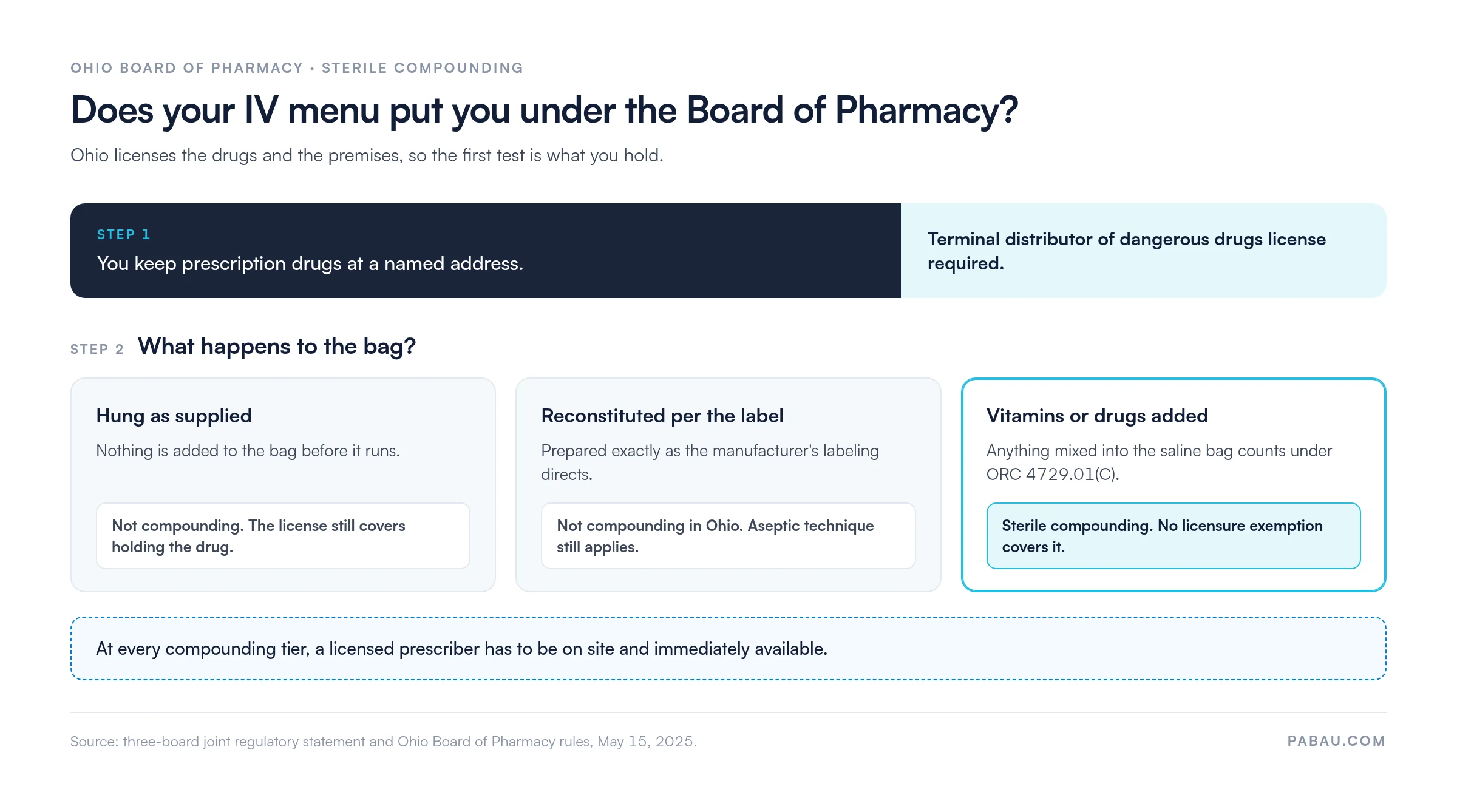
The trigger catches more than operators expect. Under ORC 4729.01(C), compounding means preparing, mixing, assembling, packaging, and labeling one or more drugs under a prescription. Adding vitamins or drugs to a saline bag meets that definition.
The boards close the obvious escape route in the same breath. Some businesses that hold prescription drugs are exempt from Board of Pharmacy licensure.
Those exemptions do not apply to a business engaged in sterile drug compounding, which is what an IV menu is.
One carve-out survives, and it is worth knowing precisely. Reconstituting a drug exactly according to the manufacturer’s labeling is not compounding under Ohio law.
Aseptic technique still applies, and the license is still needed to possess the drug. Three patterns cover almost every menu in the state, and only one of them is compounding.
Once you are licensed, which compounding rules apply depends on how many packages you touch. The Board of Pharmacy’s own tiers run like this:
Immediate use also bans two habits that make a busy Saturday easier. You cannot compound in advance, and you cannot personally furnish a compounded product for the client to take away. Bags get made for the client in front of you.
Every license carries a named responsible person, and that name is not a formality. OAC 4729:5-2-01 requires them to be physically present at the location long enough to supervise and control the drugs on site.
The boards flagged this one directly. They have seen responsible persons listed who are not even physically located in Ohio. That arrangement, they wrote, puts the business, the staff, and the clients at risk.
Supply is the last piece. A licensed business may buy drugs only from Ohio Board of Pharmacy license holders. Under OAC 4729:5-3-04 you verify the seller’s license through Ohio’s eLicense system before the first purchase, then once a year after that.
Apply through the Board’s terminal distributor licensing page, and read its prescriber compounding inspection guide before your first inspection rather than after it.
The build runs in a fixed order, and the prescriber comes at the front of it. Ask how to start an IV hydration business here and the honest answer starts with a person, not a permit. The treatment menu, the lease, and the staffing plan all follow from that hire.
Step seven deserves more than a line. ORC 4729.51(G) says a terminal distributor may not keep dangerous drugs anywhere other than the location described on its license.
Ohio does have a mobile route, at OAC 4729:5-3-23, and it grants a no-cost satellite license attached to an existing terminal distributor. The problem is who that rule opens the door to.
Division (A) names two groups. Nonprofit organizations, corporations, and associations qualify. So do for-profit entities serving people who need treatment for a substance use disorder or a mental health condition. A for-profit IV hydration operator appears on neither list.
We are not going to tell you that route is closed, because the boards have not said so. We will tell you not to buy the van until the Board of Pharmacy answers the question in writing. Our guide to running a mobile IV therapy business covers the operational side once you have that answer.
If you are opening in more than one state, expect the answers to move. Our guide to the Arizona IV hydration requirements works through how that state answers the same questions. Check it before you port an Ohio structure across.
Enforcement came first, and the written guidance followed. Ohio Capital Journal reported on May 19, 2025 that the Board of Pharmacy had suspended four distribution licenses. Two belonged to Ohio wellness businesses, and two to out-of-state suppliers.
The table below cross-walks that reporting to the rule area each case touches. Every entry is an allegation reported by one news outlet, not a finding by a court. Read it as a map of where the Board is looking.
Two of those four cases turn on where the drug came from. That is why supplier verification earns its own step above. In the Mason case, the reporting says the person in charge first named a US distributor to inspectors, then changed the account.
The pattern is wider than IV hydration. The same reporting notes that the Board had already suspended the licenses of more than half a dozen spas that year. The trigger there was largely weight-loss drugs. You can read the full account at Ohio Capital Journal.
The joint statement spells out the range of sanctions available. Failure to hold a terminal distributor license can bring administrative penalties and criminal ones. Individual licensees face fines, probation, suspension, or revocation from their own board.
The problems the boards describe are process failures more than bad intent. Each of the five below has a fix you can put in place this week:
Before you open, walk the room the way an inspector would. Ask who evaluated the client in chair three, where that order is written down, and who signed for the drugs on the shelf.
If any answer takes more than a minute to find, your records are the weak point rather than your clinical work.
Ohio’s rules turn on evidence a busy front desk has to produce months later. An inspector wants to know which prescriber evaluated this client, what they consented to, and who hung the bag. They will also want that person’s license status on the day.
Practice management software like Pabau keeps those answers on one client record. The consent form, the prescriber’s order, the treatment note, and the batch detail sit on one timeline. An inspection request becomes a search rather than a filing-cabinet afternoon.
The schedule carries the harder constraint. A prescriber has to evaluate each client and be on site while bags are compounded. So you can tie each IV service to the staff roles allowed to deliver it. Bookings that would outrun your prescriber never reach the calendar.
Staff profiles close the last loop. Keep each practitioner’s license number and expiration date on their profile, and the renewal date sits next to the schedule. Nobody discovers a lapsed RN license on the morning of a shift.
Owners weighing their options usually compare longevity clinic software against a general booking tool. Our breakdown of the best EMR for IV therapy works through what changes when consent, orders, and stock have to reconcile.

Pabau puts the consent form, the prescriber’s order, and the treatment note on one client record, and keeps license expiration dates on the staff profile. Your team books inside scope by default.

The licensing mechanics here are the cheap half. A terminal distributor application, a supervision agreement, and a supplier check in eLicense are all published processes. None of them leaves room for discretion.
The expensive decision is how many clients your prescriber can evaluate in a day. Ohio’s rules make that number the ceiling on your revenue. Build the plan on a protocol instead of a prescriber, and you have built on the one arrangement all three boards named.
So price the prescriber’s time into the model before you sign a lease, and get an Ohio healthcare attorney to review the agreements. Book a demo to see how Pabau keeps each IV order, consent, and license expiration on one record your team can produce on request.

Planning the build-out? See how to open an IV therapy clinic, from room layout through to the first booked week.
Hiring for the drip room? Check who can administer IV vitamin therapy before you write the job description.
Building your intake paperwork? Start from the IV therapy patient intake form, which captures the history a prescriber needs.
Writing the treatment menu? Read the Myers cocktail protocol, the mixture Ohio’s own statement names as a common example.
Briefing your team on risk? Work through the IV therapy complications your staff need to recognize mid-infusion.
Only if your menu includes a controlled substance. Saline, vitamins, minerals, and common anti-nausea drugs are not scheduled, so most IV rooms never register with the DEA. Add something scheduled, such as ketamine, and both the prescriber and the location need their own registration. The terminal distributor license is separate, and you need that either way.
Not on an out-of-state license alone. Treating a client who is physically in Ohio means holding an active Ohio license in that profession. Once licensed here, a prescriber in another state can run the evaluation by telehealth. They still cannot supervise compounding remotely, because that rule asks for someone on site.
Almost never for wellness drips. Payers treat elective hydration and vitamin infusions as non-covered, so retail IV pricing is cash-pay in practice. That shapes the business more than licensing does, because every visit has to carry the prescriber’s time. Model your margin per visit on that basis before you sign a lease.
Yes, though the license follows the address rather than the business. Your terminal distributor license names one location, and drugs may only be kept there. A second site, a rented treatment room, or a gym lobby needs its own license and its own inspection. Ask the Board of Pharmacy before you take the booking.