CMMC compliance checklist
A CMMC compliance checklist lists every security practice a Department of Defens...

Last Updated: Oct 6, 2026

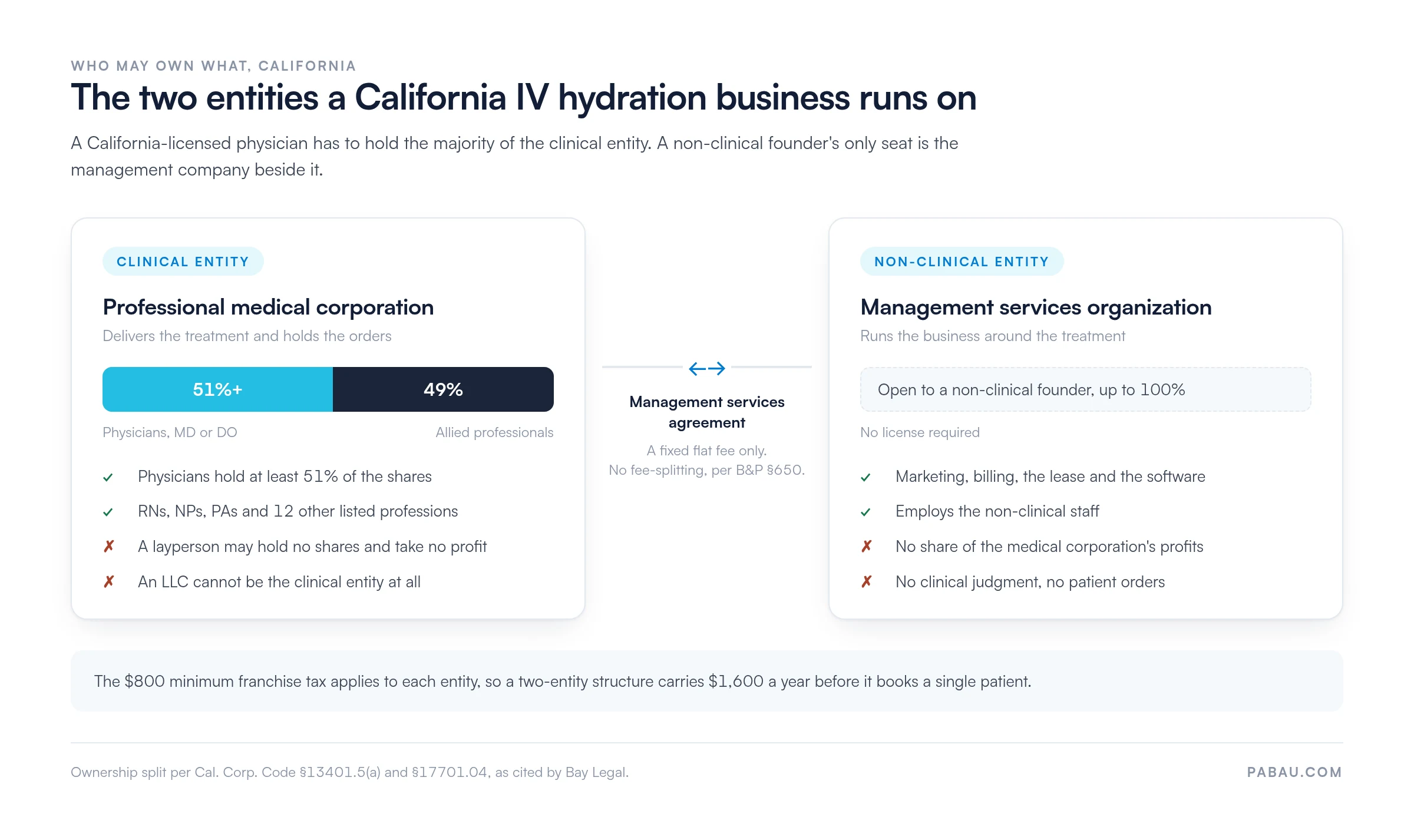
California-licensed physicians must hold at least 51% of the medical corporation, with allied professionals such as RNs and NPs holding the rest.
An RN may administer IV therapy only on an order from a physician, NP, or PA, under written standardized procedures.
Naturopathic doctors hold a separate licensable IV pathway, needing a current ND license plus a Board-approved IV course.
The medical director has to give genuine oversight, because a paper arrangement carries discipline, civil, and criminal exposure.
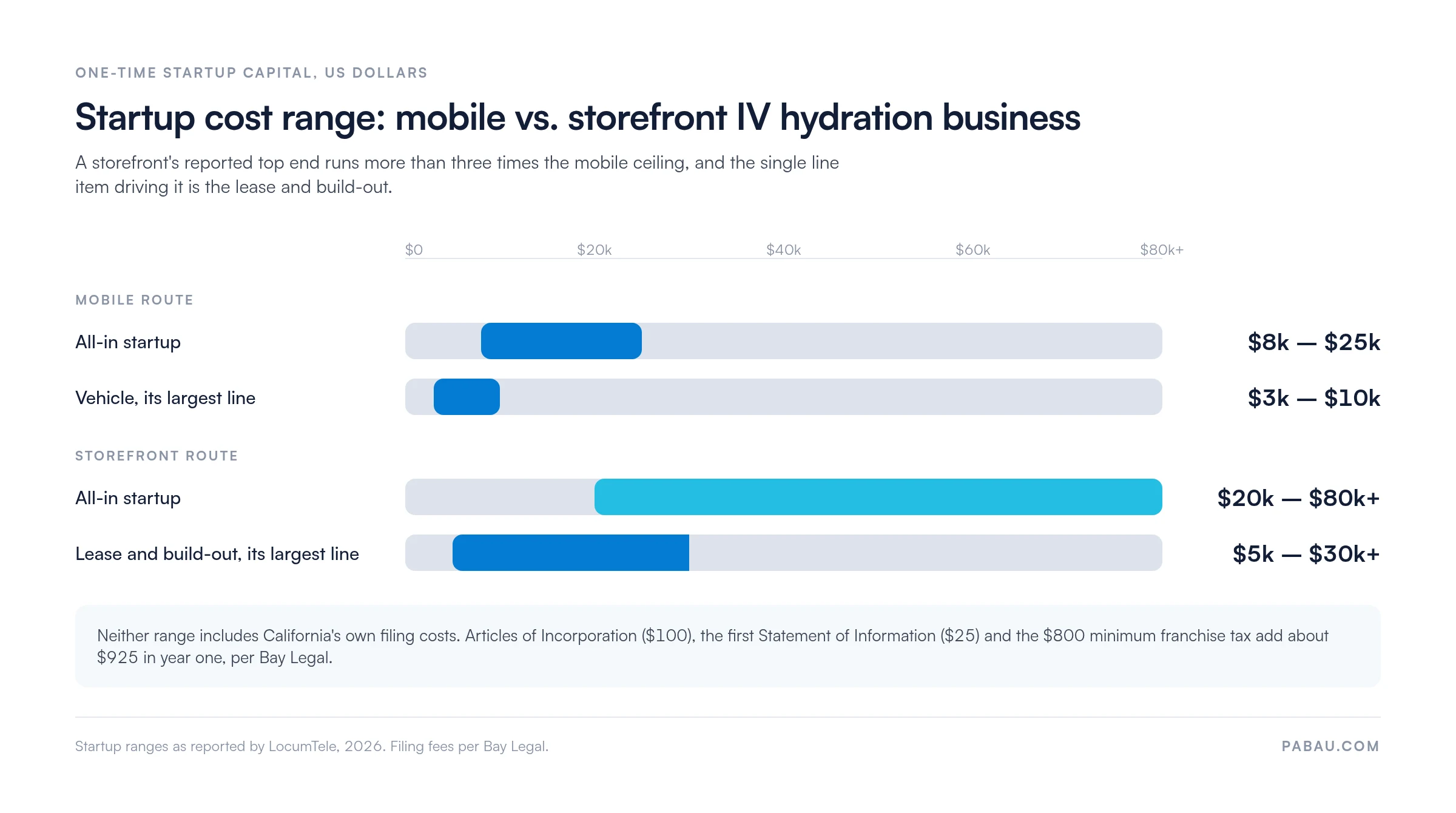
Reported startup capital runs $8,000 to $25,000 mobile and $20,000 to $80,000-plus for a storefront, before California filing fees.
IV hydration business requirements California imposes start with ownership, not with a permit. No state agency issues a single IV hydration license. California decides who may own the clinical entity, who may write the order, and who may put the needle in.
Ownership is the rule that decides whether the rest of the plan is legal. A California-licensed physician has to hold at least 51% of the professional medical corporation, under Cal. Corp. Code §13401.5(a) as cited by Bay Legal. An LLC cannot be the clinical entity at all.
So a nurse-led IV therapy business is possible in California, but only inside a two-entity structure. Every license type has a defined lane. One of those lanes belongs to naturopathic doctors, who hold their own IV pathway through California’s naturopathic medicine board. That route rarely appears in guides to starting an IV hydration business.
A California-licensed physician must own at least 51% of the medical corporation that delivers IV hydration, with allied professionals holding the remaining 49%.
The doctrine behind that split is the corporate practice of medicine, or CPOM. California treats infusing fluids and vitamins as the practice of medicine. So a layperson cannot own the entity that delivers it, or take a share of its profits. Three separate California health-law firms state the same rule.
Bay Legal traces the ownership rule to Cal. Corp. Code §13401.5(a), which reserves the majority for licensed physicians and opens the remaining 49% to 15 listed allied professions. Registered nurses, nurse practitioners, and physician assistants sit on that list. Bay Legal also cites Corp. Code §17701.04 for the rule that an LLC cannot serve as the clinical entity.
There is one narrow route for nurses. Corp. Code §13401.5(f) lets an RN form a professional nursing corporation, per Bay Legal. That corporation is limited to nursing-scope services, so it cannot bill for physician-level treatment or write the orders the drip depends on.
A non-clinical founder still has a legitimate seat. The standard California answer is two entities: A professional medical corporation for the clinical side, and a management services organization for the rest. A management services agreement, or MSA, connects them.
The MSO handles marketing, billing, the lease, the software, and the non-clinical staff. Sebastian Gibson’s firm notes that a layperson’s only permitted role is employment by the MSO, with no share of the medical corporation’s profits.
The management fee is where these structures get challenged. Business and Professions Code §650 bars fee-splitting between a medical practice and non-physicians. Bay Legal reads §650(b) alongside Epic Medical Management, LLC v. Paquette, 244 Cal. App. 4th 504 (2015), and Holt Law adds that management fees should be fixed flat amounts supported by an independent market study.
Set side by side, the two entities show exactly where a non-clinical founder can and cannot sit.
Two more documents belong in the same folder. A stock purchase agreement records how the physician acquired the shares. A buy-sell agreement sets out what happens when that physician leaves, which is the moment a single-physician corporation is most fragile.
One California health-law firm, Bay Legal, tracks the current legislative round. All three items below take effect in 2026.
None of the three changes the 51% rule. AB 890 does widen what a nurse practitioner can own on the nursing side. Anyone asking whether an RN can start an IV hydration business should check where their license category now sits.
Only a physician, physician assistant, nurse practitioner, or registered nurse may independently start an IV in California. Naturopathic doctors may too, with Board-approved IV training.
Who can administer IV therapy in California has a different answer for each license, so the table below sets them side by side. The California IV License Map covers seven license types. Each row carries what that license may own, what it may administer, and the extra California requirement attached. The naturopathic row is the one you will not find in a law-firm explainer.
The California IV License Map, drawn from the statutes and board pages cited in each row rather than from one firm’s summary.
An RN can run the whole treatment and none of the decision. Business and Professions Code §2725.1 lets a registered nurse administer drugs and devices on an order from a physician, NP, or PA. Both Bay Legal and Sebastian Gibson’s firm cite that section.
What the RN cannot do is write the order, perform the good-faith exam, or set the treatment plan. Bay Legal is explicit on all three. That is the practical reason a nurse-owned drip bar still needs a physician in the structure. Our guide to who can administer IVs works through the same question role by role.
Delegation runs on standardized procedures, sometimes called standing orders. Bay Legal cites B&P §2725 and 16 CCR §1474 for the rules. Standardized procedures must be written, dated, signed, specific to the setting, and reviewed at least every three years. In practices we onboard, the signed standardized procedures are the document that goes missing first, well before any license lapses.
Anyone searching whether an LPN can start an IV hydration business hits a naming problem first. California does not license LPNs. The state licenses licensed vocational nurses instead. Holt Law’s claim that an RN or LPN license is enough to administer IVs carries no agency citation. The claim also uses a credential California does not issue.
The better-sourced account comes from the California Board of Vocational Nursing and Psychiatric Technicians. An LVN may give IV fluids and medications only after a BVNPT-approved IV and blood-withdrawal course, commonly around 36 hours of theory and clinical work. The certificate then gets submitted to the BVNPT to sit on the license.
Even with that certification, an LVN cannot start the IV unless an RN, NP, PA, or physician is available, and cannot give IV push medications. Phlebotomists sit further out. The California Department of Public Health’s certified phlebotomy technician license excludes IV insertion and infusion management outright.
Respiratory therapists are the edge case. The California Respiratory Care Board permits respiratory therapists to start IVs, mainly inside a hospital-defined scope, which rarely describes a drip bar.
California’s Board of Naturopathic Medicine runs a specialty certification for IV therapy. The naturopathic pathway is the only one here documented by a licensing board rather than by a law firm. Two conditions apply, per BPC §3648.8(a)(1) and (a)(2): A current California ND license, and a qualifying IV therapy course from a Board-approved provider.
The application runs through the BreEZe portal. Applicants upload a curriculum vitae, waived for anyone licensed in the previous 12 months, plus the certificate of completion for the IV training. The Board answers with a confirmation, a denial, or a request for more information within 30 days.
One caveat is worth reading before you rely on the section number. The Board’s own page cites Business and Professions Code section 3640.8 in its introduction and section 3648.8 in the compliance criteria. Take the citation to your attorney rather than into a filing.
Yes. California requires an actively involved physician medical director, and a paper figurehead exposes the arrangement to discipline, civil liability, and criminal charges.
The medical director is the physician whose judgment each treatment plan rests on. Bay Legal names the statutes behind that exposure: B&P §2052 and §2264. Both reach rent-a-license arrangements where the physician’s name appears and the physician’s judgment does not.
Sebastian Gibson’s firm makes the same operational point. It describes a medical director who supervises the RNs and prescribes each patient’s treatment.
What genuine oversight looks like is less settled. InstaDrip reports a working benchmark of roughly 10% of charts reviewed monthly. Treat that as one operator’s practice rather than a rule, because no California statute in the sources reviewed here sets a review percentage.
The stipend has its own trap. Bay Legal warns that a flat medical-director payment disconnected from services performed risks a fee-splitting finding under B&P §650. LocumTele puts the going rate at $500 to $2,000 a month. Document what that stipend buys, in hours and in named duties.
One precision point separates the sources. Sebastian Gibson’s firm frames the 51% as belonging to the medical director personally. Bay Legal frames it as belonging to licensed physicians, citing the statute. The statutory requirement is physician majority ownership, so the medical director and the majority shareholder can be two different physicians.
California issues no IV hydration business license. You file incorporation papers, a statement of information, a local business license, and a medical waste registration instead.
The filings below usually arrive scattered through paragraphs of legal explanation. Consolidated, they show the year-one floor, which is larger than the $100 incorporation fee suggests.
Filing fees follow Bay Legal’s schedule for the Secretary of State and the Franchise Tax Board. The waste registration route follows Holt Law’s reading of CDPH rules.
Two rows deserve a second look. The $800 minimum franchise tax applies per entity, so a PC plus MSO structure carries $1,600 a year in minimum tax before any profit exists. That is the hidden cost of the structure California forces on a non-physician founder.
The business license is the other one. Holt Law reports that a separate city license may be needed for every city where patients are seen, even occasionally. Some cities will only issue one against a physical office address. A mobile route across five cities is five licenses, not one.
DEA registration is conditional and usually unnecessary. Standard hydration and vitamin infusions do not require it, per Holt Law. Storing or administering controlled substances changes that, and pulls a pharmacy license into the picture as well. HIPAA compliance carries no filing and no fee, but it applies from the first patient record.
The storefront rules in California are settled. The rules for a mobile IV hydration business are not, and that difference matters more than the cost gap when you pick a model.
Sebastian Gibson’s firm calls in-home administration a legal gray area. California’s mobile-clinic vehicle inspection statutes were not obviously written for a nurse arriving at a house with a bag of saline. Holt Law states the opposite in tone, treating state and local mobile healthcare permit rules as a firm requirement. Neither cites a code section.
The workable reading sits between them. Verify the permit position with every city and county you plan to treat in, and expect less consistency than the storefront rules give you. Our guide to running a mobile IV therapy business covers the operational side of that route.
Compounded sterile products have to meet USP <797> standards with aseptic technique, and Holt Law cites the standard for the detail that matters operationally. A compounded preparation must be used within four hours of preparation.
Four hours is a routing constraint, not a paperwork item. It rules out mixing a day’s bags at 8 AM and driving them around until 6 PM. InstaDrip’s answer is to source finished bags and additives from a 503B compounding pharmacy instead of compounding on the vehicle.
Drug storage adds two more rules from Holt Law. Medications stay in a locked compartment on the vehicle, and the mobile unit never gets left unattended with drugs inside.
Every patient needs an individualized evaluation before treatment. B&P §2290.5 permits that good faith exam by telehealth where the standard of care is met, per Bay Legal. InstaDrip describes the same requirement in mobile practice as standing orders plus a telemedicine evaluation before service.
Telehealth makes a mobile route workable, so the exam record becomes the document an investigator asks for. Our IV therapy patient intake form captures the history that exam depends on.
An IV therapy franchise buys a brand, a protocol set, and a supply chain. A franchise agreement does not move California’s ownership line. The clinical entity still has to be a physician-majority medical corporation, and the franchisor sits on the management side like any other MSO.
So the franchise question is commercial rather than legal. Anyone working out how to start a mobile IV therapy business in California faces the same 51% rule either way.
Reported startup capital runs $8,000 to $25,000 for a mobile IV route and $20,000 to $80,000-plus for a storefront, before California’s filing fees.
Those ranges come from LocumTele, dated 2026 and unsourced. Holt Law gives a single figure for the same question, $50,000 to $250,000, also unsourced. The two do not reconcile because they answer different questions. LocumTele splits by model. Holt Law’s band spans both models, plus a fitted-out practice at the top end.
Plan against the model, then add California. The chart above puts the filing floor at about $925 for the medical corporation alone. Add the MSO and the $800 minimum franchise tax applies twice, so the year-one floor lands near $1,725 before insurance.
Monthly running costs are the number that decides survival. LocumTele reports a medical-director stipend of $500 to $1,500 for a mobile route and $500 to $2,000 for a storefront. Nursing staff runs $3,000 to $6,000 mobile and $5,000 to $12,000 for a storefront. InstaDrip puts California mobile IV nursing at $40 to $75 an hour.
The revenue side is where the sources diverge most. LocumTele reports sessions at $99 to $299 in 2026. Sebastian Gibson’s firm reports at-home drips from under $200 to over $500. Both figures are unsourced, so the honest read is a wide spread driven by formulation, market, and whether a nurse drives to the patient.
LocumTele’s break-even benchmarks follow the same split. A mobile route with consistent bookings takes three to six months. A storefront takes nine to 18 months. Treat both as one operator’s illustrative estimate rather than an industry figure.
Legal steps and operational steps usually get listed separately, which hides the dependencies between them. Below they run in the order the work happens.
Once the corporation exists, compliance becomes a records problem. The good faith exam, the physician’s order, the consent form, and the nurse’s notes all have to point at one patient and one date. On paper and in a telehealth tool that never talks to the calendar, assembling that takes days.
Practice management software like Pabau keeps those four records on one patient timeline. The order, the signed consent, the treatment note, and the photos sit in the client record the appointment already created. When the Medical Board or a malpractice attorney asks for a chart, the chart is already assembled.
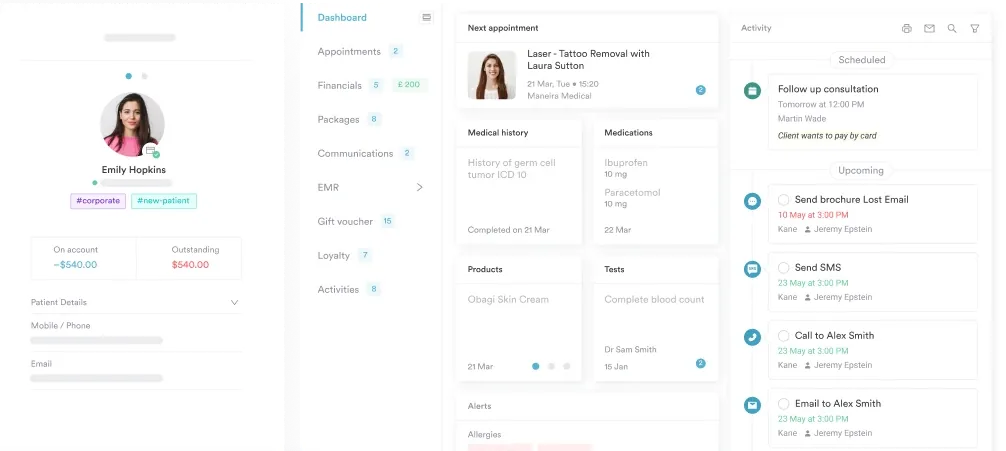
Recurring oversight is the part software genuinely rescues. Monthly chart review and the three-year standardized-procedures review can run as recurring tasks with the evidence attached. Pabau GO, our iOS app for practitioners, lets a mobile nurse capture the note at the patient’s kitchen table instead of at midnight.
Pabau is also our software for longevity practices, so drip bars, functional medicine, and wellness services run on one system. Our IV therapy EMR page covers what an infusion practice needs from clinical records.

Pabau ties every good faith exam, physician order, consent form and nursing note to one patient timeline. Staff licenses and renewal dates sit on one profile. Your medical director’s chart review is evidenced the moment the Board asks.

The IV hydration business requirements that trip up California founders are structural, not procedural. Get the ownership split and the medical director right and the filings are two weeks of admin. Get them wrong and no amount of paperwork rescues the entity.
So do the license check before the branding. An RN, an NP, a PA, and a naturopathic doctor each have a defined lane in California. None of those lanes includes holding the physician majority. Knowing which lane you are in changes who you recruit first.
On cost, plan against a range rather than a number. The gap between a mobile IV business and a storefront is wide enough that the two are separate decisions. Every published figure here is one firm’s estimate, not an industry benchmark. Book a demo to see how Pabau documents the oversight your California medical director is signing for.

Planning the whole launch, not just the paperwork? How to open an IV therapy clinic covers the build, the equipment and the first hires.
Comparing states before you incorporate? IV hydration business requirements in Arizona shows how differently a neighboring state handles ownership.
Choosing the records system next? EMR for IV therapy is our comparison of what a drip practice needs from clinical records.
Need the aftercare paperwork ready? hydration handout template gives patients written guidance to take home after a drip.
Writing the risk section of your protocols? IV therapy complications sets out what your standardized procedures need to plan for.
An RN cannot hold the 51% physician majority in the medical corporation. A registered nurse can hold part of the remaining 49%, or form a nursing corporation limited to nursing-scope services.
A nurse practitioner cannot own the California medical corporation. From 2026, AB 890’s full-practice-authority category, often called the 104 NP, may own a nursing corporation instead, per Bay Legal.
No. LocumTele reports that paramedics cannot independently start peripheral IVs in most states. The California sources reviewed here name only RNs, NPs, PAs, physicians and IV-trained naturopathic doctors, so check paramedic scope with the EMS Authority.
A certified LVN may give IV fluids and medications after a BVNPT-approved course of roughly 36 hours. The licensed vocational nurse still cannot start the line without an RN, NP, PA or physician available, and cannot give IV push medications.
No. The California Department of Public Health’s certified phlebotomy technician license excludes IV insertion and infusion management. A phlebotomist cannot start an infusion.