Professional development record
A professional development record is a structured log of a healthcare practition...

4
Last Updated: Oct 8, 2026

Only physicians may organize an Illinois practice under the Medical Corporation Act, so that route is closed to every other license type.
Physicians and APRNs may both use a professional service corporation or a PLLC, and nobody else may hold an ownership stake.
Specifically, the State Medical Board and the Board of Nursing are the two IDFPR boards that decide your licensing questions.
Notably, Illinois law frames oversight as physician delegation or APRN full practice authority, not as a licensed medical director role.
IDFPR registration is required for the professional entity, and a salon or cosmetology registration cannot stand in for it.
The IV hydration business requirements Illinois enforces start with ownership. Only physicians may organize a practice under the Medical Corporation Act (805 ILCS 15). In addition, physicians and APRNs may both use a professional service corporation (805 ILCS 10) or a professional limited liability company (805 ILCS 185).
That answer contradicts two of the pages ranking for this question today. For example, one says APRNs cannot own a medical practice in Illinois at all. In addition, another says Illinois IV clinics must be owned by physicians or nurse practitioners.
The Illinois Department of Financial and Professional Regulation, known as IDFPR, settled the point with the Illinois Department of Public Health. Specifically, their joint medical spa memo is dated October 30, 2025, and it cites the statute behind each rule.
This guide works through the requirements in the order you need them. Ownership comes first, then oversight, then who may run the drip, then registration.
In short, Illinois splits the job three ways: IDFPR registers the entity and licenses the people, its two professional boards handle licensure, and IDPH takes disease reports.
IDFPR is the licensing agency. A medspa organized as a PLLC, a professional service corporation, or a medical corporation must register with IDFPR. In addition, its articles also go to the Illinois Secretary of State.
Two IDFPR boards decide the questions that matter here. The State Medical Board works under the Medical Practice Act of 1987 (225 ILCS 60), advising on physician licensure and recommending discipline. In contrast, the Board of Nursing works under the Nursing and Advanced Practice Nursing Act (225 ILCS 65), which most people call the Illinois Nurse Practice Act.
IDPH sits behind both. The IDPH Communicable Disease Rules (77 Ill. Admin. Code 690) require reports of unusual or urgent infectious disease cases to the Local Health Department. Those rules designate all medspa staff as reporters, so the duty reaches your nurses and your front desk.
One vocabulary note before the ownership rules. Practitioners and law firms call this the corporate practice of medicine, or CPOM. The IDFPR memo never uses that phrase, and states the restrictions directly through the entity-formation acts instead.
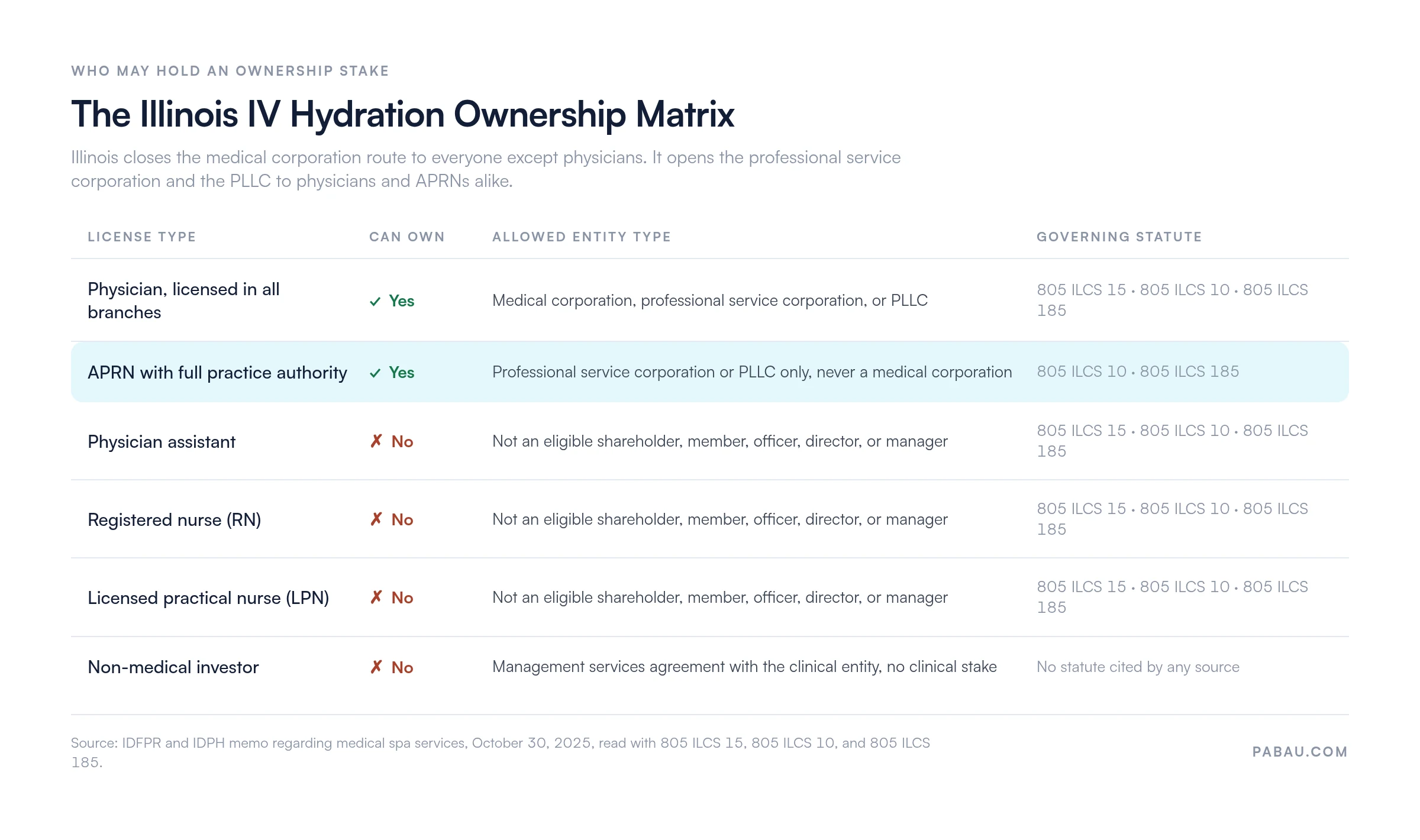
Only physicians may form an Illinois medical corporation, but physicians and APRNs may both own a professional service corporation or a PLLC.
The Medical Corporation Act (805 ILCS 15) is open to physicians only. The Professional Service Corporation Act (805 ILCS 10) and the Professional Limited Liability Company Act (805 ILCS 185) are open to physicians and APRNs alike.
Under all three acts, the ownership bar is the same. Specifically, a person who is neither a physician nor an APRN cannot be a shareholder, member, officer, director, or manager.
That resolves a contradiction sitting on the search results right now. An Illinois medspa law firm states that APRNs cannot own a medical practice, even with full practice authority. Indeed, its reasoning is that APRNs are not licensed under the Medical Practice Act.
A 50-state comparison states the opposite, that Illinois IV clinics must be owned by physicians or nurse practitioners. The IDFPR memo shows the second framing is closer. In fact, ownership runs through the entity-formation acts, and two of those three acts name APRNs directly.
The Illinois IV Hydration Ownership Matrix below sets each license type against the entity it may use and the statute behind it.
The matrix leaves out two situations that come up often.
A chiropractor can own a professional corporation in Illinois, but cannot prescribe. That prescribing limit is what rules out medspa and IV hydration ownership in practice, rather than an explicit statutory bar. The IDFPR memo says nothing about chiropractors either way.
A management services organization, or MSO, is the structure most owners reach for next. A non-clinician owns the MSO and runs scheduling, marketing, and facilities under a management services agreement. Instead, the clinical entity stays with the physician or APRN.
No source here, including the memo, cites a statute authorizing that model. So treat the MSO as a common structuring practice rather than a codified right.
No, not independently. An RN is neither a physician nor an APRN, so no Illinois entity act lets an RN hold shares, membership, or a manager’s seat.
So how to start an IV hydration business as an RN in Illinois comes down to structure. The RN owns an MSO. A physician or an APRN owns the clinical entity, employs the clinical staff, and holds the treatment decisions. Specifically, a management services agreement sets out what the MSO does and what it charges.
Be clear on two points before you sign. The clinical entity, not the MSO, is the party IDFPR registers. In addition, the physician or APRN who holds the clinical entity also holds responsibility for patient outcomes, which is not a responsibility a management fee transfers.
Illinois frames oversight as physician delegation or APRN full practice authority, so what you need is a person and a protocol, not a job title.
The industry calls this role a medical director. The IDFPR memo does not use the phrase at all. Specifically, the memo frames physician authority through delegation under 225 ILCS 60/54.2, and APRN authority through full practice authority under 225 ILCS 65/65-43. South Carolina skips the term medical director too, and its IV hydration requirements name an Authorized Provider instead.
That distinction is not pedantry. One ranking page states that certain APRNs can serve as medical directors of Illinois medspas and IV hydration businesses. Indeed, no criteria and no citation are attached. Ask the questions the memo asks:
An APRN with full practice authority may prescribe legend drugs and Schedule II through V controlled substances (225 ILCS 65/65-43). That authority stops short of operative surgery. Notably, Schedule II narcotics require physician consultation, recorded under Section 316 of the Illinois Controlled Substances Act.
If your menu grows past drips, the laser rules show how Illinois grades supervision. Laser and light-emitting device use for cosmetic treatment is the practice of medicine under 68 Ill. Admin. Code 1285.336.
A physician may delegate an ablative procedure only with on-site supervision. In contrast, a non-ablative procedure may be supervised on-site, or with the physician reachable by phone or electronic means. Either way the delegate needs documented training.
One dated change is worth putting in your protocol. Effective January 1, 2025, an amendment to 225 ILCS 60/54.2 narrowed one exam requirement. It removes the on-site physician exam before a non-ablative procedure for laser hair removal, where four conditions hold.
That exception is written for a laser hair removal facility. In contrast, it does not carry over to the other non-ablative light-device treatments on your menu.
The physician delegating still answers for the outcome. In short, delegation moves the task, not the responsibility.
Start from the license, not the title. The person you need holds an Illinois physician license to practice medicine in all branches, or an APRN license with full practice authority.
Then ask for four commitments in writing, before money moves:
In IV therapy practices we onboard, the delegation protocol usually exists as a signed PDF in somebody’s email. That is the document a complaint asks for first, and the one nobody can find.
Be careful with the medical-director-for-hire pitch. The memo’s delegation framework rests on a physician-patient relationship, so a retainer that buys only a signature leaves that requirement unaddressed. Under Georgia IV hydration requirements, paying a supervising physician through a company the APRN funds is a prohibited arrangement.
Illinois treats an IV infusion as a nursing intervention, so an APRN, an RN, or a delegated LPN may administer it.
The Illinois Nurse Practice Act is the everyday name for the Nursing and Advanced Practice Nursing Act (225 ILCS 65). Its delegation provisions govern who touches the line.
Be aware of what Illinois has not written down. Neither the IDFPR memo nor any of the statutes cited here sets a scope-of-practice rule specific to IV hydration. In fact, the memo lists vitamins and IV therapy only as example medspa services.
So the general nursing-delegation framework governs. An infusion counts as a nursing intervention rather than a separately licensed procedure.
An RN may delegate a nursing intervention or medication administration under 225 ILCS 65/50-75. The delegation has to rest on a comprehensive nursing assessment against five listed factors. As a result, it is a judgment recorded per patient, not a standing permission.
Neither the Nurse Practice Act sections cited here nor the IDFPR memo names an LPN IV certification. An LPN’s authority to run a line comes from the delegated task and documented training, so build the training record rather than hunting a certificate.
Cosmetologists and estheticians are out. Illinois bars them from any technique, product, or practice affecting the living layers of the skin (225 ILCS 410/3-1 and 410/3A-1). Specifically, IDFPR’s statement on prohibited practices names Botox, chemical peels, colonics, liposuction, microblading, microneedling, and radio frequency as the practice of medicine.
The table below sets each role against what it may do with a line, and where the rule sits.
| Role | May run an IV drip | What has to be in place | Where the rule sits |
|---|---|---|---|
| Physician, all branches | Yes | A physician-patient relationship, plus a delegation protocol for any delegated task | 225 ILCS 60/54.2 |
| APRN with full practice authority | Yes | Prescribing authority for legend drugs, with operative surgery excluded | 225 ILCS 65/65-43 |
| Registered nurse (RN) | Yes | A prescriber’s order, because the infusion carries legend drugs | 225 ILCS 65/50-75 |
| Licensed practical nurse (LPN) | As a delegated task | Documented training, and a delegating RN, APRN, or physician | 225 ILCS 65/50-75 |
| Medical assistant | Not addressed by name | The memo names LPNs, RNs, and APRNs as delegates, and adds others with documented training | Not addressed |
| Cosmetologist or esthetician | No | Barred from any practice affecting the living layers of the skin | 225 ILCS 410/3-1 and 410/3A-1 |
Roles differ sharply state to state, and our guide to who may administer IV vitamin therapy sets Illinois beside other states.
No. A phlebotomist is neither a physician nor an APRN, so the Illinois entity acts close the ownership route. The nursing provisions cited here give a phlebotomist no authority to run an infusion either.
The MSO route stays open. A phlebotomist can own and run the business side, with a physician or APRN holding the clinical entity, exactly as an RN would.
Not on their own authority. Neither the IDFPR memo nor the statutes cited here name a medical assistant rule for IV therapy.
One 50-state comparison states that Illinois medical assistants may administer IV therapy with proper supervision, without naming a statute or a board. In contrast, the memo names LPNs, RNs, and full-practice-authority APRNs as delegates for light-emitting device procedures, and adds others with documented training.
So a delegation to a medical assistant rests on the delegating clinician’s assessment. There is no rule you can point an inspector at.
Yes. An IV hydration business license in Illinois means registering the professional entity with IDFPR and filing articles with the Illinois Secretary of State.
A salon registration will not carry you. Illinois issues salon registrations for services under the Barber, Cosmetology, Esthetics, Hair Braiding, and Nail Technology Act of 1985 (225 ILCS 410). Therefore, a salon registration cannot be used to operate a medspa.
The naming rule catches people out. A cosmetology or esthetics facility must hold a shop or salon registration (225 ILCS 410/3D-5). That registration bars medical or similar terminology in the business name. As a result, IDFPR deems such a name misleading to consumers under 68 Ill. Admin. Code 1175.1305(b).
Two duties ride along with the license, and the pages ranking for this question skip both.
Advertising restrictions under the Medical Practice Act apply to every medspa (225 ILCS 60/26). Review the website, the price list, and the social posts against that section before launch, not after a complaint.
The IDPH reporting duty is the second. The IDPH Communicable Disease Rules (77 Ill. Admin. Code 690) designate all medspa staff as reporters of unusual or urgent infectious disease cases and outbreaks. Name the person who makes that call to the Local Health Department, and write the number down.
An IV hydration business plan in Illinois carries one section a generic template will not have. Your license type decides your entity, and your entity decides who can hold a stake.
Work through these before you start the IV hydration business, because each one is painful to retrofit later:
A generic IV therapy business plan will cover the market section fine. Illinois is where the entity, oversight, and registration sections have to be specific, so write those once the structure is settled.
The build-out sequence sits outside this guide. Our walkthrough on how to open an IV therapy practice covers equipment, fit-out, and hiring.
Practices running a wider menu of infusions and testing usually land on longevity practice software rather than a booking tool. Starting the IV hydration business on a system that holds clinical records saves a migration in year two.
No Illinois-specific startup figure exists in a source worth quoting, so this section names the drivers instead.
The published ranges for this business type are national, uncited, and inconsistent. For example, one guide gives a startup range in its body and a different range in its own FAQ. By comparison, another gives a single medspa figure with no breakdown behind it. None of them is an Illinois number.
Price your own model from these lines:
Two lines on that list catch first-time owners out. The oversight arrangement runs every month whether you treat 40 patients or 400. In addition, nursing hours are the line most sensitive to booking density, because a nurse is paid for the idle time between drips too.
On the software line, comparing options early saves a migration later. Our roundup of the best EMR for IV therapy sets out what the records side has to hold.
The legal requirements do not change. A mobile IV hydration business in Illinois needs the same ownership, oversight, and registration as a fixed site.
No source here, including the IDFPR memo, states an Illinois rule specific to a mobile unit. So plan the mobile IV business against the same statutes, and add operational controls for treating away from a fixed site.
Two practical points carry over from the fixed site. The IDPH reporting duty travels with your staff, not with your building. In addition, an advertising review under 225 ILCS 60/26 applies to a mobile service page exactly as it does to a storefront.
If you are planning how to start a mobile IV therapy business in Illinois, the law is the same and the logistics are not. Our guide to running a mobile IV therapy business covers the routing, pricing, and staffing trade-offs this section leaves out.
Illinois oversight is a documentation problem in practice. The delegation protocol, the prescriber’s order, the signed consent, and the treatment note all have to line up for one patient on one date.
Most new IV practices keep those four in four places. Practice management software like Pabau holds them on one patient record instead. Digital forms carry the consent and the intake screening, and the treatment note sits on the same timeline as the order.
Pabau’s digital forms also hold the delegation and collaborative-practice paperwork on the staff record. So the document a complaint asks for first sits where your team can find it. Pabau’s checkout takes self-pay at the point of treatment, so the payment and the treatment note close together.
The IDPH duty gets easier the same way. Pabau’s intake forms capture the screening questions, and the patient record shows who saw the answers and when. A report to the Local Health Department then starts from a record rather than a memory.
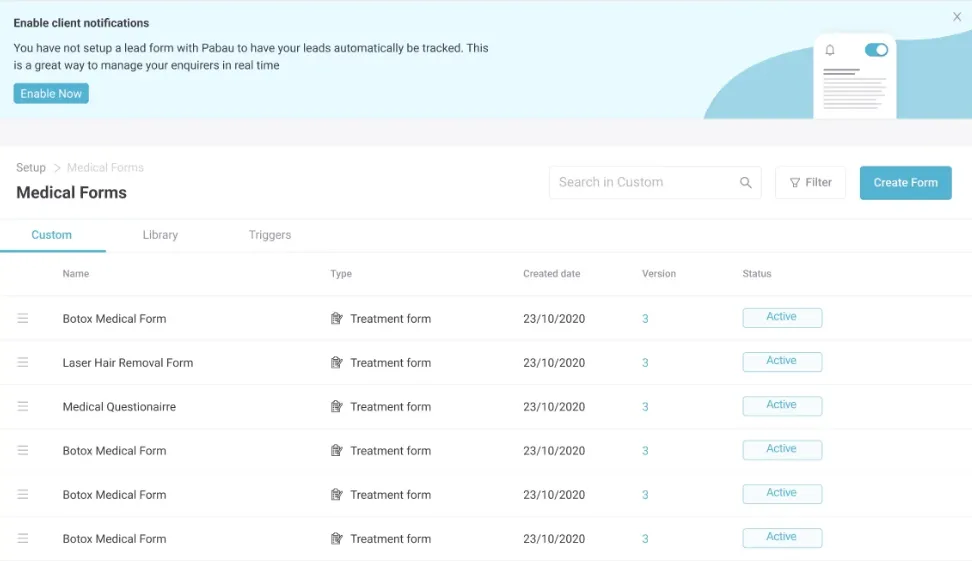

Pabau holds the delegation protocol, the prescriber’s order, the signed consent, and the treatment note on one patient record. Your team can answer an IDFPR question without opening four systems.

Illinois ownership is narrower than the medical-director-for-hire pitch suggests. The physician or the APRN holds the entity, and a management services agreement moves the admin work without moving the ownership stake.
So settle the structure before the lease and the menu. Check your intended entity against 225 ILCS 60, 225 ILCS 65, and the IDFPR and IDPH memo. Then have a healthcare attorney read the operating agreement.
The trade-off worth remembering is that Illinois is not a hard state to open in, but it is a hard state to document loosely. Book a demo to see how Pabau keeps Illinois delegation, consent, and infusion records on one patient timeline.

Comparing states before you commit? IV hydration business requirements Arizona shows how a state with no ownership ban handles the same questions.
Need the first form in the chain? IV therapy patient intake template gives you a starting intake form to adapt before your protocols go live.
Writing the consent for vitamin injections? Intravenous B-12, vitamin and amino acid injections informed consent covers the risks a signed form has to name.
Building your emergency protocol? IV therapy complications lists the adverse events worth training your nurses against, and how each one presents.
Ready to fill the schedule? IV therapy marketing covers the channels that bring repeat drip patients back without discounting.
Yes. Illinois treats an infusion as a nursing intervention, so whoever administers IV vitamin therapy holds an APRN, RN, or LPN license. In addition, the order behind the drip comes from a physician or an APRN with prescribing authority.
Physicians and APRNs, and nobody else. Only physicians may organize under the Medical Corporation Act (805 ILCS 15). Both may use a professional service corporation (805 ILCS 10) or a PLLC (805 ILCS 185). In contrast, a non-clinician is limited to a management services agreement with the clinical entity.
No Illinois figure exists in a source worth quoting. Instead, margin turns on nursing hours per drip, the recurring cost of your delegating physician or APRN, and supply cost per bag. Build the model in your IV hydration business plan from those three drivers, because published national ranges are uncited and disagree with each other.
Yes, within limits. An advanced practice registered nurse may hold a stake in a professional service corporation or a PLLC (805 ILCS 10 and 805 ILCS 185). In contrast, the Medical Corporation Act route stays closed, because that act is open to physicians only.
No. An LPN is neither a physician nor an APRN, so the Illinois entity acts bar an ownership stake. Instead, an LPN may administer an infusion as a delegated nursing intervention under 225 ILCS 65/50-75, with documented training behind it.
An APRN with full practice authority, a registered nurse acting on a prescriber’s order, or an LPN performing a delegated task. Illinois sets no scope rule specific to IV hydration, so the general nursing-delegation framework in 225 ILCS 65 applies.