How to open a peptide clinic: 7 steps for licensed practices
How to open a peptide clinic: run peptide therapy as a prescribed service inside...

Last Updated: Nov 19, 2026
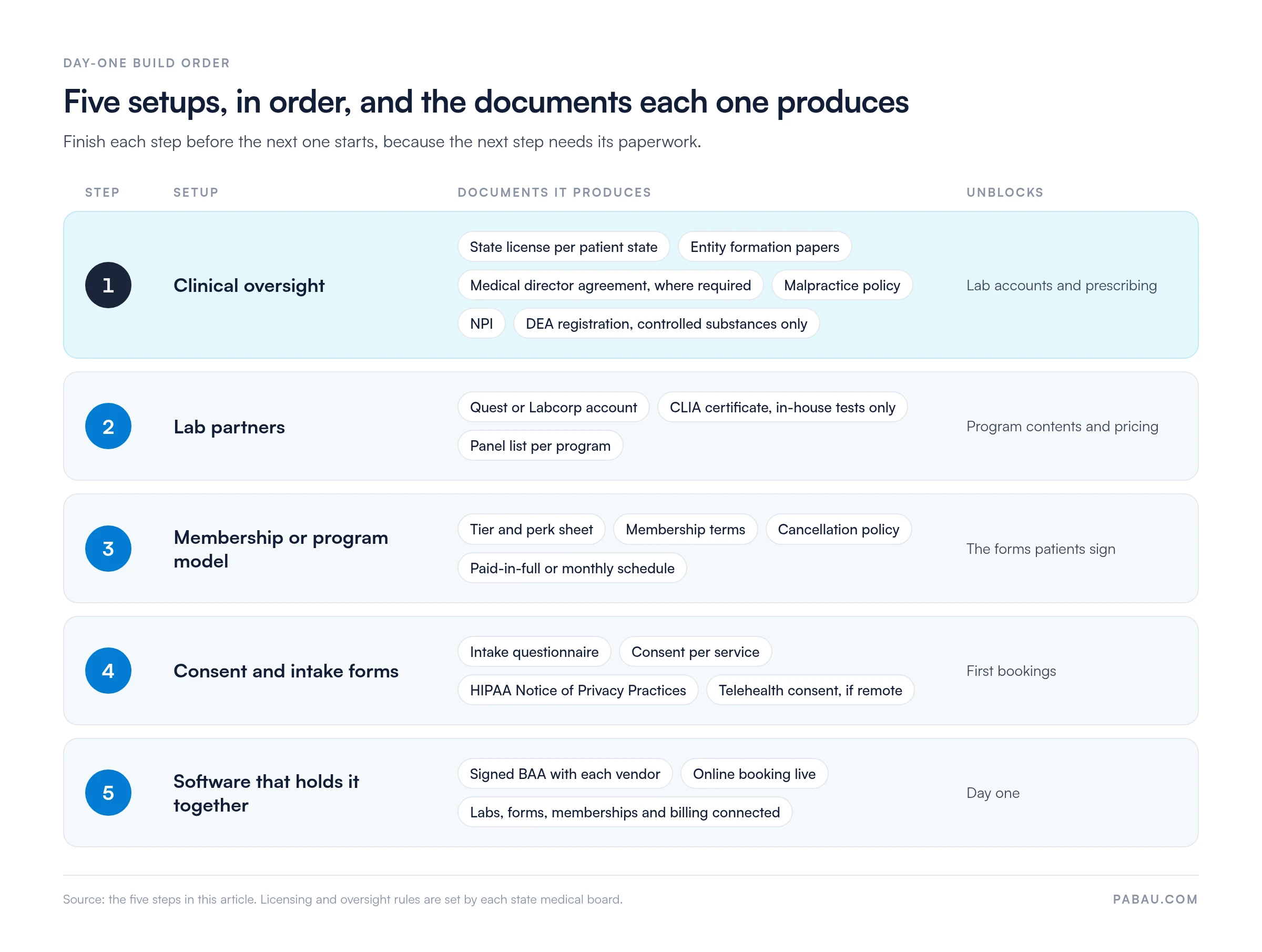
How to start a longevity clinic comes down to five setups, finished in order before your first patient books. Clinical oversight comes first, then lab partners, the membership or program model, consent and intake forms, and the software that connects them.
Licensing and oversight rules differ by state, and your state medical board is the authority on both. No template exists to copy, either. A 2025 framework paper in Aging and Disease found no universally accepted clinic model, so the model is yours to set.
We call the sequence the Day-one build order, because each step produces the documents the next step needs. Below, every step lists those documents, the fees with a published figure, and where each one sits in Pabau, a practice management platform.

Start a longevity clinic by finishing five setups in order: clinical oversight, lab partners, a membership or program model, consent and intake forms, then software.
The Day-one build order runs in that sequence because each step produces the documents the next step depends on.
Your state medical board sets licensing and oversight rules, and telehealth care happens where the patient is located, so confirm your setup with counsel.
The fixed federal fees are small: DEA registration is $888 for three years, and a CLIA Certificate of Waiver is $248 every two years.
Premises, equipment, malpractice cover and legal work are quote-based, so price them with vendors before you set membership fees.
You need clinical oversight, lab partners, a membership or program model, consent and intake forms, and software that connects them, set up in that order.
Before any of that, decide how you will deliver care. The delivery model is the first decision when you open a longevity clinic. It decides which states you license in and whether you need premises.
Whichever model you pick, the Day-one build order stays the same. It holds for a narrower launch too, such as a peptide therapy practice.
The diagram below shows each step and the documents it leaves you holding.
A licensed physician, or a medical director where your state requires one, holds clinical responsibility, and your state medical board sets the rules.
Many owners don’t prescribe themselves and rely on a medical director, so settle that agreement before any other contract.
The DEA’s 2020 fee rule set the practitioner registration fee at $888 per three-year cycle (checked November 20, 2026). A practitioner with practices in two states needs a separate DEA registration in each one.
Documents this step produces: state licenses, entity papers, a medical director agreement where required, a malpractice policy and an NPI. Prescribers of controlled substances add a DEA registration.
How Pabau holds it: in Pabau, non-prescribers can draft a prescription, but only a prescriber can approve and send it. US e-prescribing runs through DoseSpot, so the medical director keeps the final say on every script.
Open accounts with a reference lab such as Quest or Labcorp, and get a CLIA certificate before running any test in-house.
Panel design is a clinical decision for your medical director. Many longevity programs build around ApoB, HbA1c and a lipid panel, then add tests by tier.
CMS says labs generally need the appropriate CLIA certificate before they begin testing, and every certificate lasts two years (checked November 20, 2026). A Certificate of Waiver covers waived tests only and costs $248 every two years on the CMS CLIA fee schedule.
Higher-complexity testing moves you to a Certificate of Compliance or Accreditation, with fees that scale by annual test volume.
Treat biological-age results as tests, never as diagnoses. The same 2025 framework paper classes aging clocks as experimental, unlike evidence-based blood panels, so say so in your consent forms and marketing.
Documents this step produces: reference lab account agreements, a CLIA certificate if you test in-house, and a written panel for each program tier.
How Pabau holds it: practices can switch on Pabau’s medical lab software per account. The practice orders Quest tests from the patient record with its own Quest login, and results import automatically.
Labcorp orders are placed in Labcorp Link, and results sync back automatically. A biomarker-over-time chart sits on the patient record, and patients see trends on the results the practice has released to them.
Longevity practices usually sell an annual program, paid upfront or in monthly installments, with treatments and tests included as perks.
The membership is the product, and treatments sit inside it. Set three terms before you write a single form: what each tier includes, how members pay, and how renewal and cancellation work.
The framework paper describes the same handoff. After the first assessment, the physician and the patient decide together whether to sign a subscription agreement. For tier structures and margins, see our guide to longevity clinic membership pricing.
Documents this step produces: a tier and perk sheet, membership terms, a cancellation policy and a payment schedule for paid-in-full and monthly members.
How Pabau holds it: Pabau handles recurring memberships and treatment packages for hormone, GLP-1 and longevity programs. A perk in Pabau’s membership software can cover any service, a category, or wallet credit with rollover.
The till sells 2–12 month installment plans through Stripe, which suits members paying monthly toward a yearly program. Patients can view, pause and cancel memberships in the Client Portal where the practice switches that section on.
Before day one you need an intake questionnaire, consent for each service, membership terms, a HIPAA privacy notice and telehealth consent for remote care.
Review every form with your medical director and counsel before launch. A form written before the membership terms usually needs rewriting, which is why forms sit fourth in the order.
How Pabau holds it: Pabau’s patient intake software sends consent and intake forms before the visit. The completed form lands in the patient record and doesn’t sit as a PDF, so nobody chases unsigned forms by hand every week.
Pabau GO, our iOS app for practitioners, supports care-pathway forms and consents for the visit itself.
Day-one software should handle booking, records, labs, memberships, forms, payments and insurance billing in one system, under a signed HIPAA business associate agreement.
Choose the system before you open, while the first four steps are still on paper. Switching after launch means moving live member records, signed forms and lab history.
HIPAA requires a written business associate agreement with any vendor that handles patient data for you. Ask every vendor for a signed BAA before you load a single record.
Pabau’s online booking software is where patients first meet the system, so set it up after the forms it sends. For a side-by-side of other platforms, see our roundup of the best longevity clinic software.
Longevity clinic startup costs depend on your delivery model and state. The fixed government fees are small, while premises, equipment, staff and insurance are quote-based.
We don’t give an all-in total, because no primary source publishes one for longevity practices. Get written quotes for the four quote-based lines before you price your membership tiers.
The software figure comes from Pabau’s published pricing (checked November 20, 2026). Credits for SMS, two-factor authentication, telehealth and Pabau Scribe, our AI scribe, are billed by use, so the bill grows with volume.
Pabau runs booking, charting, consent forms, payments and memberships for practices that offer aesthetics, hormone therapy, weight loss and longevity care in one system. Each step of the Day-one build order has a home in one patient record.
Lab results from Quest and Labcorp chart over time on the record. Memberships carry the perks and installment plans from Step 3. Forms arrive signed before the visit, and online booking fills the calendar.
Pabau handles self-pay, memberships and insurance billing in one system, in the US, UK and Australia. That keeps you off a stack of separate tools for labs, payments and forms, which is what Pabau’s longevity clinic software is built to replace.
Every Pabau plan includes the core features, and add-ons enhance the experience. Onboarding is structured, with migration and setup support before go-live. Pabau is rated 4.8 on G2 and 4.7 on Capterra.

Pabau holds lab results, memberships, signed forms and online booking on one patient record. Set it up before launch, so your first members book, sign and pay in one place.

Lock clinical oversight and lab partners first. Your program design and your forms both depend on them, and redoing either after launch costs you members.
Once those two are signed, the membership terms write your forms, and the forms tell you what the software has to send. Follow that order, and every contract you sign is written against terms that already exist.
Book a demo to see how Pabau carries your labs, memberships and consent forms from the first booking.

Planning a functional medicine side? How to start a functional medicine practice covers the launch steps for a neighboring model.
Need an intake form to adapt? Functional medicine intake form gives you a health-history template to edit with your medical director.
Weighing other revenue models? Functional medicine business models that scale compares membership, package and hybrid models.
Longevity clinic startup costs split into fixed fees and quotes. DEA registration is $888 for three years, a CLIA Certificate of Waiver is $248 every two years, and an NPI is free. Premises, equipment, malpractice cover and legal work are quote-based, so no published total fits every practice.
You need one where your state requires it, and your state medical board sets that rule. Owners who don’t prescribe usually rely on a medical director or a licensed physician for clinical oversight. Confirm the arrangement with a healthcare attorney.
Yes, a longevity practice can bill insurance for covered services alongside its membership fees. Pabau handles self-pay, memberships and insurance billing in one system, in the US, UK and Australia.
Yes, if you’re licensed in every state where your patients are located during their visits. For controlled substances such as testosterone, the DEA and HHS extended telemedicine prescribing flexibilities through December 31, 2026. Check the DEA’s rule for 2027 before you prescribe remotely (checked November 20, 2026).