Skin clinic software Australia: 6 best picks, AUD prices
Skin clinic software in Australia costs a two-practitioner practice between A$84...

Last Updated: Sep 22, 2026

Starting an IV vitamin therapy business in Australia means satisfying three separate regulators, not one.
AHPRA does not license or approve IV therapy businesses, so there is no business approval to apply for.
A registered nurse can administer an infusion under a prescriber’s order, and Schedule 4 ingredients like glutathione need a prescription.
The TGA polices product claims, and it fined Drip IV Australia AU$160,000 in 2023 over its marketing.
ABC News reported typical treatment prices of AU$100 to AU$600, with premium anti-aging drips above AU$1,000.
Starting an IV vitamin therapy business in Australia means satisfying three separate regulators, not one. AHPRA regulates the practitioners. The TGA regulates the products and the claims made about them.
Your state or territory’s drugs and poisons law decides who may handle Schedule 4 substances. Glutathione, the ingredient behind most beauty and anti-aging drips, is one of them.
There is no AHPRA approval to apply for. The agency regulates registered health practitioners and how they advertise, not the businesses they work in.
This guide sets out what each regulator wants and who may legally give an infusion. It then compares the fixed-site, mobile and franchise routes, and covers suppliers and pricing.
IV vitamin therapy delivers fluids and nutrients straight into the bloodstream. Demand is climbing, and one Brisbane practice told ABC News its bookings rose up to 20% last year.
An intravenous vitamin infusion bypasses digestion, so the dose reaches the blood without passing through the stomach. That is the whole mechanical argument for the route.
Mainstream medicine has used intravenous vitamins for decades, for dehydration, malabsorption and diagnosed nutrient deficiencies. The wellness market runs on a different premise. It sells a vitamin drip to someone with no diagnosed deficiency at all.
Menus usually cover hydration, hangover relief, immune support, athletic recovery and beauty drips. IV glutathione is the common ingredient in the beauty and anti-aging tier.
Kate Winch, a registered nurse at Brisbane practice Inigo Cosmetic, gave ABC News that figure. Celebrity endorsement carries much of the demand behind it.
The benefits claimed for IV drips have not kept pace with the marketing. Professor Luigi Fontana of the University of Sydney says no robust studies back the wellness claims.
Dr. Danielle McMullen, president of the Australian Medical Association, calls the drips “rarely useful”. She says most people would be as well off drinking a glass of water. The AMA also names the risks, which include infection, allergic reaction and doses high enough to be toxic.
In late 2024 the Royal Australian College of General Practitioners (RACGP) called IV drips a form of low-value care. RACGP members had been competing with wellness practices for IV fluids during a global shortage. That shortage has since eased.
Demand has also outrun the advertising rules. Australia’s best-known enforcement case in this market is the TGA’s action against Drip IV Australia.
A registered nurse can administer IV vitamin infusions under a prescriber’s order, but Schedule 4 ingredients like glutathione need their own prescription.
No single license covers this work. Registration sits with the individual practitioner, and the National Boards supported by AHPRA hold that register.
A registered nurse trained in cannulation can give an infusion, working from a prescriber’s order rather than their own judgment. Prescribing rights belong to doctors and to nurses holding a prescribing qualification.
Business guides to this market sometimes suggest a naturopath can provide the clinical oversight. That looks unlikely to hold up, and this is our reading of AHPRA’s own scope rules rather than a claim any source makes directly.
Naturopaths are not registered under the National Law, and they cannot prescribe a Schedule 4 medicine. A glutathione infusion still needs a prescriber’s order.
Trading on a title you do not hold is a separate and more serious problem. AHPRA states that an unregistered person claiming to be qualified as a doctor or nurse may face criminal proceedings.
A registered practitioner faces exposure on two fronts at once. AHPRA can act on the advertising. The practitioner’s National Board can also open a separate investigation under their code of conduct.
Our wider guide to administering IV vitamin therapy breaks the scope down role by role.
Three regulators, three separate jobs, and no single approval that covers the business. Call it the three-regulator rule.
AHPRA regulates registered health practitioners under the National Law, along with how they advertise a regulated health service. AHPRA does not license an IV therapy business, and AHPRA does not regulate products. IV equipment and fluids are the TGA’s responsibility, as AHPRA states directly.
The diagram below splits the three jobs. The table after it names the enforcement each regulator can reach for.
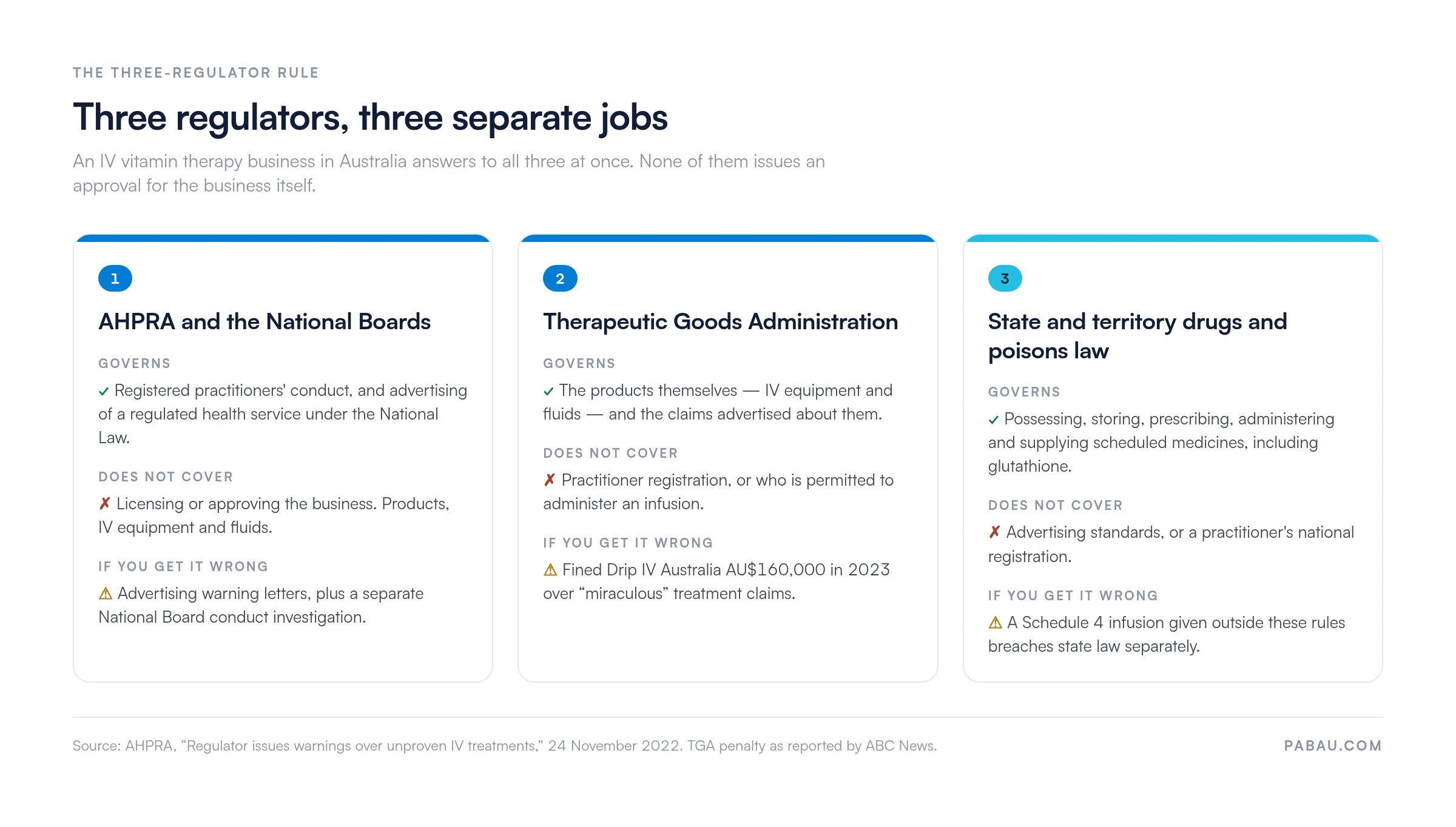
The third row is the one that catches new operators. Glutathione is a Schedule 4, prescription-only substance. A glutathione infusion is therefore a prescription-medicine event before it is a wellness treatment.
Drugs and poisons legislation in each state and territory restricts who may possess, store, prescribe, administer and supply scheduled medicines. Those rules sit on top of the National Law, not inside it.
AHPRA’s advertising tests are statutory, not guidance. Advertising a regulated health service must not do any of the following.
AHPRA also treats generalised claims of improved health, wellness or appearance as misleading where there is no diagnosed clinical need. That covers most of the language this market sells on.
Three routes are open in Australia. You can run a fixed-location IV vitamin therapy clinic, run a mobile service, or buy into a franchise.
A fixed-location IV vitamin therapy clinic carries rent and fit-out, and returns a controlled treatment room and a repeatable day. Our guide to how to open an IV clinic covers that build-out.
A mobile service trades the lease for travel time and a treatment environment you do not control. Our guide to the mobile IV therapy business covers that route.
Several franchise and licensing operators are now active in Australia. An IV vitamin therapy franchise buys brand recognition, clinical protocols and a supply chain that already works. You give up pricing control, menu control and a share of revenue.
Use the control-versus-speed test to decide. If your edge is a treatment menu or a local niche you designed yourself, a franchise will blunt it. If your edge is opening before the competition does, a franchise buys you months.
A franchise agreement does not transfer regulatory responsibility. The registered practitioner giving the infusion still answers to their National Board. Your state’s Schedule 4 rules still apply at your site.
Common niches are athletic recovery, hangover relief, corporate wellness and beauty drips. Partnerships with gyms, spas, hotels and resorts are the usual route into them.
IV vitamin therapy suppliers in Australia fall into two groups. Wholesale distributors sell the consumables, and compounding pharmacies prepare prescription formulations to a prescriber’s order.
The first line is IV vitamin therapy wholesale. Bags, giving sets, cannulas, dressings and sharps bins come by the carton from medical supplies distributors in Australia.
Price per unit matters less than lead time and lot traceability. A batch number you cannot find later is a documentation problem, not a purchasing one.
The second line is a compounding pharmacy, and this is where the three-regulator rule becomes operational rather than theoretical.
Choosing an IV vitamin therapy compounding pharmacy is a regulatory decision as much as a commercial one. The pharmacy compounds a Schedule 4 formulation against a prescription written for a named patient.
Glutathione is the clearest case. A Schedule 4 ingredient is prescription-only, so the prescription comes before the appointment rather than after it.
In the practices we onboard, the weak point is rarely the infusion itself. The paperwork behind it fails first, because no one recorded which scheduled ingredient went into the bag.
Standard IV vitamin infusions in Australia typically sell for AU$100 to AU$600, while premium anti-aging formulations can pass AU$1,000, according to ABC News reporting.
Those figures come from ABC News coverage of the Australian wellness-drip market in March 2026. Treat them as one market snapshot rather than an industry average.
The anti-aging tier is where the coenzyme and collagen-boosting formulations sit, and where the prices above AU$1,000 appear.
We could not find a published, sourceable startup-cost figure for the Australian market, so this guide does not invent one. What you can budget against is the list of cost categories.
Software is a running cost from day one rather than a one-off. Our comparison of the best EMR for IV therapy sets out what a clinical system has to hold.
On pricing, charge for the prescription and not only for the bag. Chair time is much the same for a hydration drip and a beauty drip.
The ingredient tier and the prescriber’s involvement are what separate a low-hundreds treatment from an AU$1,000 one. Advertising that price is fine. Advertising what the drip will do for someone with no diagnosed deficiency is where the National Law bites.
The three-regulator rule turns into a paperwork problem the moment you open. Practice management software like Pabau holds the record that proves what was given, to whom, on whose order.
Most new operators start with a paper consent form and a separate booking tool. The batch number lives on a sticker and the consent sits in a folder. The prescriber’s order sits somewhere in an email thread.
Pabau’s digital forms capture consent before the appointment, and each completed form lands in the client record. Pabau’s treatment notes hold the formulation, the batch number and the practitioner who administered it.
Pabau’s calendar schedules registered nurses and the prescriber against the same day. An infusion never lands in a slot with no order behind it.
Pabau’s longevity clinic software carries the marketing side too, from campaigns to a client database you own rather than rent from a marketplace. Every Pabau subscription includes the full marketing suite. That matters here, because rebooking a hydration drip is a retention job rather than a new-patient job.

Pabau captures IV consent before the appointment, records the formulation and batch number against the client, and schedules nurses and prescribers on the same calendar. Your record of what was given, and on whose order, stays in one place.

An IV vitamin therapy business is legal in Australia, and it is not lightly regulated. Three regulators each hold a piece. None of them hands you a single approval that covers the other two.
Start with the ingredient list rather than the branding. Once you know which menu items are Schedule 4, you know which prescriber relationships you need. The state rules follow from that.
The trade-off worth remembering is the one on claims. The treatments that sell hardest are the ones AHPRA is least willing to let you describe as beneficial.
Get the record-keeping right before the first booking, not after the first complaint. Book a demo to see how Pabau keeps IV infusion consent, notes and prescriber orders in one client record.

Still checking who may give the infusion? Who can administer IV vitamin therapy sets out scope of practice role by role.
Writing your safety protocol? IV therapy complications covers what can go wrong during an infusion and how to respond.
Need a consent and screening form? Our IV therapy patient intake template gives you the fields to capture before the first drip.
Building your drip menu? The Myers cocktail protocol breaks down one of the most requested formulations.
Ready to fill the calendar? IV therapy marketing covers how to attract bookings without overstating what a drip does.
IV drips are bags of fluid, vitamins and minerals delivered into a vein through a cannula. Intravenous vitamins reach the bloodstream without passing through the digestive system, which is the reason clinics use the route.
Yes. AHPRA does not license IV therapy businesses, so the National Law does not stop a registered nurse from owning one. The limit is prescribing. An RN administers infusions under a prescriber’s order, and Schedule 4 ingredients such as glutathione still need a prescription.
A registered nurse or a prescriber can give an infusion. The nurse works from a prescriber’s order rather than their own judgment. The prescriber is usually a doctor or a nurse holding a prescribing qualification.
You need current registration with the relevant National Board, plus documented competency in IV cannulation and infusion. Prescribing rights are separate. Schedule 4 ingredients need a prescribing qualification, which a general nursing registration does not provide.