Professional development record
A professional development record is a structured log of a healthcare practition...

4
Last Updated: Oct 8, 2026

Virginia has no standalone corporate practice of medicine statute, so a non-physician can own an IV hydration business.
Any business infusing patients in their own homes needs a Virginia home care organization license, at $1,500 for three years.
Running that business without the license is a Class 6 felony under § 32.1-162.15, not a fine.
Registered nurses and nurse practitioners may start an IV under a practitioner’s order, and unlicensed staff generally may not.
The Virginia IV hydration compliance stack below sorts all four requirements against the law and the board that enforces each one.
Virginia enforces IV hydration business requirements in four layers, and each one answers to a different board. Nothing in Virginia law bans a non-physician from owning the business. What the law does require is a specific license, a licensed practitioner behind every infusion order, and staff whose scope covers IV administration.
This article calls those four layers the Virginia IV hydration compliance stack. Business structure sits at the bottom. State licensure, medical oversight, and clinical scope of practice stack above it. Get one layer wrong and the layers above it stop protecting you.
Each section below names the governing law: the statute, the regulation, and the board that enforces it. Where Virginia has no rule at all, that gets said too. An assumed rule costs a new practice as much as a broken one.
The Virginia IV hydration compliance stack has four layers: business structure, a home care organization license, medical oversight, and clinical scope of practice. Each layer carries its own governing law and its own enforcing body. That is why Virginia has no single IV therapy license to apply for.
Layer four is where most role questions land. Layer two is where the criminal exposure sits. The build-out, equipment and hiring sequence underneath all four is a separate job, and our guide to open an IV clinic walks through it. The rest of this guide takes the layers in order.
Virginia has no standalone corporate practice of medicine statute, so a non-physician can own the entity that runs an IV hydration business. There is no ownership-percentage rule to satisfy and no equity split to negotiate with a physician.
What Virginia does police is who makes the medical decisions. Section 54.1-2902 makes it unlawful for any person to practice medicine in the Commonwealth without a valid unrevoked Board of Medicine license. Section 54.1-111(D) reaches the entity as well as the individual.
Under that subsection, the Department of Health Professions can pursue a corporation, partnership or other entity in court. Civil penalties run from $200 to $5,000 per violation, capped at $25,000 per entity per year. So the standard is functional rather than structural. Whoever directs medical care must hold a valid Virginia license.
A widely repeated shortcut says a physician must be a co-owner or on staff. Virginia’s code contains no such requirement. The requirement that does exist is control. The treatment protocol, the order and the clinical judgment behind each infusion have to belong to a licensed practitioner.
The entity form is where that plays out. A plain LLC can carry any owner, but it may not itself render medical care. Section 13.1-549 binds a professional corporation or PLLC formed to deliver medical services. That entity may only issue shares to individuals or professional entities licensed to render the same service.
Section 13.1-543 names the professions that route is open to. Practitioners of the healing arts and advanced practice registered nurses are on the list. Registered nurses are not, so an RN who wants to own the business uses an ordinary LLC and contracts the clinical work to licensed practitioners.
That contracting arrangement is the management services organization, or MSO, model. Non-clinical owners across Virginia’s medical spa sector use the same structure, and the same caution applies. An MSO that starts setting treatment protocols has stopped being a management company.
Any business delivering IV infusion in a patient’s residence needs a home care organization license from the Virginia Department of Health. Section 32.1-162.9 makes it unlawful to establish or operate one without that license unless an exemption applies.
The license costs $1,500 and runs for a three-year term. The Virginia Department of Health set that triennial fee effective May 22, 2025, replacing the earlier annual renewal. The department publishes the figure on its Office of Licensure and Certification pages.
The trigger is the place, not the contents of the bag. Section 32.1-162.7 defines home health services as care delivered under a medical plan of care in a patient’s residence. A residence is where the patient makes a home, so a house, an apartment or an assisted living facility all count.
A hotel room is not obviously a residence under that definition. If a hotel-call service is part of the plan, put the question to the Office of Licensure and Certification in writing before launch. A written answer is cheaper than a felony charge.
Section 32.1-162.8 exempts a natural person who provides services to a patient on an individual basis. One nurse practitioner treating patients at home under her own license falls outside the licensing article. Add a second person delivering the care and the exemption ends.
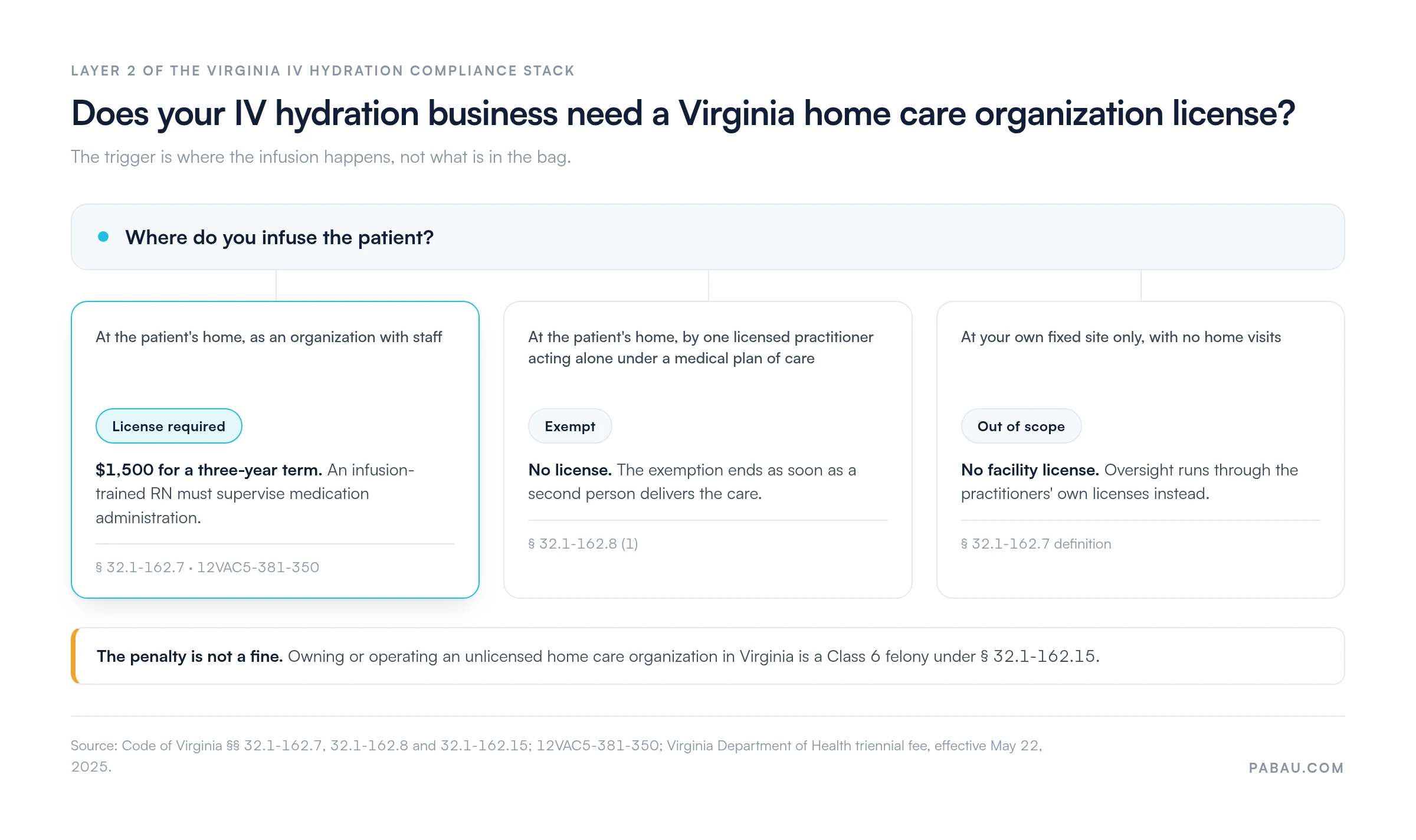
The penalty for skipping the license is criminal. Owning, establishing, conducting, maintaining, managing or operating an unlicensed home care organization is a Class 6 felony under § 32.1-162.15. The Commissioner can also ask the Attorney General to seek an injunction closing the operation down.
The regulation behind the license sets the operating condition. Under 12VAC5-381-350, a licensed organization must employ a registered nurse who has completed training in infusion therapy to supervise medication administration by staff. Home attendants may administer self-administered drugs only, and other medications need a licensed nurse or physician assistant.
Virginia issues no separate IV therapy business license, which is why a search for one comes up empty. The home care organization license is the license, and only for home-based service. A fixed-site drip lounge that never visits a home falls outside the home care article entirely.
Virginia does not license practitioner offices, so oversight at a fixed site runs through the practitioners’ own licenses instead. Mobile service is where the licensing question bites hardest. Our guide to running a mobile IV therapy business covers the operational side of that choice.
Registered nurses, nurse practitioners, physicians and physician assistants may administer IV vitamin therapy in Virginia, and unlicensed staff generally may not. Every one of those routes still runs through a practitioner’s order.
Section 54.1-2901(4) is the provision that makes nursing administration lawful. It exempts registered professional nurses, advanced practice registered nurses and other properly trained technical personnel from the medical licensure requirement. The exemption applies when they render care under the orders of a person licensed to practice medicine.
The medical assistant row is the one that trips up new owners. Whether an unlicensed employee may start an IV depends on who is delegating, not on the job title printed on the badge.
A physician has a statutory route. Section 54.1-2901(4) covers properly trained technical personnel working under a physician’s orders, and § 54.1-2901(6) lets a licensed practitioner delegate nondiscretionary functions to supervised personnel. A nurse has no equivalent route, because 18VAC90-19-280(B) bars nurses from assigning medication administration to unlicensed staff.
Practically, that means a nurse-run drip service cannot hand the cannula to an assistant, even a well-trained one. State rules on this diverge sharply, and our national guide to administering IV vitamin therapy compares them side by side.
Under the Virginia nurse practice act, a nurse may not delegate medication administration to unlicensed staff except as the Drug Control Act permits. That single rule shapes the staffing plan of every nurse-led IV hydration business in the state.
The Board of Nursing sets it out in 18VAC90-19-280(B), which names six categories of nursing work that may not be assigned to unlicensed personnel:
The permission that rule points at sits in § 54.1-3408. A prescriber may cause drugs to be administered by a nurse, a physician assistant or an intern under the prescriber’s direction and supervision. The same section also allows administration by someone who has completed a Board of Nursing-approved training program and follows the prescriber’s instructions.
Licensed practical nurses sit inside the act rather than outside it. Section 54.1-3000 defines practical nursing as selected nursing acts performed under the direction of a licensed medical practitioner or a professional nurse. An LPN infusion service therefore needs a supervising RN or practitioner in the structure, not just on paper.
The nurse practitioner route has a threshold worth planning around. Section 54.1-2957 requires a written or electronic practice agreement with a patient care team physician. Subsection I lifts that requirement after the equivalent of at least three years of full-time clinical experience, attested by the collaborating physician.
Clinical experience for that count means postgraduate care delivered under a practice agreement, so the clock starts after licensure. A newly licensed nurse practitioner cannot be the whole oversight layer on opening day. Section 54.1-2957.01 governs prescribing authority and ties it to the same set of requirements.
Virginia requires no statewide IV certification for an individual nurse, but a licensed home care organization must employ an infusion-trained registered nurse. The requirement attaches to the business rather than to the person.
12VAC5-381-350 spells it out. The organization must employ a registered nurse who has completed training in infusion therapy. That nurse also needs the knowledge, skills and competencies to administer infusion therapy safely, and then supervises medication administration by staff.
The same regulation asks for three more things around that person:
None of that is a separate application step. Those items are conditions of holding the license. An inspector can ask for the training records and the competency assessments at any point across the three-year term.
In practices we onboard, the document that has gone missing is almost never the license certificate. It is the infusion-therapy training record for a nurse who left two years ago. The practice cannot produce that record for the visits the nurse supervised.
Practice management software like Pabau holds the four layers as records rather than as a folder in a cabinet. Pabau’s staff profiles carry each nurse’s license and infusion-therapy training, each with an expiry date attached. A lapsed certificate surfaces before an inspector asks for it.
The oversight paperwork behaves the same way. The medical director’s signed arrangement, the practitioner’s order, the consent form and the treatment note all sit on one patient timeline. Producing the chain for a single visit becomes a search rather than an afternoon with a filing cabinet.
Pabau’s longevity clinic software covers the same ground for functional and infusion practices generally. Choosing between platforms is its own piece of work. Our ranking of the best EMR for IV therapy compares the options built for infusion services.

Pabau stores each nurse’s infusion-therapy training and its expiry date, the practitioner’s order, the consent form and the treatment note against one patient record. Producing an inspection trail becomes a search instead of a hunt.

Work the Virginia IV hydration compliance stack from the bottom. Structure first, because it decides what the entity may lawfully do. Then the license, then the oversight arrangement, then the staffing plan.
The order matters because the layers do not stand alone. An infusion-trained nurse cannot rescue a business that never applied for its home care organization license. A flawless license file cannot rescue an unlicensed practitioner writing the orders.
The trade-off worth carrying away is reach against burden. A fixed-site lounge skips layer two and keeps the licensing load light. Home visits open a far larger market in northern Virginia, and a Class 6 felony if the paperwork is wrong.
Book a demo to see how Pabau keeps the licenses, training records and infusion orders for a Virginia IV practice on one timeline.

Operating across state lines? IV hydration business requirements Georgia sets out the licensing and oversight rules a Georgia location answers to instead.
Comparing a second market? Ohio IV hydration business requirements covers the pharmacy and compounding rules Ohio adds on top of the nursing scope question.
Want a third comparison point? IV hydration business requirements in Arizona explains the good faith exam and the health care institution license Arizona expects.
Ready to map the whole launch? How to open an IV therapy clinic walks the build-out, equipment and hiring sequence beneath these requirements.
Need the intake paperwork? IV therapy patient intake template gives you the history, screening and consent fields an inspector expects on file.
Yes. Virginia has no corporate practice of medicine statute barring a registered nurse from owning the business. An RN would form an ordinary LLC rather than a professional corporation, because registered nurses are not among the professions § 13.1-543 names. A licensed practitioner still has to direct the medical care and stand behind every infusion order.
Yes, because ownership and administration are separate questions in Virginia. An LPN may own the entity outright. Whether that LPN can start the IV is decided by § 54.1-3000. That section limits practical nursing to selected acts, performed under the direction of a registered nurse or a licensed practitioner. So who can administer IV vitamin therapy inside the business follows the staffing plan, not the ownership.
Yes, and a nurse practitioner has the widest route of any non-physician owner. Under the Virginia nurse practice act, § 54.1-2957 requires a written or electronic practice agreement with a patient care team physician. Subsection I lifts that requirement after the equivalent of at least three years of full-time clinical experience. Before that threshold, the practice agreement is the oversight layer.
Only under a physician’s own direction, and never on a nurse’s delegation. Section 54.1-2901(4) covers properly trained technical personnel acting under the orders of a person licensed to practice medicine. Separately, 18VAC90-19-280(B) bars nurses from assigning medication administration to unlicensed staff. A business holding a home care organization license Virginia issues will have the supervising registered nurse administer instead.
In Virginia, no state IV certification exists for an individual nurse. The requirement attaches to the business instead. Under 12VAC5-381-350, a licensed home care organization must employ a registered nurse who has completed training in infusion therapy. That nurse supervises medication administration and runs the periodic staff competency assessments.