Ethical consent form: free template and what to add
An ethical consent form is a written record that a patient or participant agreed...

3
Last Updated: Oct 26, 2026

Georgia issues no license called an IV hydration business license, so compliance rests on ownership structure, individual licensure and a documented physician relationship.
Georgia repealed its standalone corporate practice of medicine statute in 1982, but the Professional Corporation Act still limits medical PC shareholders to licensed physicians.
The Georgia Composite Medical Board’s May 7, 2026 position statement bans the matchmaker medical director model, where an APRN pays a platform for supervision.
The Georgia Board of Nursing bans standing orders, so every patient needs an individualized order and a completed history and physical first.
A nurse protocol agreement reaches the GCMB within 30 days of signing, and one physician may hold four agreements at a time.
IV hydration business requirements Georgia enforces come down to three rules, not one license. No state agency issues an IV hydration business license. Georgia regulates who owns the clinical entity, who writes the order, and who administers the drip.
The newest of those rules is only months old. On May 7, 2026 the Georgia Composite Medical Board published its IV Hydration/Therapy Position Statement, which treats IV therapy as the practice of medicine. The statement closed off the workaround a lot of new owners had been sold: the matchmaker medical director.
Reaction was loud enough that the Board published a second statement on June 5, 2026. That follow-up told owners the Board was not asking anyone to close and was not terminating active protocols.
Each section below sorts the IV hydration business requirements by the rule that governs it. One test cuts through most of the ownership questions: ask which direction the money flows between the APRN and the physician. Call that the payment-direction test.
Two state boards regulate Georgia IV hydration businesses: the Georgia Composite Medical Board for physicians and PAs, the Georgia Board of Nursing for nurses.
Neither board licenses the business. Each licenses people, then judges the arrangement those people work inside. The table below splits the jurisdiction by the question each board actually answers when a complaint arrives.
Both boards have written to IV hydration specifically. The Georgia Board of Nursing issued its IV Hydration Position Statement on April 1, 2024. The GCMB followed on May 7, 2026. An IV business has to satisfy both, and the two documents do not cover the same ground.
Only a Georgia-licensed physician can hold shares in the professional corporation that provides IV hydration, because Georgia’s Professional Corporation Act limits shareholders to licensed practitioners.
That answer surprises owners arriving from a state with an explicit corporate practice of medicine law, because Georgia does not have one. The old prohibition, former O.C.G.A. §43-34-37, was repealed in 1982 and never replaced. Health care attorneys in the state note the GCMB has never disciplined a licensee for corporate practice of medicine.
The practical result still lands close to a CPOM state. Under O.C.G.A. §43-34-22, only a physician licensed by the GCMB may prescribe treatment or hold themselves out as treating disease. So a professional corporation formed to deliver physician-level care can only be owned by people who hold that license. A registered nurse, an LPN, a phlebotomist or an outside investor cannot be a shareholder in it.
Fee splitting is the second half of the ownership question. The Medical Practice Act’s unprofessional conduct provision, O.C.G.A. §43-34-8, lets the Board discipline a physician for dividing professional fees for patient referrals and for aiding unlicensed practice.
So a management fee has to be a fee, never a share of treatment revenue. State rules differ sharply on this point, and Arizona’s IV hydration rules take a different route to a similar place.
A nurse practitioner cannot own the medical corporation billing for physician-level IV hydration, but can run the clinical operation under a filed nurse protocol agreement.
The nurse protocol agreement framework sits in O.C.G.A. §43-34-25 and GCMB Rule 360-32. A delegating physician and an APRN sign the agreement, which names the drugs or drug classes the APRN may order. The GCMB must receive it within 30 days of execution, along with a $150 fee. Amendments follow the same 30-day clock.
The ratio limits are strict. One physician may hold nurse protocol agreements with no more than four APRNs at a time. At a location that maintains evidence-based clinical practice guidelines and holds accreditation the Board approves, that rises to eight agreements. Even then the physician may supervise no more than four APRNs at once.
The May 2026 GCMB position statement named the arrangement it will not accept. Say an APRN pays a third-party company for access to a delegating physician. If that company then compensates the physician to supervise the APRN, the Board treats the arrangement as prohibited.
That arrangement is the matchmaker medical director model, and most turnkey IV hydration company packages were built on it. The Board also said it judges substance rather than form. Routing the same money through a staffing firm or a management company does not fix the structure underneath.
Which gives a single question worth asking before signing anything. Does money flow down from the physician-owned entity to the APRN, or up from the APRN to the physician? Downward is the chain of authority working as written. Upward is the payment-direction test failing, whatever the contract calls the parties.
The Board’s June 5, 2026 statement is worth reading alongside it. The GCMB said the position statement created no new law and only restated a longstanding interpretation. The Board also confirmed it was terminating no active protocols and advising nobody to close.
A non-physician can legally run the business side through a management services organization, or MSO, sometimes called the friendly-PC model. The MSO takes marketing, billing, HR, equipment and the lease.
The physician-owned PC or PLLC keeps every clinical decision, including who is hired to administer treatment and how they are supervised.
The MSO’s fee is where this structure usually breaks. A flat fee or a fair-market-value fee for services actually delivered is defensible. A percentage of treatment revenue reads as a division of professional fees under §43-34-8, no matter how the management agreement is worded.
Georgia issues no IV hydration business license, so you license the people instead: the ordering physician, the APRN or PA, and every nurse who administers.
Searching for an IV hydration business license turns up nothing at the Secretary of State because the requirement is distributed across roles. Here is what each role has to hold before a first appointment.
That last item catches people out. Any compounded IV solution has to come from a 503A compounding pharmacy or a 503B outsourcing facility registered with the FDA. Buying bags from an unregistered compounder is a licensing failure on its own, entirely separate from the staffing rules above it.
Read together, those roles form a chain. Each link only carries authority it received from the link above, which is the structure the diagram below sets out.
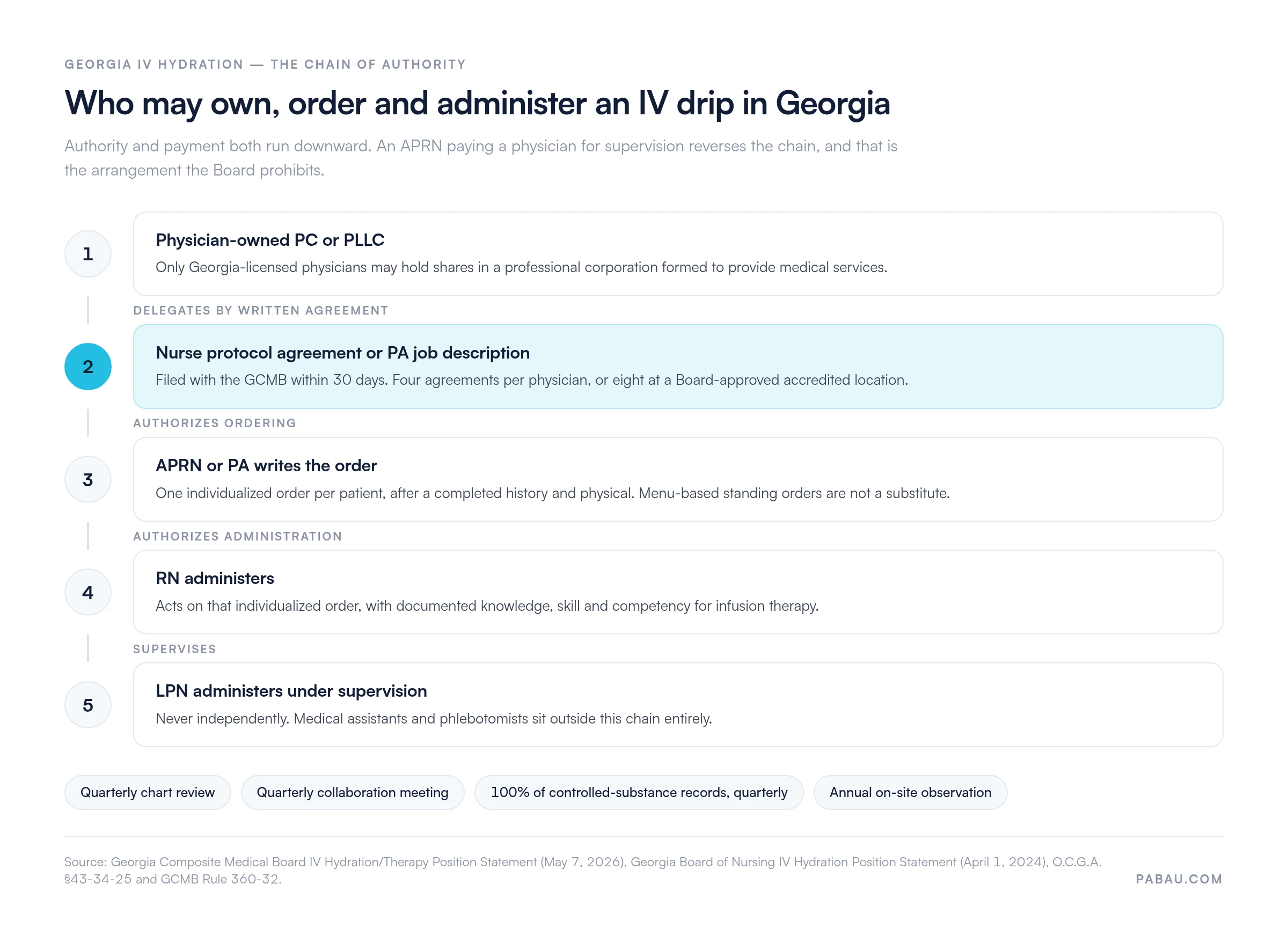
A Georgia IV hydration medical director must be an actively licensed physician who documents ongoing oversight, not a name on a filed agreement.
GCMB Rule 360-32-.05 sets the cadence, and it is more specific than most owners expect. The delegating physician has four recurring duties on top of signing the protocol.
The 2026 position statement adds a public disclosure duty. An APRN or PA has to make the delegating or supervising physician’s name and contact information available to the public without restriction. A poster in a treatment room a patient never enters does not meet that standard.
Compensation is the part worth getting a lawyer for. A medical director for IV hydration business compliance should be paid at fair market value by the employing entity. Payment from the APRN they oversee is the arrangement to avoid. The direction of that payment is what the Board looks at first.
In practices we onboard, the document that fails a review is almost never the protocol itself. The missing piece is the quarterly chart review nobody wrote down, because the physician did the reading and closed the chart without logging it.
A registered nurse can administer IV hydration in Georgia on an individualized order, after a physician, APRN or PA completes a history and physical.
The Georgia Board of Nursing’s April 2024 position statement is blunt about the alternative. Standing orders are not an appropriate substitute for an individualized order and a completed history and physical. The Board repeats that point several times in a two-page document, which tells you what it was seeing in the field.
The GCMB reinforced the same rule in 2026 by rejecting menu-based ordering. A patient choosing a drip off a laminated menu is not a patient who has been assessed. Our guide to administering IV vitamin therapy works through how that assessment fits a walk-in schedule.
An LPN can administer IV hydration too, but only under supervision from an RN, physician, APRN or PA. Independent administration by an LPN is outside the Nurse Practice Act’s Article 2 scope.
Medical assistants cannot start IVs in Georgia, because a medical assistant holds no nursing or prescribing license. A phlebotomist cannot start an IV either. Phlebotomy training covers venipuncture for blood collection, which is a different procedure from establishing and monitoring an infusion.
Every location that offers IV hydration services also needs written policies and procedures kept on site. Those cover administration, nutrient therapies, medications and emergency response.
A mobile IV hydration business follows the same seven steps as a fixed site, with two extras at the end. Nothing about treating a patient in a hotel room relaxes the ordering or supervision rules.
Two things change once you travel. Insurance has to cover treatment away from a fixed premises, so check the malpractice policy names off-site visits. And public disclosure of the supervising physician follows the service rather than the building, which usually means the booking page carries it.
The operational side of running a mobile IV therapy business deserves its own read, from routing to consent capture on a tablet.
Practice management software like Pabau gives a Georgia IV therapy business one place for staff credentials. Each provider’s license number, protocol agreement and renewal date sits on their own profile. A manager can confirm an APRN’s nurse protocol agreement is still current before a booking is accepted, rather than after a complaint.
The same record ties each treatment to its individualized order, its consent form and the administering nurse’s notes on one patient timeline. That timeline is what a GCMB investigator or a malpractice attorney asks for first. Assembling it from a paper diary and a phone camera roll takes days. Keeping it in one HIPAA-compliant record takes none.
Recurring oversight is the part software actually rescues. Quarterly chart review and the annual on-site observation can be scheduled as recurring tasks with a note attached. The evidence then exists at the moment the Board asks for it.
Pabau sits in the same family as our software for longevity practices, so drip clinics, functional medicine and wellness services run on one system.
Still choosing a platform? Our comparison of the best EMR for IV therapy works through what a drip clinic needs from clinical records.

Pabau stores staff licenses, nurse protocol agreements and renewal dates on one profile, and ties every individualized order and consent form to the patient timeline. Your oversight records are ready when the Board asks.

Get the ownership structure and the physician relationship right before you buy a single IV bag. Those two decisions set the ceiling on what the business can legally do, and both are expensive to unwind once patients are booked.
The May 2026 position statement exists because enough Georgia operators bought a supervision package instead of building a chain of authority. The payment-direction test is the cheapest way to tell which one you have.
Where a protocol, an MSO agreement or a scope question is genuinely unclear, a Georgia health care attorney is the right call. An hour of review costs a fraction of a Board investigation. Book a demo to see how Pabau keeps licenses, protocols and treatment records audit-ready in one system.

Planning the whole launch, not just the paperwork? How to open an IV therapy clinic covers the build, the equipment and the first hires.
Still working out who may run the line? Who can administer IV vitamin therapy sets out the scope of practice question role by role.
Need the assessment on paper before the drip? Our IV therapy patient intake form captures the history a Georgia individualized order depends on.
Only a Georgia-licensed physician can hold shares in the professional corporation that delivers physician-level IV hydration. A non-physician IV hydration business owner can own the management company that handles marketing, billing and the lease instead.
An RN can start an IV hydration business in Georgia only on the non-clinical side, through a management company. A registered nurse cannot hold equity in the professional corporation that bills for physician-level treatment.
An NP can start an IV hydration business in Georgia and run its clinical operation under a nurse protocol agreement filed with the GCMB. The nurse practitioner cannot own the medical professional corporation itself.
No LPN can start an IV hydration business in Georgia as the clinical owner. A licensed practical nurse may only administer IV hydration under supervision by an RN, physician, APRN or PA.
Yes. Delivering IV hydration services requires an active RN or LPN license. The nurse also needs an individualized order from a physician, APRN or PA who completed a history and physical. Medical assistants and phlebotomists do not qualify.
An IV hydration business in Georgia can be profitable, though compliance shapes the margin more than the drip menu does. Any IV hydration business model in Georgia carries physician compensation, protocol filing fees, registered pharmacy sourcing and malpractice cover before the first patient.