OSHA respirator medical evaluation questionnaire
The OSHA respirator medical evaluation questionnaire is the mandatory health for...

3
Last Updated: Oct 15, 2026

South Carolina treats running an IV hydration business as the practice of medicine under § 40-47-20(36).
The business must employ a physician, PA, or APRN holding exclusive authority to diagnose, treat, and prescribe.
Registered nurses may administer on a valid patient-specific order, and licensed practical nurses may not take part.
A Board of Pharmacy permit applies once you store legend medications, unless an Authorized Provider owns the entity outright.
The scope grid below sorts eight roles against prescribing, administering, and owning, with the authority behind each.
The IV hydration business requirements in South Carolina start with one word, and that word is exclusive. A physician, PA, or APRN has to hold sole authority to diagnose, treat, and prescribe inside the business. Equity is a separate question.
South Carolina has no stand-alone IV hydration statute. The rules live in a joint advisory opinion from the Boards of Medical Examiners, Pharmacy, and Nursing, dated August 15, 2023. Several state-by-state roundups get this wrong, and one contradicts the Boards on who may start an IV.
Below, we sort ownership, staffing, the pharmacy permit, and the paperwork by the body that decides each one.
Retail IV therapy in South Carolina answers to three licensing boards at once. The Boards of Medical Examiners, Pharmacy, and Nursing issued a single joint advisory opinion. No stand-alone IV hydration statute exists.
All three boards sit inside the South Carolina Department of Labor, Licensing and Regulation, known as LLR. LLR publishes the document as the Joint Position Statement on Retail IV Therapy, dated August 15, 2023.
Each board owns a different piece of the answer. Medical Examiners decides who may diagnose and prescribe, under the Medical Practice Act. Nursing decides what an RN or an LPN may do. Pharmacy decides when holding medications needs a permit.
Read all three together or the answer comes out wrong. A nurse’s scope allows administration. The Medical Practice Act decides whether the order behind it was valid. Answer one board and you have answered a third of the question.
Each state sets its own requirements, so a second location re-answers every question here from scratch. The Arizona IV hydration requirements settle the same questions under a different rulebook.
Anyone may hold equity in an IV hydration business here. South Carolina restricts clinical control instead of ownership. The entity has to employ a physician, PA, or APRN. That provider holds exclusive authority to diagnose, treat, and prescribe.
Two sections of the Medical Practice Act do the work. Section 40-47-20(36) makes operating an IV therapy business the practice of medicine. Then § 40-47-200 makes it unlawful practice without that provider in place.
The word carrying the weight is exclusive. A provider who shares clinical judgment with an investor or a manager fails the test.
Some state-by-state guides shorten this to one line. Anyone can own one in South Carolina, they say, provided the regulations are followed. That shorthand hides the constraint that shapes the cap table.
The corporate practice of medicine doctrine, or CPOM, is the framework this sits inside. Most states bar corporations and non-physicians from practicing medicine. South Carolina’s hook is the exclusive-authority requirement in § 40-47-200 rather than a separate CPOM statute.
Separating equity from clinical judgment answers the question nurses ask first. Can an RN start an IV hydration business in South Carolina? Yes on the equity, no on the orders. An Authorized Provider has to be contracted or employed before the doors open.
Management services organizations, or MSOs, are the usual route where a non-clinician wants the business side. One South Carolina health law firm reports extra scrutiny from the Board of Pharmacy on these structures.
The board looks closely at who holds practitioner control. A physician who is owner in name only can draw a permit requirement.
Physicians, PAs, and APRNs may prescribe an infusion. Registered nurses may administer one on a valid patient-specific order. LPNs, EMTs, and paramedics may not take part.
The table below is the South Carolina IV Therapy Scope Grid. Every row traces to the Boards’ joint advisory opinion or to a statute it cites. Check a staffing plan against it line by line.
Read down the last column and the shape of the rule shows up. One document decides all three permissions, and the diagram below traces the branch each role lands on.
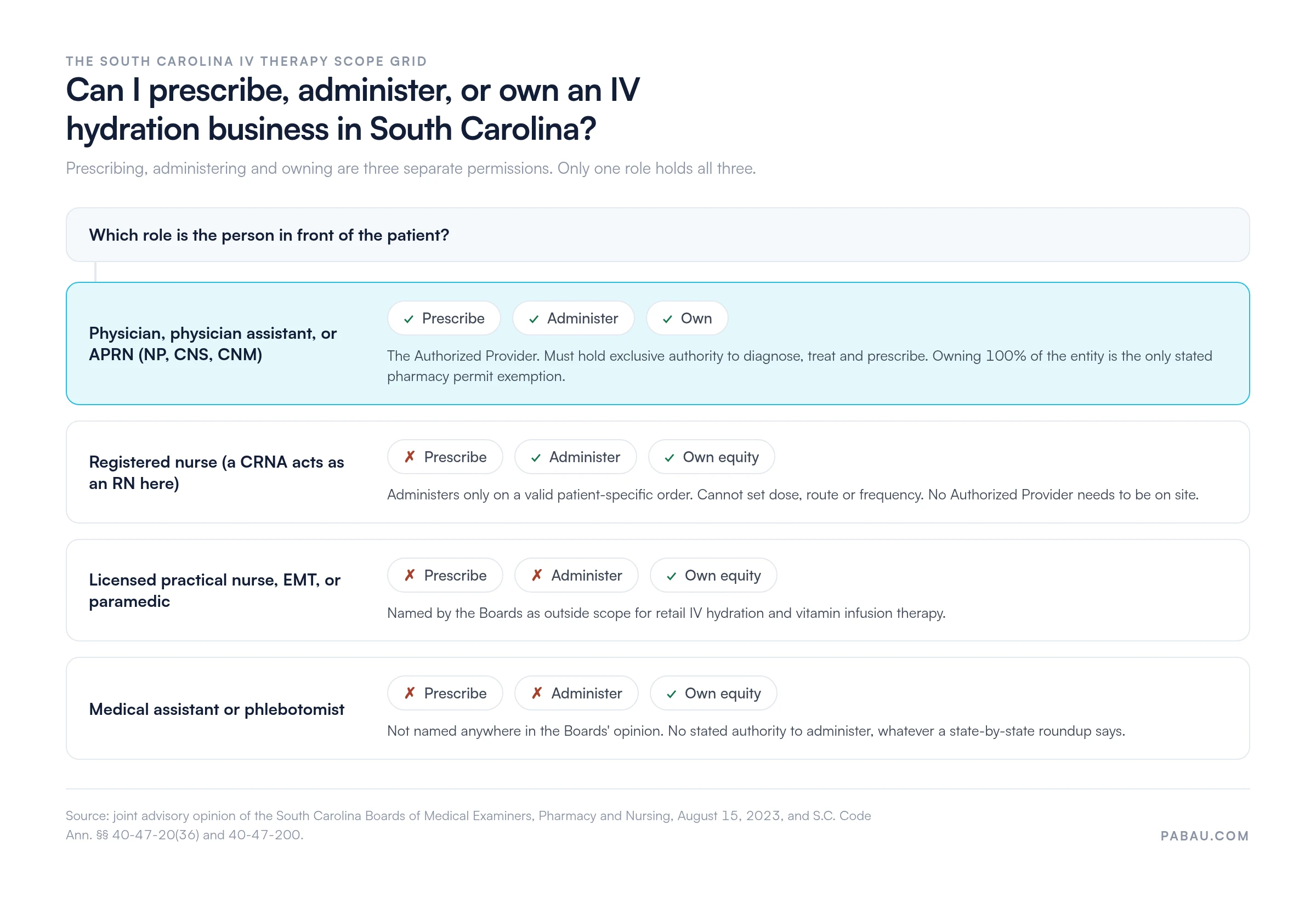
Three questions come up constantly, and the published roundups answer two of them wrong:
The nursing rule has two halves worth separating. An RN may administer fluids, vitamins, and medications on a valid patient-specific order. Setting the dose, the route, or the frequency belongs to the Authorized Provider alone.
No Authorized Provider has to be physically on site while the RN administers. The nurse does have to be competent to monitor that patient. That is a hiring and training standard rather than a paperwork one.
Who may administer IV vitamin therapy follows a similar shape in most states. What changes across borders is which roles get named, and which get excluded by silence.
South Carolina law never uses the term medical director. The state requires an Authorized Provider who personally forms a practitioner-patient relationship before any infusion is prescribed.
The terminology mismatch is worth naming. A medical director is what consultants sell, and what several other states require by name. South Carolina says Authorized Provider instead, and the duties attached run deeper than a monthly protocol review.
Section 40-47-113 sets out what the relationship requires. The provider personally performs and documents a history and physical exam. A diagnosis and a therapeutic plan follow. Then comes the conversation about risks and benefits, plus follow-up care the patient can reach.
Standing orders do not satisfy that duty, and § 40-47-200 goes further. A physician who signs standing orders for a nurse never forms the relationship. That physician can be aiding and abetting the unlicensed practice of medicine.
The Boards named the exact arrangement they were writing against. A business uses a physician’s NPI number to acquire IV supplies. An RN runs the floor alone. The physician issues standing orders without ever seeing a patient. That pattern is the one the joint opinion calls unacceptable.
Telemedicine can carry the evaluation. Section 40-47-37 lets a telemedicine encounter establish the practitioner-patient relationship. The same standard of care applies as in an in-person visit.
One boundary is hard. Section 40-47-37(C)(1)(b) bars Schedule II narcotic and Schedule III narcotic prescriptions through a telemedicine-only encounter. Non-narcotic Schedule II and Schedule III drugs sit outside that specific bar. A narcotic order needs an in-person visit first.
Read together, those rules explain why the remote-provider model works here at all. The Authorized Provider can evaluate by video and stay off site while the RN administers. That holds as long as the prescription is not a Schedule II or III narcotic.
A South Carolina Board of Pharmacy permit applies once the business stores or administers legend medications. An entity owned 100% by an Authorized Provider is exempt.
The IV hydration business license question here comes down to a permit. No state license for IV hydration exists as such. What you need turns on what sits on the shelf and who owns the shelf.
Two permits sit behind the answer, both issued by the Board of Pharmacy through LLR. A full Pharmacy Permit applies where compounding happens. The Non-Dispensing Drug Outlet Permit covers a business that holds medications without compounding them.
You likely need a permit if:
You are likely exempt if:
Storage stays at the permitted site. The rules prohibit overnight storage in a home or a vehicle. A mobile IV service usually collides with that one first.
Research for this guide turned up no verified permit fee or processing time from the Board of Pharmacy. Check LLR’s current fee schedule before you budget for either permit.
Most of the pain in this step arrives before the application does. Four choices cause it, and all four are cheap to change on paper:
Settle all four on paper, then file. Reversing any of them afterward means paying twice for the same work.
South Carolina draws a bright line under Title 40, Chapter 43. Pushing medications or vitamins through an IV is not compounding. Putting those same medications into an IV bag is compounding.
Sit that line next to the sterile compounding standard and the result sharpens. USP General Chapter <797> is the enforceable standard for sterile compounding, adopted by the FDA. The joint opinion states that the immediate use exception does not cover walk-in or concierge IV businesses.
Put both rules together and the treatment menu becomes a licensing decision. Draw a vitamin into a bag and the business is compounding. The joint opinion has already closed the immediate use shortcut to that business by name.
A service that pushes additives directly stays on the near side of the compounding line. Mix bags on site and you land on the far side, with USP <797> attached to every preparation.
Three documentation duties land on a South Carolina IV hydration business, and each has a named source. Different rules govern the relationship, the consent, and the retention period.
The relationship duty comes first. Section 40-47-113 requires the Authorized Provider to personally perform and document the history and exam. The same section requires a diagnosis and a therapeutic plan for that patient.
You obtain and document informed consent before care starts. The joint opinion sets out five elements the consent record has to cover:
Retention runs from the date of last treatment under § 44-115-120. That is the South Carolina Physicians’ Patient Records Act. Hold adult records for 10 years. Records for a patient treated as a minor run 13 years.
In practices we onboard, the order, the consent, and the treatment note usually start out in three different places. Usually the consent is a photograph of a paper form. The order lives in a text thread, and the note gets typed up after close.
Pulling those three onto one patient record is the core job of longevity clinic software. A 13-year retention duty is survivable when the record is one file. It gets painful when the record is three systems and a camera roll.
Secure an Authorized Provider before you sign a lease. South Carolina’s clinical requirements decide your entity structure, your permit track, and your staffing plan.
Starting an IV hydration business here is a sequencing problem before it is a capital problem. Most launch guides put entity formation at step one. That commits you to an ownership split before you know whether the permit exemption is available.
That order is obligatory rather than arbitrary. Steps one and two decide step four, and step four reopens step three if you get it backwards.
Take a hypothetical solo RN planning a mobile IV hydration company around Charleston. The sequence is not the one a standard business plan template produces.
She contracts a South Carolina physician as the Authorized Provider first. The written agreement gives the physician exclusive authority over diagnosis and prescribing. Because she holds the equity, the 100% ownership exemption is unavailable, so a pharmacy permit sits on the critical path.
Only then does the entity filing make sense. The permit application needs the entity to exist and the ownership settled.
The physician evaluates each patient, by video where the medication schedule allows, and issues a patient-specific order. She administers on that order, with no requirement that the physician be on site.
The medications stay at the permitted site rather than traveling home overnight. That storage rule turns a mobile plan into a fixed base with outbound visits.
The core licensing questions are identical for a storefront and a van. Our guide to the mobile IV therapy business covers the operational differences on top of them.
Whichever model you pick, the record system has to hold the order, the consent, and the note together for a decade. Judging an EMR for IV therapy against that duty beats judging it on a feature list.
Profitability here turns on the compliance structure more than on the marketing. The Authorized Provider relationship and the permit track set your fixed costs. Both land before the first patient books.
No credible published margin exists for a South Carolina IV hydration business. Any figure quoted without a source is somebody’s guess. What is documented is the downside.
Unlicensed practice of medicine is a misdemeanor in South Carolina. Sections 40-1-200 and 40-47-200 carry up to one year of imprisonment. The fine runs as high as $50,000, and a licensee separately risks probation, suspension, or revocation.
That $50,000 exposure belongs in the business plan next to the rent. A structure built to avoid paying an Authorized Provider looks cheaper every month. It also puts the whole business on the wrong side of a misdemeanor statute.
The cost owners underestimate is the retrofit. Restructuring ownership after a permit question lands means paying twice for work that was cheap the first time. Unwinding standing orders into patient-specific ones after a complaint costs the same way.
Enforcement here tends to be reactive rather than scheduled, according to a health law firm practicing in the state. The risk is complaint-shaped, so it arrives on the day one patient is unhappy.
Every requirement above ends as a record somebody has to produce on request. Practice management software like Pabau keeps the order, the consent, and the treatment note on one patient file.
Pabau’s digital forms hold the five consent elements as named fields rather than a scanned image. The record then shows which element is missing before treatment starts. Both the provider’s order and the nurse’s administration note sit on one timeline.
Pabau’s telehealth appointments let the provider run the evaluation remotely where the medication schedule allows. The resulting note lands on that patient’s record, so no one re-keys a video call into a separate chart.
Retention runs 10 years. A record split across a filing cabinet, a phone camera roll, and a spreadsheet is slow to produce. Keeping each element on one patient file turns a records request into a search.

Pabau ties the Authorized Provider’s order, the five documented consent elements, and the nurse’s administration note to one patient record. Producing a decade of documentation stops meaning a hunt through three separate systems.

South Carolina’s rules collapse into one sentence. An Authorized Provider must hold exclusive clinical control, however the ownership is structured.
If you are still choosing a structure, choose the provider relationship first and let the entity follow. That order costs less. It is also the order the Boards read a business in when a complaint lands.
The trade-off worth remembering is timing. Every requirement here is cheap to satisfy before a lease and expensive to unwind afterward.
Book a demo to see how Pabau holds consent, provider orders, and treatment notes on one South Carolina patient record.

Comparing a second state? IV hydration business requirements Georgia sets out the licensing and oversight rules a Georgia location answers to instead.
Weighing a third market? Ohio IV hydration business requirements covers the pharmacy and compounding rules Ohio layers on top of the nursing scope question.
Ready to map the whole launch? How to open an IV therapy clinic walks the build-out, equipment and hiring sequence that sits beneath these requirements.
Need the intake paperwork? IV therapy patient intake template gives you the history, screening and consent fields the Boards expect on file.
Open and want to tighten operations? IV therapy clinic best practices covers the protocols, monitoring and follow-up habits that keep a busy infusion floor safe.
Usually yes. South Carolina issues no statewide general business license, so the requirement sits with the city or county where you operate. Charleston, Columbia, and Greenville each run their own. Check the municipality before you sign a lease, because a mobile service may owe a license in every jurisdiction it visits.
Only with a South Carolina medical license. The Authorized Provider practices medicine on a patient located in this state, so the Board of Medical Examiners has to license that practitioner. Telemedicine does not change it. A remote provider still needs South Carolina licensure before the first evaluation.
Yes, if you run the test yourself. CLIA is federal and administered by CMS, and even waived tests need a Certificate of Waiver. Sending the sample to an outside lab keeps the testing on that lab’s certificate instead. Decide which route you want before you buy an analyzer.
You can sell them, and the clinical duty does not bend. Section 40-47-113 still requires an Authorized Provider to evaluate and prescribe. A package therefore buys sessions, never a guaranteed infusion. Write the terms so a declined treatment is refundable or bankable.
South Carolina sets no interval. The duty attaches to the order, so an infusion outside the documented therapeutic plan needs a fresh evaluation. Repeat visits inside that plan can run on it. Record the plan’s scope and end date so the nurse knows where it stops.