

CCSD code G5100: Bypass of duodenum billing guide
CCSD code G5100 bills a bypass that leaves the duodenum in place CCSD code G5100...

Last Updated: Oct 16, 2026
94664 is the CPT code for demonstration and/or evaluation of patient utilization of an inhalation device. That covers an aerosol generator, a nebulizer, a metered-dose inhaler, or an IPPB device. The code pays for the instruction and the technique check. The treatment delivered through the device is billed with CPT 94640.
Denials on this code trace back to two recurring errors. The first is billing it on the same date as CPT 94640 without modifier 59. The second is thin documentation of what was demonstrated and assessed during the encounter.
Let Pabau's smart automation suggest the right codes, reduce claim denials, and keep your practice compliant—effortlessly.
Automate repetitive tasks and focus on what matters most—your patients.
Reduce coding errors and ensure compliance with the latest regulations.
Clean claims, fewer denials, and faster reimbursements.
Powerful insights and reporting to help your practice thrive.
HIPAA compliant SOC 2 certified GDPR-compliant Trusted by 4,000+ clinics worldwide

CPT 94664 covers inhaler and nebulizer instruction and technique evaluation, not the inhalation treatment itself.
94664 bundles into 94640 under NCCI edits on the same date, and modifier 59 unbundles it only when the instruction is clinically distinct.
Modifier 25 goes on the same-day E&M code, which must be a significant, separately identifiable service.
Medicare usually pays 94664 once per beneficiary for the same provider or group, with repeats for justified circumstances.
Practice management software like Pabau tracks NCCI edits and modifier requirements to reduce 94664 denials before submission.
CPT Code 94664 is the American Medical Association’s procedure code for inhaler and nebulizer technique instruction. Its official descriptor covers demonstration and/or evaluation of patient utilization of an aerosol generator, nebulizer, metered-dose inhaler or intermittent positive pressure breathing (IPPB) device.
The code sits in the Pulmonary Diagnostic Testing and Therapies section of CPT, code range 94010-94799, under therapy and patient instruction. Payment turns on which activities the note describes and whether 94640 was billed on the same date.
The descriptor covers two clinical activities. Demonstration means showing the patient how to use the device, and evaluation means assessing whether the patient uses it correctly. A visit that only demonstrates technique still qualifies, and so does one that only assesses competency. Performing both in one encounter does not create a second billable unit.
Three neighboring services fall outside 94664 and carry their own codes.
Billing one of these alongside 94664 when only a single service took place is a common audit trigger.
Where the pulse oximetry runs overnight rather than as a single determination, the code is 94762 instead. That code requires at least six continuous hours of recording, plus a reported 8-hour mean and 4% desaturation index.
Every 94664 claim requires a supporting ICD-10 diagnosis code that establishes medical necessity. The Centers for Medicare and Medicaid Services (CMS) governs this in Article A57225, which covers billing and coding for respiratory care. Payers expect the diagnosis to reflect an active respiratory condition that requires device instruction.
CMS Article A57225 also sets the national baseline for how often 94664 is paid. Medicare usually allows it once per beneficiary for the same provider or group. Extenuating circumstances, such as new equipment, can justify a second session or repeat evaluation.
Individual Medicare Administrative Contractors (MACs) then add Local Coverage Determinations (LCDs) restricting which diagnosis codes qualify. Verify the applicable LCD for your MAC region before submitting. A diagnosis of respiratory failure alone, with no documented device and instruction context, does not meet most payer policies.
Medicare reimbursement for CPT Code 94664 comes from the Medicare Physician Fee Schedule (MPFS). Rates vary by geographic practice cost index (GPCI) and place of service. The MPFS updates annually, so check current rates with the CMS Physician Fee Schedule lookup tool. Figures quoted in a reference guide go stale within the year.
The non-facility rate (office setting, POS 11) is higher than the facility rate (hospital outpatient, POS 22). In a facility setting, overhead is reimbursed separately through the facility fee. Billing 94664 with a facility POS code when the service happened in an office is a common error. It reduces the payment rather than triggering a denial.
Practices can submit claims through Claim.MD, Pabau’s integrated US clearinghouse. It processes CMS-1500 and 837P claims to thousands of US payers and flags place-of-service mismatches before submission.
Commercial payer rates for 94664 typically exceed Medicare allowables, so verify the contracted rates in your payer agreements. Some payers require prior authorization for repeat 94664 billing inside the same calendar year, Medicare Advantage plans especially. Confirm eligibility and any prior authorization requirement before the encounter.
Modifier selection is the most technically demanding part of billing CPT Code 94664. Three modifiers come up regularly. Using the wrong one, or omitting a required one, generates automatic denials under National Correct Coding Initiative (NCCI) edits. Each modifier carries its own documentation requirement, set out below.
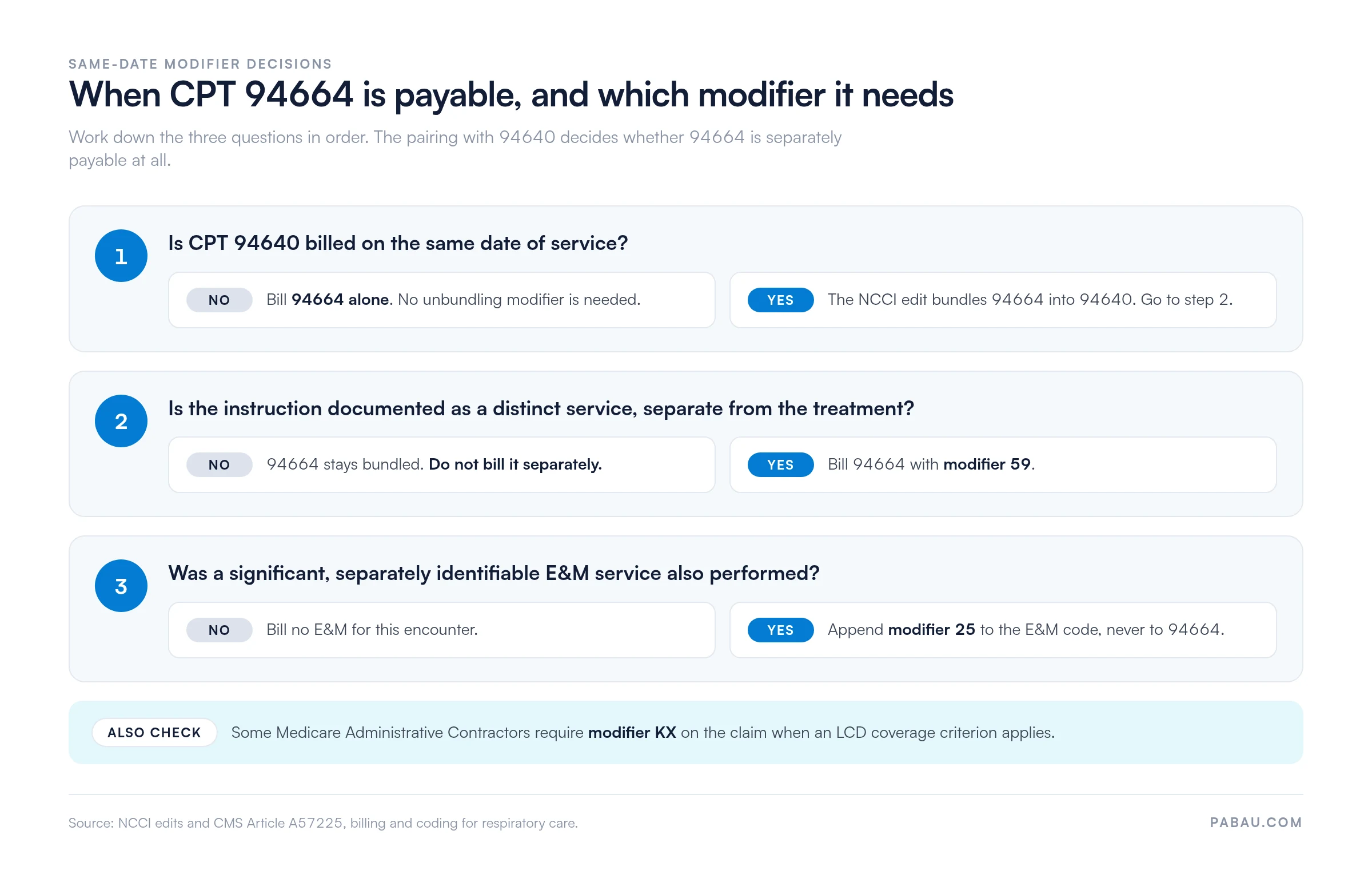
The NCCI edit bundles CPT 94664 into 94640 by default when both codes appear on the same date of service. A patient may receive a nebulizer treatment and inhaler instruction at one encounter. The payer’s edit engine then denies or bundles 94664 unless a modifier overrides the edit.
Modifier 59 can legitimately unbundle these codes when the demonstration or evaluation happens as a distinct service. Picture a patient attending for a scheduled nebulizer treatment. The provider separately checks whether the patient’s at-home MDI technique is correct and gives corrective instruction.
The two activities must be documented as clinically independent. Routine instruction given while setting up or explaining the in-office treatment does not qualify for separate billing. Payers and CMS auditors look for temporal separation in the note. An entry showing when the evaluation happened carries more weight than one woven into the treatment narrative.
The sequence below follows the order a coder works through at the point of billing.
Document the 94664 service in a separate note section with its own time stamp and clinical purpose when billing alongside 94640. A combined note that blends instruction into the treatment narrative gives a payer auditor reason to deny 94664 as incidental to the treatment.
An E&M code may be billed on the same date as CPT Code 94664. The E&M must represent a significant, separately identifiable evaluation and management service. CMS Article A57225 confirms this policy for respiratory care billing. Modifier 25 is appended to the E&M code, never to 94664.
The documentation must show that the E&M service went beyond what the procedure itself required. A provider who performs inhaler instruction and then writes a note covering only the device and technique has not documented a separately identifiable E&M.
The following activities, when documented alongside the instruction service, typically support a modifier 25 E&M.
One denial pattern recurs. A provider performs 94664 and bills a level 3 E&M (99213) with modifier 25. The note then shows an encounter focused almost entirely on device instruction, with no separately documented assessment and plan. Payers reviewing the record rebundle the E&M into the procedure and recover the overpayment.
A clean claim for CPT Code 94664 depends on a medical record that contains every element below. Missing one item gives a payer grounds to request records, or to deny the claim on post-payment audit.
Documentation templates pre-populated with these fields reduce the risk of incomplete records. The American Association for Respiratory Care (AARC) publishes coding guidelines that include documentation checklists for respiratory instruction codes.
Most 94664 denials fall into a small number of predictable categories. Sorting each rejected claim into its category is the first step to fixing the pattern behind it. The table below shows the most frequent denial reasons, the payer rationale behind each, and the prevention action.
Tracking the medical billing denial codes returned on 94664 claims shows whether the pattern is systematic or isolated. A documentation template problem repeats across claims, while a single coding error does not.
Knowing how CPT Code 94664 relates to the wider pulmonary code family helps coders pick the right code for each service. It also keeps upcoding and fragmentation errors off the claim. The AAPC Codify CPT lookup and the AMA CPT code set overview are the authoritative references for this code family.
Run a quarterly audit of 94664 claims that also billed 94640 on the same date, filtering for claims where modifier 59 was absent. If the denial rate on same-date pairs runs above 15%, the inhaler instruction template needs work. Give it a standalone note section that separates the instruction service from the treatment narrative.
In many practices a 94664 bundling problem surfaces only when the remittance arrives. The biller reads the denial code, pulls the note, and finds the instruction blended into the treatment narrative. The claim then gets reworked weeks after the encounter.
Practice management software like Pabau moves that check forward to the point of coding. Cleaner claims management means NCCI edit conflicts and modifier completeness get validated before the claim leaves the practice.
The billing team sees which 94664 claims need modifier 59 and which need a fuller note. Once payment posts, ERA denial reason codes sit against each claim. An appeal then starts from the payer’s own wording rather than a hunt through the record.

Pabau’s claims management software tracks NCCI edits, modifier requirements, and documentation completeness before submission, so 94664 claims reach the payer correctly the first time.

94664 is a small-dollar code with an outsized denial rate, and most of that rate traces to one decision. If 94640 sits on the claim, the note has to show the instruction as its own service, at its own point in the encounter.
Fix the note template first, then the modifier logic. A template that names the device, the technique reviewed, and the patient’s competency gives modifier 59 something to stand on. Without it, a correctly applied modifier still fails on review.
Watch the frequency baseline too. One paid session per beneficiary for the same provider or group is the starting point, so repeat instruction needs its circumstances written down. Book a demo to see how Pabau validates a 94664 claim before it reaches the payer.

Need to understand NCCI bundling edits more broadly? Common denial codes in medical billing covers how NCCI edit denials are structured and how to appeal them effectively.
Submitting 837P claims for respiratory services? 837 file format guide explains the electronic claim file structure required for CMS-1500 equivalent submissions.
Managing revenue cycle for a pulmonary or primary care practice? Revenue cycle management overview covers the end-to-end process from eligibility verification to payment posting.
CPT Code 94664 is the procedure code for demonstrating or evaluating how a patient uses an inhalation device. That covers an aerosol generator, a nebulizer, a metered-dose inhaler, or an IPPB device. It applies when a clinician teaches correct technique, checks existing technique, or both. It does not cover the inhalation treatment itself, which is CPT 94640.
Yes, NCCI edits bundle 94664 into 94640 by default when both are billed on the same date of service. Modifier 59 unbundles them when the instruction is a distinct service, documented separately from the treatment. CMS cautions against routine modifier 59 use to bypass edits without clinical justification.
Physicians and non-physician practitioners who meet Medicare enrollment requirements may bill 94664 directly. Respiratory therapists may bill incident-to under a supervising physician’s NPI. The physician must be present in the office suite during the service. Respiratory therapist billing rights vary by state scope-of-practice law and payer contract, so verify both before billing.
CMS Article A57225 sets a national baseline. Medicare usually pays 94664 once per beneficiary for the same provider or group. Extenuating circumstances, such as new equipment, can justify a second session or repeat evaluation. Individual MAC Local Coverage Determinations may add further limits, so document the clinical justification for each repeat encounter.



