Black box medication list
A black box medication list is a clinical reference of drugs that carry an FDA b...

Last Updated: Oct 14, 2026
The Informed Consent Action Network (ICAN) is a US vaccine-policy advocacy group, not a regulator or a clinical consent standard. Practices that need to document consent still need a form that holds up to scrutiny.
This free template gives you that form. It records the proposed treatment, its benefits, risks, and alternatives, and the patient’s right to withdraw. It closes with signatures from the patient and clinician.
A clinical consent form covering patient details, the proposed procedure, benefits, risks and side effects, alternatives, photography consent, and relevant medical history. It ends with a consent declaration and signature lines for the patient, clinician, and parent or guardian.
Download template
Informed consent is a patient’s voluntary, informed agreement to treatment, built on disclosure of risks and benefits, understanding, free choice, and capacity to decide.
FDA 21 CFR Part 50 sets federal consent requirements for research and clinical investigations, while HIPAA governs patient authorization for using and disclosing health information.
The four core principles are disclosure, comprehension, voluntariness, and competence, and each one should be visible in your consent form.
ICAN is a vaccine-policy advocacy group, so its name carries no clinical or regulatory weight on a consent form.
Pabau, the practice management platform we build, captures consent digitally, stores the e-signature, and files the signed form in the patient record for audits.
An informed consent form records that a patient was told about a proposed treatment, understood its risks and benefits, and agreed voluntarily. It does three jobs:
The clinical concept and the Informed Consent Action Network share a name and little else. ICAN’s positions on vaccine safety are disputed by mainstream medical organizations, and it sets no clinical standard. This template follows FDA, HIPAA, CQC, and professional medical guidance instead.
Every compliant informed consent form should demonstrate four widely recognized elements, consistent with guidance from the HHS Office for Human Research Protections (OHRP). They apply in clinical practice and research alike:
A complete form has mandatory and recommended sections. Use this checklist to audit your current template. If you run research, also check it against FDA 21 CFR Part 50.
Adapting the form to your practice takes five steps:
Informed consent is a legal requirement, but which rule applies depends on where you practice and what you’re doing. Here’s how the main US and English regulators frame it.
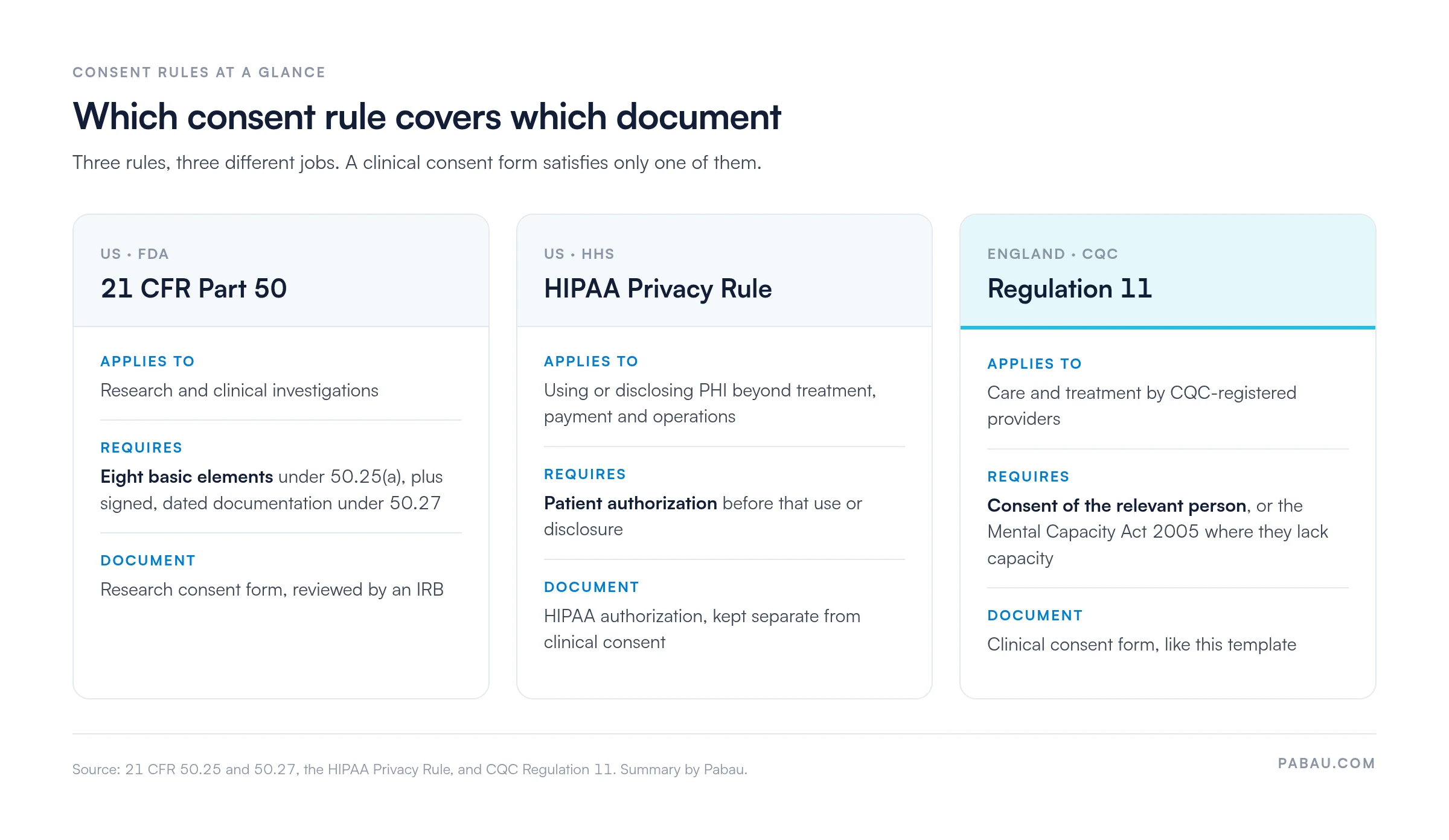
FDA 21 CFR Part 50. The FDA requires informed consent for the clinical investigations it regulates, such as studies of drugs and devices. A clinical procedure falls under it only when it is part of such an investigation. Under 21 CFR 50.25(a), the consent must cover eight basic elements:
Signed, dated documentation of that consent is a separate requirement under 21 CFR 50.27.
HIPAA Privacy Rule. HIPAA requires practices to get patient authorization before using or disclosing protected health information (PHI) for purposes beyond treatment, payment, and health care operations. Informed consent and HIPAA authorization are separate documents. Consent is clinical, while authorization covers how health information is used. Where you need both, use a dedicated HIPAA authorization form alongside this template.
CQC Regulation 11 (England). The Care Quality Commission regulates health and social care in England only. Regulation 11 requires care and treatment to be provided only with the consent of the relevant person. If the person lacks capacity, providers must act under the Mental Capacity Act 2005. Consent given under pressure, in pain, or without enough information is not valid.
Side by side, the three rules govern three different documents, which is why one form can’t satisfy all of them.
Research vs. clinical consent. If you run clinical trials or enroll patients in studies, consent requirements are stricter. An institutional review board (IRB) must review and approve the form. Researchers must also disclose more about study risks, compensation, and data use than clinical consent requires. A clinical consent template like this one won’t meet federal research standards on its own.
Have a healthcare attorney review your consent form before you roll it out. A form that passes in one state (such as California) or country (such as the UK) may fail in another. A lawyer can check it against your treatments, patient population, and jurisdiction, and spot the clauses that need changing.
Many practices still download a PDF like this one, print it, collect a wet signature, then scan the page into a patient file. Each handoff is a chance for a form to go missing before an audit.
In Pabau’s digital forms, you build a consent form once per treatment and send it to the patient before the visit. Patients sign on their own device, and the signed form files against their record with a timestamp. Your front desk stops chasing paperwork on the day.
Pabau GO, our iOS app for practitioners, shows outstanding consents in each patient’s pre-appointment checklist. Practitioners can see whether consent is signed before treatment starts, so no one treats on an unsigned form.

Pabau sends treatment-specific consent forms before the appointment, captures the e-signature, and files it in the patient record. Your consent trail is ready when an auditor asks.

A consent form is only as strong as the conversation behind it. Use this template as the record, but make disclosure, comprehension, and the patient’s freedom to say no part of every consultation.
Before you roll it out, tailor the risks to each treatment and have a healthcare attorney check it against your jurisdiction. Decide where signed copies will live, too. Pairing the form with automated compliance tracking keeps renewals and audits from slipping.
Book a demo to see how Pabau sends, collects, and files signed consent forms, so each one stays attached to the right patient record.

Treating adults outside a research setting? Medical consent form for adults gives you a general consent template for routine treatment.
Need to use or share patient health information? HIPAA authorization form covers the separate authorization HIPAA requires.
Treating a patient under 18? Consent to treat minor form records a parent or guardian’s permission before treatment.
Running a dental practice? Dental treatment consent form adapts consent and its legal requirements to dental procedures.
Releasing records to a third party? Authorization for release of confidential information documents the patient’s permission before records leave your practice.
Informed consent is a clinical and legal standard. It means a patient’s voluntary, informed agreement to a medical procedure. ICAN is a US advocacy organization focused on vaccine policy and litigation. It isn’t a clinical authority or regulator, and this template follows clinical consent standards rather than ICAN’s advocacy.
The four core elements are disclosure (providing full information), comprehension (confirming understanding), voluntariness (no coercion), and competence (the capacity to decide). Document all four in the consent form and your practitioner notes.
No. A signature proves only that the patient signed the form, not that they understood it, agreed freely, or had capacity. Note how you confirmed comprehension, such as “Practitioner reviewed risks and alternatives with the patient.” Record any barriers to understanding, like language or cognitive impairment. Keep contemporaneous notes in the patient record alongside the signed form.
In the US, follow your state’s record retention law and the statute of limitations for malpractice claims. Limitation periods typically run two to 10 years from the injury, and longer for minors. In England, the NHS Records Management Code of Practice sets eight years after the patient’s last treatment for adult records. Some jurisdictions require longer retention for serious procedures, so check with your regulator.
Digital consent is legally valid in most US states and the UK, provided the e-signature tool keeps an audit trail, timestamps, and encryption. That applies whether you use DocuSign, Adobe Sign, or built-in practice software. Many practices send forms before the appointment through a patient portal, capture the e-signature, and file it automatically. That’s compliant and faster than paper.
Use a qualified interpreter, and document their name and credentials in the record. Avoid relying on family members except in an emergency, because accuracy and voluntariness can’t be assured. Provide the form in the patient’s primary language where possible, signed by the patient and the interpreter or clinician. Never rely on the signature alone without checking understanding.