OSHA respirator medical evaluation questionnaire
The OSHA respirator medical evaluation questionnaire is the mandatory health for...

3
Last Updated: Oct 15, 2026
HIPAA compliant texting is possible when a text holds no protected health information (PHI), or when the PHI travels through a secured platform. That platform needs encryption, access controls, audit logs and a signed business associate agreement (BAA). Plain SMS from a staff member’s phone has none of those, so it suits a bare appointment reminder and no clinical message.
The harder part is sorting the texts your team already sends. This guide gives you the three-lane texting rule, a verdict for 12 common practice texts with compliant wording for each. The guide also maps every safeguard to its HIPAA citation and adds the TCPA consent rules and current penalties.

Standard SMS isn’t HIPAA compliant for PHI, but a text with no health, treatment or payment detail can go by plain SMS.
The three-lane texting rule sorts each message: Lane 1 by plain SMS, Lane 2 behind a secure link, Lane 3 never by text.
A texting vendor that stores or transmits PHI is a business associate, so sign the BAA before the first Lane 2 message.
Encryption is addressable under 45 CFR 164.312, which means you implement it or document why an equivalent safeguard is reasonable.
A HIPAA compliant text can still break the TCPA, and HIPAA civil penalties now reach $2,190,294 per violation in the top tier.
Standard text messaging is not HIPAA compliant for PHI. Texting becomes compliant when the message holds no PHI, or when it travels through a secured platform covered by a BAA. A bare appointment reminder qualifies, while a treatment photo from a personal phone doesn’t.
So is text HIPAA compliant? The content and the channel decide, and your practice controls both. Apple’s support documentation states that SMS and MMS messages aren’t end-to-end encrypted, so a third party can read them in transit. A plain text also leaves no audit trail your practice can review, and a copy stays in the phone’s native inbox.
Texting and HIPAA only meet when the sender is regulated. HIPAA binds covered entities and the business associates working for them. A provider becomes a covered entity by sending health information electronically in a HIPAA standard transaction, such as an electronic claim (45 CFR 160.103).
That detail matters in aesthetics. A cash-only med spa that never bills a health plan electronically may sit outside HIPAA, although state privacy laws can still apply. A practice that files even one electronic claim is covered, and HIPAA then governs every text its team sends about patients.
A text becomes protected health information when it links an identifiable patient to their health, their treatment or their payments for care.
HIPAA’s definition covers past, present and future health, the care provided, and payment for that care (45 CFR 160.103). An invoice that names a treatment is therefore PHI, even with no diagnosis in it.
Identification comes from the 18 HIPAA identifiers listed in the de-identification standard at 45 CFR 164.514(b)(2). The identifiers include names, dates, phone numbers, email addresses and full-face photographs. The list closes with any other unique identifying characteristic, which catches what the first 17 miss.
The phone number a text goes to is itself on that list. Every text to a patient is therefore identifiable, and the content decides whether it counts as PHI. Three gray areas catch practices out:
Texting patients safely means choosing the lane before you type. The three-lane texting rule is our framework, not HHS terminology. The rule applies HIPAA’s definitions and safeguards to the messages practices send every day.
Lane 1 rests on HHS guidance. HHS lets providers use unencrypted channels with patients if they apply reasonable safeguards, such as limiting the type of information (HHS FAQ 570). That FAQ addresses email, and we apply the same reasoning to SMS. The diagram below sorts the most common messages into their lanes.
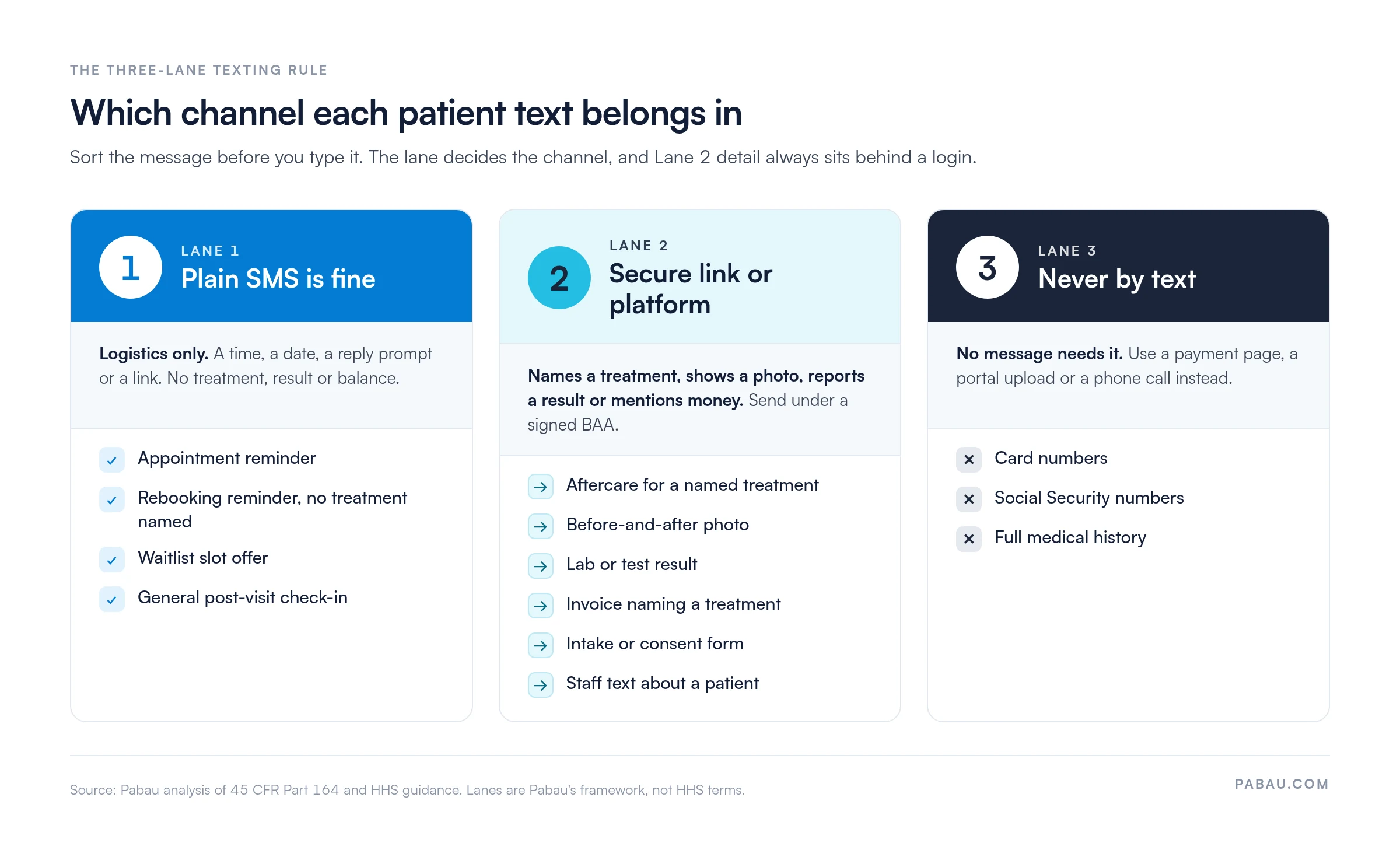
When practices move onto Pabau, the practice management platform we build, we often find before-and-after photos and aftercare threads sitting on a provider’s personal phone. Those are Lane 2 messages traveling by Lane 1 means, and they’re the first ones to move. The table gives a compliant version of each common text.
| Message | Lane | Compliant version | Why (the rule it hangs on) |
|---|---|---|---|
| Appointment reminder | 1 | “You’re booked Tue 3:00 PM. Reply C to confirm or R to reschedule.” | A time with no treatment detail limits the information, as HHS expects on unencrypted channels. Drop a provider name that reveals a specialty. |
| Rebooking reminder | 1 | “You’re due for your next visit. Book here: [link]” | Naming the treatment moves it to Lane 2. Promotional wording also brings in TCPA written consent. |
| Waitlist slot | 1 | “A slot opened Thu 10:30 AM. Reply YES to take it.” | Logistics only. Leave out which treatment the slot is for. |
| Post-treatment check-in | 1 | “How are you feeling after today’s visit? Reply here or call [number].” | A general question carries no clinical detail. Move the patient’s symptom reply to the secure channel. |
| Aftercare for a named treatment | 2 | “Your aftercare instructions are ready: [secure link]” | The treatment name ties the patient to their care, so the instructions sit behind a login. |
| Before-and-after photo | 2 | “Your progress photos are in your portal: [secure link]” | A full-face photo is one of the 18 identifiers, and the image itself shows the treatment. |
| Lab or test result | 2 | “A new result is ready to view: [secure link]” | A result tied to the patient’s phone number is health information about an identifiable person. |
| Invoice or payment link naming a treatment | 2 | “Your invoice is ready: [secure payment link]” | Payment for care is part of the PHI definition at 45 CFR 160.103. |
| Intake or consent form | 2 | “Please complete your forms before Tuesday: [secure link]” | The text is harmless, but the form collects history. The form must live on a platform under a BAA. |
| Patient texts a clinical question | 2 | “Thanks for asking. I’ve sent a secure message so we can go through it: [link]” | The patient chose SMS, but your clinical answer adds PHI. Reply securely, or warn and document if they insist. |
| Staff text about a patient | 2 | “Your 2:30 has a question. Details are in the chart.” | Internal texts are PHI too. CMS expects a secure, encrypted platform for care-team texting. |
| Card number, Social Security number or full history | 3 | No text version. Use a payment page, a portal upload or a phone call. | No message needs this data, and a leaked card or Social Security number can’t be taken back. |
Two rows trip teams up. A general check-in is Lane 1, but a reply describing swelling is PHI arriving by SMS. Answer that reply on the secure channel rather than continuing the plain thread.
HIPAA texting rules set three conditions for any PHI text: Security Rule safeguards on the channel, a signed BAA with the vendor, and limited content.
The technical safeguards live in 45 CFR 164.312, and each one is either required or addressable. The table maps each safeguard, plus the BAA and Privacy Rule duties, to what it means when your team texts a patient.
| Safeguard | HIPAA citation | Required or addressable | What it means for texting |
|---|---|---|---|
| Unique user identification | 164.312(a)(2)(i) | Required | Every staff member signs in as themselves. No shared front-desk login. |
| Automatic logoff | 164.312(a)(2)(iii) | Addressable | The app locks after a set idle time, so an unattended phone doesn’t show patient threads. |
| Encryption at rest | 164.312(a)(2)(iv) | Addressable | Messages stored on the server and the device are encrypted. |
| Audit controls | 164.312(b) | Required (standard) | The platform records who sent, opened and deleted each message. |
| Integrity | 164.312(c)(1) | Required (standard) | Messages can’t be altered or deleted without a trace. |
| Person or entity authentication | 164.312(d) | Required (standard) | The platform verifies each user, usually with a password plus multi-factor authentication. |
| Encryption in transit | 164.312(e)(1), (e)(2)(ii) | Standard required, encryption addressable | Plain SMS has no protection in transit, so PHI needs an encrypted channel. |
| Business associate contract | 164.308(b), 164.502(e) | Required | A signed BAA before the vendor creates, stores or transmits any PHI. |
| Security awareness training | 164.308(a)(5) | Required (standard) | Staff learn the three lanes and what to do after a misdirected text. |
| Minimum necessary | 164.502(b) | Required, with exceptions | Applies to staff and third-party texts. Disclosures to the patient and treatment talk between providers are exempt. |
| Reasonable safeguards | 164.530(c) | Required | Limit what texts to patients contain and verify the number before sending. |
Addressable doesn’t mean optional. Under 45 CFR 164.306(d)(3), you assess whether a safeguard is reasonable and appropriate, and implement it if so. If it isn’t, you document why and put an equivalent measure in place. Record that decision in your HIPAA risk assessment, so the reasoning exists on paper if OCR asks.
For texting, encryption is the safeguard to implement rather than argue around. HHS proposed in January 2025 to remove the addressable label and make encryption required (90 FR 898). As of October 2026 that rule is still a proposal, and eCFR still lists encryption as addressable.
HIPAA doesn’t require written consent before you text a patient about their care. Patients can ask to be contacted another way, though, and you must accommodate reasonable requests.
That right sits in 45 CFR 164.522(b), the confidential communications standard, and you may ask for the request in writing. A patient can also start the conversation. HHS says that when a patient emails first, the provider can assume email is acceptable unless the patient says otherwise.
The consent most texting vendors ask you to collect is a TCPA requirement, covered in the next section. The same channel logic governs HIPAA compliant email, so one written policy can cover both channels.
When a patient asks for results or photos by plain SMS, warn them, offer the secure option and document their choice. HHS’s email FAQ describes the same steps: alert the patient to the risks and let them decide. A short front-desk script keeps the warning consistent:
Then log the date, the warning given and the patient’s decision in their record.
Staff texts about patients are still PHI, and they need the same safeguards as patient-facing messages. “Check the chart for your 2:30” passes. A patient’s name with a photo of their swelling, sent from a personal phone, doesn’t.
Minimum necessary doesn’t limit treatment conversations between clinicians (45 CFR 164.502(b)(2)). Front-desk and billing texts about a patient do fall under it, so they carry only what the task needs.
CMS changed its position on texted orders in 2024. Its January 5, 2018 memo said texting patient orders didn’t comply with hospital Conditions of Participation. The February 8, 2024 memo, QSO-24-05-Hospital/CAH, now permits texting patient information and orders among the care team.
Conditions apply. The texts must go through a HIPAA compliant secure texting platform and meet the Conditions of Participation. Computerized provider order entry (CPOE) remains the preferred method. Older guides still quote the 2018 ban, so check the date on any guidance you rely on.
The memo binds hospitals and critical access hospitals only. For a med spa or private practice, the memo still sets a useful bar. CMS wants a secure, encrypted platform, clear author identification and the message ending up in the record.
A HIPAA compliant text can still break the Telephone Consumer Protection Act (TCPA) when you lack the right consent or ignore an opt-out.
TCPA texting rules come from the FCC, and they apply to the same messages HIPAA does. The FCC text message regulations at 47 CFR 64.1200 set three levels of consent:
A narrower FCC exemption covers healthcare texts that are free for the patient to receive. Most practice texts are charged to the recipient’s plan, so few qualify. The exemption’s conditions still make a good checklist for any Lane 1 text:
Opt-out rules are stricter now too. Patients can revoke consent by any reasonable method, including a reply of STOP, CANCEL or UNSUBSCRIBE. You must honor the request within 10 business days, and one confirmation text sent within five minutes is allowed.
Carrier registration is the last layer, and it’s an industry requirement rather than a law. Business texts from 10-digit numbers run on A2P 10DLC, where The Campaign Registry verifies each brand and campaign before it can send. Practices can’t register directly, so your texting provider registers on your behalf.
To send a HIPAA compliant text, pick the message’s lane first. Plain SMS carries logistics only, and every message with PHI goes through a platform under a signed BAA.
HIPAA compliant SMS is mostly a habit your team builds, and six steps cover it:
HIPAA compliant text messaging holds up only if the whole team works the same way. Write it into a texting policy and procedure, and adapt a HIPAA compliance policy template rather than starting from a blank page. The policy should settle seven points:
Texts that form part of the clinical record follow your state’s rules, which our guide to medical record retention sets out by state.
Training closes the loop. HIPAA requires it for new staff within a reasonable time of joining, and again after a material policy change (45 CFR 164.530(b)). Our guide to HIPAA training for employees covers the full program, and the three lanes make a good first module.
HIPAA compliant texting software must come with a signed BAA, because without one it can’t carry PHI, however strong its encryption is.
Treat the BAA as the gate, then test the rest. A HIPAA compliant texting app should give you each of these:
Then choose the delivery model. A HIPAA compliant messaging platform reaches patients in one of three ways, and each one trades patient effort against control:
If you’re comparing full platforms rather than standalone texting tools, our roundup of HIPAA compliance software covers the wider field. Choosing compliance software for practices that already runs your booking and records means one fewer vendor and one fewer BAA.
HIPAA civil penalties now run from $145 to $2,190,294 per violation, depending on culpability, after HHS’s 2026 inflation adjustment.
HHS published the current amounts on January 28, 2026 (91 FR 3665), updating the table at 45 CFR 102.3. Since 2019, OCR has applied lower annual caps to the first three tiers as a matter of enforcement discretion (84 FR 18151). The table shows both sets of caps.
| Tier | Culpability | Per violation | Annual cap in the regulation | OCR annual cap (2019 notice, before inflation) |
|---|---|---|---|---|
| 1 | Didn’t know, and couldn’t have known with reasonable diligence | $145–$73,011 | $2,190,294 | $25,000 |
| 2 | Reasonable cause, not willful neglect | $1,461–$73,011 | $2,190,294 | $100,000 |
| 3 | Willful neglect, corrected within 30 days | $14,602–$73,011 | $2,190,294 | $250,000 |
| 4 | Willful neglect, not corrected within 30 days | $73,011–$2,190,294 | $2,190,294 | $1,500,000 |
Most cases never reach a fine. OCR first seeks voluntary compliance, corrective action or a resolution agreement, and imposes civil money penalties when those fail. Our breakdown of HIPAA violation penalties covers how tiers get assigned. Three other routes add to the exposure:
The Breach Notification Rule covers unsecured PHI only, and PHI encrypted to the standard HHS specifies doesn’t count as unsecured (45 CFR 164.402). If a breach does occur, the deadlines are fixed:
Pabau keeps Lane 1 reminders automatic and Lane 2 detail behind a login. Reminders and confirmations go out from the practice account rather than a staff phone. Each patient’s opt-in is recorded in Pabau with its date, time and source, and a STOP reply ends the messages.
For Lane 2, the Client Portal and digital forms carry the detail. Patients complete intake and consent forms and manage their bookings behind their own login. Before-and-after photos are captured against the patient record, so they never need to sit on a provider’s camera roll.
Pabau also has a HIPAA compliance setting, found under Setup, then Business details, then Security. Alongside it sit role-based permissions, multi-factor authentication, session timeouts and audit logs of user activity. Like any tool, Pabau supports compliance alongside the policies your practice puts in place.

Pabau sends automated reminders from your practice account and keeps forms, consent and photos on the patient record, so treatment detail stays off staff phones.

Whether your team can text patients is settled, because it can. The useful question is which lane each message belongs in, and that answer should be written down before the next reminder goes out.
Audit a week of your practice’s sent texts against the three-lane texting rule. Lane 1 messages can stay as they are. Lane 2 messages need a platform with a signed BAA. The trade-off is one extra tap for the patient, which buys an audit trail and a smaller breach risk.
Book a demo to see how Pabau keeps patient reminders automated and treatment detail off your team’s personal phones.

Worried a text has already gone to the wrong person? What to do if you violate HIPAA sets out the disclosure and remediation steps to take next.
Running a smaller office without a compliance officer? HIPAA compliance for medical offices covers the policies, roles and safeguards a small practice needs.
Does your team post patient results or photos online too? HIPAA and social media explains where marketing posts cross into PHI disclosures.
Want the same safeguards across your whole record system? EHR security walks through the access controls and audit logs that protect patient records.
Need to tell patients how you use their information? Notice of privacy practices gives you a template that covers communication channels and patient rights.
Not on their own. Apple encrypts iMessages end to end. A personal Apple ID still gives your practice no audit trail, no BAA you’ve signed and no way to file the thread to the chart. When a contact isn’t on iMessage, Messages falls back to RCS or SMS, and Apple notes SMS isn’t end-to-end encrypted. Keep iMessage to Lane 1 logistics at most, and route PHI through a HIPAA compliant messaging platform. The same reasoning applies to WhatsApp.
Yes, several, but no app is compliant out of the box. HIPAA compliant texting software needs a signed BAA from the vendor, plus encryption, unique logins, audit logs and remote wipe. Compliance then depends on your team using the app for Lane 2 messages and keeping PHI off personal phones.
Only for messages that carry no PHI. A free tool can send Lane 1 logistics such as an appointment time. For a message with PHI, no-cost secure texting comes down to one question: will the vendor sign a BAA and meet the Security Rule safeguards? If the vendor won’t sign, the free app can’t carry PHI.
Therapists follow the same three lanes, with a stricter Lane 1. A reminder signed by a counseling practice already tells anyone reading the lock screen that the patient is in therapy. Send reminders from a neutral sender name and keep session content on a secure channel. Never text psychotherapy notes, which need the patient’s authorization for most disclosures under 45 CFR 164.508(a)(2).