CPT code 93503: Swan-Ganz catheter billing and modifiers
CPT code 93503: Official descriptor and procedure overview In the AMA CPT code s...

Last Updated: Oct 23, 2026
D1530 is the CCSD code for myringotomy, a cut in the eardrum that drains the middle ear in one ear or both. It sits in the ear, nose and throat chapter of the CCSD schedule, under section 5.2.0 Middle ear and mastoid.
One detail decides most D1530 claims. If the surgeon leaves a ventilation tube in the drum, the procedure becomes D1510 instead. A bilateral case still takes a single D1530, and eight neighboring codes can never share its claim. A clean D1530 claim starts with an operative note that says plainly what was done.
Let Pabau's smart automation suggest the right codes, reduce claim denials, and keep your practice compliant—effortlessly.
Automate repetitive tasks and focus on what matters most—your patients.
Reduce coding errors and ensure compliance with the latest regulations.
Clean claims, fewer denials, and faster reimbursements.
Powerful insights and reporting to help your practice thrive.
HIPAA compliant SOC 2 certified GDPR-compliant Trusted by 4,000+ clinics worldwide

CCSD code D1530 covers myringotomy, an incision in the eardrum to drain the middle ear, in one ear or both.
If a ventilation tube goes in through the incision, the correct code is D1510, not D1530.
The CCSD schedule bars D1530 from a claim with D1420, D1440, D1510, D1520, D1610, D1710, D1720 or D2030.
The operative note should record the ear findings, the indication, the side treated and that no tube was placed.
Insurers set their own D1530 fees and authorization rules, so check each insurer’s current schedule before the procedure.
CCSD code D1530 is the UK private billing code for myringotomy, a small cut in the eardrum that drains trapped middle ear fluid. It sits in the ear, nose and throat chapter, under section 5.2.0 Middle ear and mastoid. The descriptor reads “Myringotomy (and bilateral)”, so one D1530 covers one ear or both.
The tube decides the code. If the surgeon leaves a ventilation tube in the drum, the claim belongs under D1510 instead. Pick the wrong one and the claim gets queried, paid late, or clawed back at audit.
Section 5.2.0 covers the mastoid too, and D1530 stops at the middle ear. Infection that reaches the mastoid air cells calls for a cortical mastoidectomy, coded D1040.
The middle ear codes around D1530 describe closely related work. The difference usually comes down to what happened after the drum was opened, or whether it was opened at all.
Read the note against the descriptor, never against the code number. Neighboring codes are not interchangeable, and insurers check that the note supports the exact wording of the code billed. Asking the note four questions in a fixed order settles the choice.
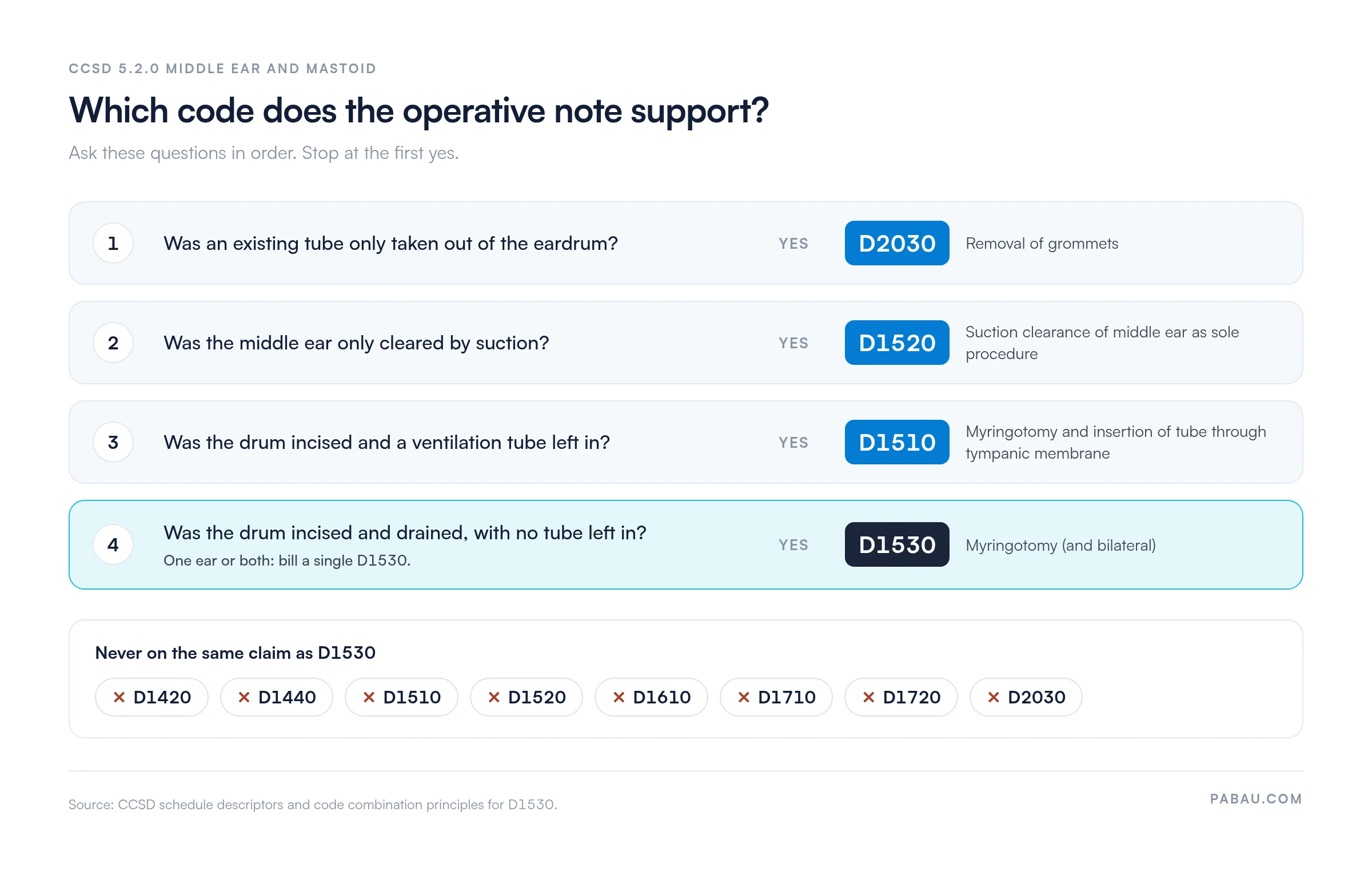
The CCSD schedule lists eight codes that cannot be combined with D1530. Most of them already involve opening or working on the eardrum. A separate myringotomy charge would therefore bill the same step twice. One of the eight, CCSD code D1520, covers suction clearance as a sole procedure, so it never shares a claim with a myringotomy.
A grommet change is the classic trap. The surgeon removes an old tube, then opens the drum again for a new one. D1530 has no place on that claim, because it cannot sit next to D2030 or D1510. Check the schedule’s code principles for how the remaining codes combine.
A myringotomy claim gets queried when the note leaves the insurer guessing. Before the claim goes anywhere, make sure the record covers these points.
The tube statement does more work than it looks. A note that says “grommet considered” without saying it was not placed invites a D1510 query.
Billing teams see this case often. A seven-year-old with bilateral glue ear is authorized for D1510. In the operating room, the surgeon opens both drums and finds the middle ears almost dry, so no tubes go in.
The procedure performed is now D1530, not D1510. Bill the work done, not the work authorized. Because the descriptor covers both ears, the invoice carries a single D1530.
Next, tell the insurer the code changed and ask for the authorization to be updated to D1530. The operative note should explain the finding that changed the plan. With that in place, the claim matches the authorization, the note and the descriptor.
If the surgeon might switch from grommets to a myringotomy alone, ask the insurer how it handles a code change. Ask at the authorization stage, and you avoid chasing a fresh reference after the procedure.
Once the note is right, the claim follows a predictable path. Each step below has its own way of tripping up a myringotomy claim.
The CCSD Group maintains the CCSD codes specialists bill, but it does not set fees. Each insurer decides its own D1530 fee, fee band and authorization rules, and reviews them on its own timetable.
So treat any fee quoted online as a starting point only. Check each insurer’s current schedule for the patient’s policy before the procedure. Our Bupa procedure codes fee schedule shows how one insurer groups its fees.
A two-minute check catches most of the problems described above. Run it on every myringotomy invoice before submission.
Most rejected myringotomy claims trace back to a handful of errors. Each one has a simple fix.
In many ENT practices, the operative note lives in one system and the invoice in another. A biller then copies the code, the side and the authorization number across by hand.
Pabau, the practice software our team builds, keeps both on the same patient record. With claims management, the CCSD code, membership number and authorization reference carry into the claim. Pabau checks the required fields, then sends the invoice to Healthcode.

You then follow each claim’s status and payment in one place. Your billing team stops re-keying, and a missing authorization number gets caught before the insurer sees it.

Pabau builds CCSD claims like D1530 from the patient record and checks required fields before submission. Then you can track each claim’s status in one place.

D1530 is a small code with one clear test. Was the drum opened and drained, and did the patient leave without a tube? If so, the code fits, once, for one ear or both.
Get the note to say that plainly on the day of surgery. When the record names the findings, the side and the missing tube, the code choice settles itself. The insurer then has little left to query.
Book a demo to see how Pabau carries a D1530 claim from the ear note to Healthcode without retyping.

Billing a bigger middle ear operation? CCSD code D1440 covers combined approach tympanoplasty, one of the codes barred alongside D1530.
Coding other ENT surgery? CCSD code E4100 explains voice prosthesis insertion from the same ear, nose and throat chapter.
Need the diagnosis side of a glue ear claim? ICD-10 code H65.31 covers chronic mucoid otitis media of the right ear.
Want every Bupa code in one place? Bupa CCSD codes sets out the schedule and how its codes are organized.
Worried about audit risk? Medical billing compliance shows how to keep coding defensible across every claim.
Most myringotomy incisions close on their own within a few days. That quick healing is why fluid can return, and why surgeons often choose a ventilation tube for recurring effusion. A later procedure that places a tube is coded as D1510.
Adults can often have a myringotomy under local anesthetic as an outpatient. Children usually need a general anesthetic in the operating room. The choice of anesthetic does not change the surgeon’s code, which stays D1530.
Common adult reasons include fluid that lingers after a cold, and pressure damage from flying or diving, called otitic barotrauma. An adult with fluid in one ear usually needs the back of the nose examined as well. Record that assessment, because it supports the indication.
A separate follow-up appointment is usually billed as an outpatient consultation, not under D1530. Same-day assessment before the procedure is different, as many insurers treat it as part of the procedure fee. Check the insurer’s consultation rules before invoicing both.