CCSD code F5010: Parotid duct transposition billing guide
CCSD code F5010 covers parotid duct transposition, one side or both CCSD code F5...

Last Updated: Oct 9, 2026
CPT code 49507 reports open repair of a first-time inguinal hernia that is incarcerated or strangulated, in a patient aged 5 or older. Surgeons use it when trapped bowel or fat cannot be pushed back, often as an urgent case.
One documented finding decides the code. If the operative note calls the hernia reducible, the claim belongs to 49505 instead. Getting that call right protects a higher-paying claim from denial and from an upcoding audit. Below are the bundling rules, ICD-10 pairings, modifiers, payment rules, and a checklist to run before you submit.
Let Pabau's smart automation suggest the right codes, reduce claim denials, and keep your practice compliant—effortlessly.
Automate repetitive tasks and focus on what matters most—your patients.
Reduce coding errors and ensure compliance with the latest regulations.
Clean claims, fewer denials, and faster reimbursements.
Powerful insights and reporting to help your practice thrive.
HIPAA compliant SOC 2 certified GDPR-compliant Trusted by 4,000+ clinics worldwide

CPT code 49507 is for open repair of an initial inguinal hernia that is incarcerated or strangulated, in patients aged 5 or older.
A reducible hernia moves the claim to 49505, so the operative note must state the hernia’s status in plain words.
Pair 49507 with an ICD-10 code showing obstruction or gangrene, such as K40.30 or K40.40, never K40.90.
Mesh is included in 49507, but resecting dead bowel from a strangulated hernia is reported separately, for example with 44120.
Laparoscopic repairs use 49650 or 49651 whatever the hernia status, and recurrent open repairs use 49520 or 49521.
CPT code 49507 reports an open repair of a first-time inguinal hernia that is incarcerated or strangulated, in a patient aged 5 or older. The official AMA descriptor reads: Repair initial inguinal hernia, age 5 years or older; incarcerated or strangulated.
In practice, three conditions must all apply before 49507 fits the case.
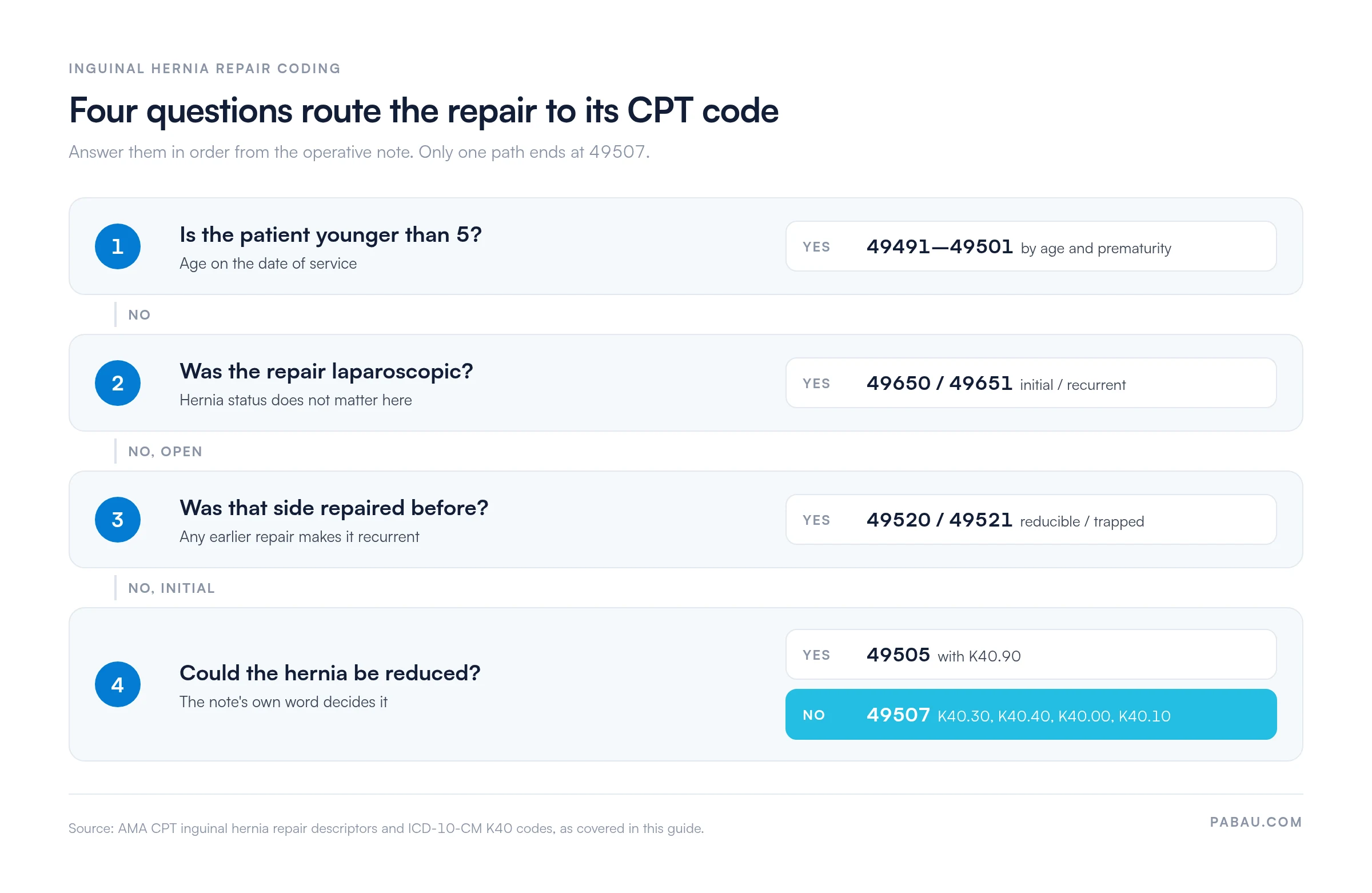
The code also assumes an open incision, since a laparoscopic repair uses a different code. Run the four checks below in order, and only one path ends at 49507.
Bundling errors are easy to make on hernia claims, because the surgical package absorbs more than many coders expect. Use this table to decide what stays inside 49507.
Incarcerated vs strangulated: Both qualify for 49507. An incarcerated hernia is trapped but still has a blood supply. A strangulated hernia has lost its blood supply, which makes the repair urgent.
On the diagnosis side, ICD-10-CM treats both as a hernia “with obstruction.” Only documented gangrene moves the diagnosis into the “with gangrene” codes.
49505 and 49507 share the same age rule, approach, and initial-repair requirement. The only difference is whether the hernia could be reduced, so the operative note carries the whole decision.
Worked example: A 46-year-old man arrives with a painful right groin bulge that will not reduce. At surgery, the surgeon finds trapped but healthy small bowel and repairs the defect with mesh.
The claim line is 49507-RT with K40.30, and no mesh code is added. If the bowel had been gangrenous and resected, the claim would add 44120 and switch the diagnosis to K40.40. If the note had described a reducible hernia, the same surgery would code to 49505 with K40.90.
Surgeon preference never decides the code. Billing 49507 when the note says “easily reduced” is upcoding, and auditors look for exactly that.
49507 is an open, initial repair code only. Change either the approach or the history, and the claim moves to a different code.
The laparoscopic codes ignore hernia status. 49650 covers an initial repair whether the hernia was reducible or trapped, and 49651 covers any recurrent one.
Coders may not assume the approach from the surgeon’s habits. If the note says “open” or describes a groin incision, 49507 applies.
Payers check that the diagnosis supports a trapped hernia. A 49507 line paired with a “without obstruction or gangrene” code reads as a mismatch, and the claim often comes back denied.
The first digit after the decimal carries the story. A 3 (unilateral) or 0 (bilateral) means obstruction, 4 or 1 means gangrene, and 9 or 2 means neither. The final digit separates initial from recurrent.
Most 49507 claims need a side modifier, and some need a global-period modifier too. These are the ones you will use most.
Bilateral billing rule: 49507 carries a bilateral surgery indicator of 1 in the Medicare fee schedule. For Medicare, report one line with modifier 50 and one unit. Some commercial plans want two lines with RT and LT instead.
If one side is incarcerated and the other is reducible, modifier 50 does not fit. Report 49507 for one side and 49505 for the other, each with its side modifier.
Check each payer’s bilateral format before you submit. Medicare wants one line with modifier 50, but some commercial plans want two lines with RT and LT. The wrong format looks like a keying slip, yet it still needs a corrected claim.
Medicare payment for 49507 depends on your locality and the year’s fee schedule. Instead of quoting a figure that changes every January, look it up in the CMS Physician Fee Schedule search tool.
Three parts make up the payment, and a fourth adjusts it.
The global period is 90 days. The fee covers the visit the day before or the day of surgery, the operation itself, and routine follow-up through day 90. For locality-adjusted figures, the FastRVU lookup tool imports the CMS data.
Traditional Medicare does not require prior authorization for inguinal hernia repair. Medicare Advantage, Medicaid, and commercial plans set their own rules, so check the patient’s plan.
Many 49507 cases are emergencies, which changes the timing. A plan may waive prior approval but still ask for notice soon after an emergency admission. Eligibility verification at booking, or as soon as the patient is admitted, catches those rules early.
For planned repairs that do need approval, payers usually look for the following evidence.
Every handoff in this chain is a chance for the hernia’s status to get lost. Here is the usual path, step by step.
The operative report is the document auditors pull first on a 49507 claim. It should state each of these points in plain words.
A surgical superbill built around these six points means fewer coder queries back to the surgeon. Charge entry moves faster as a result.
49507 denials follow a handful of patterns. Good denial management tracks them by code, so you fix the cause once instead of claim by claim.
Match each remittance code against a denial codes reference to see which fix applies.
Run through this list before any 49507 claim leaves the practice. It takes a minute and prevents most of the denials above.
A clean claim is the cheapest claim you will ever send. Each item above removes one reason for a resubmission.
In many surgical practices, coders retype codes from the operative note into a separate billing tool. Each retyped field is another chance for a K40.90 to slip onto a 49507 line.
In Pabau, the billing and practice software we build, the claim starts from the patient record instead. Our claims software for surgeons places the service’s CPT code on the charge line and seeds ICD-10 slots from the recorded diagnoses. Built-in CPT and ICD-10 lookups let the coder confirm K40.30 rather than type it from memory.
The claim will not send until required fields, such as an authorization number, are complete. For US practices, Pabau’s Claim.MD integration adds eligibility checks, electronic submission, status tracking, and remittance posting. The coding call stays with your coder, but fewer claims go out incomplete.

Pabau builds claims from the patient record and blocks submission until required fields are filled. US practices also track claims and remittances through Claim.MD.

49507 rewards practices that treat the operative note as the claim’s source. If the note names the hernia’s status, the code, the diagnosis, and the modifier follow from it.
So the most useful change is upstream. Ask surgeons to write “incarcerated,” “strangulated,” or “reducible” in every hernia note. Then make your coders check the K40 code against that word before charge entry.
The trade-off is a little extra time per case. In return, you avoid both denied 49507 claims and the upcoding risk of billing it on a reducible hernia. Book a demo to see how Pabau helps surgical practices send complete hernia repair claims.

Need to see how surgical claims reach payers? How a medical claims clearinghouse works follows a claim from charge entry to remittance.
Tracking denials across your surgical caseload? What is revenue cycle management explains how procedures turn into collected revenue.
Repairing the same hernia laparoscopically? CPT code 49650 covers the laparoscopic code for an initial inguinal repair.
New to the billing cycle? What is medical billing walks through each step from visit to payment.
Use 49501 for children from 6 months to under 5 years. Full-term infants under 6 months take 49496, and preterm infants take 49492 up to 50 weeks postconception age. 49507 starts at age 5.
CPT 49553 covers initial open repair of an incarcerated or strangulated femoral hernia at any age. 49507 applies to inguinal hernias only, so the site named in the operative note decides.
Often, yes. A strangulated hernia loses its blood supply, so surgeons repair it urgently. The code does not change with timing, but an emergency admission can change the payer’s notification rules.
Check the assistant-at-surgery indicator for 49507 in the current Medicare fee schedule before billing modifier 80 or 82. Commercial plans publish their own assistant surgeon lists, so confirm each payer’s policy too.