OSHA respirator medical evaluation questionnaire
The OSHA respirator medical evaluation questionnaire is the mandatory health for...

1
Last Updated: Oct 15, 2026
A needle stick injury protocol is a written plan that tells staff what to do after a sharps exposure. It covers first aid, reporting, exposure risk assessment, post-exposure prophylaxis (PEP) and follow-up testing. Every practice that handles sharps needs one before an exposure happens, because the first hour decides how quickly PEP can be considered.
First aid is the part staff tend to remember. The reporting chain and the PEP deadline are what people struggle to recall under pressure, so both belong in writing. The template below gives your team a structure to adapt, and the guide explains what each stage should cover.
A ready-to-adapt protocol covering first aid, incident reporting, exposure risk assessment, source patient testing, PEP decision points and the follow-up testing schedule. Have occupational health or your legal adviser review it before your practice adopts it.
Download template
A needle stick injury protocol is a written response plan for every sharps exposure in your practice.
HIV PEP is generally considered within 72 hours of exposure, and starting sooner is better.
Sharps injury logs are required for most US employers covered by OSHA’s Bloodborne Pathogens Standard.
In England, RIDDOR covers work-related bloodborne infections and certain dangerous occurrences, not every sharps injury.
Pabau’s client records and digital forms let teams capture incident details in a structured format.
A needle stick injury protocol is a documented procedure for percutaneous exposure to blood or body fluids from a sharp. It defines who acts first, what first aid is given, and who is notified. It also sets out how the exposure is risk-assessed, and when the case goes to occupational health or an emergency department.
The protocol matters because the window for PEP is short. Public health guidance treats 72 hours as the point beyond which PEP is unlikely to be useful. Every hour lost to a late report narrows the options available to the injured person.
In the US, OSHA’s Bloodborne Pathogens Standard requires employers with exposure risk to keep an exposure control plan. A sharps injury log is required for most US employers covered by that standard. Employers with 10 or fewer employees are largely exempt from OSHA’s injury and illness recordkeeping.
In England, RIDDOR requires reporting of work-related bloodborne infections and certain dangerous occurrences involving biological agents. A sharps injury on its own is not automatically reportable. CQC-registered providers are also expected to show documented infection prevention and incident management, and an inspector will ask for both at a CQC inspection.
A written protocol turns those obligations into a routine. Staff do not have to work out under stress who to call or which form to complete.
The immediate response follows a fixed order. Each step below should appear in your practice’s version of the protocol.
Each of those steps carries its own deadline, and they are easier to rehearse as a clock than as a list.
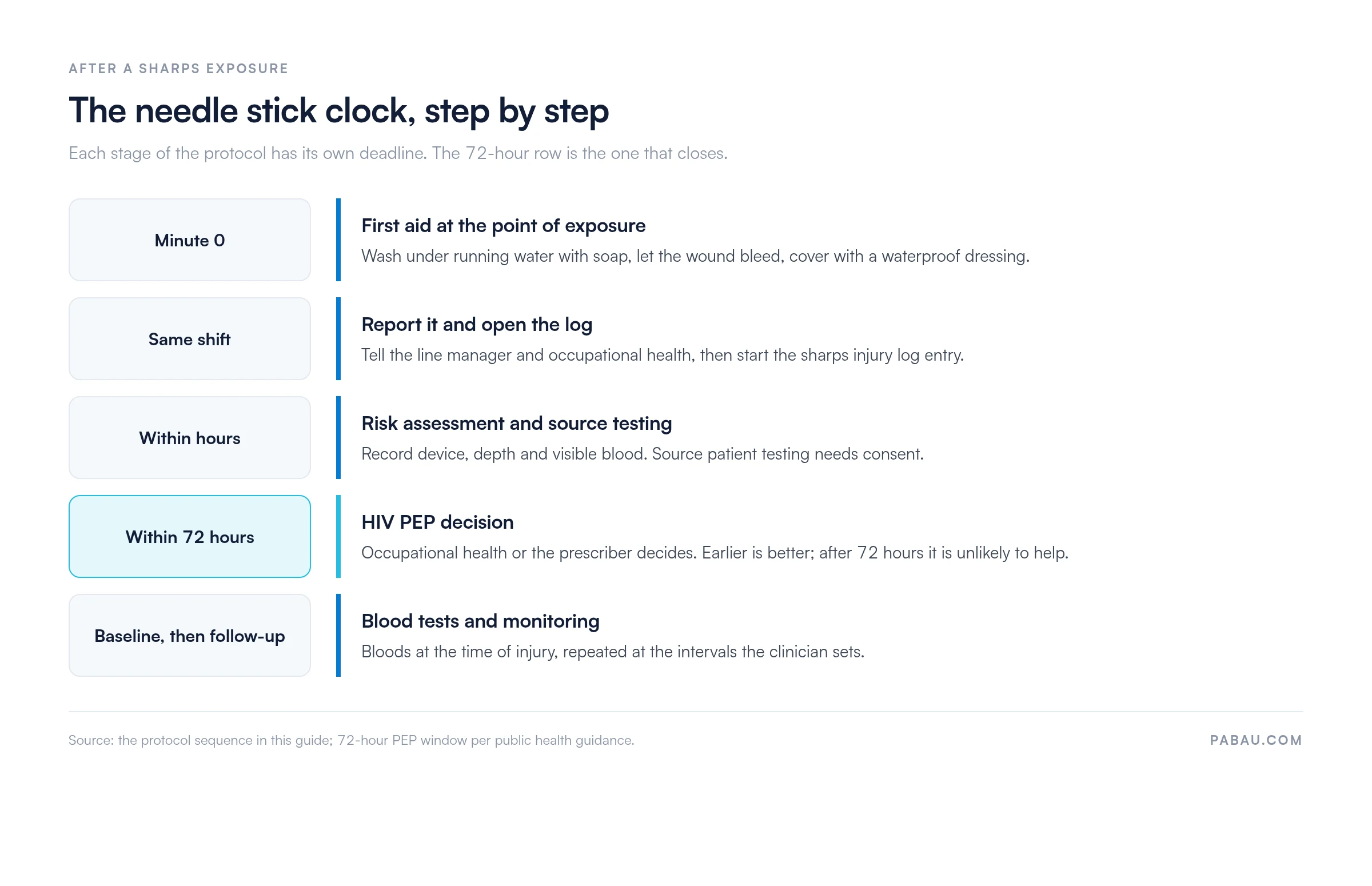
Begin first aid straight away, while the injured person is still at the point of exposure. Washing with soap and running water, then covering the site with a waterproof dressing, follows CDC sharps safety guidance.
Reporting should happen during the same shift. Start the sharps injury log entry at this stage, rather than reconstructing it days later from memory.
Your protocol should address HIV, hepatitis B and hepatitis C, because each carries a different risk and a different follow-up pathway. The table summarizes the points that most often change clinical decisions.
Vaccination lowers hepatitis B risk but does not guarantee protection, because some people do not respond to the vaccine. That is why vaccination status should be checked rather than assumed.
Store the protocol and the sharps injury log in the same place, and make sure every staff member knows where to find both. Review the contact list every quarter, since out-of-hours occupational health cover often changes without notice. Run a short walkthrough each time new staff join so the first step is never a surprise.
An accurate incident record protects the injured person, the practice and the team managing the follow-up. Record the date and time, the procedure being performed, the device involved, the exposure details, the source patient status, and the actions taken.
In the US, an injury that needs treatment beyond first aid is also recordable. The entry then carries through to the annual summary on OSHA Form 300A. Keeping the underlying detail in one system makes that summary quick to compile.
Pabau, the practice management platform we build, holds that detail in client records and digital forms. Teams capture incident details in a structured format rather than scattered notes.
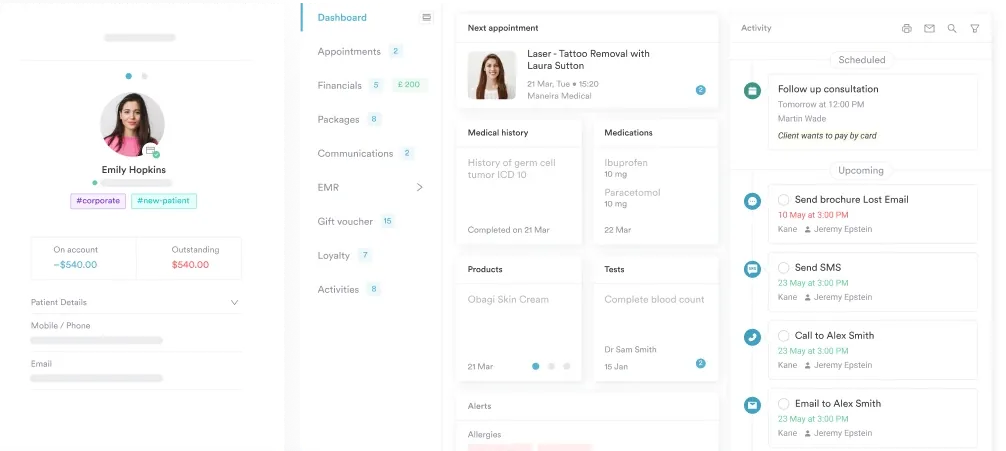
The downloadable template follows the sequence above, so your team can work through it in order during an incident.
Adapt the fields to your own practice before use. Local reporting routes, contact numbers and out-of-hours arrangements differ from one practice to the next.
A protocol handles the response, but prevention reduces how often it is needed. A few consistent habits cut exposure risk across the team.
Keep the protocol with the rest of your workplace safety documents, so staff meet one consistent set of instructions. Most practices file it alongside their emergency action plan.
Reporting obligations depend on where your practice operates. The table compares the main frameworks at a high level. Confirm the current requirements with your regulator before relying on any of them.
Whichever framework applies, an inspector asks for the same two items. They want the written procedure, and the records it produced. Keeping both in software that tracks compliance saves hunting through folders at short notice.
A protocol only works if staff can find it and the records it produces stay complete. Practices that keep the procedure in a shared document often find the file drifting out of date between reviews.
Pabau’s client records and digital forms let teams capture incident details in a structured format. The entry sits with the rest of that person’s documentation. Reporting tools let a manager pull those records back out when a review or an inspection calls for them.
The result is one consistent record per exposure, written while the detail is fresh. That is what occupational health, an inspector, or your own post-incident review will ask to see.

Pabau’s digital forms and client records capture incident details in a structured format. Your team can retrieve the documentation when occupational health or an inspector asks for it.

Write the protocol while nobody is injured. A procedure drafted during an incident is the one that skips the reporting step and loses the PEP window.
Download the template, put your own reporting routes and contact numbers into it, and have occupational health or your legal adviser check it. Then walk every new starter through it, and store it where someone can reach it at 9pm on a Friday.
The practices that handle an exposure calmly are the ones that decided all of this months earlier. Book a demo to see how Pabau keeps incident forms and patient records in one system.

Need the annual injury summary as well? OSHA Form 300A explains the posting deadlines, the filing rules and the penalties for getting them wrong.
Writing the rest of your safety documents? The emergency action plan template covers evacuation, roles and the contact list your team needs on hand.
Preparing for an inspection in England? CQC inspection walks through what inspectors look at and the evidence they expect to see.
Handling patient data in incident records? The HIPAA compliance policy template sets out how your practice stores and shares protected health information.
A needle stick injury protocol is a written plan that tells staff what to do after a sharps exposure. It covers first aid, reporting, risk assessment, PEP referral and follow-up. Practices should adapt it to their own reporting routes.
As soon as possible. Public health guidance places the limit for HIV PEP at 72 hours after exposure. Contact occupational health or a prescribing clinician immediately.
Yes, every sharps exposure should be reported internally and logged, even when the risk seems low. External reporting duties, such as RIDDOR in England, depend on the circumstances.
Follow-up depends on the pathogens involved and the clinician’s plan. Blood tests are usually repeated at set intervals over several months.