ICD-10 code S61.201A: Open wound of left index finger without nail damage
ICD-10 code S61.201A covers a left index finger wound of unstated type ICD-10 co...

Last Updated: Oct 16, 2026
Billable Code Specific Code
W18.11XS is the billable ICD-10-CM code for fall from or off toilet without subsequent striking against object, sequela.
Coders most often confuse this code with its siblings W18.11XA and W18.11XD, and with W18.12. The 7th character sets the encounter type, and the 5th character records whether the patient struck an object. Getting either one wrong is the biggest source of denied claims for this code family.
Let Pabau's smart automation suggest the right codes, reduce claim denials, and keep your practice compliant—effortlessly.
Automate repetitive tasks and focus on what matters most—your patients.
Reduce coding errors and ensure compliance with the latest regulations.
Clean claims, fewer denials, and faster reimbursements.
Powerful insights and reporting to help your practice thrive.
HIPAA compliant SOC 2 certified GDPR-compliant Trusted by 4,000+ clinics worldwide

W18.11XS codes a toilet fall as the external cause of a sequela encounter, not an acute injury visit
The residual condition is sequenced first in the diagnosis order, and W18.11XS always sits in a secondary position
If the record shows the patient struck an object during the fall, the correct subcategory is W18.12, not W18.11
Dropping the placeholder X, or using 7th character A or D instead of S, are the top denial triggers for this code
Pabau’s claims management software checks 7th character choice and diagnosis sequencing before a claim reaches the clearinghouse
ICD-10 Code W18.11XS identifies a sequela encounter after a fall from or off a toilet. The W18.11 subcategory applies only when the patient did not strike against an object during that fall. It sits in the W18 block, “Other slipping, tripping and stumbling and falls,” inside chapter 20 of ICD-10-CM.
The code is an external cause code, so it describes the mechanism behind the injury rather than the injury itself. Per the CMS ICD-10 coding guidelines, external cause codes are supplemental. They give context to the principal diagnosis and never replace it.
Falls from a toilet are common in older adults and in patients with limited mobility. The code turns up often in geriatric, orthopedic, and rehabilitation billing. The quick-reference table below shows the attributes coders need at a glance.
Each character position in W18.11XS carries specific meaning. Misreading any one of them produces an invalid code, or one that classifies the encounter incorrectly.
The placeholder X at position 6 is required by ICD-10-CM Official Guidelines Section I.A.5. Submitting W18.11S, with the X omitted, creates an invalid code that most clearinghouses reject before the claim reaches the payer. It is the most preventable denial trigger in the W18.11 family.
A sequela encounter means the patient is being treated for a residual condition that follows directly from an old injury. The toilet fall itself is over. The claim today addresses what that fall left behind.
The ICD-10-CM Official Guidelines define three 7th character options for the W18.11 family. The distinction matters for payers and for accurate sequela coding.
The sequela sequencing rule is non-negotiable. The residual condition code is always the principal diagnosis, and W18.11XS is always secondary. If a patient fell from a toilet eighteen months ago and now presents with a nonunited hip fracture, the nonunion is coded first. W18.11XS explains how the fracture happened.
W18.11XA, W18.11XD, and W18.11XS describe the same toilet-fall mechanism under three different encounter types. Choosing wrong causes a claim denial, or misrepresents the encounter in the medical record.
Two documented facts settle the choice. The grid below crosses whether an object was struck with the stage of care the patient is in today.
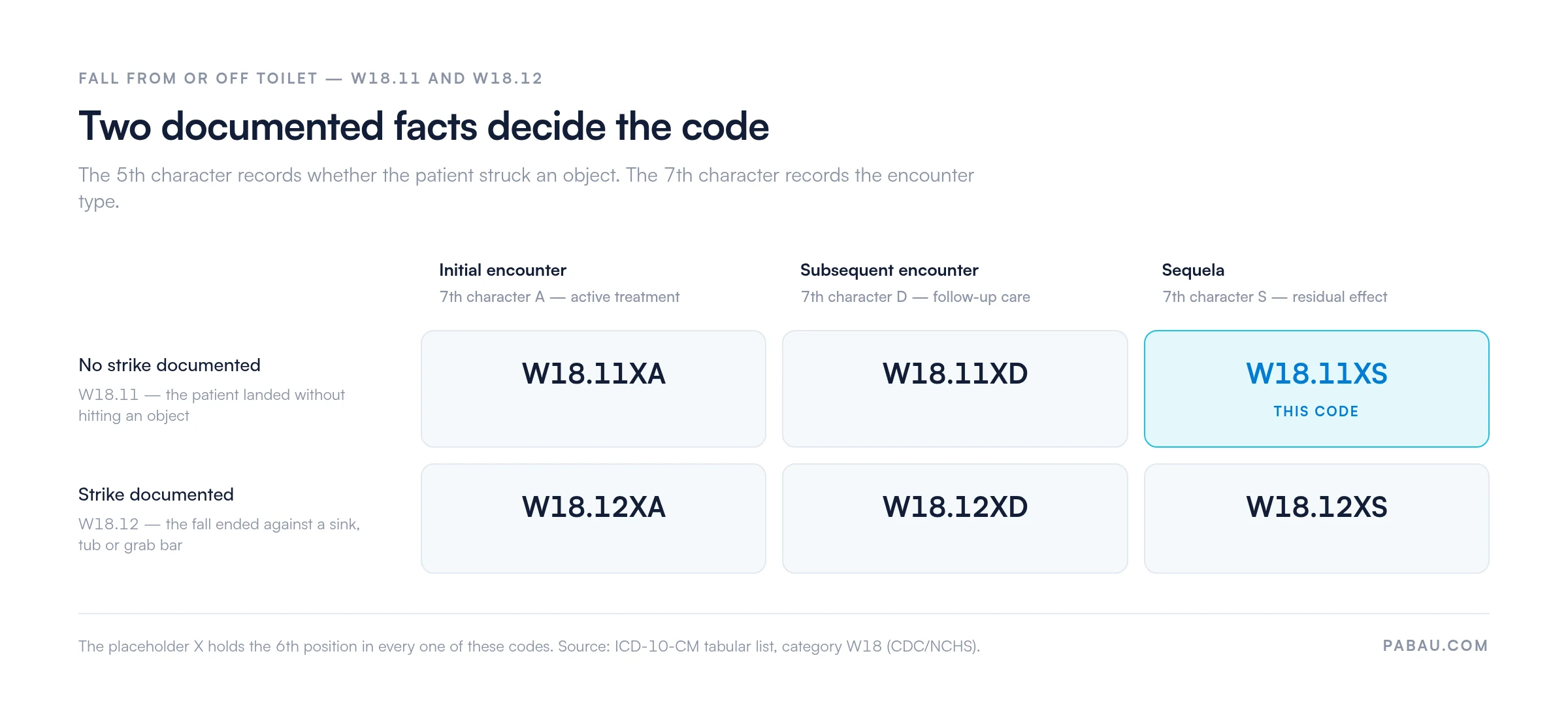
A common coder error is switching to W18.11XS too early, before the original injury is clinically resolved. If the fracture is still healing, the correct code remains W18.11XD. Use W18.11XS only when a provider explicitly documents a residual or late effect that is distinct from the original acute injury.
Before assigning W18.11XS, look for explicit provider documentation using terms like “sequela,” “late effect,” “residual,” or “due to prior fall.” A discharge summary that says “healing hip fracture” does not support sequela coding. That encounter is still W18.11XD.
W18.11 is one of several codes covering falls in and around the bathroom, and the sibling codes sit only one character apart. Picking the wrong one is an accuracy error that skews injury data even when the claim pays. The table below shows the closest neighbors and what separates them.
One documented detail separates W18.11 from W18.12. It records whether the patient struck something on the way down or on landing.
A scalp laceration from the edge of a sink points to W18.12. A note that records only a fall from the toilet, with no strike described, supports W18.11.
When the record says nothing either way, query the provider instead of defaulting. The AAPC listing for the W18 category shows the full set of siblings side by side.
Because W18.11XS is always secondary, coders must identify and sequence the residual condition first. The table below lists the conditions most often documented as late effects of a toilet fall, with the code that usually leads the claim.
One check applies to every row. If the record shows the patient struck a fixture during the fall, the external cause code is W18.12 with the S 7th character, not W18.11XS. Head and facial injuries are the usual sign that a strike occurred.
Fear of falling and post-fall anxiety are well documented after bathroom falls in older patients. Those encounters still need a principal diagnosis that names the residual condition. Always confirm that the provider has documented the causal link between the original fall and the condition being treated.
Sequela coding lives or dies on documentation quality. CMS and commercial payers do not accept W18.11XS without supporting clinical evidence, and a single missing element routinely triggers a denial. Knowing the documentation rules for external cause codes prevents most of those denials before the claim goes out.
Five documentation elements must be present in the medical record to support a W18.11XS encounter:
CMS treats W18.11XS as a valid supplemental code under its ICD-10-CM guidelines. As the ResDAC coding reference for Medicare files describes, external cause codes appear in Medicare claims data as secondary codes.
They are never evaluated as a standalone reimbursement trigger. The critical rule follows from that: W18.11XS cannot be the only diagnosis code on any Medicare or commercial claim.
Practices that use claims management software with built-in code validation catch the sole-external-cause error before the claim leaves the practice. Manual review rarely catches it reliably across high claim volumes. Submitting through a clearinghouse adds a second layer, flagging missequenced diagnosis fields and missing principal codes in real time.
Commercial payer rules vary. Some carriers require W18.11XS on all injury-related sequela claims for coordination-of-benefits purposes, while others treat external cause codes as optional. Check individual payer contracts or LCD and NCD policies rather than assuming uniform behavior.
W18.11XS denials cluster around five error patterns, and all of them are preventable with pre-submission checks. A structured approach to denial management lets coders address these patterns systematically rather than case by case.
A guide to medical billing denial codes covers the CARC and RARC codes usually returned on external cause code errors. Practice management software like Pabau reports those codes against the original claim, so billers can spot the pattern without cross-referencing EOBs by hand.
W18.11XS covers falls from or off a toilet where the record shows no strike against an object. The 7th character S marks a sequela encounter. The code does not cover every bathroom fall.
What is included: A fall from or off a toilet, with no subsequent striking against an object. Today’s encounter must treat a residual condition from that fall.
What to use instead for specific situations:
Read the tabular list entry for W18 before you assign the code. The Excludes notes there decide whether a second external cause code belongs on the same claim. The current tabular list and the Official Guidelines are published by the CDC National Center for Health Statistics and updated each October.
Consistent accuracy with W18.11XS comes from running a short checklist before every sequela encounter. These steps apply to external cause sequela coding broadly, not only to falls from a toilet.
Practices with structured billing compliance protocols see fewer sequela coding errors. The checklist is built into the workflow instead of depending on coder recall. Building a clean claim process around these five steps catches most W18.11XS errors before they turn into denials.
Run a monthly denial audit on all claims carrying W18.11XS. Filter it by CARC 16 (claim or service lacks information) and CARC 11 (diagnosis inconsistent with the procedure). Those two codes account for most sequela documentation and sequencing denials. Reviewing them as a group, rather than claim by claim, shows which provider or service line is generating the documentation problem.
Today those W18.11XS checks usually live in a coder’s head, or on a laminated sheet beside the monitor. That holds until volume rises, staff change, or an October code update lands.
The denials that follow are avoidable. A placeholder goes missing, an external cause code lands in the first diagnosis field, or an S is assigned while the fracture is still healing.
Pabau’s claims management software moves those checks into the claim itself. Diagnosis sequencing, 7th character choice, and code format are validated as the claim is built. The error surfaces while the coder still has the chart open. Our Claim.MD integration then applies clearinghouse edits before the claim reaches the payer.
The result is fewer resubmissions on external cause codes and a shorter path to payment on injury and sequela claims. Coders spend their time on the records that genuinely need a provider query, rather than on formatting rejections.

Pabau’s claims management software validates diagnosis code sequencing, 7th character accuracy, and placeholder requirements before claims reach your clearinghouse. See how practices reduce external cause code denials in a live walkthrough.

W18.11XS has one narrow job. It names a fall from or off a toilet as the external cause of a sequela encounter, where no object was struck.
Most denials trace back to four errors. They are the wrong 7th character, a missing principal diagnosis, and absent sequela documentation. The fourth is a documented strike that should have sent the claim to W18.12. All four are catchable before submission.
Pabau validates 7th character selection, diagnosis sequencing, and placeholder formatting as part of the pre-submission workflow. That takes the manual burden off coders handling high volumes of injury and sequela claims. To see how the system handles external cause code edits, book a demo with the Pabau team.

Coding another fall sequela? W00.1XXS applies the same 7th character rules to a fall on stairs due to ice and snow.
Sequencing a spinal injury sequela? S33.8XXS walks through billing, sequencing, and the denials that follow a late-effect claim.
Handling a denial on this claim? What is revenue cycle management explains how sequela denials fit into the broader RCM workflow and where to intervene.
Need a clearinghouse that validates ICD-10 external cause codes? How a medical claims clearinghouse works covers the edit logic applied before claims reach payer adjudication.
ICD-10 Code W18.11XS is the external cause code for a fall from or off a toilet without subsequent striking against an object, sequela. It records the mechanism behind a residual condition being treated today. It is always reported as a secondary code, alongside the principal diagnosis that describes the residual condition itself.
W18.11XA is for the initial, active-treatment encounter for the acute injury from a toilet fall. W18.11XD is for subsequent follow-up care of that same ongoing injury. W18.11XS is for sequela encounters, where the acute injury has resolved and the visit treats a lasting residual condition caused by the original fall.
Both codes describe a fall from or off a toilet, and the documented landing separates them. W18.11 applies when the patient did not strike against an object. W18.12 applies when the fall ended with a strike against a sink, tub, grab bar, or similar object. Query the provider when the record does not say.
No. W18.11XS is an external cause code and cannot be the sole diagnosis on any claim. ICD-10-CM Official Guidelines require the residual condition code to appear as the principal diagnosis. W18.11XS is always secondary, giving context for the mechanism of the original injury.
Five errors cause most denials. Coders use the wrong 7th character, or sequence W18.11XS as the primary diagnosis. They omit the placeholder X, or bill without provider documentation of the causal link. The fifth is assigning W18.11 when the record shows the patient struck an object.
Use the S 7th character when the acute injury from the original fall is considered resolved and the current encounter treats a lasting residual effect. Chronic pain, post-traumatic arthritis, fracture nonunion, and mobility loss all qualify. If the original injury is still under active care or routine follow-up, use D instead.
Medicare accepts W18.11XS as a valid supplemental code when a principal diagnosis is present. External cause codes are never evaluated as standalone reimbursement triggers, and they supply mechanism context in claims data. Submitting W18.11XS without a principal residual condition code will result in claim rejection.