GI bleed nursing care plan
A GI bleed nursing care plan is a structured document for a patient with gastroi...

1
Last Updated: Oct 15, 2026
The OSHA respirator medical evaluation questionnaire is the mandatory health form employees complete before a respirator fit test or first use at work. OSHA publishes it as Appendix C to 29 CFR 1910.134.
A physician or other licensed health care professional (PLHCP) reviews the answers and decides whether the employee can wear the respirator safely. The employer receives only that written recommendation, never the answers.
Employers, HR teams and occupational health providers use the form for the medical evaluation step of their respiratory protection program. The free template below reproduces the Appendix C questions, ready to hand to each employee.
A ready-to-use questionnaire covering Part A’s mandatory health history and cardiopulmonary questions, the Part B questions a PLHCP may add, and a PLHCP review section.
Download template
The questionnaire is the Appendix C form under 29 CFR 1910.134, and employers must use its mandatory content.
Only a physician or other licensed health care professional (PLHCP) reviews the completed form, never the employer.
The medical evaluation must be completed before any fit test or respirator assignment.
Employers receive the clearance decision only, not the employee’s specific medical details.
Full-facepiece and self-contained breathing apparatus (SCBA) users answer six extra Part A questions, and the PLHCP can add Part B questions for anyone.
The OSHA respirator medical evaluation questionnaire is a mandatory written form that OSHA publishes as Appendix C to its Respiratory Protection Standard. Employers must give it to any employee who may be required to use a respirator. It’s the first step of a compliant respiratory protection program.
The questionnaire has two parts. Part A holds the mandatory questions, split into background details and health questions. Part B holds optional questions the reviewing PLHCP may add.
Any employee who is required to wear a respirator must complete the questionnaire before wearing it. This covers many healthcare, construction and manufacturing roles where respiratory protection is part of the job.
For new hires, the questionnaire can run alongside a pre-employment medical exam, so clearance is settled before the first shift that needs a respirator.
Under 29 CFR 1910.134, the employer must make a medical evaluation available at no cost to the employee, before fit testing and before first use. The employer is responsible for the process, but the clinical assessment itself belongs to the PLHCP.
Along with the questionnaire, the employer must tell the PLHCP how the respirator will be used:
The PLHCP also receives a copy of the written respiratory protection program and of the standard itself. From there, the evaluation runs in four steps:
The sequence below shows where the fit test sits in that process, and which events send an employee back to the start.
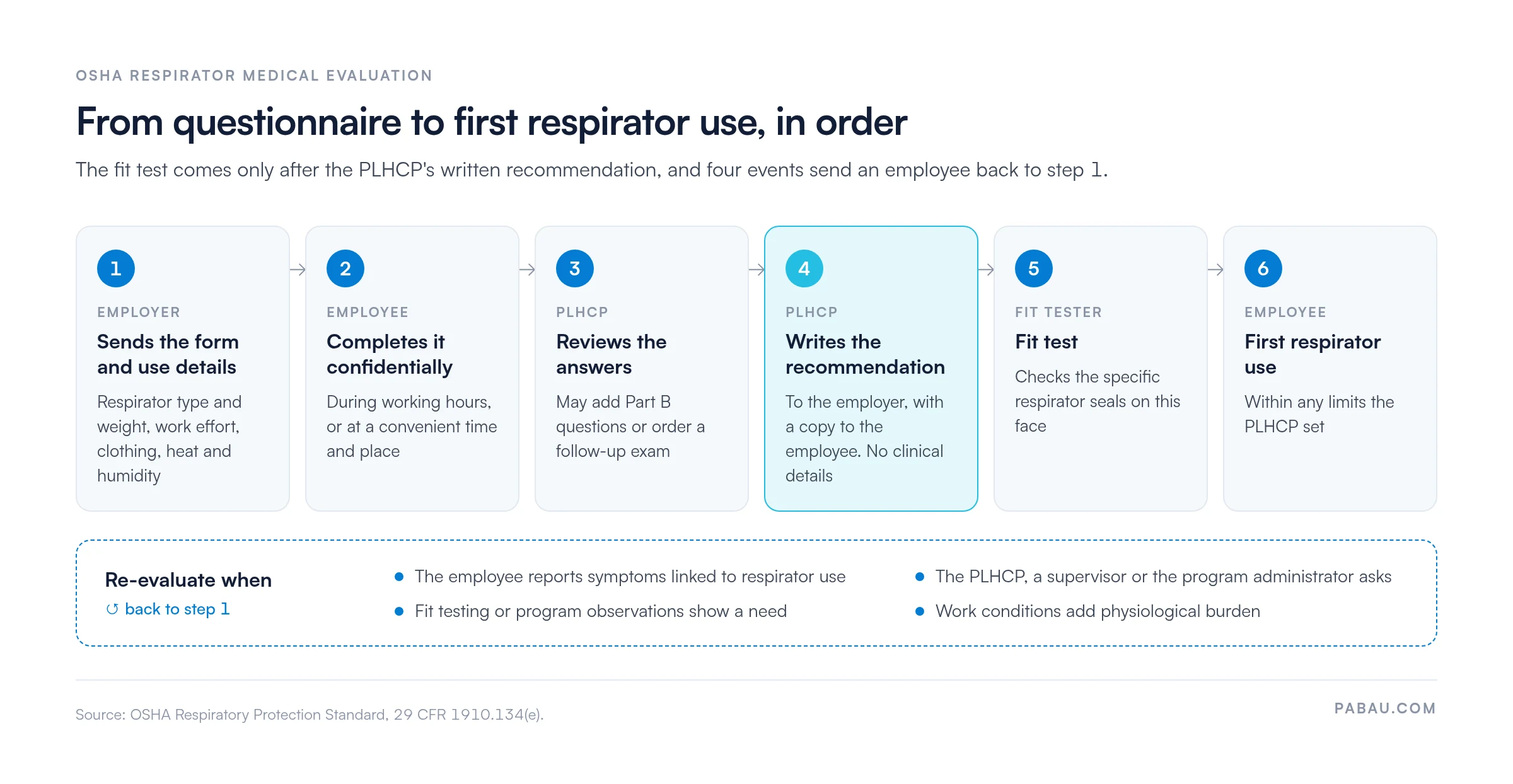
Confidentiality is central to this process. The employer receives the PLHCP’s recommendation, not the employee’s clinical details, so the questionnaire should never be stored in a general personnel file.
Part A has two sections, and every employee completes both. Section 1 collects background details such as job title and respirator type. Section 2 asks about smoking, heart and lung conditions, symptoms and medications.
Questions 1 to 9 of Section 2 apply to every employee. Questions 10 to 15 cover vision, hearing and musculoskeletal health, and they are mandatory only for full-facepiece and SCBA users.
The reviewing PLHCP decides which Part B questions, if any, each employee answers, whatever respirator they will wear.
The PLHCP is the person who reviews the completed questionnaire and makes the clearance decision. PLHCP stands for physician or other licensed health care professional, and the review is a clinical judgment made within the scope of their license.
Where answers raise a concern, the PLHCP may arrange a follow-up medical examination before deciding. A structured respiratory assessment keeps the lung findings from that exam in one record.
Once the review is complete, the employer receives only the outcome, such as cleared, cleared with limitations, or not cleared. That written recommendation can follow a medical clearance letter format, naming any limits on respirator use.
A medical evaluation checks whether the employee can safely wear a respirator. A fit test checks whether a specific respirator seals properly on that person’s face. They are separate OSHA steps, and the medical evaluation always comes first.
Full-facepiece respirators and SCBAs trigger the extra Part A questions on vision, hearing and musculoskeletal health. Their weight, fit and narrower field of vision put more demand on the wearer in those areas.
Powered air-purifying respirators (PAPRs) and positive-pressure supplied-air respirators reduce breathing resistance compared with negative-pressure types. They do not, by themselves, add questions to the form.
That difference shapes clearance too. If a negative-pressure respirator would put an employee’s health at increased risk, OSHA requires the employer to provide a PAPR instead. That applies when the PLHCP finds the employee can use one.
Record the exact respirator model each employee will wear, so the PLHCP reviews the right demands.
Use the template as the employee-facing form, and keep the Part A and Part B wording intact. Changing or removing mandatory questions creates compliance risk.
OSHA requires a new medical evaluation when any of these happens:
The standard sets no fixed annual re-evaluation, so these triggers are easy to overlook. They arise during ordinary work, not at a scheduled review.
Heart and lung conditions, including asthma and COPD, are common reasons for further review. A flag doesn’t disqualify an employee. It means the PLHCP needs to make a clinical decision, sometimes with limits on use.
Many occupational health teams still email the PDF, collect paper copies and chase the reviewing clinician for a decision. Each handoff puts confidential health answers in one more inbox.
Pabau, the practice management platform we build, turns the questionnaire into a digital form employees complete on their own device. With Pabau’s patient intake software, answers land straight in a secure patient record the reviewing clinician can open.
The clinician records the outcome against that record, and automated reminders prompt re-evaluations and follow-up exams. Your team sees the decision and date, while the health answers stay with the clinician.

Pabau’s digital forms send the questionnaire, store answers in a secure record and keep each PLHCP decision on file. Your team tracks clearance without handling confidential health details.

Put the questionnaire at the very start of your respiratory protection program. Send it before any fit test, route the answers only to the PLHCP, and keep the record for employment plus 30 years.
Getting that order right protects employees and keeps your program defensible if OSHA inspects it. The cost is admin, because every re-evaluation trigger restarts the process. Build a workflow your team can repeat without exposing anyone’s health answers.
Book a demo to see how Pabau sends, stores and tracks respirator questionnaires while keeping employee health answers confidential.

Need a broader fitness-for-duty check? Work physical form template covers the physical exam employers request for job clearance.
Clearing an employee after illness? Return to work doctor’s note helps you document when an employee is fit to resume duties.
It is the mandatory Appendix C form under 29 CFR 1910.134 that screens employees before they wear a respirator at work.
Yes, where OSHA requires the employee to wear a respirator, the questionnaire must be offered before use.
The standard does not prohibit electronic completion, but the confidentiality and PLHCP review requirements still apply, so check that any platform keeps answers private.
Yes, a physician or other licensed health care professional (PLHCP) must review the completed questionnaire. The employer never makes that clinical decision.