CPT code 92521: Speech fluency evaluation billing guide
CPT code 92521: Definition and clinical scope CPT code 92521 is defined by the A...

Last Updated: Oct 5, 2026
83690 is the CPT code for a lipase assay, a quantitative enzymatic test of serum or plasma lipase. Its AMA descriptor is simply "Lipase," and the code is billed once per specimen.
It sits in Chemistry (82009-84999) within the Pathology and Laboratory chapter. Medicare pays it under the Clinical Laboratory Fee Schedule, and an acute pancreatitis diagnosis (K85.x) is the usual support for medical necessity.
Let Pabau's smart automation suggest the right codes, reduce claim denials, and keep your practice compliant—effortlessly.
Automate repetitive tasks and focus on what matters most—your patients.
Reduce coding errors and ensure compliance with the latest regulations.
Clean claims, fewer denials, and faster reimbursements.
Powerful insights and reporting to help your practice thrive.
HIPAA compliant SOC 2 certified GDPR-compliant Trusted by 4,000+ clinics worldwide

CPT code 83690 covers a quantitative serum or plasma lipase assay, distinct from the amylase assay billed under CPT 82150.
K85.x (acute pancreatitis subtypes) is the primary ICD-10 family for medical necessity, and missing or mismatched diagnosis codes are the top denial cause.
Medicare pays 83690 under the Clinical Laboratory Fee Schedule (CLFS) at a single national limitation amount, so check the current CMS file before billing.
Pabau’s claims management software checks each claim for missing details before it can be sent, which stops avoidable 83690 denials at source.
CPT code 83690 is the American Medical Association (AMA) code for a lipase assay, and its official descriptor is simply “Lipase.”
The short and long descriptors are identical. The code covers a quantitative enzymatic assay of serum or plasma lipase. It is billed once per specimen, however many test runs the lab performs on that sample.
The AMA CPT code set places 83690 in Chemistry (82009-84999) within Pathology and Laboratory (80047-89398).
The once-per-specimen billing rule is the detail most often misread. If a patient provides one blood draw, that is one specimen, billed once. A repeat specimen collected on a different date of service is a separate, billable encounter under 83690.
Lipase testing is classified as moderately complex under CLIA. A physician office lab must therefore hold a CLIA certificate of compliance or accreditation before billing 83690 from an in-office draw. Independent and reference labs bill under their own CLIA number. For practices that refer samples out, the billing entity is the lab that performs the analysis, not the ordering physician.
Most labs measure serum lipase with an enzymatic colorimetric or turbidimetric assay on an automated analyzer. Fasting is not clinically required, though some labs prefer a fasting specimen to reduce interference from lipemia. The standard collection tube is a serum separator tube (SST) or a lithium-heparin plasma tube. EDTA tubes are generally not recommended, because chelation can interfere with the enzymatic reaction.
Documentation requirements for billing 83690 fall into three categories.
A well-documented superbill links the 83690 CPT code to the ICD-10 diagnosis code, the ordering provider NPI, and the date of service. It is the most efficient way to keep this documentation complete at the point of billing.
CPT 82150 covers an amylase assay, and CPT 83690 covers a lipase assay. Both measure pancreatic enzyme levels, but the codes are not interchangeable. According to the American College of Gastroenterology (ACG) clinical guidelines, lipase is the preferred enzyme for diagnosing acute pancreatitis.
Lipase stays elevated for about 8-14 days after onset, while amylase typically normalizes within about 3-5 days. That longer window matters clinically. A patient who presents several days after symptom onset may have a normal amylase but a still-elevated lipase.
The most common cross-coding error is billing 82150 when the order says “lipase.” Before assigning the code, coders should confirm which test the lab report shows, rather than relying on the symptom-driven language in the clinical note.
Payers cross-reference the diagnosis code on a claim against the procedure code to confirm medical necessity. For CPT code 83690, the primary supported ICD-10 family is K85.x (acute pancreatitis). The subtypes matter. Billing K85.9x (acute pancreatitis, unspecified) when the documentation specifies a cause may result in a specificity-related denial, so code to the highest documented specificity.
Routine lipase testing with no documented symptom or diagnosis, such as a wellness panel, is generally non-covered under most payer LCDs. For Medicare patients where necessity is uncertain, an ABN must be issued before the test is performed. See the ICD-10 code lookup for current code descriptions and effective dates.
CPT code 83690 is covered under Medicare Part B and paid under the Clinical Laboratory Fee Schedule (CLFS). The Centers for Medicare and Medicaid Services (CMS) administers it. Established tests like 83690 are paid at a single national limitation amount. The rate does not change from one Medicare Administrative Contractor (MAC) to the next.
Rates reset from private payer data that labs report under the Protecting Access to Medicare Act (PAMA), on a multi-year cycle. CMS publishes quarterly and annual updates. Pull the current 83690 rate from the CMS Clinical Laboratory Fee Schedule files rather than a past year’s figure.
Medicare MACs publish Local Coverage Determinations (LCDs) that define covered indications for CPT code 83690. Covered indications generally include signs and symptoms consistent with acute or chronic pancreatic disease. Examples are epigastric pain, nausea, vomiting, elevated liver enzymes with a possible biliary cause, or a history of pancreatitis with current symptoms. Routine screening without symptoms is not covered.
The medical billing compliance obligation for ABNs is the most commonly mishandled part of 83690 billing. The patient must sign the ABN before the specimen is collected, not after a denial arrives. A retroactive ABN has no force under CMS rules and does not protect the provider from financial liability.
An ABN is required only when there is reason to believe Medicare will deny the claim for medical necessity. It is not required for every lipase order.
Flag lipase orders on patients without a documented pancreatic symptom or diagnosis in your billing workflow before submission. An ABN issued at ordering time takes minutes, while recovering a denied claim takes far longer. Build a pre-submission checklist that matches ICD-10 to the covered indications in your MAC’s LCD.
The National Correct Coding Initiative (NCCI), maintained by CMS, defines code pairs that should or should not be billed together. CPT 83690 (lipase) and CPT 82150 (amylase) are not in an NCCI edit pair that automatically bundles one into the other. That means they can be billed on the same date of service when there are clinically distinct indications for both.
CMS updates NCCI edits quarterly, and the CMS NCCI edits page carries the current tables. Verify the edit status before billing any code pair together.
Unbundling means billing 83690 separately when it is included in a panel code the practice also billed on the same date. It is an NCCI violation. Before adding 83690 as a separate line item, check whether lipase is a component of any organ or disease panel your lab bills.
Most CPT 83690 denials fall into five categories. Each has a specific prevention action that stops the denial before it reaches the payer.
Effective denial management for lab codes starts with pre-submission editing. Correcting the ICD-10 pairing and the ABN status before the claim goes out takes far less time than appealing a denial afterward.
For practices tracking denial patterns across a panel of lab codes, the medical billing denial codes reference covers the full CARC/RARC structure. It also shows how to use remittance data to spot repeating denial reasons by code.
The setting where the lipase test is performed determines who bills and which payment system applies, as the grid below shows. Coders and billers who work across multiple settings need to apply the right rules for each.
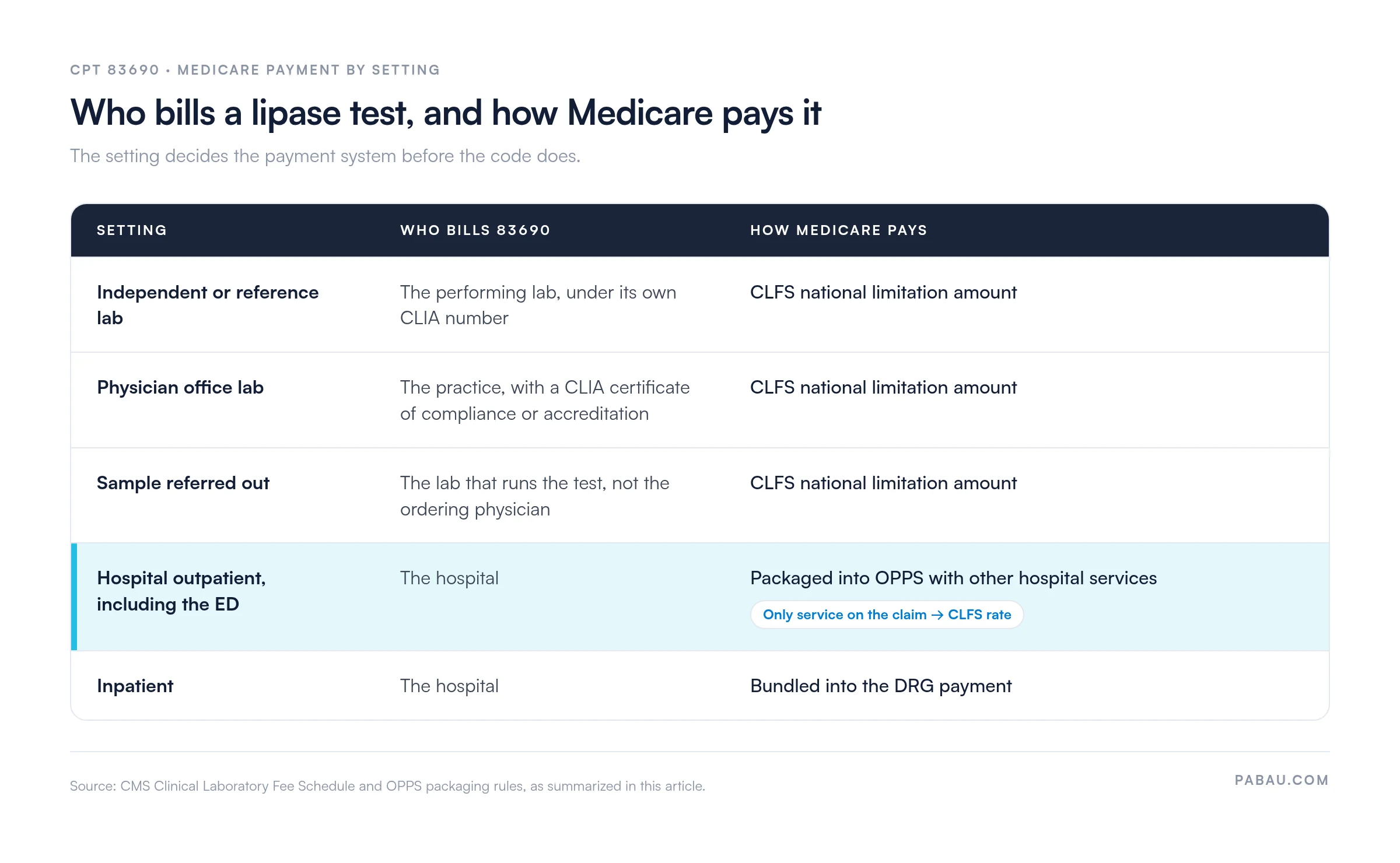
Understanding what makes a clean claim in each setting is the baseline for avoiding setting-based denials. On an HOPD claim, check whether 83690 sits alongside other hospital services. If it does, it is packaged, and if it is the only service, it is paid at the CLFS rate.
When an ED patient is admitted after 83690 was ordered, confirm with your coding team where the lab service belongs. Under Medicare’s payment window rule, outpatient services shortly before an admission usually move onto the inpatient claim and are paid through the DRG.
Most 83690 denials trace back to details that were wrong before submission. A missing diagnosis code, an unchecked Medicare status, or an unsigned ABN usually surfaces only when the remittance advice arrives. By then, the fix means an appeal.
In Pabau, the practice management platform we build, the Claim.MD clearinghouse integration checks a patient’s coverage in real time before the specimen is collected. Claims are generated from the invoices your team already raises and sent electronically to US payers.
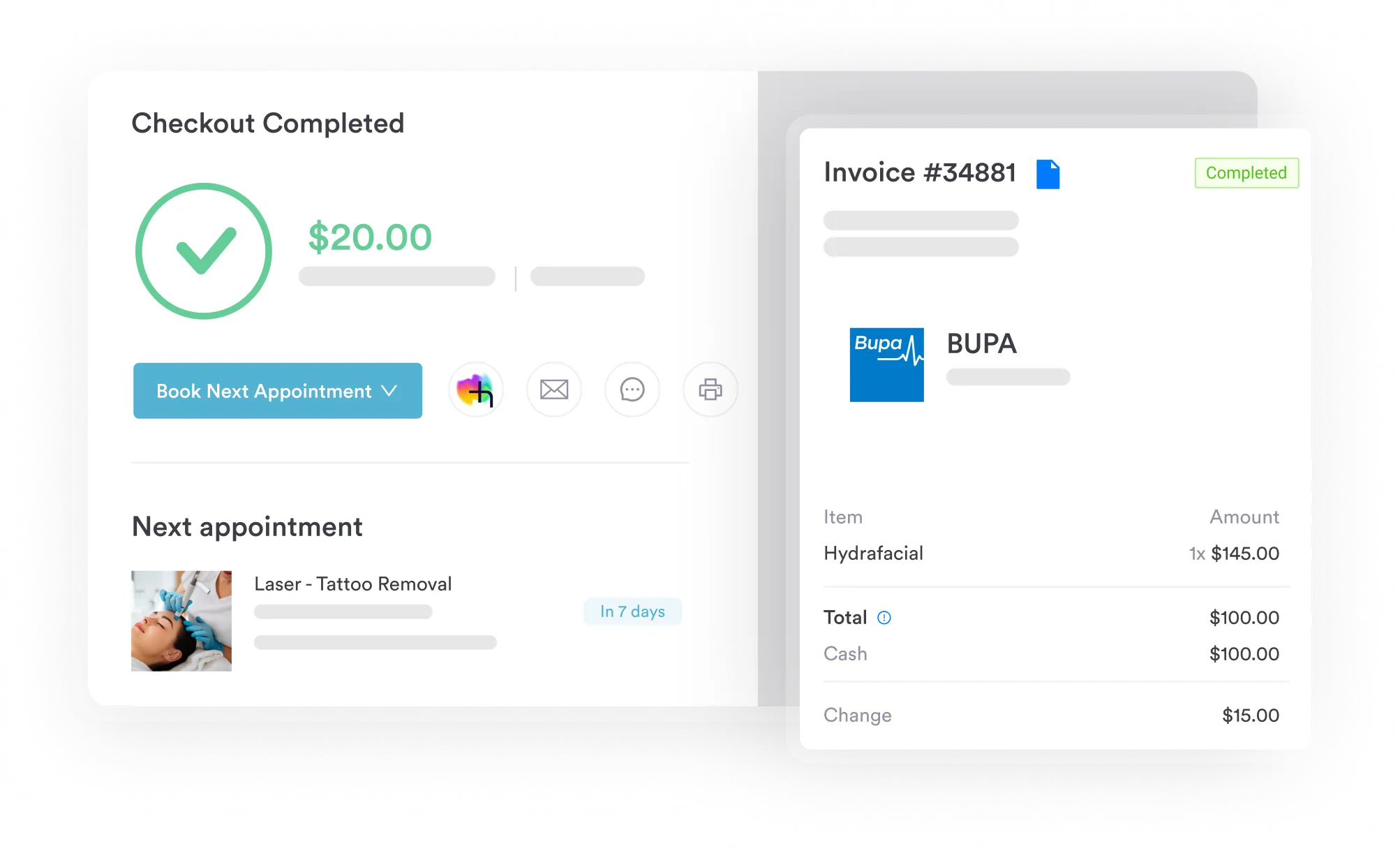
Pabau’s claims management software runs validation checks every time you go to send a claim. If a required detail is missing, the Send button stays disabled until it’s fixed. Claim statuses then update from the payer, and electronic remittance advice posts back against the invoice it settles.

Pabau generates claims from your invoices, checks them for missing details before they go out, and submits them through Claim.MD. See how it handles lab billing in a live demo.

If you fix one part of your 83690 workflow first, make it the diagnosis pointer. Mismatched ICD-10 codes cause more lipase denials than any other reason, and checking them at order entry takes seconds.
ABN timing comes next, because a retroactive ABN can’t be repaired later. Once both are routine, hospital outpatient packaging is the remaining risk, and it is worth an occasional audit.
Pabau keeps the eligibility check, the claim, and the remittance in one medical billing workflow. A lipase denial is then quick to trace back to its cause. Book a demo to see how it handles lab claims for your practice.

Need to understand how clearinghouse claim validation works? Pabau’s Claim.MD clearinghouse guide explains how electronic claims are scrubbed, validated, and submitted to payers, with notes on eligibility verification and ERA processing.
Want a structured reference for electronic remittance codes? Electronic remittance advice explained covers the 835 transaction, CARC and RARC codes, and how to reconcile ERA data against your billing system.
Looking to verify insurance eligibility before ordering lab tests? Insurance eligibility verification outlines the real-time 270/271 transaction process and how to catch coverage problems before claims are filed.
CPT code 83690 is used to bill a quantitative serum or plasma lipase assay. It is ordered mainly to diagnose acute pancreatitis, monitor chronic pancreatitis, and evaluate exocrine pancreatic insufficiency. It is also used in abdominal pain workups where pancreatic disease is in the differential.
The primary ICD-10 codes that establish medical necessity for CPT 83690 are K85.0x-K85.9x (acute pancreatitis subtypes), K86.0-K86.1 (chronic pancreatitis), and K86.81 (exocrine pancreatic insufficiency). R10.10-R10.13 (abdominal pain) applies when pancreatitis has not yet been confirmed. Code to the highest level of specificity documented in the clinical record.
Yes, generally, when there are clinically distinct indications for both a lipase and an amylase assay on the same date of service. CPT 83690 and 82150 are not an NCCI bundled pair that precludes separate billing, but some payers require modifier 59 (or XU/XE) with documented justification. Verify the current quarterly NCCI edit table before billing them together.
An ABN is required when there is reason to believe Medicare will deny the claim for medical necessity. A typical case is a lipase order with no symptom or diagnosis covered under the applicable MAC LCD. The patient must sign the ABN before the specimen is collected, and a retroactive ABN is not valid under CMS policy.
Medicare pays CPT 83690 under the CLFS at a single national limitation amount, so the rate does not vary by MAC. Rates reset from lab-reported private payer data on a multi-year cycle. Take the current figure from the quarterly or annual CLFS files CMS publishes, not from prior-year materials.
The most common cause is a missing or mismatched ICD-10 diagnosis code. Next come non-covered indications such as routine screening, and exceeded frequency limits. Duplicate billing with CPT 82150 without modifier documentation is fourth. The fifth is a missing ABN for a Medicare patient whose indication falls outside the LCD covered list.