

CCSD code G5100: Bypass of duodenum billing guide
CCSD code G5100 bills a bypass that leaves the duodenum in place CCSD code G5100...

Last Updated: Oct 16, 2026
T1014 is the HCPCS Level II code for telehealth transmission, per minute, professional services bill separately.
State Medicaid programs use it to bill the transmission time of a synchronous, live-video encounter. One minute of transmission is one unit. The code is always submitted alongside the primary clinical service code, never on its own.
Let Pabau's smart automation suggest the right codes, reduce claim denials, and keep your practice compliant—effortlessly.
Automate repetitive tasks and focus on what matters most—your patients.
Reduce coding errors and ensure compliance with the latest regulations.
Clean claims, fewer denials, and faster reimbursements.
Powerful insights and reporting to help your practice thrive.
HIPAA compliant SOC 2 certified GDPR-compliant Trusted by 4,000+ clinics worldwide

HCPCS code T1014 bills telehealth transmission per minute for synchronous services, and it is never billed on its own.
T1014 is a Medicaid and state-program code, so Medicare does not routinely reimburse it as a standalone transmission charge.
Unit calculation errors and missing primary service codes are the two denial triggers that account for most rejected lines.
Practice management software like Pabau timestamps the session, so the unit count matches what the patient record shows.
HCPCS code T1014 describes “telehealth transmission, per minute, professional services bill separately.” The code belongs to the T-code series within HCPCS Level II, the supplemental coding system maintained by the Centers for Medicare and Medicaid Services. Level II covers services that CPT codes do not capture, and T-codes are designated primarily for Medicaid and state health programs.
Within that series, T1014 sits in the T1013-T1018 range, Other services. Our HCPCS code library lists the rest of the Level II ranges. The table below summarizes the key metadata for the code.
The per-minute billing unit is where T1014 claims most often go wrong. Each unit of T1014 represents one minute of live-video transmission time. A 30-minute synchronous telehealth visit therefore generates 30 units, not 1. Payers that accept T1014 expect the unit count to match the documented duration of the encounter.
T1014 is a Medicaid-designated code. Medicare does not include it on its List of Telehealth Services as a separately reimbursable transmission charge. T-codes as a category also sit outside the Medicare Part B fee schedule. Practices billing Medicare for telehealth should use the relevant CPT codes with telehealth modifiers rather than T1014.
State Medicaid programs vary significantly in how they handle transmission billing. Some states bundle the transmission cost into the service rate and do not accept T1014 separately. Others, including California, have active fee schedules for it. Always verify payer-specific policies before submitting T1014 claims. Practice management software like Pabau handles medical claims management in the same system as the schedule. That makes it easier to track which payers accept which telehealth codes.
Reimbursement rates for T1014 vary by state and payer, so no single national rate applies. The code sits outside the CMS Medicare Physician Fee Schedule entirely, which means each state Medicaid program sets its own allowed amount per minute.
The following figures represent general guidance based on publicly available state fee schedule data. Verify current rates directly with your state Medicaid agency before billing.
Because reimbursement is per minute and visits often run 15 to 60 minutes, the unit calculation directly affects claim value. A 45-minute session that is submitted as 44 units instead of 45 loses one minute of reimbursement on every claim. Over hundreds of visits, those rounding errors accumulate. Practices using telehealth platforms with built-in session timers can pass accurate minute counts to their billing teams without manual calculation.
Billing HCPCS code T1014 requires pairing it with a primary service code. The transmission code does not stand alone. Follow these steps to submit a clean T1014 claim.
Each step is there because a specific denial follows when it is skipped. The chart below pairs the two.
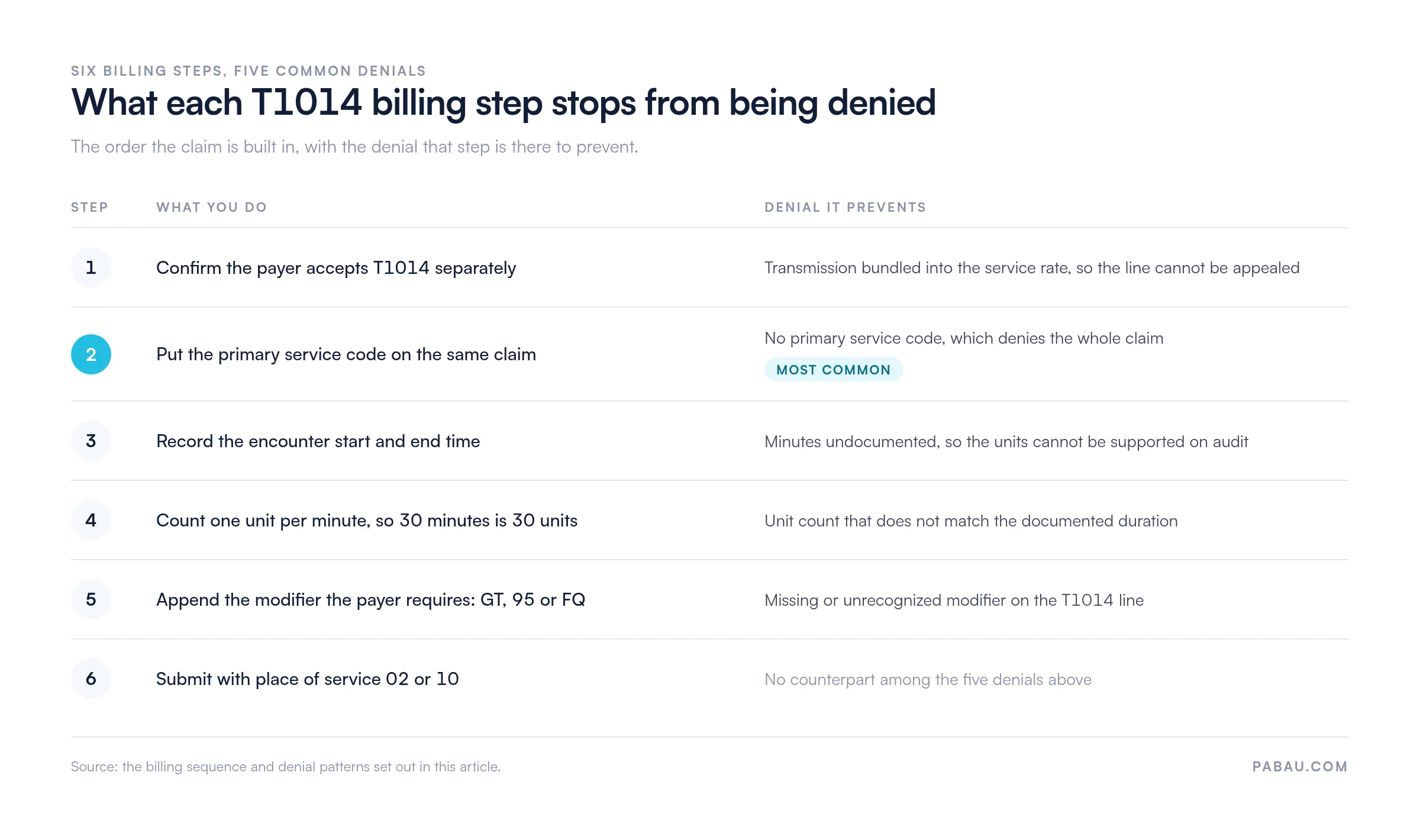
Run a pre-submission eligibility check specifically for telehealth codes. Some Medicaid managed care plans that cover the primary service do not separately reimburse T1014. A denial on the transmission line does not pull down the primary service code, but it does require a separate appeal. Checking coverage before submission saves the rework.
Modifier requirements for T1014 vary by payer. The modifiers below are commonly used across Medicaid programs, but always verify requirements with the specific plan before submitting. Using a modifier the payer does not recognize, or omitting one they require, both result in denials.
Note that GT and GQ modifiers are not interchangeable. T1014 covers synchronous transmission, so GQ (asynchronous) should not appear on the same claim unless the payer has specific instructions. When in doubt, check the AAPC HCPCS code reference and the payer’s clinical policy bulletin for current modifier requirements.
Documentation for T1014 must support both the primary service code and the transmission charge. Missing any of the required elements is the most direct path to a denial or audit finding. They also overlap with the HIPAA requirements that apply to any telehealth encounter.
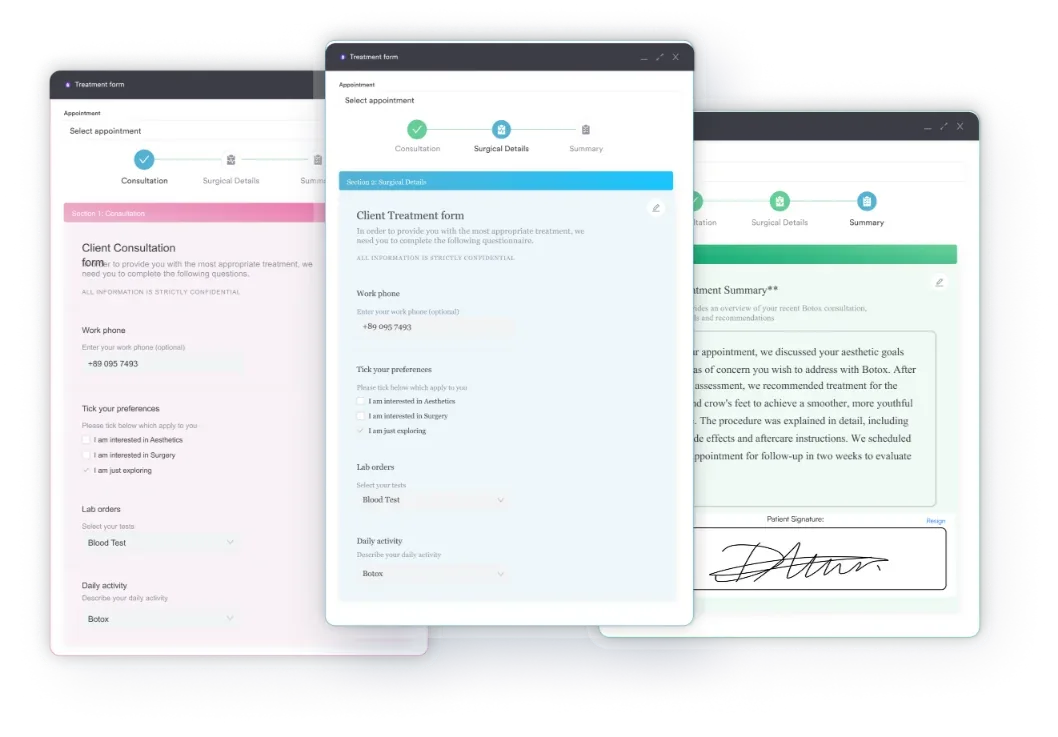
Payer-specific requirements may add to this list. Some Medicaid programs require documentation of why an in-person visit was not feasible, particularly for behavioral health services. Review the relevant provider manual for your state program. Practices that collect telehealth consent on a digital form at booking have the signature on file before the session starts.
T1014 applies specifically to synchronous telehealth, which is real-time, two-way audio-video communication between a provider and patient. It does not apply to asynchronous (store-and-forward) services, where clinical information is transmitted and reviewed at different times. Understanding this distinction prevents the wrong code from appearing on a claim.
The distinction matters for documentation as well as code selection. Synchronous services need encounter notes written in real time. Asynchronous workflows need evidence of when the information was transmitted and when a clinician reviewed it.
Several HCPCS and CPT codes cover adjacent telehealth billing scenarios. Selecting the wrong code, or stacking codes that should not be billed together, produces denials a basic crosswalk prevents.
T1014 and Q3014 are frequently confused because both relate to telehealth infrastructure. Q3014 is an originating site facility fee for Medicare and is billed by the site where the patient is physically located. T1014 is a per-minute transmission code billed by the rendering provider or the facility handling the transmission, under Medicaid. They serve different payers and different billing purposes.
Most T1014 denials fall into five categories. Practices that audit their telehealth claims find the same errors recurring across encounters. Fixing one process step therefore eliminates many denials at once. Understanding denial management workflows helps billers prioritize which patterns to address first.
Eligibility to bill T1014 depends on the state Medicaid program’s definition of qualifying providers for telehealth services. Requirements vary, so these represent commonly eligible provider categories across states that actively use the code. Check your state’s Medicaid provider billing manual for the precise list.
Mental health and behavioral health providers represent the largest segment of T1014 billers in most state programs. If your practice runs a telehealth mental health service, confirm eligibility annually. State Medicaid telehealth rules change more often than most other billing policies.
California’s Medi-Cal program operates one of the most active T1014 billing frameworks in the country. The California Department of Health Care Services (DHCS) and the California Telehealth Resource Center (CTRC) both publish guidance for fee-for-service providers. Their instructions cover how to apply T1014 to audio-video telehealth delivery.
In most practices the minutes that decide a T1014 claim live outside the billing system. A clinician notes the session length in a chart, or nowhere at all. A biller then estimates the unit count days later, and under audit that estimate has to match the encounter record.
Pabau timestamps the telehealth session in the same record that holds the appointment, the consent form and the charge. The duration is captured while the encounter is happening. The unit count then comes off the record rather than out of a biller’s reconstruction.
Signed telehealth consent sits in that same patient file, so the claim leaves with the documentation a Medicaid reviewer asks for. That shortens the appeal when a T1014 line is questioned, because the evidence is already attached to the encounter.

Pabau records session start and end times, stores patient telehealth consent forms, and keeps the documentation your T1014 claims depend on in one place. See how practices using Pabau reduce per-minute billing errors on Medicaid telehealth claims.

T1014 is simple to understand and easy to bill wrong. The five denials above trace to one moment. The minutes and the consent were never captured while the session was happening.
So the work sits at the point of care, not at submission. Record start and end times, keep signed telehealth consent on file, and check each payer’s T1014 policy once a year. Practices that do all three rarely see the transmission line denied.
The trade-off worth remembering is that T1014 pays by the minute, so the documentation has to be as precise as the billing. Book a demo to see how Pabau captures telehealth session times and consent before the claim goes out.

Checking coverage before the visit? Insurance eligibility verification covers the pre-visit checks that catch a non-covered telehealth code early.
Not sure why a claim came back? What is a clean claim in medical billing? sets out the fields a payer accepts first time.
Billing Medicare alongside Medicaid telehealth? Medicare billing for practices explains the claiming channels that apply where T1014 does not.
HCPCS code T1014 bills the per-minute cost of transmitting synchronous, live-video professional healthcare services. Medicaid and state health programs are the payers that accept it. Each minute of the encounter is one billable unit. T1014 is always submitted alongside a primary clinical service code, never as a standalone charge.
Yes, T1014 is effectively a Medicaid and state-program code. Medicare does not include T1014 in its List of Telehealth Services, and T-codes as a series are outside the Medicare Part B fee schedule. Commercial payers generally do not reimburse it either, relying instead on CPT telehealth codes with modifiers for their own reimbursement structures.
The most commonly required modifiers are GT (via interactive audio and video telecommunications system) and 95 (synchronous telemedicine via real-time audio and video). Which modifier a payer requires varies by plan, so confirm with the specific Medicaid program or managed care organization before submitting. The GQ modifier, used for asynchronous services, is not appropriate for T1014 billing.
Reimbursement rates for T1014 vary by state Medicaid program and payer. There is no single national allowed amount because T1014 sits outside the CMS Medicare fee schedule. State programs that actively reimburse the code set rates in their own provider fee schedules, which are updated periodically. Check your state Medicaid agency’s published fee schedule for current rates.
No, Medicare does not routinely reimburse T1014 as a standalone telehealth transmission charge. T-codes are designated primarily for Medicaid. T1014 does not appear on the CMS List of Telehealth Services that Medicare Part B covers. Providers billing Medicare for telehealth should use applicable CPT codes with the appropriate telehealth modifier.
Documentation must include the encounter start and end time, plus a total duration in minutes that matches the units submitted. It must also record the telehealth modality, the patient and provider locations, documented patient consent, and clinical content supporting the primary service code. Some state Medicaid programs add further requirements, so check the relevant provider manual for your program.



