CPT code 93503: Swan-Ganz catheter billing and modifiers
CPT code 93503: Official descriptor and procedure overview In the AMA CPT code s...

Last Updated: Oct 23, 2026

CPT code 25441 describes arthroplasty with prosthetic replacement of the distal radius, and it sits in the 25441 to 25449 wrist arthroplasty family.
For 2026 the code carries 12.96 work RVUs and 26.02 total RVUs, which pays about $869 nationally before any locality adjustment.
Medicare pays 25441 roughly 6% less in 2026 than in 2025, even though the conversion factor went up.
CPT 25441 has a 90-day global period, so a return to the operating room inside that window needs modifier 78 or 79.
If the surgeon also resected carpal bones, the operation is 25446, and coding 25441 instead gives up about $183 per case.
Practice management software like Pabau submits 25441 claims through the Claim.MD clearinghouse, with CPT and ICD-10 catalogs built in to cut coding errors.
CPT code 25441 reports arthroplasty with prosthetic replacement of the distal radius. The descriptor is deliberately narrow. It covers a prosthetic implant at the distal radius, and nothing beyond it.
That narrowness is where the money leaks. Four neighboring codes describe an implant at a different wrist bone, and a fifth covers the same radius plus a carpal resection. That fifth code pays about $183 more per case.
This reference covers the descriptor, the 2026 RVU and payment figures, and the modifiers. It also covers the 90-day global period, the ICD-10 pairings, and the documentation a payer will ask for. Every dollar figure comes from the current CMS Physician Fee Schedule.
CPT code 25441 covers arthroplasty with prosthetic replacement of the distal radius. The American Medical Association places it in the Musculoskeletal System section, under repair, revision, and reconstruction procedures on the forearm and wrist. The official descriptor reads: Arthroplasty with prosthetic replacement; distal radius.
Clinically, the surgeon resects the damaged distal radial articular surface and seats a prosthetic implant in its place. The usual indications are advanced radiocarpal destruction from osteoarthritis, rheumatoid arthritis, or a healed distal radius fracture that left the joint incongruent. Joint-sparing options have normally been tried and have failed first.
Two details in the descriptor decide the claim. The implant has to go at the distal radius, and the carpus has to be left alone. Once carpal bones come out, the operation belongs to a different code in the same family.
For 2026, CPT 25441 carries 12.96 work RVUs and 26.02 total RVUs, which pays about $869 nationally. Medicare builds that figure from three relative value unit components, then adjusts each one for your locality. You can confirm every value in the CMS Physician Fee Schedule lookup tool.
The payment formula is total RVU multiplied by the Geographic Practice Cost Index, then multiplied by the conversion factor. 2026 is the first year with two conversion factors, so the same 26.02 RVUs pay slightly more for a qualifying APM participant. Check which factor your group falls under before you set a fee schedule.
The national payment for 25441 fell from $927.70 in 2025 to $869.09 in 2026, a drop of 6.32%. That happened in a year when the conversion factor rose by more than 3%, which surprises a lot of orthopedic practices.
Two policies in the CY 2026 Physician Fee Schedule final rule did the damage. CMS applied a 2.5% efficiency adjustment to the work RVUs of procedures and diagnostic tests. It also cut indirect practice expense RVUs for services performed in a facility by half.
Wrist arthroplasty is a facility procedure, so 25441 absorbed both changes at once. Every code in the family took a similar hit. A fee schedule built on 2025 figures now overstates what each case pays.
Most surgical codes pay the surgeon more in the office than in a hospital, because the practice absorbs the overhead. CPT 25441 does not work that way. It is priced as a facility procedure, so the fee schedule carries one practice expense value. The surgeon’s payment does not move with the place of service.
The facility payment dwarfs the professional fee, because it covers the implant. That difference is the reason a payer looks hard at the operative note before approving the case. It is also why the POS code on your claim has to match the setting in the record.
Run a locality check in the CMS lookup tool before you quote CPT 25441 to a payer or a patient. The $869 national figure moves several hundred dollars once your MAC applies its Geographic Practice Cost Index. Quoting the unadjusted number is how practices end up writing off the difference.
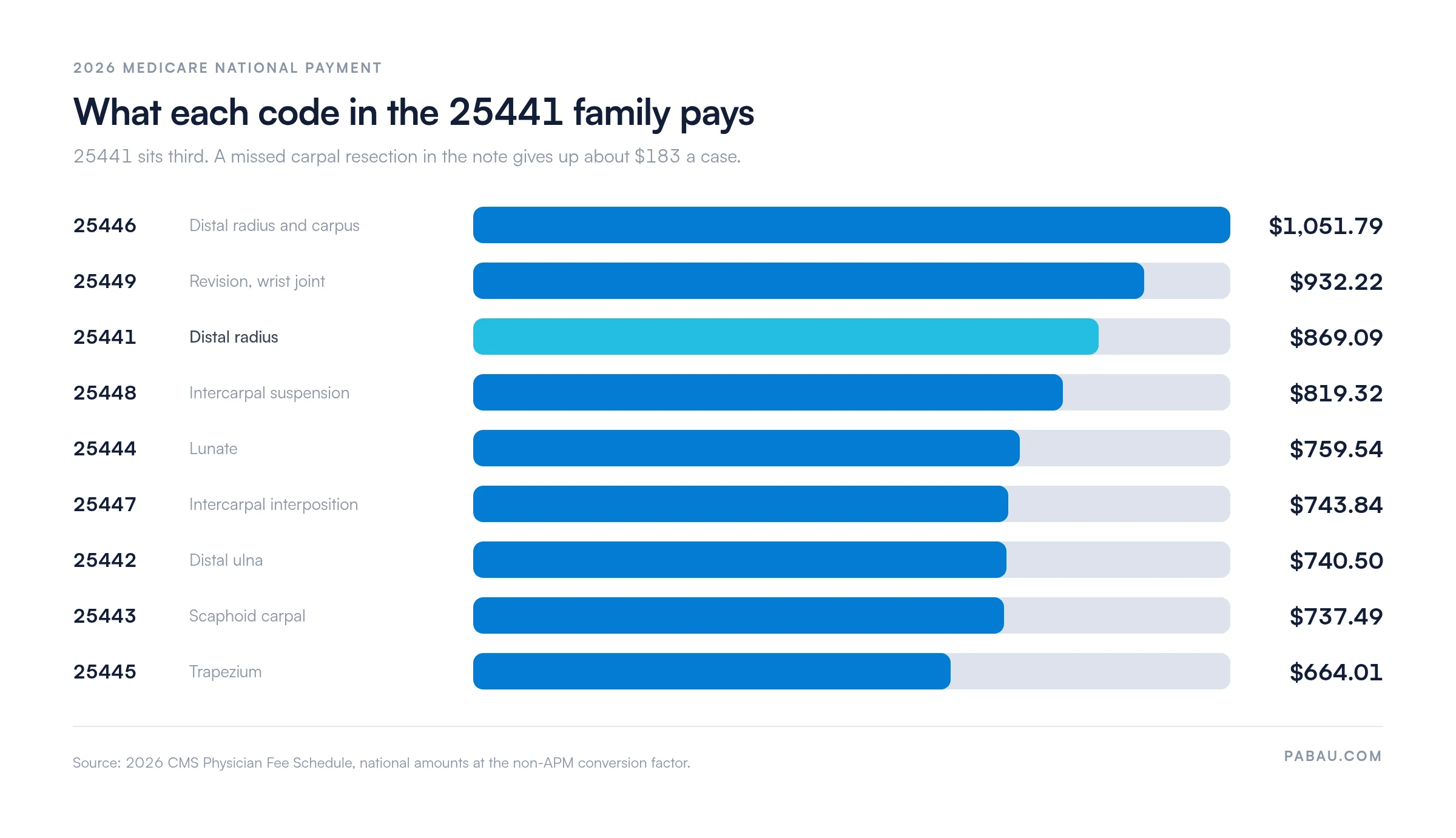
CPT 25441 opens a run of codes that describe wrist and forearm arthroplasty by implant site. Each one names a specific bone, and the payment spread below runs from $664 to $1,052. Picking the wrong sibling is the most common audit finding in hand surgery coding.
One code that looks like a family member is not one. CPT 25440 is repair of nonunion of the scaphoid, with or without radial styloidectomy, and it involves no prosthesis at all. Coders who scan the range by number rather than by descriptor reach for it by mistake.
Technique divides the family as well as implant site. CPT 25447 covers arthroplasty with interposition at the intercarpal or carpometacarpal joints, where the descriptor names no prosthetic replacement. A note that records interposition without an implant belongs in that code, not in 25441.
Two other forearm and wrist codes come up in the same charts. Our references for CPT 25031 and CPT 24115 cover incision and drainage of the wrist and humeral bone cyst excision on the same pattern.
The dividing line between these two codes is the carpus. CPT 25441 replaces the distal radius and leaves the carpal bones in place. CPT 25446 replaces the distal radius and takes part or all of the carpus with it. Most surgeons call that a total wrist arthroplasty.
The financial spread is 3.91 work RVUs, or about $183 per case at the 2026 national rate. Coding 25441 for a total wrist gives that money away. Coding 25446 when the carpus was untouched overstates the service and invites a records request.
The operative note settles it, not the scheduling entry. Look for language describing resection of the proximal carpal row or the scaphoid and lunate. If the note is ambiguous, query the surgeon before the claim goes out rather than after the denial arrives.
Modifier selection decides whether a 25441 claim pays on the first pass. Laterality is the one that trips practices up most often, because the wrist is a paired site and most payers reject the claim without it. Payer rules differ, so confirm the detail with your MAC or commercial plan.
Modifier 22 has its own evidence burden. The operative report has to name what made the case unusual, whether that was dense scarring, implant sizing trouble, or an anatomical anomaly. It also has to compare the work against a typical case. Without both, payers strip the modifier and reprice at the base rate.
CPT 25441 carries a 090 global period. That covers the day before surgery, the day of surgery, and the 90 days that follow. Routine wound checks, dressing changes, suture removal, and follow-up visits inside that window are already paid for in the $869.
Three modifiers get you paid for work that falls outside the package. Use 58 for a planned second stage, 78 for an unplanned return to the operating room, and 79 for surgery on an unrelated site. Each one needs the reason documented in the note.
Office visits need the same care. A visit for a separate problem is billable with modifier 24, and the visit where the surgeon decided to operate is billable with modifier 57. A post-operative check on the wrist itself is not billable at all.
Occupational therapy after a wrist implant sits outside the surgical package. When an occupational therapy practice bills those visits under its own codes, they pay separately. Do not suppress them because the global period is still running.
Medical necessity for CPT 25441 rests on the linked ICD-10-CM diagnosis. The diagnosis has to describe joint destruction severe enough to justify an implant rather than conservative care.
An unspecified injury or sequela code such as S69.91XS will not carry that weight. Laterality also has to match the modifier on the claim line, which is the pairing payers screen first.
ICD-10-CM changes every October 1, so check the current-year file before you submit. A retired code will bounce the claim no matter how clean the CPT side looks. Where a payer publishes a covered diagnosis list for wrist arthroplasty, code from that list rather than from habit.
The National Correct Coding Initiative tables decide which codes can ride alongside 25441 on the same claim. Four checks catch most of the trouble on a wrist arthroplasty claim, and each one takes a minute in the current procedure-to-procedure file.
The implant itself never belongs on the surgeon’s claim. The hospital or ASC bills the device under its own payment system, and a device charge on the professional claim reads as a duplicate. Building that rule into your charge template stops the error at source.
Payers scrutinize implant claims harder than routine surgery, because the facility payment behind them is large. Most commercial plans maintain a wrist arthroplasty medical policy and require prior authorization. The criteria differ across Medicare Advantage, Medicaid managed care, and commercial books. Confirm the requirement before the case is scheduled.
The operative report carries the claim. For a clean 25441 submission it should include:
The charge side needs its own checks. A surgical superbill for 25441 should carry the code, the POS code, and the laterality modifier. It also needs the linked ICD-10-CM code, the rendering physician NPI, and the facility NPI. A missing element produces a technical denial and another month of aging.
Ensuring clean claim submission matters more on this code than on an office visit. A single arthroplasty denial is worth dozens of small rejections, so it deserves a front-end check rather than a back-end appeal.
Record the prosthesis manufacturer and model number in the operative note on every 25441 case, not just in the facility implant log. Some commercial payers cross-reference implant data against their own coverage policy during review. A missing description turns a payable claim into a 60-day records request.
Five errors account for most denied and underpaid 25441 claims. All five are catchable before the claim leaves the practice.
If the surgeon resected carpal bones, the code is 25446 and the difference is about $183. Read the operative note for carpal resection language on every case rather than trusting the scheduled procedure name.
The device belongs on the facility claim. A prosthesis line on the surgeon’s claim looks like duplicate billing. That can pull the whole claim into review, not just the extra line.
A wrist claim without LT or RT is a technical denial at most payers. The fix is a claim scrubber rule, not a reminder, because the omission happens under time pressure rather than through misunderstanding.
The 2025 rate for 25441 was $927.70 and the 2026 rate is $869.09. A practice still posting expected payment at last year’s figure shows a variance on every case. Staff then chase adjustments that were correct all along.
Wound checks and cast changes on the operated wrist are included for 90 days. Billing them without a qualifying modifier produces a denial now, and it looks like a pattern if an auditor samples the account later.
A wrist arthroplasty claim passes through more checkpoints than an office visit. Prior authorization, implant documentation, laterality, the carpal resection question, and the 90-day global period each have to hold. An orthopedic or sports medicine practice running several of these cases a month will lose one to a manual handoff sooner or later.
Practice management software like Pabau closes those handoffs by keeping the note, the charge, and the claim on the same record. Our claims management software scrubs the claim before it leaves and flags a missing modifier or a mismatched POS code. Denials route into a worklist instead of an inbox.
US practices submit claims through our Claim.MD integration, which handles eligibility checks and 835 electronic remittance advice. Payments and adjustments post against the right patient account on their own. Your team spends the morning on the exceptions rather than on data entry.
Tying revenue cycle management to the clinical record also shortens the feedback loop. When a 25441 denial lands, the reason code sits next to the note that caused it. That turns denial management into a documentation fix rather than a guessing game.

Pabau keeps the operative note, the charge, and the claim on one record for orthopedic and hand surgery practices. Catch a missing laterality modifier before submission, track prior authorizations, and post ERAs automatically. See how it handles surgical arthroplasty billing.

The margin on 25441 sits in the operative note, not in the fee schedule. A note that names the implant site and says what happened to the carpus decides whether you bill 25441 or 25446. Read it before the charge is posted, on every case.
The 2026 figures deserve a second look too. At 26.02 RVUs and about $869, the code pays 6.32% less than it did last year. A fee schedule still carrying the 2025 rate will distort your expected payment.
To see how Pabau catches a missing modifier before a 25441 claim leaves your practice, book a demo.

Need to know how a clearinghouse handles a surgical claim? Our Claim.MD clearinghouse guide walks through what happens between submission and the remittance advice.
Want the documentation standard behind a clean surgical claim? Medical billing compliance guidelines covers the records that support a high-value procedure under review.
Got a denial on a 25441 claim and need to read the reason code? Denial codes in medical billing explains the common CARC codes and how to clear them.
New to the mechanics of a surgical claim? Our guide to the medical billing process sets out each step from the operative note to the posted payment.
CPT code 25441 describes arthroplasty with prosthetic replacement of the distal radius. The surgeon resects the damaged distal radial articular surface and seats a prosthesis in its place. The code sits in the Musculoskeletal System section, under repair, revision, and reconstruction procedures on the forearm and wrist. The carpal bones stay untouched.
For 2026, CPT 25441 carries 12.96 work RVUs, 10.31 practice expense RVUs, and 2.75 malpractice RVUs, for a total of 26.02. At the non-APM conversion factor of $33.40, that pays about $869 nationally. Your Medicare Administrative Contractor then applies its own Geographic Practice Cost Index, so the paid amount will differ from the national figure.
CPT 25441 has a 090 global period, which covers the day before surgery, the day of surgery, and the following 90 days. Routine wound checks, dressing changes, and post-operative visits on the operated wrist are included in the surgical fee. Use modifier 58, 78, or 79 for work that falls outside the package.
The national payment fell from $927.70 to $869.09, a drop of 6.32%, even though the conversion factor rose. Two policies in the CY 2026 final rule caused it. CMS applied a 2.5% efficiency adjustment to the work RVUs of procedures, and it halved indirect practice expense RVUs for services performed in a facility.
Laterality comes first: LT or RT on every claim, or modifier 50 for a bilateral case where the fee schedule allows it. Modifier 22 covers unusual complexity when the note proves it. Modifiers 58, 78, and 79 handle work inside the global period, and 24 or 57 handle billable office visits. Confirm each one with your payer.
The carpus decides it. CPT 25441 replaces the distal radius and leaves the carpal bones in place. CPT 25446 replaces the distal radius along with part or all of the carpus, the operation most surgeons call a total wrist arthroplasty. The spread is 3.91 work RVUs, or roughly $183 per case in 2026.
The usual pairings are M19.031 and M19.032 for primary osteoarthritis of the right and left wrist. Rheumatoid arthritis with rheumatoid factor uses M05.731 and M05.732. Traumatic arthropathy uses M12.531 and M12.532, and secondary osteoarthritis uses M19.231 and M19.232. The laterality in the diagnosis has to match the modifier on the claim line.
Most commercial payers maintain a medical policy for wrist arthroplasty and require prior authorization before the case is scheduled. Criteria differ across Medicare Advantage, Medicaid managed care, and commercial plans, so check the specific policy rather than assuming. Missing authorization is one of the most common reasons a 25441 claim is denied outright.