

CCSD code G5100: Bypass of duodenum billing guide
CCSD code G5100 bills a bypass that leaves the duodenum in place CCSD code G5100...

Last Updated: Oct 16, 2026
T1029 is the HCPCS Level II code for a comprehensive environmental lead investigation, not including laboratory analysis, per dwelling. State Medicaid agencies use it to pay for an on-site investigation of a home where a child has an elevated blood lead level.
The investigation covers information gathering, a visual assessment, environmental sampling, and a written report naming each lead hazard found. Laboratory analysis of those samples is billed separately. The unit of service is the dwelling, so one claim covers every child living there.
Let Pabau's smart automation suggest the right codes, reduce claim denials, and keep your practice compliant—effortlessly.
Automate repetitive tasks and focus on what matters most—your patients.
Reduce coding errors and ensure compliance with the latest regulations.
Clean claims, fewer denials, and faster reimbursements.
Powerful insights and reporting to help your practice thrive.
HIPAA compliant SOC 2 certified GDPR-compliant Trusted by 4,000+ clinics worldwide

HCPCS code T1029 covers a comprehensive environmental lead investigation of one dwelling, billed per residence rather than per child.
Laboratory analysis of the paint, dust, soil, and water samples is excluded from T1029 and billed separately.
T1029 is a Medicaid-only T-code, so coverage rules, rates, and modifiers come from each state Medicaid billing manual.
An elevated blood lead result is what triggers the investigation; the CDC blood lead reference value is 3.5 micrograms per deciliter.
Practice management software like Pabau keeps the lead result, the referral, and the retest date on one patient record.
HCPCS code T1029 is the Medicaid code for “Comprehensive environmental lead investigation, not including laboratory analysis, per dwelling.” That wording is the official descriptor published by the Centers for Medicare and Medicaid Services (CMS).
The code sits in the T-code range of HCPCS Level II, which CMS maintains for state Medicaid agency programs. T-codes carry no national Medicare rate, so every rule about T1029 billing is set at state level.
The “per dwelling” unit decides how many claims a household can generate. One unit of T1029 pays for one investigation of one residence, no matter how many children live there. Billing a separate unit for each sibling in the same home produces a duplicate denial. Some states do allow two investigations where a child regularly stays in two homes under a shared custody arrangement.
T1029 is billed by the organization responsible for investigating the source of a child’s lead exposure. In most states that is the local health department, either directly or through a certified investigator it contracts with.
The trigger is a blood lead test result, not a request from the family. CDC clinical guidance asks clinicians to arrange an environmental investigation once a child’s blood lead level reaches 3.5 micrograms per deciliter. Each state sets its own action threshold for a Medicaid-funded investigation, and some still use a higher number.
T1029 is not the code for a general home safety check, and it is not the code for the blood test itself. Its scope is the dwelling: finding where the lead is, in what condition, and at what concentration. The blood lead test bills under 83655, the CPT code for a quantitative venous lead level.
T1029 is a Medicaid billing code. Medicare does not recognize T-codes, and commercial payers rarely cover them. State Medicaid agencies write their own coverage policies. Treat the requirements below as the common pattern, then verify each one in your state billing manual.
The coverage basis sits inside EPSDT. CMS requires a blood lead screening test for every Medicaid-enrolled child at 12 months and again at 24 months. Any child between 24 and 72 months with no record of a previous test must also be screened. The environmental investigation is the diagnostic step that follows when one of those tests comes back elevated.
Billing an environmental lead investigation follows a consistent sequence, though claim fields differ by state Medicaid system. The steps below apply to CMS-1500 paper claims and 837P electronic transactions.
Using claims management software that supports T-code billing helps the correct modifiers, diagnosis codes, and authorization details travel with each claim. An error caught before submission takes a minute to correct. The same error found during adjudication costs time, rework, and sometimes repayment.
Modifiers tell the payer which program the investigation was performed under and whether it was the initial visit or a clearance check. No single modifier set applies in every state, so treat the table below as a starting point.
A T1029 claim needs a diagnosis code that explains why the dwelling is being investigated. Several state programs require a lead toxicity diagnosis in the primary position. The codes below are the ones that appear most often on these claims.
Sequencing matters on these claims. Where the state requires a toxic effect code, R78.71 on its own will not pass the edit, even where the result is clearly elevated. Check the billing manual for the exact diagnosis list before the first claim goes out.
T1029 has no national Medicare fee schedule rate. Each state Medicaid program sets its own payment, and the amount reflects the cost of sending a certified investigator to a home for several hours. Published rates differ widely between states.
Comparing payments against the state fee schedule each cycle is how underpayments surface. A rate updated mid-year, or a claim paid at the plan rate when fee-for-service applied, shows up as a small shortfall repeated across every investigation.
Auditors reviewing a T1029 claim want the investigation report and the record that justified sending an investigator out. Missing either one creates recoupment exposure, however carefully the investigation itself was carried out.
Record retention periods are set by each state Medicaid agency, and several require the report to be kept for the life of the property file. Check that your retention schedule satisfies both the state rule and the HIPAA minimum before a closed case is archived.
The initial investigation finds the hazards. After the property owner completes the control work, a second visit checks that dust levels have come down and the work was done correctly. That clearance visit is billed with T1029 again, this time with the TS follow-up modifier, in states that pay for it.
Certification rules tighten at this stage. Wisconsin, for example, allows only a certified lead hazard investigator or certified lead risk assessor to perform a clearance investigation. Submitting the clearance without the TS modifier reads as a duplicate of the initial claim and denies.
Before submitting a clearance claim, check the initial T1029 claim for the same dwelling. The service dates must differ, the TS modifier must be present on the follow-up, and the address on both claims must match exactly. Address mismatches between the two visits are a common reason clearance claims are pended for review.
T1029 works alongside a small set of codes that cover the blood test, the nursing follow-up, and the case management that surrounds an elevated result. Picking the wrong one is a common and avoidable billing error. The pathway below maps each stage of the follow-up to the code that pays for it.
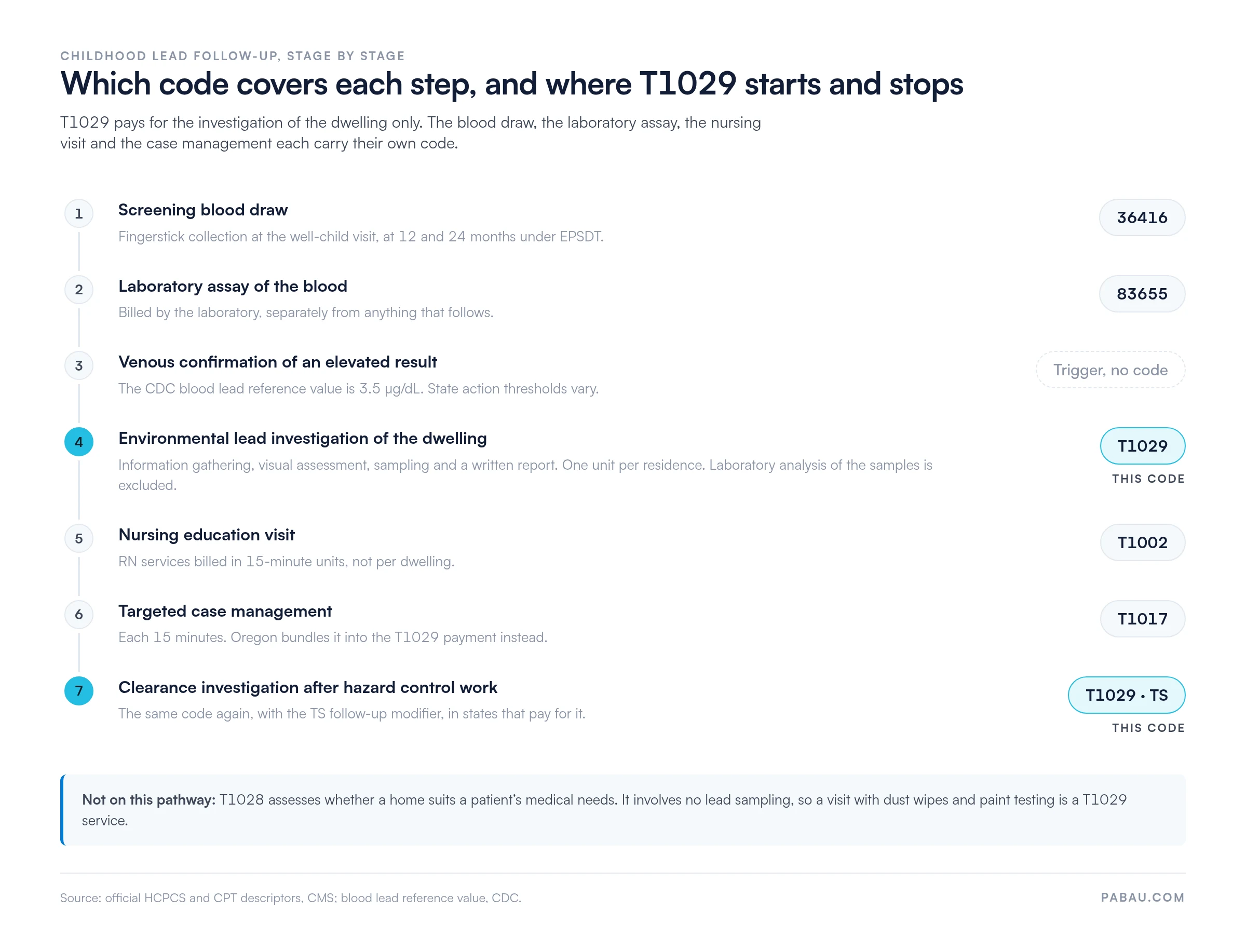
Each row below gives the descriptor and the one distinction that decides which code belongs on the claim.
The T1028 versus T1029 decision is the one worth slowing down for. T1028 asks whether the home can support the patient’s medical needs. T1029 asks where the lead is.
A home visit that included dust wipes and paint testing is a T1029 service, whatever the referral form called it. For descriptors across the rest of the T-code range, AAPC’s HCPCS code search is a quick lookup.
Recording the lead result, the referral, and the investigation date against one chart keeps the codes straight. Without that record, the follow-up visit gets coded from memory months later, when nobody recalls which visit was which.
T1029 denials cluster around a predictable set of mistakes, and most are correctable. Tracking which reason code comes back each cycle shows whether the problem sits in the claim or in the workflow that produced it.
Reviewing medical billing denial codes after each remittance cycle shows whether denials are isolated errors or a pattern. Where the same reason code repeats, the correction belongs upstream in intake or scheduling rather than in the claim.
Most of the work around a T1029 claim happens before and after the investigator’s visit. The practice that ordered the blood lead test confirms the venous result, makes the referral, and books the retest. Those dates then have to line up with the claim. When that sequence lives in a spreadsheet, the retest is usually the step that slips.
Practice management software like Pabau holds the whole sequence in one patient record. Lead results sit on the chart, and recalls fire automatically at the interval the state expects. The referral to the health department is logged with its date. Our claims management tools then carry the diagnosis, modifiers, and authorization details onto the claim.
The result is fewer children lost between an elevated result and the follow-up test, and fewer claims returned for a missing modifier. Billing staff stop rebuilding the documentation packet from memory, because it was captured at the point of care.

Pabau helps practices record blood lead results, schedule the retest, and send clean claims with the right modifiers and diagnosis codes attached.

T1029 pays for one comprehensive environmental lead investigation of one dwelling, with the laboratory analysis billed separately. Coverage rules, rates, modifiers, and the blood lead level that triggers the visit all come from the state Medicaid program rather than from CMS. Reading the current billing manual before the investigator goes out is cheaper than reworking the claim afterward.
Pabau’s claims management software helps practices track lead results, referrals, and documentation at the point of care instead of chasing them after submission. To see how it fits your billing process, book a demo.

Need a broader HCPCS billing foundation? What is medical billing covers the end-to-end process from code selection through claim payment.
Tracking denials after each remittance run? Denial management in healthcare explains how to categorize, appeal, and prevent recurrent claim denials.
Submitting T1029 claims electronically? Electronic remittance advice explains how ERAs work and how to read 835 transaction data to reconcile Medicaid payments.
T1029 covers a comprehensive environmental lead investigation of one dwelling. The service includes information gathering, a visual assessment of the property, environmental sampling, and a written report naming each lead hazard found. Laboratory analysis of those samples is excluded and billed separately.
A state-certified lead risk assessor or lead hazard investigator performs the investigation. In most states the local health department either employs that investigator or contracts with a certified private assessor. Wisconsin allows only a certified investigator or risk assessor to perform the follow-up clearance investigation.
Yes. T-codes in HCPCS Level II are maintained by CMS for state Medicaid agencies, and Medicare does not reimburse them. Commercial payers rarely cover T1029. Each state sets its own rate, coverage rules, and modifier requirements for the investigation.
No. The official descriptor excludes laboratory analysis, so the paint, dust, soil, and water samples are analyzed and billed under their own codes. Bundling the analysis into the T1029 line either denies outright or draws a post-payment review.
Modifier use is state-specific. Wisconsin requires the EPSDT modifier EP in the primary position, and TS identifies a follow-up clearance investigation after hazard reduction work. Some states also use their own U1 through U9 modifiers to flag the funding source.
Usually once. Oregon limits reimbursement to one investigation per dwelling, and Wisconsin allows one per residence per provider each rolling year. A single unit covers every child living at that address. Clearance investigations are billed separately with the TS modifier.
CDC clinical guidance asks clinicians to arrange an environmental investigation once a child’s blood lead level reaches 3.5 micrograms per deciliter. That figure is the CDC blood lead reference value. State Medicaid action thresholds vary, and some programs still use a higher number.
The codes seen most often are T56.0X1A (toxic effect of lead, accidental, initial encounter) and T56.0X4A (undetermined intent). R78.71 reports an abnormal lead level in blood, and Z77.011 covers suspected exposure to lead. Several states require a lead toxicity code first.



