

CCSD code G5100: Bypass of duodenum billing guide
CCSD code G5100 bills a bypass that leaves the duodenum in place CCSD code G5100...

Last Updated: Oct 16, 2026
HCPCS code S0812 is the Level II code for phototherapeutic keratectomy (PTK). This excimer laser procedure removes diseased tissue from the front of the cornea. Surgeons use it for corneal scars and opacities, superficial dystrophies, Salzmann's nodular degeneration and recurrent corneal erosions that conservative care has not settled.
S0812 is a temporary national S-code, effective since July 1, 2001. Medicare does not recognize it, so it is billed to private payers that accept S-codes. Payers that cover PTK limit it to corneal disease, and some narrow the list further. That therapeutic purpose is what separates S0812 from S0810, the PRK code, and it shapes the diagnosis, paperwork and payer checks that follow.
Let Pabau's smart automation suggest the right codes, reduce claim denials, and keep your practice compliant—effortlessly.
Automate repetitive tasks and focus on what matters most—your patients.
Reduce coding errors and ensure compliance with the latest regulations.
Clean claims, fewer denials, and faster reimbursements.
Powerful insights and reporting to help your practice thrive.
HIPAA compliant SOC 2 certified GDPR-compliant Trusted by 4,000+ clinics worldwide

HCPCS code S0812 reports phototherapeutic keratectomy (PTK), an excimer laser treatment for diseased corneas rather than vision correction.
Photorefractive keratectomy (PRK) for myopia, hyperopia or astigmatism belongs on S0810, so the documented reason for surgery decides the code.
Pair S0812 with a corneal diagnosis such as H17.- scars, H18.5- dystrophies or H18.83- recurrent erosion, never an H52 refractive code.
Medicare does not accept S-codes, and commercial PTK coverage varies, so check each plan’s covered indications before surgery.
Confirm whether each payer wants S0812 or a CPT code such as 65400 before the claim goes out.
HCPCS code S0812 reports phototherapeutic keratectomy (PTK). The surgeon uses an excimer laser to remove thin, even layers from the front of the cornea. The aim is a smoother, clearer surface, not a new glasses prescription.
PTK treats disease. It clears superficial scars and opacities, flattens irregular nodules and gives a fragile epithelium a smooth base to reattach to. Payer policies position it as an option before lamellar keratoplasty when the damage sits near the surface.
The code belongs to the HCPCS Level II S-series. The CMS HCPCS workgroup creates these temporary national codes for private payers, so Medicare does not accept them.
PTK and PRK use the same excimer laser. Several payer policies even call them technically the same procedure. The reason for treatment is what differs, and that reason picks the code.
Watch for one trap in the notes. PTK often shifts refraction toward hyperopia as a side effect. That shift is a known outcome, and it does not turn a corneal treatment into PRK.
Some surgeons plan both goals in a single session. In that case, ask the payer before surgery how to report it. Many plans exclude the refractive portion outright.
Several published commercial policies list five indications for PTK. The wording below follows the BCBSIL and QualChoice policies. Other plans narrow it, so check each policy.
That last indication carries a condition. The record must show the erosions kept returning despite lubricants, hypertonic saline, patching, bandage contact lenses or gentle debridement.
Outside these five, BCBSIL and QualChoice class PTK as experimental or investigational. QualChoice names infectious keratitis specifically. A refractive goal on its own never qualifies.
The diagnosis tells the payer why the cornea needed treatment. Pick the ICD-10-CM code for the corneal condition and code it to the treated eye. Skip H17.9, the unspecified scar code, whenever the chart says where the scar sits.
Laterality sits in the final character of these codes. It should match the RT or LT modifier on the claim line.
Keep H52 codes off a PTK claim. Myopia, hyperopia and astigmatism describe refractive error, which points the payer straight to PRK and an elective exclusion.
Here is how a typical recurrent erosion case moves through billing. The patient details are illustrative.
Change one fact and the code changes too. If the same patient wanted laser surgery to reduce myopia, the case would be PRK on S0810. Most plans would then deny it as elective.
Medicare does not recognize S-codes, so S0812 never goes on a Medicare claim. That rule concerns the code set. Whether the payer covers PTK itself is a separate question.
Payers that reject S-codes expect a CPT code instead. The BCBSIL PTK policy lists four CPT codes alongside S0812:
The right choice depends on the payer and the operative note. Ask the Medicare Administrative Contractor or the plan first, and file its answer with the case. Medicare Advantage and Medicaid plans set their own rules, so check each provider manual.
S0812 has no national fee schedule amount either. The rate comes from each private payer contract. The decision path below puts the three checks from this guide in the order they settle the code.
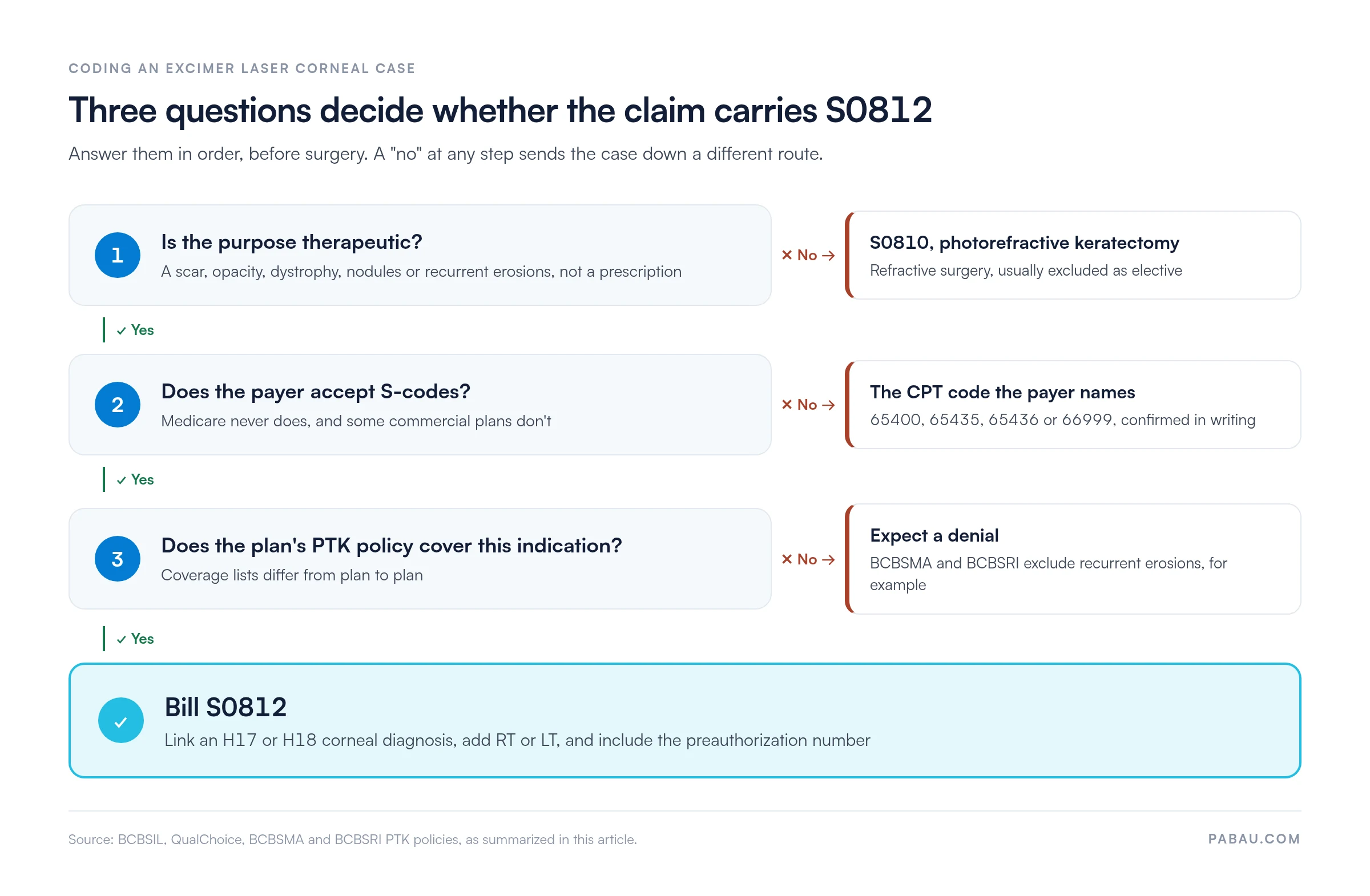
Most corneal codes near S0812 describe refractive surgery, such as S0800 for LASIK. Only S0812 and the CPT options above describe therapeutic laser work.
PTK approvals turn on the record, so build the file before you request authorization. Reviewers usually look for six items.
Good medical billing compliance means this file exists before the claim does. Assembling it after a denial costs weeks.
Write the purpose of the procedure in the surgeon’s own words in the plan. A line such as “PTK to remove anterior stromal scar, right eye” leaves a reviewer little room to read the case as refractive surgery.
Commercial coverage varies. Some plans cover the five indications listed earlier, while others restrict PTK to deeper disease or call it investigational.
Policies change, so pull the current version before each request. Run insurance eligibility verification at the same time to confirm the plan is active.
Most PTK denials trace back to a short list of errors. Each one has a simple fix.
A steady denial management routine catches repeat errors. Log each PTK denial reason and review the pattern monthly.
Do S0812 lines need RT or LT? Usually, yes. Eye procedures are reported per eye, and the modifier should match the diagnosis.
What if both eyes are treated on one day? Payers differ. Some want two lines with RT and LT, while others accept modifier 50. Check the plan policy first.
Does the excimer laser get its own line? No. S0812 describes the whole procedure, so the laser ablation is not billed separately.
Ophthalmology billing teams often track authorization numbers, payer policies and diagnosis codes in separate places. Each handoff is a chance to drop a detail the claim needs.
Pabau, the practice management platform we build, keeps the patient record and the claim together. Its claims management software pre-fills the claim from the record. It also checks required fields, such as authorization numbers, before the claim can be sent.
US practices submit through Claim.MD, with eligibility checks and remittance posting built in. Your team still chooses the code and confirms payer rules, and Pabau makes sure the claim carries what you recorded.


Pabau pre-fills claims from the chart and checks required fields, such as authorization numbers, before you submit. See it in a live demo.

Code S0812 from the indication, not the laser. A chart that describes a scar, a dystrophy or erosions that resisted conservative care supports PTK. A chart that describes a prescription belongs on S0810.
The work that pays happens before surgery. Confirm the payer takes S-codes and covers the indication, then secure authorization with the conservative-care history attached. Do that, and the authorization and the claim tell the same story.
Book a demo to see how Pabau carries PTK documentation from the patient record onto a complete claim.

Need a clean-claim framework for ophthalmology billing? Clean claim requirements in medical billing covers what every professional claim needs to clear payer edits without a rejection.
Fighting repeat PTK denials? Denial management in healthcare explains how to track, appeal and prevent the most common claim rejections.
New to the revenue cycle behind S0812 claims? What is medical billing outlines the full cycle from patient eligibility through payment posting.
Checking corneal thickness before PTK? CPT code 76514 for corneal pachymetry explains how to bill the thickness measurement behind depth-limited PTK policies.
Mapping an irregular corneal surface? CPT code 92025 for corneal topography covers coding and reimbursement for the imaging behind many surface-disease workups.
PTK stands for phototherapeutic keratectomy. It is an excimer laser procedure that removes thin layers of diseased tissue from the front of the cornea to smooth and clear it.
No. Superficial keratectomy removes tissue mechanically, for example by scraping. PTK uses an excimer laser to ablate tissue in even, controlled layers, which suits deeper or irregular surface disease.
Usually not. Numbing eye drops are standard, and the patient stays awake through the procedure.
The surface epithelium usually regrows within about a week, under a bandage contact lens. Vision can take longer to settle, and the surgeon sets the follow-up schedule.
Yes. Dystrophies and erosions can return, and surgeons sometimes retreat the same eye. Payers usually review a repeat as a new request, so document the recurrence.
Not for Medicare. Medicare treats S-codes as invalid and needs a CPT code instead. Private payers that accept HCPCS S-codes can still reimburse S0812 under their own coverage rules.



