

HCPCS code E0198: Water pressure pad billing guide
HCPCS code E0198 is a water pad for a standard mattress HCPCS code E0198 is the ...

Last Updated: Oct 13, 2026
M0076 is the HCPCS Level II code for prolotherapy, the injection of a sclerosing solution into a joint, ligament, or tendon attachment. One session bills as one unit, however many sites the practitioner treats.
The code is valid, but payment is the hard part. Medicare treats prolotherapy as experimental and covers none of it, and most commercial plans say the same. Payment then depends on an Advance Beneficiary Notice signed before treatment, or a prior authorization granted in writing.
Let Pabau's smart automation suggest the right codes, reduce claim denials, and keep your practice compliant—effortlessly.
Automate repetitive tasks and focus on what matters most—your patients.
Reduce coding errors and ensure compliance with the latest regulations.
Clean claims, fewer denials, and faster reimbursements.
Powerful insights and reporting to help your practice thrive.
HIPAA compliant SOC 2 certified GDPR-compliant Trusted by 4,000+ clinics worldwide

HCPCS code M0076 is the Level II code for prolotherapy, and the official CMS descriptor is a single word, Prolotherapy.
One session bills as one unit, however many joints or ligament insertions the practitioner treats in the visit.
Medicare and most commercial plans call prolotherapy experimental, so a signed ABN or a granted prior authorization has to come first.
Billing M0076 with CPT injection codes 20550 to 20553 on the same date of service triggers an unbundling denial.
Pabau’s claims management software blocks submission until every required claim field is complete, and its code libraries let billers look up M0076.
HCPCS code M0076 is the Healthcare Common Procedure Coding System Level II code for prolotherapy. The official CMS descriptor is a single word, Prolotherapy. The procedure itself is the injection of a sclerosing or irritant solution into a joint, ligament, or tendon attachment.
One session equals one unit. Treat four sites in a single visit and the claim still carries one unit of M0076. The M-series sits inside the set of HCPCS Level II codes maintained by CMS. That set exists for medical services CPT does not describe well.
The table below holds the reference data a biller needs when setting M0076 up in a practice management system.
Prolotherapy under M0076 means injecting a sclerosing or irritant solution to provoke an inflammatory repair response. The target is a joint, a ligament insertion, or a tendon attachment. Some clinical settings call the same procedure proliferative therapy or regenerative injection therapy.
The usual injectate is concentrated dextrose, typically 12.5% to 25% in water. Practitioners also use other sclerosing agents such as sodium morrhuate. Chronic low back pain, knee pain, and shoulder instability account for most of the sessions a musculoskeletal practice bills.
Several injection procedures get coded to M0076 by mistake. Each one has its own pathway, and reaching for M0076 instead draws denials and audit attention.
Use M0076 when the injectate is a sclerosing agent and the intent is proliferative. Use a CPT injection code when the injectate is a corticosteroid, an anesthetic, or a biologic. HCPCS Level II exists for services CPT does not describe, so an approximate CPT code is the wrong call here.
These are the injection CPT codes most often used in error alongside or instead of M0076.
One pathway per encounter, chosen before the charge is entered. Never post M0076 and a CPT injection code for the same anatomical site on the same date of service.
The diagnosis on an M0076 claim has to carry medical necessity by itself. Most payers already treat prolotherapy as experimental, so a vague pain code hands the reviewer a second reason to deny.
Pick the most specific code the record supports. Our ICD-10-CM codes library lists the full set, and the CDC/NCHS ICD-10-CM web tool confirms current-year status before you bill.
Medicare does not cover prolotherapy. CMS classifies the procedure as experimental and investigational under Part B, and no National Coverage Determination grants coverage. The position is long-standing, and no billing workaround changes it.
That puts the weight on the Advance Beneficiary Notice of Non-coverage. It has to be issued and signed before the service, not at checkout afterward. A notice signed after treatment comes too late, and the practice can no longer bill the patient. Most Medicare prolotherapy breakdowns happen at exactly this step.
Run an eligibility check before every prolotherapy session. Confirming Medicare or Medicaid status ahead of the appointment gives your team time to prepare the ABN and get it signed. It also means patient-pay rates get collected at check-in, rather than chased after a denial.
Most major commercial payers mirror Medicare here. Blue Cross Blue Shield plans, Aetna, Cigna, and UnitedHealthcare each name prolotherapy as non-covered in their medical policies. The wording varies, from “not medically necessary” to “investigational”, but the remittance reads the same.
A minority of plans do cover it, usually self-funded employer plans operating under ERISA. For those, prior authorization is close to universal. Typical clinical criteria include:
Record the authorization number on the claim itself. An approved authorization that never reaches Box 23 produces a fresh denial for missing auth, separate from the coverage review.
M0076 has no published Medicare Physician Fee Schedule amount, because Medicare does not cover it. The CMS Physician Fee Schedule lookup tool returns no payment data for the code, which is expected rather than a data error.
Where a commercial plan does pay, the allowable is whatever the provider contract says. That figure varies by region, network, and plan tier.
Practices billing prolotherapy at self-pay rates usually price by the number of sites treated and by local market rates. Practice management software like Pabau posts remittance data back against the patient record. Its claims management software then shows which commercial contracts paid for prolotherapy, and at what rate.
For the descriptor itself, AAPC’s HCPCS code reference is a reasonable place to cross-check how payers describe M0076 in their own systems.
Thin documentation is the second-biggest cause of M0076 denials, behind the experimental classification itself. When a plan does cover prolotherapy, or when a denial goes to appeal, the record has to prove every element of medical necessity.
Capture these at the point of service, not at claim submission:
Build these fields into the procedure note template, so compliance does not depend on which practitioner writes the note. Then audit a sample of prolotherapy encounters each quarter, before a denial pattern has time to form.
An M0076 claim passes six checkpoints, and it dies at the first one it fails. Five of those are cleared before the patient leaves the building. Only the last, the session count, depends on what happened earlier in the plan year.
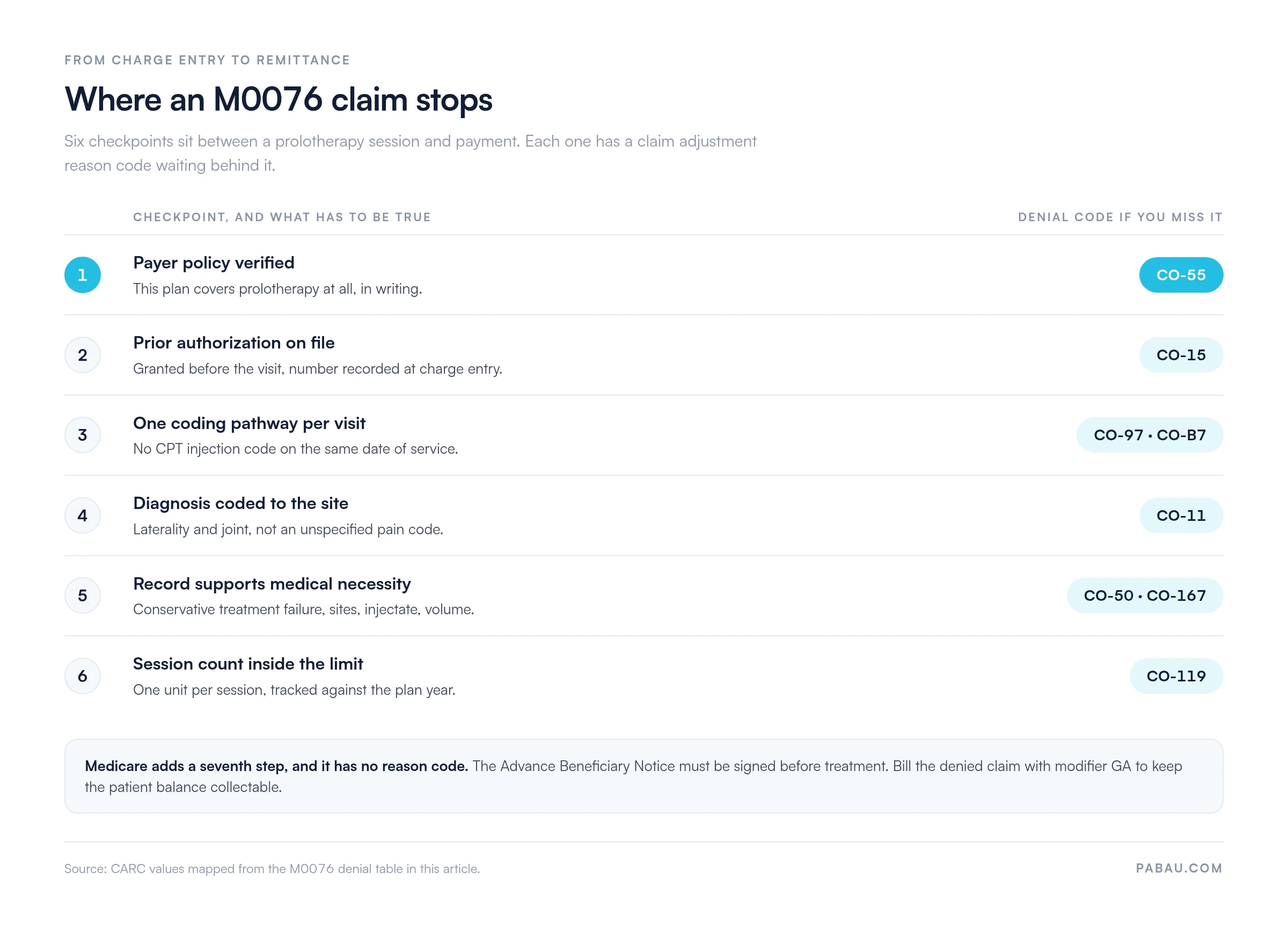
Here is the same path as a working sequence, from the booking call through to the remittance.
The unbundling denial is usually somebody else’s charge. It happens when one clinician posts M0076 and another posts CPT 20610 for a steroid injection given at the same visit. Run a same-date charge review on every prolotherapy encounter before the batch goes out, rather than after.
Two denials often arrive for the same claim. The payer rejects the service as experimental under CO-55, and an unbundling edit fires because a CPT injection code shared the date of service.
When that pattern repeats, the fix belongs in charge entry rather than in the appeal. Sound denial management in healthcare starts by grouping denials by cause, then closing each cause in turn.
Appeals on experimental grounds rarely succeed. They earn the time in two cases only. The payer’s own policy carries an exception for the diagnosis, or the denial was clerical, such as a wrong NPI on the claim. Read the current LCD and medical policy first, and confirm an appeal pathway exists at all.
The denial usually lands about four weeks after the session, and the fix then costs hours of rework. The information that would have prevented it was already in the patient record on the day of the visit. Payer policy, authorization number, diagnosis code, all of it sat there unused.
Pabau closes that loop at charge entry. Its claims management tools pre-fill the CMS-1500 from the record. The code attached to the service lands on the charge line, and the diagnosis slots seed from the patient’s recorded problem list. Built-in ICD-10-CM and HCPCS lookup libraries let a biller confirm M0076 and its supporting diagnosis without leaving the claim.
Before a claim can leave the practice, Pabau checks that every required field is complete, the authorization code included. The send button stays locked until they are. Remittances then post back against the same record, so you can see which prolotherapy sessions paid and which came back denied.

Pabau pre-fills the CMS-1500 from the patient record and checks every required field before the claim can go out. Remittances post back against the same record, so you can see which prolotherapy sessions paid.

Prolotherapy is a service most payers will not fund, and no coding trick changes that. Three steps stay under the practice’s control. Did the patient know before the session, was the authorization chased early enough, and did the claim go out clean? Get those three right and M0076 stops being a monthly write-off.
The trade-off worth remembering is time. Five minutes of policy checking at booking costs far less than an hour of appeal writing six weeks later. Book a demo to see how Pabau handles HCPCS billing, from charge capture through to remittance.

Setting your own price because there’s no fee schedule to peg it to? Patient self-pay billing covers how to price, collect, and document out-of-pocket procedures like this one.
Patient wants to submit the claim to their own insurer instead? Superbill shows how to itemize the code, charge, and diagnosis so they can try for reimbursement themselves.
Already got a denial back on an M0076 claim? Denial codes maps the CARC code on the remittance to the fix that clears it.
No. Medicare treats prolotherapy as experimental under Part B, and no National Coverage Determination grants coverage. Get a signed ABN before the session, then append modifier GA when you bill the denied claim.
One. M0076 bills per session, not per injection site. A visit treating the knee, the shoulder, and two ligament insertions still generates a single unit. Extra units invite a CO-119 denial.
No. M0076 belongs to HCPCS Level II, the code set CMS maintains for services CPT does not describe. CPT codes such as 20550 and 20610 cover different injections, so they are not substitutes.
No. Both codes on one date of service for the same site fires an unbundling edit. Pick the pathway before the charge is entered. Use M0076 for sclerosing agents and a CPT code for steroid or anesthetic injections.
The most specific one the record supports. M25.561 for right knee pain beats M25.50. Site and laterality matter, because reviewers read an unspecified pain code as weak medical necessity.
The practice loses the right to bill the patient. Medicare requires the notice before the service, so a signature collected at checkout comes too late. Keep the form ready at check-in instead.



