

ICD-10 Code S42.444P: Medial epicondyle fracture, right humerus
ICD-10 Code S42.444P: full descriptor and code validity ICD-10 Code S42.444P car...

Last Updated: Oct 13, 2026
Billable Code Specific Code
N06.0 is the billable ICD-10-CM code for isolated proteinuria with minor glomerular abnormality.
Coders often confuse it with the R80.x symptom codes, or reach for it when the patient has nephrotic syndrome. Nephrotic syndrome with the same histology belongs in N04.0 instead. The fourth character rests on physician documentation of the histologic lesion type, with or without a biopsy report.
Let Pabau's smart automation suggest the right codes, reduce claim denials, and keep your practice compliant—effortlessly.
Automate repetitive tasks and focus on what matters most—your patients.
Reduce coding errors and ensure compliance with the latest regulations.
Clean claims, fewer denials, and faster reimbursements.
Powerful insights and reporting to help your practice thrive.
HIPAA compliant SOC 2 certified GDPR-compliant Trusted by 4,000+ clinics worldwide

N06.0 applies to isolated proteinuria with a documented minor glomerular abnormality, not to proteinuria that is still being worked up
The fourth character comes from documented histology, so the record needs a biopsy report or an explicit physician statement of the lesion
Minimal change disease maps to N06.0 only when the picture is isolated proteinuria; nephrotic syndrome features send the same histology to N04.0
The N06 category carries a single Excludes1 note, covering proteinuria not associated with a specific morphologic lesion (R80.0)
Pabau’s claims management software captures ICD-10-CM codes at the point of documentation and submits through the Claim.MD clearinghouse
ICD-10 code N06.0 is the billable diagnosis code for isolated proteinuria with minor glomerular abnormality. It applies when the record documents protein loss without nephrotic syndrome, alongside a minor glomerular lesion. The code sits within the N00-N08 glomerular diseases block, Chapter 14 of the CDC/NCHS ICD-10-CM web tool. The table below summarizes the reference data coders check first.
Isolated proteinuria is significant protein loss in the urine without the full clinical picture of nephrotic syndrome. The patient has no edema, no hypoalbuminemia, and no hyperlipidemia. The minor glomerular abnormality qualifier refers to a histologic finding on kidney biopsy, or one documented by the treating physician. It describes minimal or no structural glomerular damage at the light microscopy level.
Minimal change disease is the most commonly cited condition in this category. On light microscopy the glomeruli appear normal. Even so, the abnormality shows only on electron microscopy, as podocyte foot process effacement. Mesangial hypercellularity can also qualify as a minor glomerular abnormality, depending on biopsy interpretation.
The fourth-character subcategory across the N06 block is driven entirely by the histologic qualifier. That qualifier must come from a biopsy report, or from explicit physician documentation stating the lesion type. Without either, the coder cannot validate N06.0 over another N06 subcode.
All N06 subcodes share the same parent descriptor, and they differ only by the fourth character. That character identifies the histologic finding, so the biopsy report or the physician-documented lesion type decides which one you assign. The FY2026 range runs from N06.0 through N06.9, plus N06.A.
The N06 category carries one Excludes1 note, and it is narrower than most coders expect. The note reads: proteinuria not associated with specific morphologic lesion (R80.0). Even so, nothing in the tabular list bars N06 from sharing a claim with the other N00-N08 categories, or with chronic kidney disease.
R80.x codes represent proteinuria as a symptom, used only when a definitive glomerular diagnosis has not been established. Once the physician documents a confirmed diagnosis with a specified morphological lesion, the appropriate N06 code displaces R80.x. In fact, the ICD-10-CM Official Guidelines are explicit on this point. Symptom codes are not used when a definitive diagnosis is documented.
This is the most important distinction in the N00-N08 block for coders working with minimal change disease patients. In short, the clinical syndrome determines the code category, and the biopsy finding sets the fourth character within it.
A patient with biopsy-proven minimal change disease, significant edema, serum albumin below 3.0 g/dL and a urine protein-to-creatinine ratio above 3.5 g/g belongs in N04.0. By contrast, the same biopsy finding in a patient with asymptomatic proteinuria and no nephrotic triad maps to N06.0. Coders who anchor to the biopsy result and ignore the clinical syndrome invite medical-necessity denials.
Two questions settle almost every case, and they run in a fixed order. The chart below walks the record from a first proteinuria result to a fourth character.
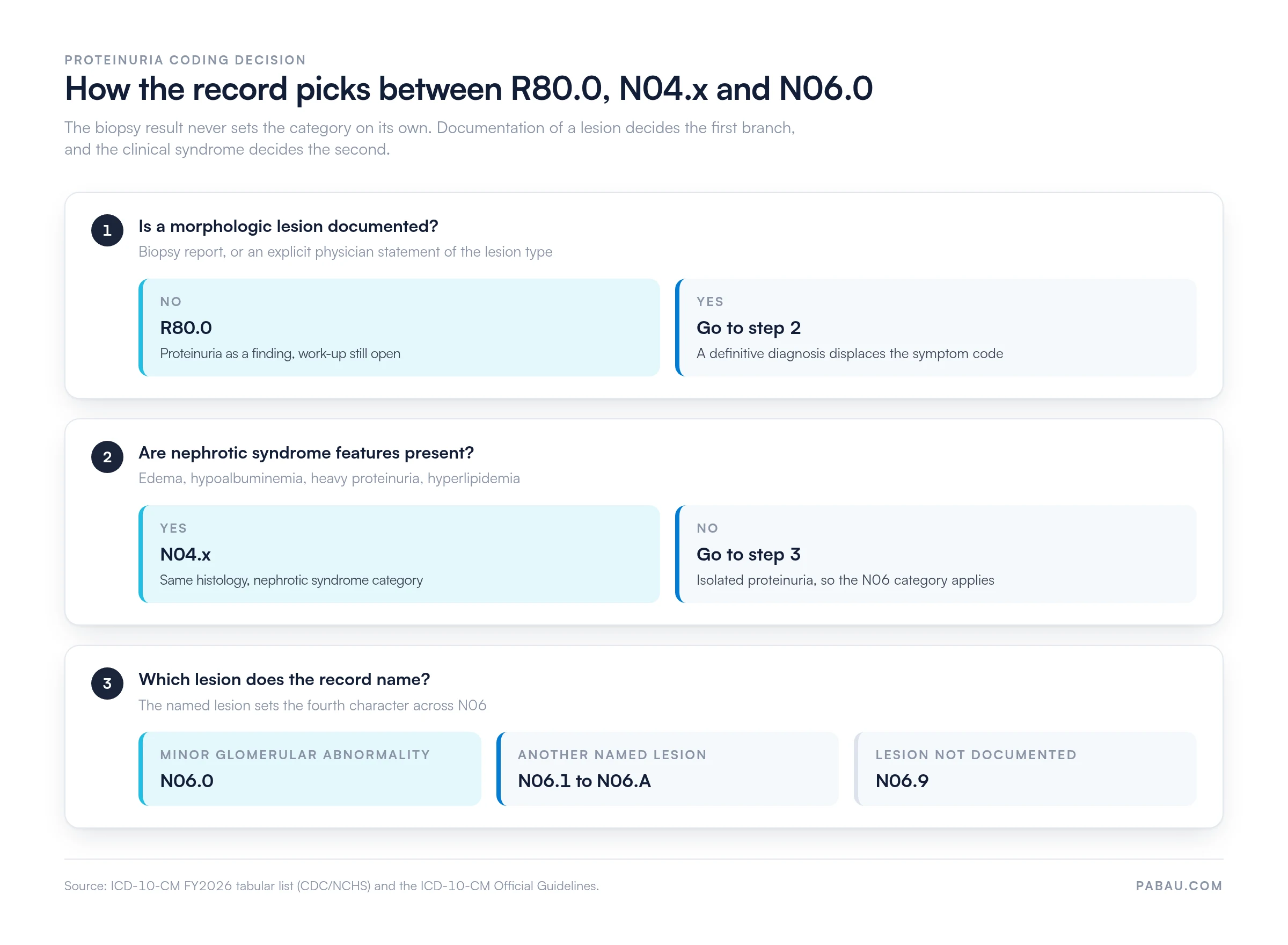
The medical record must contain specific elements before N06.0 is coded. The fourth-character qualifier depends on documented detail, never on coder inference. Likewise, the same standard runs through medical billing compliance work more broadly, where an auditor reads the note rather than the claim line. For N06.0, these are the required elements.
N06.0 does not include or assume chronic kidney disease. Instead, the two conditions are separately coded when both are documented. According to CMS ICD-10-CM coding guidance, instructional notes in the Tabular List direct coders to assign additional codes for associated conditions.
A patient with isolated proteinuria from minimal change disease, Stage 3a CKD (eGFR 45-59 ml/min) and hypertension needs N06.0, N18.31 and I12.9 at minimum. The CKD stage must reflect the GFR lab values in the record, not the physician’s own severity assessment.
Run a dual-code audit on every N06 claim. Check the patient record for a documented CKD stage, then check whether N18.x reached the claim. Payer audits in nephrology routinely pick up the claim that carries the glomerular diagnosis and drops the CKD stage. The GFR value in the most recent lab report sets the stage.
N06.0 alone is not a high-risk or high-cost code, so it rarely triggers prior authorization. Instead, the diagnostic and therapeutic procedures around it often do. Percutaneous kidney biopsy, immunosuppressant therapy and repeat nephrology visits often require pre-authorization under Medicare Advantage and commercial plans. So, practices submitting claims online should route them through a clearinghouse that validates ICD-10-CM codes against payer edits first.
From a Medicare inpatient perspective, N06.0 groups under the kidney and urinary tract diagnosis categories of the MS-DRG system. CMS runs version 43.0 for FY2026, updated to version 43.1 in April 2026. The DRG assignment depends on the procedures billed alongside the diagnosis and on any complications or comorbidities. For outpatient claims, the Ambulatory Payment Classification follows the CPT procedure code rather than the diagnosis.
Local Coverage Determination policies for nephrology services vary from one Medicare Administrative Contractor to another. So, practices should check whether their MAC has an active LCD covering kidney biopsy or proteinuria diagnostic services. The next check is whether that LCD lists N06.0 as a covered indication. Pre-submission edits catch an LCD mismatch before the payer does.
N06.0 claims fail for five predictable reasons, and each has a documentation or coding fix. The remittance advice usually carries CARC 4, CARC 16 or CARC 97. Those mean the service does not match the diagnosis, the claim lacks information needed for adjudication, or payment sits in another service’s allowance. The full set of denial reason codes maps each one to the correction it calls for.

Denial work starts before submission. Running pre-submission edit checks through a clearinghouse clears most CARC 4 and CARC 97 rejections before they turn into rework.
N06.0 is valid for FY2026 claims, covering October 1, 2025 through September 30, 2026. In fact, the CMS ICD-10-CM FY2026 release published no descriptor changes, addenda or errata affecting N06.0 or the N06 category. Overall, the descriptor, chapter placement and Excludes1 note are unchanged from FY2025.
Coders can verify current-year status through the CDC/NCHS ICD-10-CM web tool, which publishes the official annual tabular list. CMS releases each new code set in the preceding months, with an effective date of October 1.
Bookmark the CMS ICD-10-CM FY2026 files page and set a calendar reminder for September 1 each year. CMS publishes the following fiscal year’s code set files by early August. That gives practices about six weeks to update EHR and billing code tables before October 1. N06.0 has been stable for several years, but the N00-N08 block has seen descriptor refinements in past cycles.
In most nephrology practices the biopsy report, the clinical note and the claim live in three systems. The coder reads the note in one, checks the lesion type in another, then types N06.0 into a third. As a result, every hop is a chance for the fourth character to land without the documentation that supports it.
Pabau is practice management software that keeps the clinical record and the billing record on the same patient file. The nephrology note, the UPCR result and the morphological qualifier sit beside the diagnosis code the coder assigned. Pabau’s claims software for practices then submits through the Claim.MD clearinghouse, with eligibility checks and claim-level edits ahead of the payer.
When a denial comes back, the ERA lands against the original claim line with its CARC code attached. As a result, your biller can see which N06.0 claim was rejected, and which note to open, without rebuilding the encounter from three exports.

Pabau captures ICD-10-CM codes inside the clinical note and submits claims through the Claim.MD clearinghouse, with real-time eligibility checks and ERA-level denial tracking built in.

N06.0 rewards precision in the chart rather than speed at the keyboard. Read the syndrome first, because it decides the category, and read the lesion second, because it sets the fourth character. A biopsy report on its own answers only half of that.
The trade-off worth remembering is that N06.9 is always available and almost always the weaker claim. In short, chasing the physician for the lesion type takes one query today and saves an appeal later. Book a demo to see how Pabau keeps the nephrology note and the claim that depends on it in the same record.

Need to understand how ERA denial codes map back to claim errors? Electronic remittance advice processing explains how CARC and RARC codes in 835 files identify the exact denial reason for each rejected claim line.
Want a structured framework for managing denied claims before they age? Denial management in healthcare covers the appeal workflow, timelines, and documentation strategies for overturning preventable denials.
Coding comorbid conditions alongside glomerular disease diagnoses? Medical billing fundamentals covers the sequencing rules and additional-code instructions that apply when multiple diagnoses appear on the same claim.
ICD-10 code N06.0 covers isolated proteinuria with minor glomerular abnormality. Significant protein appears in the urine without the clinical features of nephrotic syndrome. A biopsy report or explicit physician documentation confirms the minor glomerular lesion.
Yes, N06.0 is a billable, valid-for-submission ICD-10-CM code for FY2026. Payers accept it on inpatient and outpatient claims. CMS has not retired or revised it in any FY2026 addendum.
N06.0 requires a confirmed diagnosis with a documented morphological lesion. R80.x is a symptom code, used only while a definitive glomerular diagnosis is still open. Once the physician documents isolated proteinuria with a minor glomerular abnormality, N06.0 replaces R80.x.
N06.0 applies when the patient has isolated proteinuria with no edema, hypoalbuminemia or hyperlipidemia. N04.0 applies when the same histology presents alongside the full nephrotic syndrome picture. The clinical syndrome decides the category, and the biopsy result decides the fourth character.
Yes. N06.0 and N18.x are separately coded when both conditions are documented. Stage the CKD from GFR values rather than symptom severity. Where hypertensive CKD is documented, assign I12.x or I13.x alongside both.
No, a biopsy is not mandatory, but the morphological qualifier must be documented. A biopsy report is the strongest support. Explicit physician documentation of the lesion type can substitute where no biopsy was performed. Coders cannot infer the fourth character from clinical context.




