Sulcus Test: Shoulder Instability Assessment
The sulcus test is an orthopedic special test that checks for inferior glenohume...

3
Last Updated: Oct 22, 2026

Five GLP-1 receptor agonists remain available in the US, and albiglutide and lixisenatide have both been discontinued.
Only semaglutide, liraglutide, and tirzepatide carry a chronic weight-management approval, each under a brand separate from its diabetes brand.
Rybelsus is the only oral GLP-1, and every agent approved for weight management is injectable.
Absolute contraindications are limited to medullary thyroid carcinoma history, MEN 2, and known hypersensitivity to the drug.
Pancreatitis is a warning rather than a contraindication, so you monitor for it and stop the drug if it is suspected.
Every FDA-approved GLP-1 agent in one chart, with generic name, brand names, delivery form, approved indication, and standard dosing frequency. Print it for the consult room, or attach it to your prescribing protocol.
Download templateThis GLP-1 medication list covers the five receptor agonists still available in the US: semaglutide, liraglutide, tirzepatide, dulaglutide, and exenatide. Albiglutide and lixisenatide have been discontinued.
Only three of the five carry a chronic weight-management approval, and each of them does so under a brand name separate from its diabetes brand.
The table below sets out every generic name, brand name, delivery form, approved indication, and dosing schedule in one place.
Underneath it you can see why the brand on the prescription decides what a payer will cover. The whole chart downloads as a PDF for your prescribing and consent workflow.
GLP-1 receptor agonists mimic glucagon-like peptide-1, a gut hormone that regulates blood sugar and appetite. The FDA approves them for type 2 diabetes and for chronic weight management in adults with obesity, or overweight plus a weight-related comorbidity.
Unlike older diabetes drugs, these agents deliver cardiovascular and weight-loss benefits independent of glucose control. That has made them first-line options in many diabetes guidelines. For a weight-loss practice it also means one molecule can sit behind two completely different treatment plans. Many of these patients also take cardiovascular drug classes, so keep that reference beside this chart.
Demand has followed. Our GLP-1 statistics page collects the figures on how quickly the category has grown.
The table covers every FDA-approved GLP-1 receptor agonist in the United States, including the two that have left the market. Each row gives the generic name, its brand names, the delivery form, the approved indications, and the standard dosing frequency.
Note: tirzepatide is technically a dual GIP/GLP-1 receptor agonist rather than a pure GLP-1 agonist, but clinicians group it with the GLP-1 agents. Albiglutide and lixisenatide left the US market for commercial reasons, not safety signals.
Only oral semaglutide (Rybelsus) comes as a tablet, and it is approved for type 2 diabetes alone. Every agent approved for chronic weight management is injectable, so route is not a choice on the weight-loss side.
Once-weekly injections tend to support adherence better than a daily tablet, because the patient has 52 doses to remember instead of 365. Rybelsus also has to be taken on an empty stomach, at least 30 minutes before the first food or drink of the day.
Efficacy pushes the same way. Semaglutide (Wegovy) and tirzepatide (Zepbound) produce the largest weight reductions in trials. Liraglutide (Saxenda) is the once-daily alternative for patients who cannot tolerate a weekly dose.
Not every GLP-1 on this list is approved for weight management. Semaglutide, liraglutide, and tirzepatide are dual-approved, each under two separate brands. Dulaglutide and exenatide are diabetes-only agents.
If diabetes is the main indication in your practice, the diabetes medication list covers the non-GLP-1 classes alongside these.
The split matters at the claim, not just at the prescription. Insurance pathways run off the diagnosis code and the brand together, so the patient record has to show which indication the prescription addresses.
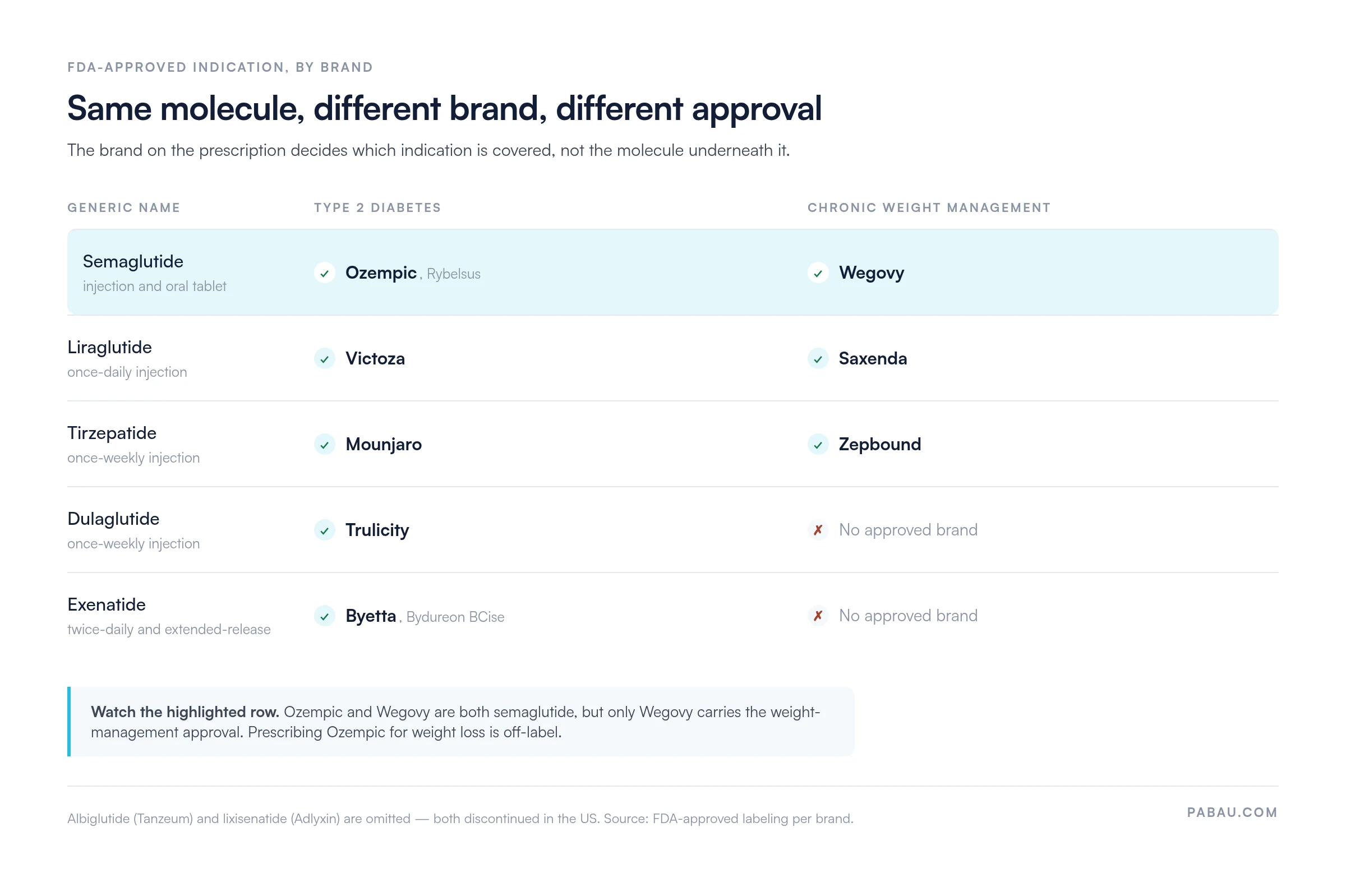
Off-label prescribing is where practices get caught. Ozempic is approved for type 2 diabetes only, so writing it for weight loss is an off-label use that needs its own consent and note. The same applies to Mounjaro. Zepbound is the tirzepatide brand a payer expects on a weight-management claim.
All GLP-1 medications carry an FDA boxed warning for thyroid C-cell tumors, based on rodent studies. Human risk has not been established. Nausea, vomiting, diarrhea, and constipation are common during dose escalation and usually settle as the patient titrates up.
Absolute contraindications are narrow. They cover a personal or family history of medullary thyroid carcinoma, multiple endocrine neoplasia type 2, and known hypersensitivity to the drug or its excipients.
Pancreatitis sits in a different category. FDA labeling treats it as a warning and precaution rather than a pre-treatment contraindication, so a prior episode does not automatically rule a patient out. Watch for persistent severe abdominal pain, and discontinue the drug if pancreatitis is suspected.
Check the current FDA prescribing information before you dispense. Labeling changes, and a chart printed last year will not tell you that it has.
The download is built to sit inside a prescribing workflow rather than a filing cabinet. Use it to:
Running that at volume is where paper falls over. A practice seeing 40 GLP-1 patients a month needs the eligibility screen, the consent, and the titration history in one record. That is the job weight loss clinic software is built for, and practice management software like Pabau keeps all three on one patient timeline.
Two companion forms slot straight into the same workflow. The Ozempic questionnaire covers pre-treatment eligibility questions, and the tirzepatide informed consent form covers the risks a patient signs off on.

Long-term data from the SUSTAIN and SCALE trial programs shows cardiovascular and weight-loss benefits holding past three years. The monitoring burden runs alongside that benefit. Annual thyroid checks, pancreatic symptom review, and the weight regain that follows discontinuation all need documenting.
Weight regain after stopping is the part patients ask about least and need to hear about most. Record the conversation, and set the next recall before they leave the room.
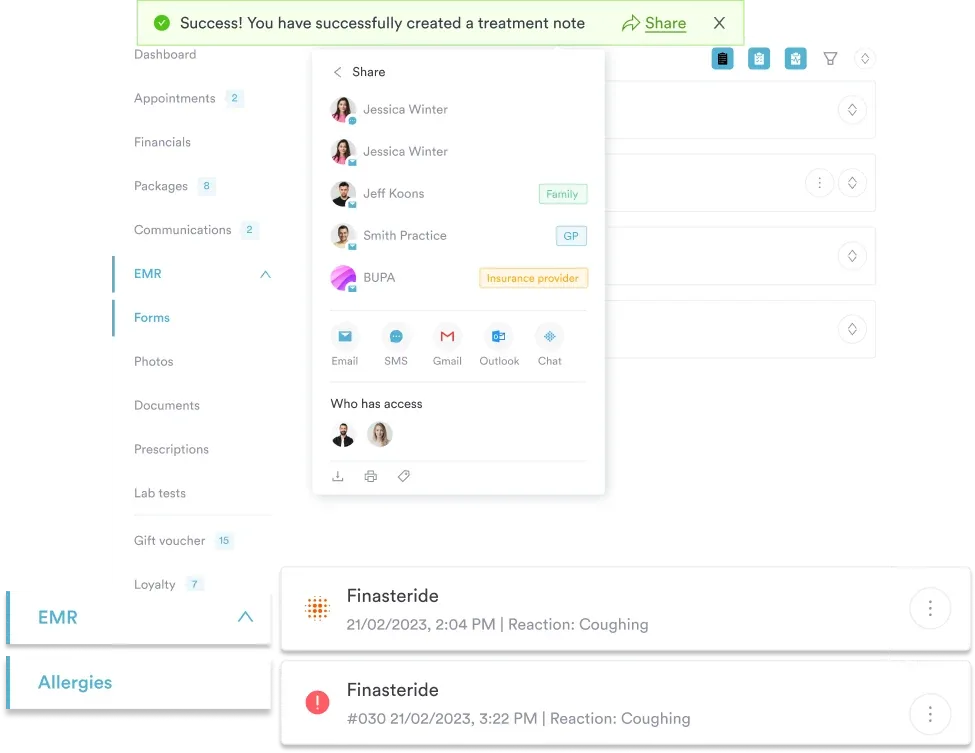
Most weight-loss practices run GLP-1 therapy across three or four disconnected places. Eligibility answers live in a paper questionnaire, consent in a signed PDF, dose changes in the clinician’s note, and weights in a spreadsheet.
Pabau puts all four on one patient record. The intake form asks the eligibility and contraindication questions before the consult is confirmed, and the answers stay attached to the chart. Consent is signed on screen and archived with a timestamp.
Dose titration, weight, and A1C sit on the same timeline, so a clinician picking up a follow-up sees the whole course in one screen. Automated recalls book the next review before the patient leaves, so the annual thyroid check does not slip.
The outcome is a record that stands up to an insurance review without anyone rebuilding it from four sources first.

Pabau captures eligibility screening, consent, dose titration, and follow-up weights against a single chart. Your team stops chasing paperwork across four systems.

The hard part of GLP-1 prescribing is not picking the molecule. It is proving, months later, that the indication on the chart matched the brand on the prescription.
So download the chart, then decide where the answers it produces are going to live. A reference sheet only pays off if the eligibility check, the consent, and the dose history end up somewhere you can retrieve them.
Book a demo to see how Pabau keeps GLP-1 screening, consent, and titration records in one place for your weight-loss program.

Want the numbers behind GLP-1 demand? Our GLP-1 statistics page collects the prescribing and market figures in one place.
Prescribing beyond the GLP-1 class? The diabetes medication list covers the other drug classes used in type 2 diabetes management.
Choosing a system to hold these records? Our guide to an EMR for a weight-loss practice walks through what the charting side has to do.
A GLP-1 receptor agonist is an injectable or oral medication that mimics glucagon-like peptide-1, a hormone that regulates blood sugar and appetite. The FDA approves GLP-1 medications for type 2 diabetes management and for chronic weight management in eligible adults.
Five remain available in the US: semaglutide (Ozempic, Wegovy, Rybelsus), liraglutide (Victoza, Saxenda), tirzepatide (Mounjaro, Zepbound), dulaglutide (Trulicity), and exenatide (Byetta, Bydureon BCise). Albiglutide (Tanzeum) and lixisenatide (Adlyxin) have been discontinued in the US. The table above gives the indications and dosing for all seven.
Yes. Ozempic is the brand name for semaglutide, a GLP-1 receptor agonist the FDA approves for type 2 diabetes. Wegovy is the same active ingredient approved for chronic weight management, so the brand rather than the molecule carries the indication.
Semaglutide (Wegovy) and tirzepatide (Zepbound) are approved specifically for weight loss and show the largest weight reductions in clinical trials. Liraglutide (Saxenda) is also approved for weight loss but is less potent. The choice comes down to patient tolerance, injection frequency, and insurance coverage.
Nausea usually fades after titration, while constipation or diarrhea can persist. Every GLP-1 carries a boxed warning for thyroid C-cell tumors and a warning about pancreatitis risk. Review patients annually for thyroid nodules, and ask about pancreatic symptoms at each follow-up.
Yes. The download above is built for use in consultations, patient education, and clinical documentation. Take it as a PDF, customize the fields to match your protocol, and store it alongside your prescribing workflow.