Botox reconstitution chart
A Botox reconstitution chart shows how much saline to add to a vial and how many...

2
Last Updated: Oct 6, 2026
Patient financing lets patients spread the cost of treatment over weeks or months instead of paying in full on the day. The four main forms are in-house payment plans, third-party lenders, medical credit cards, and buy now, pay later (BNPL). For your practice, the choice turns on who carries the loss if a patient stops paying, and when you get paid.
The Consumer Financial Protection Bureau (CFPB) estimated that medical debt affects about 100 million Americans, though the rule that release announced was later vacated. Below, we compare the models, then cover setup, legal traps, and patient scripts.

Patient financing lets patients pay over time, while a lender pays the practice upfront or the practice collects installments itself.
The four main models are in-house payment plans, third-party financing, medical credit cards, and buy now, pay later (BNPL).
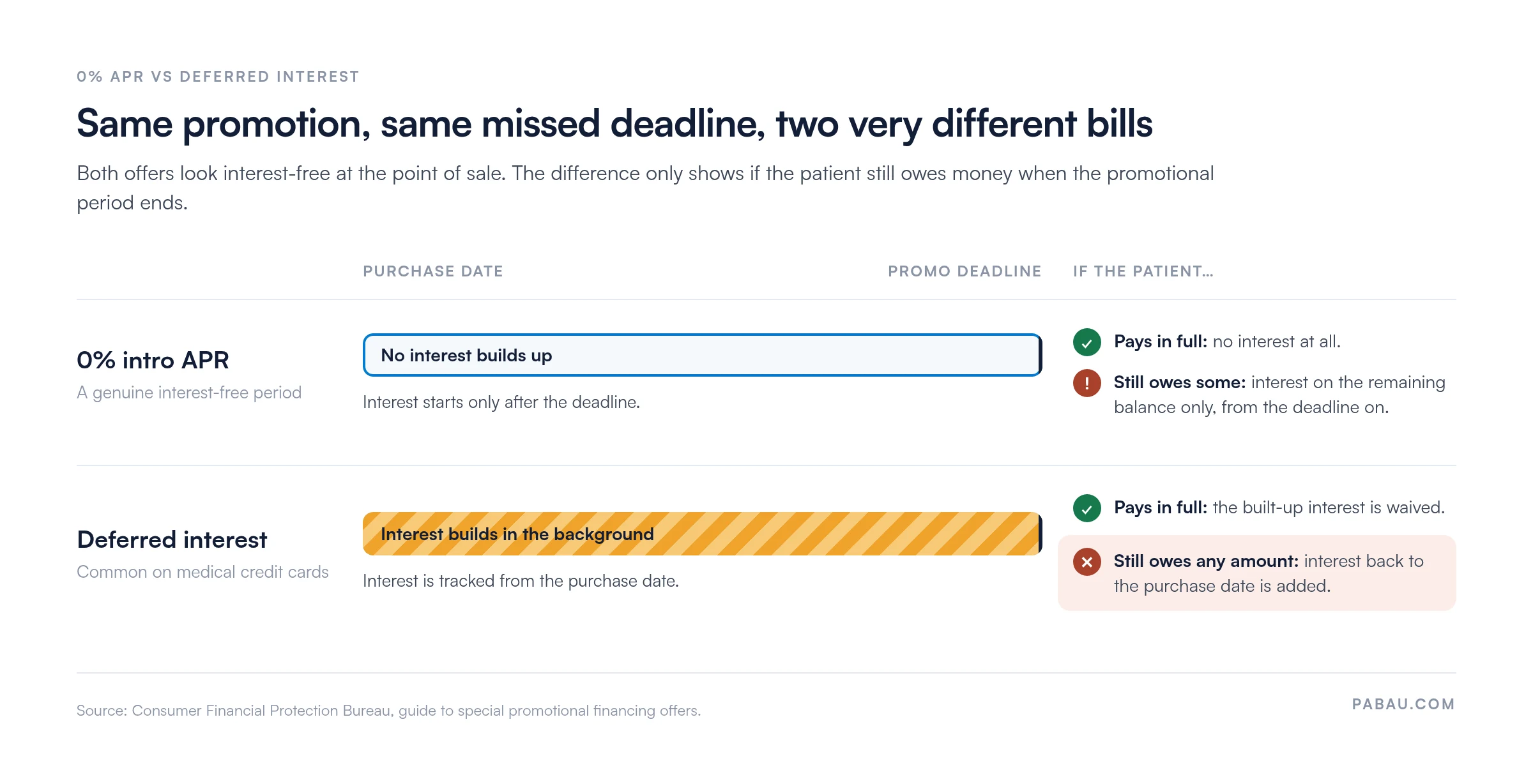
Deferred-interest products are NOT the same as 0% APR financing. Patients who miss the payoff deadline owe interest back to the purchase date.
An interest-free in-house plan paid in more than four installments still counts as credit under Regulation Z, so disclosures apply.
Raise financing during treatment planning, not at checkout, and document every offer, acceptance, and refusal.
Treatment cost is a common reason patients delay or decline care. In a May 2025 KFF poll, 36% of US adults said they had skipped or postponed needed care because of cost. So when a patient says “I’ll think about it,” they often mean “I can’t pay for this today.”
Elective, self-pay services show the effect most clearly. A patient weighing a $3,000 laser package is setting a lump sum against rent, holidays, and car repairs. Split it into $125 a month over two years and the conversation changes. The question becomes whether the monthly figure fits their budget.
Many practices report higher average invoice values once financing is on offer. The uplift varies by specialty and price point. The mechanism is simple, though. Financing lifts the spending ceiling a patient sets when they know they must pay in full today.
Each model moves default risk, cash flow, and admin work to a different place. Here is how they compare at a glance.
With an in-house plan, your practice is the lender. You set the terms, collect the payments, and absorb the loss if a patient stops paying. You avoid merchant fees, but you manage accounts receivable instead of banking cash.
Third-party financing flips that arrangement. The lender approves the patient and pays your practice a lump sum, minus a merchant fee. It then collects repayments directly from the patient. You get paid whether or not the patient finishes the schedule. For most small practices, that certainty is worth the fee.
Medical credit cards like CareCredit, a Synchrony product, and Alphaeon Credit work like standard credit cards at enrolled practices. Your practice signs up as a merchant, and patients pay with the card at the front desk.
Here is where front-desk scripts often go wrong. Many medical credit card offers use deferred interest, not 0% APR. The CFPB explains the difference. With a 0% intro APR, interest starts on any remaining balance only once the promotion ends.
With deferred interest, an unpaid balance at the deadline triggers interest backdated to the purchase date. The chart below shows how far apart those two bills can land.
Patients who expected 0% APR and then face a surprise charge tend to blame the practice that suggested the card, not the issuer.
BNPL in healthcare works like any consumer BNPL product. The patient splits the cost into fixed installments, often four payments over six weeks or monthly plans over 12 to 24 months. The provider pays the practice upfront after taking a fee. Platforms like Cherry were built specifically for aesthetic and elective-procedure practices.
Timing matters as much as the product. When the BNPL option appears at booking, the patient makes the money decision before they reach the treatment room.
Easier access for patients is the obvious win. The operational gains matter just as much.
Raise patient financing options at treatment planning, not checkout. Once a patient has seen the total price, the conversation gets harder. Framed as part of the care plan, financing feels like help rather than a sales pitch.
Signing up with a lender is the easy part. These six steps decide whether your team uses it.
The most common mistake is launching with one person who understands the product. When that person is off, financing quietly disappears from the conversation.
Aesthetic and wellness practices face different financing pressure than dental or primary care. Almost every service is elective and self-pay, so patients are more price-sensitive.
A patient considering a course of laser treatments isn’t responding to a health crisis. They are making a discretionary purchase. Your payment terms compete with every other elective spend in their budget.
Three factors make financing especially important in these settings:
Financing law is where self-built payment plans run into trouble. Four areas deserve a look before launch.
TILA applies when a practice extends credit to a patient directly or arranges it. Before the patient signs, you must disclose the APR, finance charge, amount financed, and payment schedule in writing.
Dropping the interest doesn’t always take you outside the law. Under Regulation Z, a written agreement payable in more than four installments counts as credit, even with no finance charge. A five-payment, zero-interest plan can still need full disclosures. Ask a healthcare attorney to confirm before you assume your plan is exempt.
If your in-house plans charge interest, state usury laws cap the rate. The limits vary widely by state. Exceeding them exposes you to penalties, even if the patient agreed in writing. Third-party lenders handle this for you. With in-house plans, it falls to you.
The CFPB finalized a rule in January 2025 to remove medical debt from credit reports. In July 2025, a federal court in the Eastern District of Texas vacated it, so the rule is not in force.
Credit reporting is still a weak collections lever for practices. The three national credit bureaus already leave off paid medical debt and balances under $500. Several states also restrict medical debt reporting. That supports third-party financing for larger balances, because the lender handles collections.
The CFPB has flagged deferred-interest promotions as a consumer harm risk, including for medical and dental services. Only call an offer “interest-free” or “no interest” if the terms are zero-interest financing, not deferred interest. Review your own patient-facing wording and your partner’s promotional materials before you publish them.
Most financing conversations stall because they come too late and sound like a pitch. These habits help.
A quick example shows the difference. A patient hears the plan, then the clinician adds, “Most people do this over 12 months, and the front desk can set that up today.” The patient leaves with a booked course and an agreed schedule, not a quote to think over.
Settling the payment plan during the consultation also saves trouble later. It keeps the balance from turning into a patient collections problem three months on.
In many practices, financing runs on a separate lender portal. Staff open it mid-consultation, retype the patient’s details, and reconcile the payment by hand at month end.
Pabau, the practice management platform we build, moves that step into the patient journey. Its Klarna integration lets patients choose Klarna during online booking or when paying an invoice by link, email, or the Client Portal. Klarna pays the practice upfront and takes on the repayment risk, where Stripe and Klarna support your region.
Each Klarna transaction syncs with the patient record, invoice, and reports, so nobody reconciles it by hand. Payment processing and Pabau Pay card terminals run in-person payments through the same system. Klarna doesn’t cover deposits, gift cards, or memberships, so those go through standard payments.

Pabau links online booking, invoices, and Klarna payments to the patient record. Book a demo to see how financing fits your patient journey.

Treat patient financing as part of the care plan, and pick the model that matches the risk you can carry. A busy practice with nobody free to chase payments should lean on a lender or BNPL provider. A practice with tight admin and loyal patients can run small in-house plans.
Lenders cost you a fee, while in-house plans cost staff time and some bad debt. Whichever you choose, put the terms in writing and check them against TILA. Then train your team to raise financing early, before the price becomes the patient’s last impression.
Book a demo to see how Pabau puts Klarna and invoice payments in front of patients before they reach checkout.

Need a better system for chasing balances? Patient collections: How to improve your collection rate covers follow-up habits that keep in-house plans on track.
Handling card data for payment plans? HIPAA compliant payment processing: A practice guide explains how to take payments without exposing patient information.
Storing cards for scheduled installments? Our credit card authorization form gives you a signed record of what patients agreed to be charged.
Comparing systems before you launch financing? Best medical practice billing software: 7 platforms reviewed weighs the options for invoicing and payments.
It depends on the product. Third-party loans and medical credit cards usually run a hard credit check, which can lower a score briefly. Some BNPL providers use a soft check only. An in-house plan generally won’t show up unless the practice sends an unpaid balance to collections.
Often, yes. Some providers, including Cherry and several BNPL platforms, look beyond a traditional credit score. In-house plans are another route, because the practice sets its own approval rules. Patients with weaker credit may get lower limits or higher rates from outside lenders.
Only for eligible medical care. HSA and FSA funds cover qualified medical expenses, and the IRS excludes most purely cosmetic procedures. A medically necessary treatment may qualify, while a cosmetic injectable usually won’t. Patients should confirm with their plan administrator before relying on those funds.
In-house plans carry no merchant fee, but they cost staff time and some bad debt. Lenders, card issuers, and BNPL providers charge the practice a fee on each financed transaction. Rates differ by provider and often by plan length, so ask each one for its full fee schedule.