Free model waiver form + what it is and when your practice needs one
A model waiver form is a signed document that lets a healthcare practice use a p...

2
Last Updated: Sep 29, 2026
A Botox reconstitution chart shows how much saline to add to a vial and how many units each 0.1 ml then carries. The label standard for Botox Cosmetic is 2.5 ml of preservative-free saline in a 100-unit vial, or 1.25 ml in a 50-unit vial. Both give 4 units per 0.1 ml.
Botox Cosmetic ships in those two vial sizes only. The 200-unit vial is therapeutic Botox, used for conditions such as chronic migraine, spasticity, and underarm sweating, so the chart lists it separately. Below you’ll find the full dilution table, how each dilution reads on an insulin syringe, and typical units by treatment area.
A one-page record sheet for your practice’s approved reconstitution values, with fields for treatment area, product batch, source and date checked, and sign-off. A recording section logs the date, time, batch, and preparer each time a vial is mixed.
Download template
Reconstitution means mixing freeze-dried botulinum toxin powder with sterile, preservative-free 0.9% saline before injection.
Adding 2.5 ml of saline to a 100-unit vial, or 1.25 ml to a 50-unit vial, gives the standard 4 units per 0.1 ml.
More saline means a weaker solution: 1 ml per 100 units gives 10 units per 0.1 ml, while 4 ml gives 2.5 units.
Botox Cosmetic comes in 50-unit and 100-unit vials only. The 200-unit vial is therapeutic Botox.
The manufacturer says to keep reconstituted Botox at 2–8°C and use it within 24 hours.
Recording the batch, saline volume, and concentration in each treatment note lets you trace any result back to the vial.
Botox (onabotulinumtoxinA) arrives as a freeze-dried powder in a single-use vial. Before injection, you add sterile, preservative-free 0.9% saline. That dissolves the powder into a solution you can draw up in precise, repeatable volumes.
The saline volume sets how many units sit in every 0.1 ml you inject. Guess at the volume, or use the wrong fluid, and the dose in each syringe stops matching the dose in your notes. That makes results harder to predict and harder to defend.
For the same reason, record each vial’s open date, saline volume, and concentration. If a patient questions a result or an inspector reviews your records, you can show the math.
AbbVie, which makes Botox, specifies preservative-free saline and use within 24 hours of reconstitution. Some injectors use bacteriostatic saline to extend that window, but this is off-label.
Botox Cosmetic is supplied only in 50-unit and 100-unit vials, according to its FDA label. The 200-unit vial is therapeutic Botox, licensed for indications such as chronic migraine, spasticity, and severe underarm sweating. It isn’t used for cosmetic treatment, and its column is here only for practices that also offer therapeutic care.
Find your saline volume in the left column, then read across to your vial size:
The 100-unit vial is the standard choice for cosmetic Botox. Adding 2.5 ml of saline gives 4 units per 0.1 ml, the concentration most injectors use for the forehead, glabella, and crow’s feet. For a more dilute solution over larger areas, 4 ml gives 2.5 units per 0.1 ml.
The 50-unit vial suits practices that treat fewer toxin patients, because an opened vial has to be used within 24 hours. Reconstitute it with 1.25 ml of saline to reach 4 units per 0.1 ml. That matches the 100-unit standard, so your team trains on one injection protocol.
The 200-unit vial is therapeutic Botox, not Botox Cosmetic. Adding 5 ml of saline gives the same 4 units per 0.1 ml. Therapeutic doses follow the prescribing information for each indication, not the cosmetic area ranges further down this page.
If you treat underarm sweating, pair the dose record with a signed hyperhidrosis consent form before the first session.
Many injectors draw toxin into U-100 insulin syringes, where each numbered mark holds 0.01 ml. Those marks count insulin units, not Botox units. To convert, divide any per-0.1 ml figure in the chart by 10.
At 2.5 ml per 100 units, each mark holds 0.4 Botox units, so a 20-unit glabellar dose fills 50 marks, or 0.5 ml. At 1 ml per 100 units, each mark holds exactly 1 unit. Always write Botox units in the treatment note, never syringe marks.
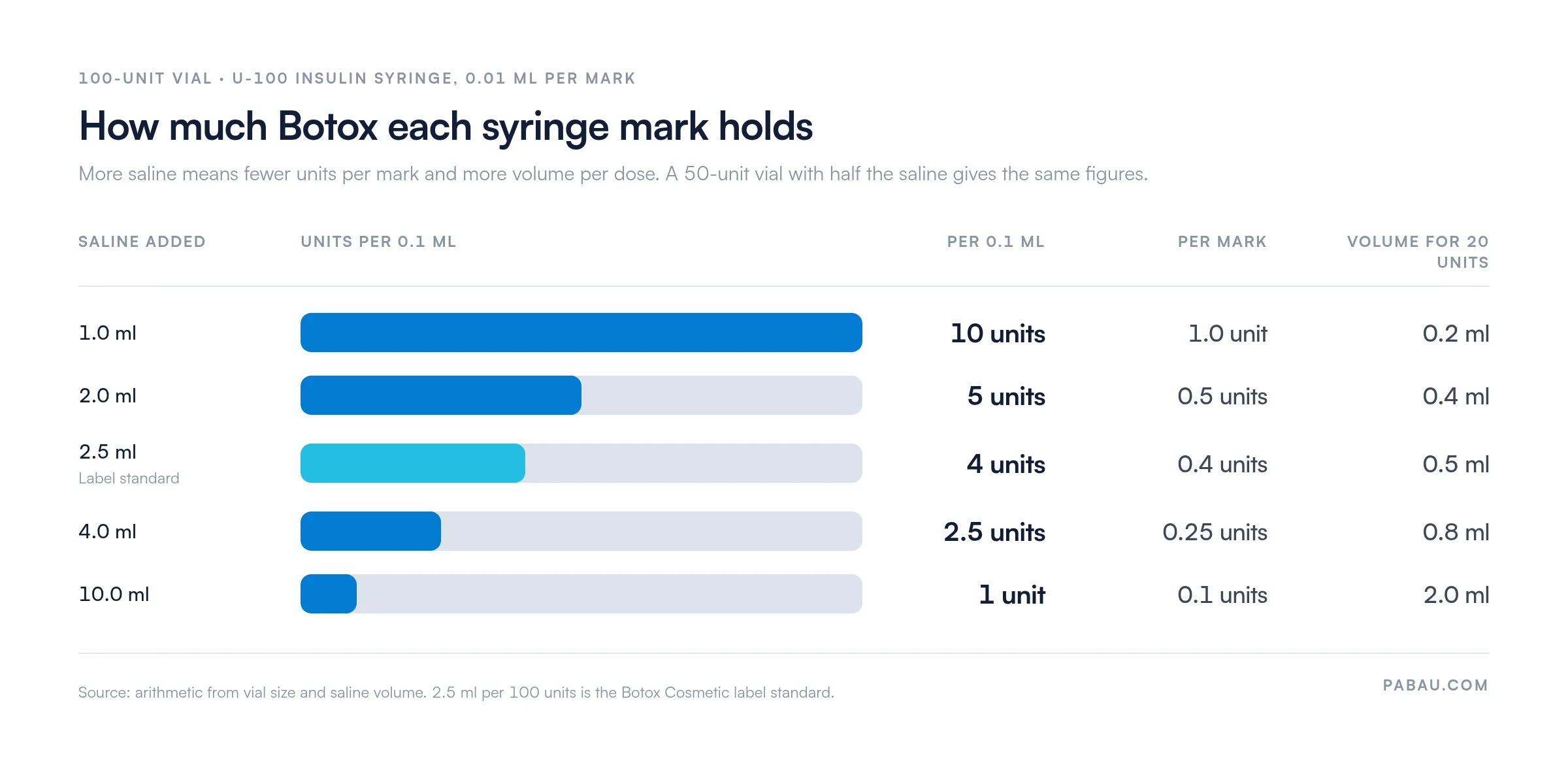
These seven steps keep the technique aseptic and the paperwork complete:
If you don’t yet have a set place for those details, a Botox treatment note template gives every injection session the same record.
Once you know the concentration, you can turn planned units into volume. At 4 units per 0.1 ml, a 20-unit dose is 0.5 ml. A Botox face mapping diagram then shows where each of those units goes.
The ranges below are typical figures drawn from aesthetic literature and practitioner consensus:
Anatomy, muscle mass, and treatment goals all move the dose, so treat these as starting points. Record your practice’s own protocol and any patient-specific adjustment in the treatment note.
Beyond the mixing itself, five habits keep toxin handling safe and traceable:
In many practices, the reconstitution details live on a vial sticker and a paper log. The treatment note, consent form, and photos sit somewhere else, so reviewing one patient’s toxin history means checking three places.
Pabau, the medical spa software we build, keeps those pieces on one patient record. You can add batch number, saline volume, concentration, and preparer fields to your toxin treatment note, so injectors complete them every time. Stock tracking logs each vial against the treatment, so your inventory and your notes stay in step.
Consent forms and before-and-after photos sit on the same record in Pabau’s clinical records software. When a patient questions a result, you can see the vial, the dilution, the dose, and the outcome together.

Pabau’s treatment notes, digital forms, and stock tracking record batch, dilution, and units on the patient record. Your reconstitution log is ready whenever an inspector asks.

Pick one dilution per vial size and make it your practice standard. For Botox Cosmetic, 2.5 ml per 100 units is the label default, and it keeps the syringe math simple at 0.4 units per mark.
You can still dilute differently for larger areas. Just make sure every label and treatment note states the concentration, or the unit counts in your records stop meaning much.
Agree your reference values, sign them off on the record sheet, and log each vial as it’s mixed. Book a demo to see how Pabau links every vial’s batch and dilution to the patient’s treatment record.

Billing Botox to Medicare or a commercial payer? HCPCS code J0585 billing guide explains per-unit billing, NDC reporting and the JW modifier for discarded units.
Recording where each unit went? Free printable Botox face chart maps injection sites and logs the dose given at each one.
Delegating injections to your team? Who can inject Botox covers licensing, supervision and how the rules vary by state.
Bringing patients back before the toxin wears off? Botox reminder email templates time each message from 48 hours before treatment to the month-three rebooking.
You mix Botox with sterile, preservative-free 0.9% sodium chloride injection, also called normal saline. AbbVie specifies preservative-free fluid for product stability. Bacteriostatic saline, which contains benzyl alcohol, extends shelf life but is off-label.
Most injectors add 2.5 ml, which gives 4 units per 0.1 ml for the forehead, glabella, and crow’s feet. The usable range runs from 1 ml to 10 ml. Use 4 ml for a more dilute solution over larger areas.
AbbVie’s prescribing information says to store reconstituted Botox at 2–8°C and use it within 24 hours. Some practitioners cite four to six weeks with bacteriostatic saline, but the manufacturer doesn’t endorse this. Follow the 24-hour guideline to stay on-label.
Yes. Add 4 ml of preservative-free saline to a 100-unit vial to reach 2.5 units per 0.1 ml. This weaker solution suits larger areas or subtler results, though each area then needs more injected volume.
Only the saline volume changes, because the ratio scales with the vial. A 50-unit vial with 1.25 ml gives the same 4 units per 0.1 ml as a 100-unit vial with 2.5 ml. Choose the vial size by how many toxin patients you treat in a day.
No. Botox Cosmetic comes only in 50-unit and 100-unit vials. The 200-unit vial is therapeutic Botox, used for indications such as chronic migraine, spasticity, and severe underarm sweating.