Dental vacuum form: Free template for appliance records
A dental vacuum form is a production record for each vacuum-formed appliance you...

Last Updated: Oct 6, 2026
A food frequency questionnaire (FFQ) asks patients how often they eat particular foods and drinks over a set period. Published FFQs list dozens or hundreds of foods and convert the answers into estimated nutrient intakes.
The free template on this page works differently, and it’s worth knowing that before you download it. It is a two-page clinical check-in form with 10 statements about diet-related understanding, confidence, tolerances, adherence, and satisfaction. Patients rate each one from never to always. A free-text box and a scored office-use section close the form.
That makes it a structured way to open a dietary conversation and record how a patient is coping between appointments. It doesn’t produce nutrient estimates. If you need those, this guide points you to the validated instruments that do.

A food frequency questionnaire asks how often a patient eats specific foods, usually to estimate habitual intake over months or years.
The template on this page is a two-page clinical check-in form, not a food-list FFQ that produces nutrient estimates.
It contains 10 statements rated from never to always, a free-text box, and a total score with interpretation for office use.
Reach for a published instrument such as the Harvard or EPIC Norfolk FFQ when you need validated nutrient data.
Practice management software like Pabau can send the form before the visit and file each response in the patient record.
A two-page clinical form with 10 diet-related statements rated from never to always, plus a free-text box for anything the patient wants to raise. It closes with a total score and interpretation section for office use.
Download templateA food frequency questionnaire is a structured dietary assessment tool that records how often a patient eats each item on a food list. Unlike a single-day recall, it looks at habits across weeks, months, or years.
Dietitians, nutritionists, primary care physicians, and functional medicine specialists use FFQs to build a picture of habitual intake. A full instrument records frequency and portion size for every listed food. Those answers are matched against a food composition database to estimate nutrient intake.
According to the National Cancer Institute Dietary Assessment Primer, the FFQ is the most commonly used dietary assessment instrument in large epidemiological studies. Its appeal is cost, speed, and reach rather than precision.
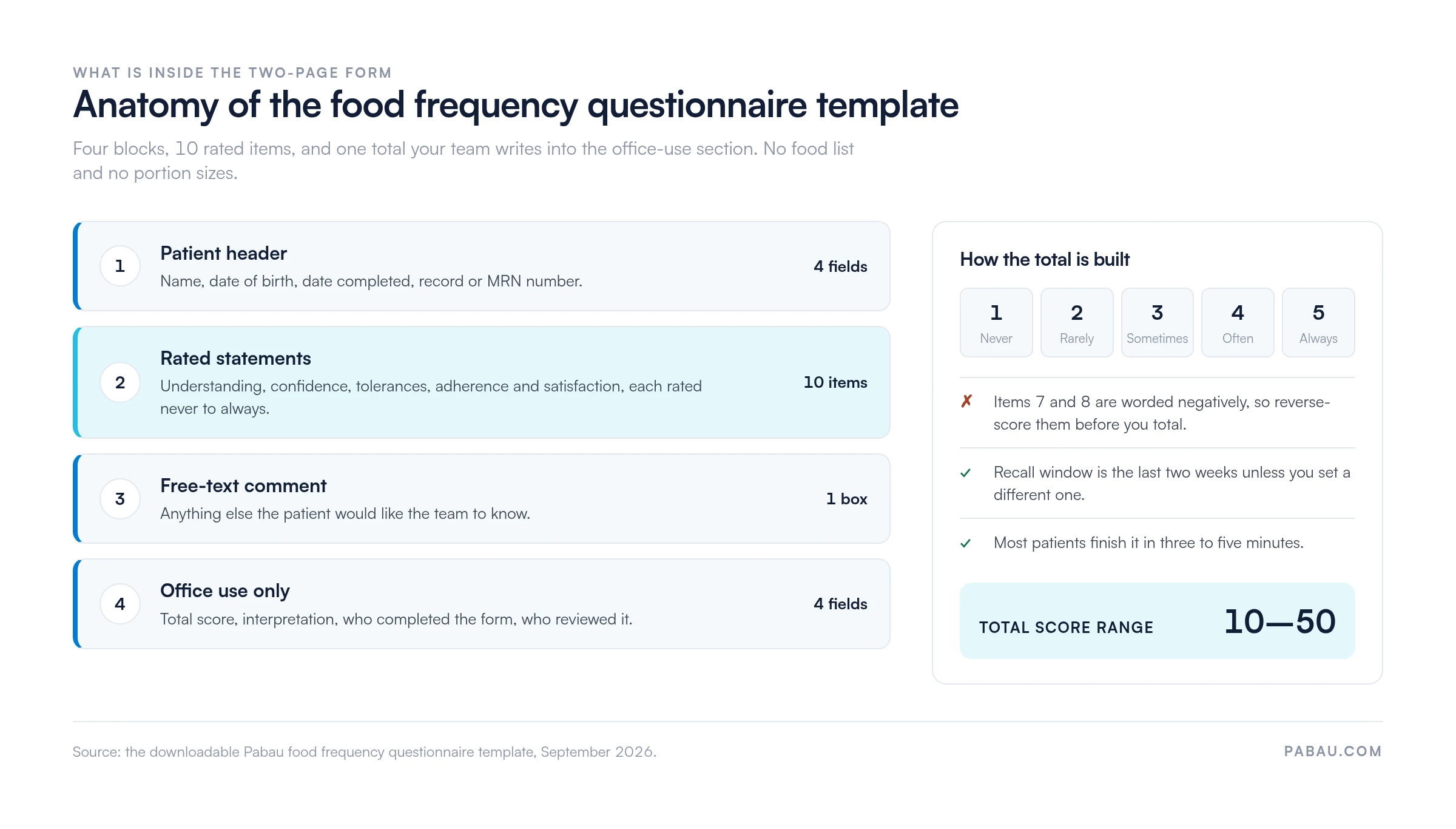
The downloadable template collects 10 patient-rated statements, a free-text comment, and a scored summary for your team. It carries no food list, no per-food frequency grid, and no portion size references.
The header records the patient name, date of birth, date completed, and record or MRN number. Patients answer every item for the last two weeks, unless you ask them to use a different window.
Each of the 10 statements is rated on the same five-point scale, from never to always:
Items 7 and 8 are worded negatively, so a high rating there signals a problem rather than progress. Keep that in mind when you total the score.
A free-text box follows the statements, headed Anything else you would like the team to know. The final block is marked for office use and holds the total score, the interpretation, who completed the form, and who reviewed it. The four blocks below make up the whole two-page form.
Administering the form takes a few minutes, but the value comes from doing it the same way every time. These five steps keep the responses comparable across visits.
The template supplies a total score field but no published scoring key, so your practice sets the rule and applies it consistently. A simple three-step approach works well.
Step 1: Assign a value to each response. Score never as 1, rarely as 2, sometimes as 3, often as 4, and always as 5. Ten answered items give a total between 10 and 50.
Step 2: Reverse-score the negative items. Items 7 and 8 describe difficulty, so flip them, turning 5 into 1 and 4 into 2. Without this step, a struggling patient can score the same as a thriving one.
Step 3: Interpret against the patient, not a population. No validation study underpins this form, so there are no published cut-offs. Compare each patient with their own earlier score, and note which individual items moved.
Write the interpretation in words as well as numbers. A one-line note such as confidence up, support down tells the next clinician more than the total ever will.
Three food frequency questionnaire variants exist, each suited to a different clinical context. Understanding these types of intake forms helps you pick the version that matches your workflow and patient population.
Brief FFQs are a shorter fourth option. They cover 40 to 60 foods in 5 to 10 minutes. The list focuses on items linked to chronic disease risk, such as vegetables, fruit, whole grains, and fish.
The template on this page is none of these. It sits closer to a patient-reported experience measure than to a dietary assessment instrument. A quality of life assessment works the same way, scoring how a patient feels rather than what they ate. That’s why this form pairs with an FFQ rather than replacing one.
Several dietary assessment tools exist. The right one depends on your clinical question, the time the patient can give, and whether the numbers have to leave your practice.
Use a validated instrument whenever the numbers have to stand up outside your practice. Research outcomes, published audits, and nutrient deficiency claims all need a tool with documented reliability.
NHANES FFQ: the National Health and Nutrition Examination Survey questionnaire is administered to nationally representative US samples. It has been validated against biomarkers and 24-hour recalls. Access it through the NCI resource page.
Harvard semi-quantitative FFQ: developed at the Harvard T.H. Chan School of Public Health and used in the Nurses Health Study. It captures frequency and portion size for around 130 foods. Scoring services run through the Harvard Nutrition Questionnaire Service Center.
EPIC Norfolk FFQ: used in the European Prospective Investigation into Cancer and Nutrition UK Norfolk cohort. It covers 130 foods and has published validation against urinary biomarkers and 24-hour recalls.
Even validated FFQs carry known weaknesses:
Functional medicine practitioners often pair FFQ data with a 24-hour recall or biomarker testing before advising a patient.
Completed questionnaires belong in the patient record, not in a folder on a shared drive. Store them in encrypted systems that only authorized staff can open, with access logged and timestamped. Built-in compliance tracking keeps that audit trail without a separate log to maintain.
Dietary information is protected health information under HIPAA in the US, and personal data under GDPR in Europe. Never pass responses to supplement companies or wellness partners without written patient consent. Record that consent separately in the chart.
Repeat the questionnaire on a schedule. Reassessment at three and six months shows whether confidence and adherence are moving, and it pairs neatly with weight, lipid, and glucose results.
Most practices email the PDF, wait for a scan to come back, and retype the answers into the chart. The score ends up in one place and the clinical note in another, so nobody trends either.
Pabau, our practice management software, sends the questionnaire with the appointment confirmation and stores the completed answers on the patient record. Front desk staff can see who has responded without phoning anyone.
Automated workflows then handle the follow-up. You can set a reminder at three months, a repeat form before the review appointment, and a task for the clinician when a score drops.
The result is a dietary record you can trend over time, and a shorter consultation because the answers arrive before the patient does.


Pabau sends intake forms before the appointment, files every answer on the patient record, and automates the follow-up. Your team spends less time chasing paper and more time on the plan.

The template on this page is a dietary check-in, and used that way it earns its place. It gives you 10 consistent questions, a score you can trend, and a written note of what the patient is struggling with.
It won’t tell you how much fiber or vitamin D someone eats. Reach for a validated FFQ when that is the question, and keep this form for the conversation around it.
Whichever you use, the value comes from repeating it and storing the results where the whole team can see them. Book a demo to see how Pabau files dietary questionnaires straight into the patient record.

Need a framework for comprehensive patient intake? Medical forms at your healthcare practice walks through designing effective clinical intake workflows.
Building a broader intake pack? New patient questionnaire gives you a general-purpose form to pair with this dietary check-in.
Documenting a nutrition problem in the chart? Imbalanced nutrition nursing care plan sets out goals, interventions, and evaluation criteria for nutritional deficits.
A food frequency questionnaire estimates how often a patient eats particular foods over an extended period. Practitioners use the results for nutritional screening, spotting dietary risk factors, and tracking whether eating habits change after an intervention.
The template is a two-page clinical form. It carries patient identification fields, 10 statements rated from never to always, a free-text comment box, and an office-use section for the total score. It does not contain a food list or portion size guidance.
Score each response from 1 for never to 5 for always, then reverse-score items 7 and 8, which are worded negatively. Ten completed items give a total between 10 and 50. No published cut-offs exist, so compare each patient against their own earlier score.
No. It is a clinical check-in form for recording how a patient feels about their dietary plan. Validated instruments such as the Harvard semi-quantitative FFQ and the EPIC Norfolk FFQ carry published reliability data. Use one of those when results feed research or formal outcome reporting.
Most patients finish the 10 rated items and the comment box in three to five minutes. A full food-list FFQ takes considerably longer, usually 15 to 20 minutes for the self-administered version.
An FFQ captures habitual intake over weeks to years using frequency categories and standard portions. A 24-hour recall asks detailed questions about one specific day. FFQs suit screening and research, while recalls give precise single-day data for validation.