CPT code 21011: Excision of soft tissue tumor of the face
CPT code 21011: Official descriptor and procedure overview CPT code 21011, as pu...

Last Updated: Oct 8, 2026

The Medicare 8 minute rule requires at least 8 minutes of a timed service before one unit can be billed.
One unit covers 8-22 minutes, and two units require 23-37 minutes of timed service.
Untimed codes are billed once per session and never count toward the timed-minute pool.
Medicare pools leftover minutes across timed codes, unlike the Rule of 8s that some commercial payers apply.
Clock time in the note, not an estimate, is what survives a RAC audit.
The Medicare 8 minute rule is the billing standard for time-based services in Medicare Part B outpatient therapy. It decides how many units a therapist can claim per session. It comes from the Centers for Medicare & Medicaid Services (CMS) in the Medicare Benefit Policy Manual, Chapter 15. At least 8 minutes of a timed service must be provided before a single unit can be claimed. Below 8 minutes, the service cannot be billed at all.
For physical therapists, occupational therapists, and speech-language pathologists, the rule governs a large share of outpatient billing. Get it wrong in either direction and the consequences run from unpaid claims to Recovery Audit Contractor (RAC) scrutiny.
Most therapy billing errors are not fraud. They come from misreading how time accumulates across a session when several CPT codes are involved.
This guide covers how the rule works, which CPT codes it touches, how to calculate units, and what documentation keeps a therapy practice audit-ready.
CMS sets billable units for time-based therapy codes on a fixed threshold ladder. One unit is claimable at 8 to 22 minutes of timed service. Two units require 23 to 37 minutes, three units 38 to 52, and four units 53 to 67. Each further unit adds another 15-minute block at the top end.
The principle underneath the ladder is short. Once you account for the full 15-minute blocks, the leftover minutes must reach 8 before they round up to another unit. A remainder below 8 minutes earns nothing.
| Minutes spent on timed service | Billable units |
|---|---|
| Less than 8 minutes | 0 units (cannot bill) |
| 8-22 minutes | 1 unit |
| 23-37 minutes | 2 units |
| 38-52 minutes | 3 units |
| 53-67 minutes | 4 units |
| 68-82 minutes | 5 units |
| 83-97 minutes | 6 units |
| 98-112 minutes | 7 units |
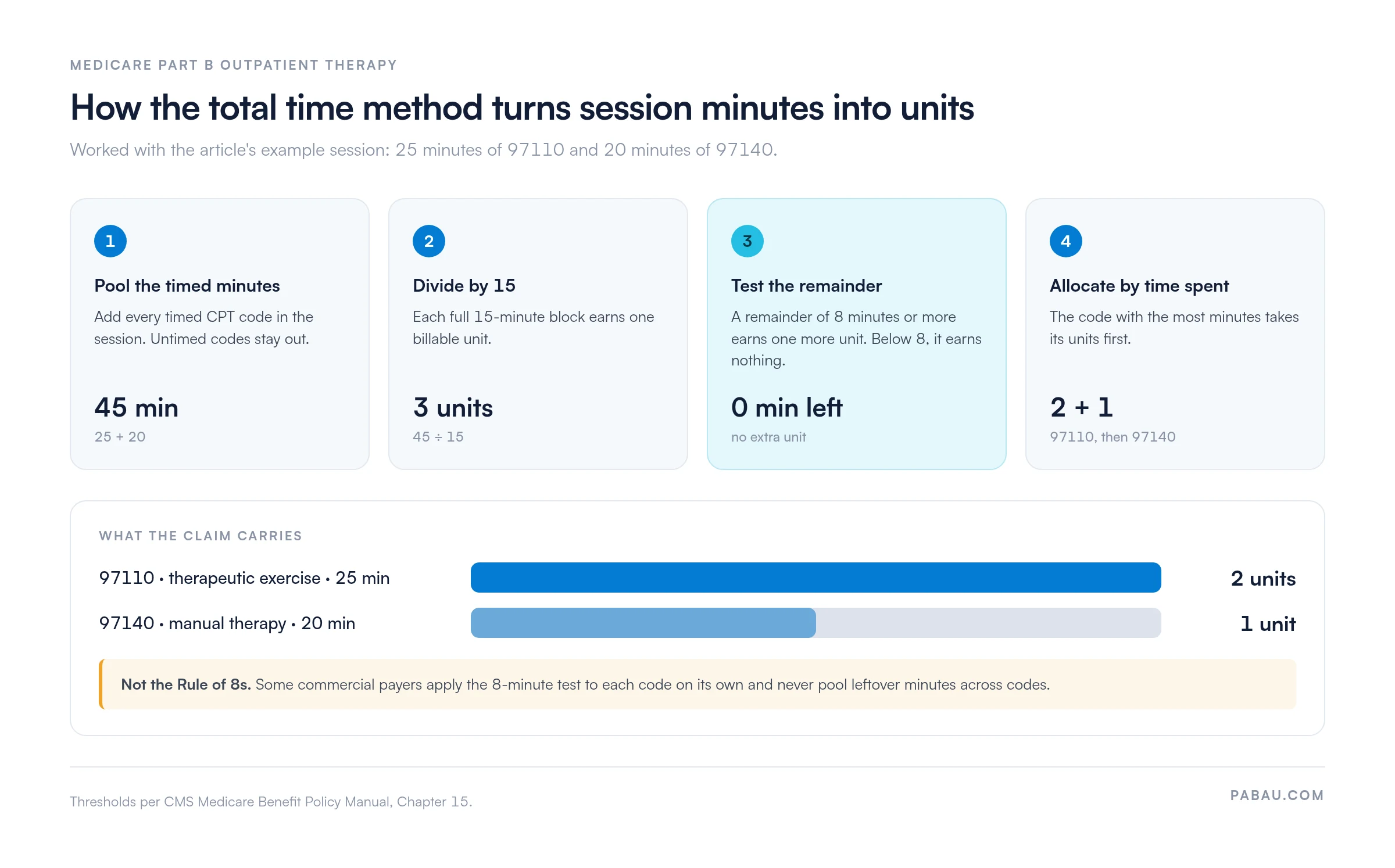
A session with several timed CPT codes takes an extra step. You add up all the timed minutes first, work out the total units, then hand those units to individual codes in order of time spent. The code with the most minutes takes its full units first. Practices running high Medicare volume often hand that arithmetic to claims software for therapists rather than repeat it by hand for every visit.
Take a therapist who provides 25 minutes of therapeutic exercise (97110) and 20 minutes of manual therapy (97140). That session holds 45 minutes of timed service. Divided by 15, it produces exactly 3 billable units with no remainder.
Those units are then allocated by time spent. 97110 takes 2 units because it had the most minutes, and 97140 takes 1. The 10 leftover minutes from 97110 and the 5 from 97140 are pooled to generate that third unit, under CMS’s combined-remainders rule.
The Rule of 8s that some commercial payers apply does not allow the pooling. It tests each code on its own, so an identical session can produce a different unit count depending on who is paying.
Only timed codes fall under the Medicare 8 minute rule. These are the services where duration decides the billing. Untimed codes are billed as one unit per session, however many minutes the therapist spends on them. Surgical codes sit outside the rule altogether, so 21014 is billed once whatever the operation took.
| CPT code | Description | Discipline |
|---|---|---|
| 97110 | Therapeutic exercise | PT, OT |
| 97112 | Neuromuscular re-education | PT, OT |
| 97116 | Gait training | PT |
| 97140 | Manual therapy techniques | PT, OT |
| 97530 | Therapeutic activities | PT, OT |
| 97535 | Self-care/home management training | OT |
| 97129 | Therapeutic interventions, cognitive function, initial 15 minutes | OT, SLP |
| 97130 | Therapeutic interventions, cognitive function, each additional 15 minutes | OT, SLP |
| 97550 | Caregiver training, initial 30 minutes | PT, OT, SLP |
| 97551 | Caregiver training, each additional 15 minutes | PT, OT, SLP |
Treating CPT 92507 and 92526 as timed codes is a common SLP billing error. Speech-language pathology codes such as 92507 (individual treatment), 92508 (group treatment), and 92526 (swallowing treatment) are untimed, along with the evaluation codes 92521-92524.
Those codes are billed once per session regardless of duration. The genuinely timed SLP-relevant codes are 97129 and 97130 for cognitive function interventions, plus 97550-97552 for caregiver training. On the PT and OT side, 97530 is another timed code billed in 15-minute increments.
| Code | Description | Discipline |
|---|---|---|
| 97010 | Hot or cold packs | PT, OT |
| G0283 | Electrical stimulation, unattended. Medicare requires this HCPCS code instead of CPT 97014 | PT, OT |
| 97018 | Paraffin bath | PT, OT |
| 97150 | Group therapeutic procedures | PT, OT |
| 92507 | Speech/language treatment, individual | SLP |
| 92508 | Speech/language treatment, group | SLP |
| 92521 | Evaluation of speech fluency | SLP |
| 92522 | Evaluation of speech sound production | SLP |
| 92523 | Evaluation of speech sound production with language | SLP |
| 92524 | Behavioral/qualitative analysis of voice and resonance | SLP |
| 92526 | Treatment of swallowing dysfunction | SLP |
None of these minutes accumulate toward the unit count. The time still belongs in the record of total session length, but it never converts into a billable unit of its own. Product lines work the same way, and Q4112 is billed by volume rather than by minutes.
Electrical stimulation is the row worth reading twice. Medicare does not recognize CPT 97014 on its fee schedule, and CMS Transmittal AB-03-093 directs providers to bill HCPCS G0283 instead for unattended stimulation. A 97014 line sent to a Medicare payer denies automatically. Some commercial plans still accept 97014, so confirm the payer before the claim goes out.
Confirm with your Medicare Administrative Contractor (MAC) which codes count as timed in its local coverage determinations. SLPs should use ASHA’s Medicare SLP coding rules for the authoritative distinction.
The code descriptor settles it. A timed code names a time increment in its own wording, such as “each 15 minutes”, “initial 30 minutes”, or “each additional 15 minutes”. An untimed code carries no time designation anywhere in the descriptor. By that test 64635 is untimed, even though the procedure fills a scheduled slot.
That test covers the codes a therapy practice meets day to day. It does not override the payer. Check the fee schedule and the local coverage determination first, because a code will not always behave the same way on every plan you bill. Imaging behaves that way too, since 70498 sits under separate coverage criteria at most plans.
Documentation is where the Medicare 8 minute rule either holds up or falls apart under review. CMS requires therapy records to substantiate the minutes spent on each timed service in a session. A total session time is not enough on its own. The record has to show how those minutes were split across each CPT code billed.
A compliant Medicare therapy note carries five things:
Medicare Administrative Contractors review that breakdown when they assess a claim. Vague or missing time documentation is the most common reason therapy claims get flagged during RAC audits.
Recording the actual start and end time of each intervention is the most defensible approach. A narrative line like “approximately 20 minutes of therapeutic exercise” leaves an auditor room to work with. An electronic health record that timestamps clinical entries builds part of the trail. The clinician still has to record time per service rather than a session total.
The APTA coding and billing guidance aligns with CMS requirements on time documentation and is the clearest PT-side reference. Practices handling high Medicare volume should also know the wider Medicare billing rules that govern Part B claims. Re-read your MAC’s local coverage determinations each year, because documentation expectations get refined at the regional level.
Document clock time (e.g., ’10:00 AM-10:22 AM’) rather than approximations like ‘about 20 minutes.’ Specific start and end times are the most defensible documentation in a RAC audit, and they remove the ambiguity an auditor works with.
Three billing patterns produce most of the 8 minute rule claim errors in outpatient therapy.
Counting untimed minutes toward timed unit totals. Time spent on hot packs or unattended electrical stimulation does not accumulate toward the calculation. Including it inflates the unit count and creates an overbilling error. Isolate the timed minutes and calculate those on their own.
Applying the rule to each code independently. Medicare adds the minutes of all timed services first, derives units from that combined total, then allocates them. Calculating units per code in isolation almost always produces the wrong count. The error grows when short services are involved.
Failing to document remainder minutes. Say a session leaves 6 minutes over once the full units are accounted for. Those minutes still belong in the clinical note, because auditors expect the total time to be accounted for across all services.
A note reading “45 minutes total” with only 38 minutes of documented timed service invites a question. Attribute the remaining 7 minutes to untimed services, patient setup, rest, or documentation time, whichever is accurate.
When a unit count is wrong, the claim usually comes back rather than gets paid. Reading the denial codes on the remittance tells you whether the payer rejected the arithmetic, the documentation, or the code itself. Unit errors are not only a therapy problem, and a duplicate 43235 line draws the same rejection.
Billing teams that work from one shared reference of which codes are timed make fewer allocation errors than teams working from memory. Our medical coding cheat sheet is a printable place to start.
Medicaid adds another layer. Some state Medicaid programs follow the same thresholds as Medicare. Others use per-visit flat rates or a different unit structure. Practices billing both should verify their state agency’s therapy billing rules rather than assume parity. Wound care programs meet the same split, where coverage for a skin substitute such as Q4156 varies by program.
The rule applies equally to physical therapy, occupational therapy, and speech-language pathology billed under Part B of Medicare. CMS sets out the scope of Medicare Part B therapy coverage on the official coverage portal. The unit calculation is identical across all three disciplines. What differs is the set of CPT codes each one uses.
Physical therapists billing musculoskeletal rehabilitation work mostly inside the 97000-series codes, and most of those are timed. A PT seeing a post-surgical patient for 60 minutes might provide 20 minutes each of 97110, 97112, and 97140. That totals 60 timed minutes and generates 4 billable units. The diagnosis behind that visit might be S52.355C, and it has to stay consistent across the course.
Occupational therapists often mix timed and untimed codes inside one session. A cognitive training session combining 97129 with ADL practice under 97535 needs careful time tracking per code. The rule still treats each timed code’s minutes as part of one combined session total.
Speech-language pathologists work mostly with untimed codes, so much of an SLP caseload sits outside the rule entirely. Only 97129, 97130, and the caregiver training codes 97550-97552 feed the total-time calculation for a typical SLP session.
Most therapy practices track session minutes in two places. The clinician writes the visit into the note, and the biller reconstructs the unit split afterwards from whatever the note happened to say. When those two records disagree, the claim goes out on the biller’s arithmetic and the note has to defend it in an audit.
Practice management software like Pabau keeps both in one record. You configure note templates per discipline. The fields for start time, end time, and minutes per code then sit on the form instead of in a free-text box. The biller then reads the unit count off what the clinician actually recorded.
Claims are raised from that same record, and every subscription includes the full platform. A practice running PT, OT, and SLP under one roof works one process instead of three. The outcome is fewer denied lines, and a note that already holds what a RAC reviewer asks to see. Comparing that claims management software against alternatives such as Waystar shows how it affects claim denial rates.

Pabau gives PT, OT, and SLP practices note templates that capture minutes per CPT code. Claims are raised from the same record, so there are fewer denied lines and less rework for the billing team.

The arithmetic in the Medicare 8 minute rule is not the hard part. Pooling the timed minutes, dividing by 15, and testing the remainder against 8 takes an afternoon to learn.
What costs a practice money is the habit underneath it. A note written as “about 20 minutes” cannot be defended. A biller who calculates each code separately will keep producing counts Medicare declines to pay. Fix the note template first and the unit counts follow.
Audit one month of your own therapy claims against the four steps above. If minutes per code are missing from more notes than you expected, that is the first project, not the billing software. Book a demo to see how Pabau captures time per service in the note and carries it through to the claim.

Need the wider rulebook behind Part B therapy claims? Medicare billing walks through enrollment, claim submission, and the reimbursement rules that sit above the 8 minute rule.
Want to know what a payer is telling you when a therapy claim bounces? Denial codes in medical billing decodes the reason codes that appear on a remittance advice.
Billing manual therapy alongside therapeutic exercise? CPT code 97140 covers the documentation and modifier rules for the code that most often shares a session with 97110.
Building a compliance routine around your billing? Medical billing compliance sets out the audits, checks, and record-keeping that keep a practice defensible.
Losing paid claims to the calendar rather than the coding? Timely filing limits lists the submission windows each payer holds you to, and how to track them.
The Medicare 8 minute rule is the CMS billing standard for Part B outpatient therapy. It requires at least 8 minutes of a timed CPT service before one unit can be claimed. In physical therapy, it governs how time on therapeutic exercise and manual therapy converts into billable units. One unit covers 8-22 minutes. Each additional unit requires at least 8 minutes of remaining time beyond the previous full unit.
Add up all the minutes spent on timed CPT services during the session. Divide by 15 to get the full units, then check the remainder. If the remainder is 8 minutes or more, it counts as an additional unit. If it falls below 8 minutes, it generates nothing. For example, 45 minutes of timed service equals 3 units with no remainder. 48 minutes also equals 3 units, plus a 3-minute remainder that cannot be billed.
Timed CPT codes are subject to the rule. Common examples include 97110 (therapeutic exercise), 97112 (neuromuscular re-education), 97116 (gait training), and 97140 (manual therapy). The list also covers 97530 (therapeutic activities), 97129 and 97130 (cognitive function interventions), and 97550-97552 (caregiver training). Untimed codes are billed as one unit per session regardless of time. Those include 97010 (hot and cold packs), 97150 (group therapeutic procedures), and the SLP codes 92507, 92508, 92521-92524, and 92526.
No. Medicare does not recognize CPT 97014 on its fee schedule, so a 97014 line submitted to a Medicare payer denies automatically. CMS Transmittal AB-03-093 directs providers to bill HCPCS G0283 for unattended electrical stimulation instead. Some commercial plans still accept 97014, so check the payer’s own policy before the claim goes out. Either way the code is untimed, so it never contributes minutes to the unit calculation.
Yes. It applies to occupational therapy services billed under Medicare Part B, using the same unit calculation as physical therapy and speech-language pathology. OT-specific timed codes including 97535, 97129, and 97530 are subject to the rule. Time spent on untimed codes is excluded from the timed unit calculation.
Not necessarily. Many state Medicaid programs model their therapy billing on Medicare’s approach, but Medicaid is administered at state level and the rules vary. Some states use flat per-visit rates or different time-based unit thresholds. Practices billing both should verify their state agency’s therapy billing policies rather than assume they mirror the Medicare 8 minute rule.
Fewer than 8 minutes of a timed service cannot be billed as a unit on its own, because it does not meet the minimum threshold. If those minutes are part of a multi-code session, they still count toward the combined timed-service total. Pooled with time from other timed codes in the same session, they can help generate a billable unit.