CPT code 21011: Excision of soft tissue tumor of the face
CPT code 21011: Official descriptor and procedure overview CPT code 21011, as pu...

Last Updated: Oct 8, 2026
19370 is the CPT code for revision of peri-implant capsule, breast, including capsulotomy, capsulorrhaphy, and/or partial capsulectomy. It covers incision, tightening or partial removal of the scar capsule around a breast implant, reported per breast.
The descriptor took effect in the 2021 CPT code set, replacing the older "open periprosthetic capsulotomy" wording. Complete capsulectomy with removal of all intracapsular contents is CPT 19371, which is not reported with 19370 in the same breast. Payers decide coverage on whether the indication is reconstructive or cosmetic.
Let Pabau's smart automation suggest the right codes, reduce claim denials, and keep your practice compliant—effortlessly.
Automate repetitive tasks and focus on what matters most—your patients.
Reduce coding errors and ensure compliance with the latest regulations.
Clean claims, fewer denials, and faster reimbursements.
Powerful insights and reporting to help your practice thrive.
HIPAA compliant SOC 2 certified GDPR-compliant Trusted by 4,000+ clinics worldwide

CPT code 19370 covers revision of the peri-implant capsule in one breast, including capsulotomy, capsulorrhaphy, and/or partial capsulectomy. Complete capsulectomy is CPT 19371.
Payers classify 19370 as cosmetic or reconstructive based on the clinical indication. Grade III or IV capsular contracture and post-mastectomy implant complications typically support reconstructive coverage.
CPT 19371 is not reported with 19370, 19328 or 19330 in the same breast, because complete capsulectomy already includes removal of all intracapsular contents.
Pabau’s claims management software connects to the Claim.MD clearinghouse, so eligibility checks and ERA remittances sit alongside the claim before it reaches the payer.
CPT code 19370 is defined by the American Medical Association (AMA) as: Revision of peri-implant capsule, breast, including capsulotomy, capsulorrhaphy, and/or partial capsulectomy. This wording took effect in the 2021 CPT code set and replaced the older “open periprosthetic capsulotomy” descriptor.
The code covers three kinds of work on the fibrous capsule around a breast implant. The surgeon may incise it (capsulotomy), tighten or repair it (capsulorrhaphy), or remove part of it (partial capsulectomy).
What the procedure involves: The surgeon opens the breast to reach the capsule around the implant. Depending on the problem, the capsule is incised to release contracture, sutured to tighten or reshape the pocket, or partly excised.
The implant may stay in place, be removed and put back to give access to the capsule, or be exchanged for a new one. Each scenario changes what else is reported. A new implant adds 19342, while putting the same implant back never adds 19328.
The code covers capsulotomy, capsulorrhaphy and partial capsulectomy performed in the same breast at the same session. It does not cover complete removal of the capsule, and it has specific rules for implant removal and replacement. The decision path below puts those rules in the order a coder meets them.
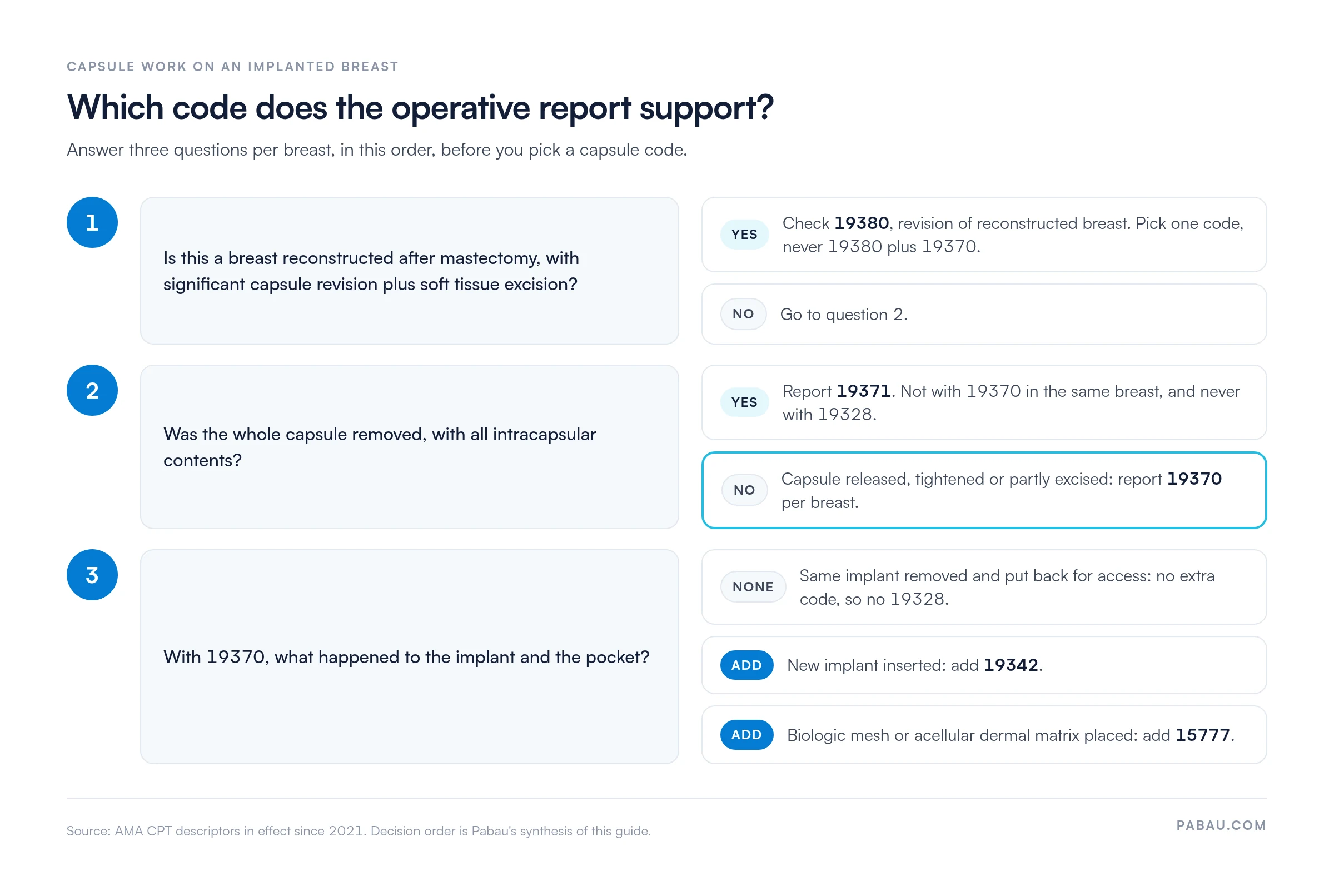
The codes most often confused with CPT code 19370 differ on two points. The first is how much capsule tissue is removed. The second is whether the breast was previously reconstructed.H
The operative report is the deciding document. If it describes incision, tightening or partial excision of the capsule, 19370 is correct. If the whole capsule was removed with all intracapsular contents, 19371 applies instead. If the patient previously had mastectomy reconstruction, check whether 19380 is the more accurate descriptor before defaulting to 19370
Flag operative reports that use ambiguous language like ‘capsule work performed’ or ‘capsule addressed.’ Ask the surgeon whether the capsule was released, partly removed or completely removed before coding. Vague wording invites payer queries on 19370 claims and can end in downcoding.
Pairing CPT code 19370 with the correct ICD-10-CM diagnosis code is what separates a reconstructive claim from a cosmetic one in payer adjudication systems. The T85 category (complications of internal prosthetic devices) and Z98.82 (breast implant status) are the codes most commonly accepted as medical necessity support.
Episode-of-care suffix alert: All T85 codes require a 7th character. Use A (initial encounter) while the condition is under active treatment, including the surgery itself. Use D (subsequent encounter) for follow-up during healing, and S (sequela) for late effects. Submitting T85.44x without the 7th character makes the code invalid and triggers an automatic denial.
Whether CPT code 19370 is covered by insurance hinges on whether the procedure is classified as reconstructive (medically necessary) or cosmetic (patient-pay). Payers follow the Women’s Health and Cancer Rights Act (WHCRA) of 1998 for post-mastectomy cases, and apply medical necessity criteria for other indications.
Medicare generally does not cover breast implant procedures performed for cosmetic reasons. Medicare covers reconstruction after cancer-related mastectomy under its own coverage rules. WHCRA mandates the same for group health plans and insurers. Verify the applicable Local Coverage Determination (LCD) with the Medicare Administrative Contractor (MAC) serving the practice’s jurisdiction, as coverage criteria vary by region.
Medicare covers CPT code 19370 when the procedure is medically necessary and not primarily cosmetic in nature. CMS has published coverage articles on cosmetic and reconstructive breast surgery, including articles 56658 and 58774. These outline the criteria MACs use to evaluate the claims. Always verify the current LCD with your MAC before billing, as coverage criteria are updated periodically.
Modifier selection for CPT code 19370 is straightforward when the procedure is unilateral. Bilateral cases need careful attention to how the payer processes the claim.
Check the AAPC Codify CPT lookup and the individual payer’s modifier policy before submitting bilateral claims. Some regional BCBS plans reject modifier 50 on 193xx codes and require separate RT/LT lines instead.
CPT code 19370 carries a 90-day global surgical period under the Medicare Physician Fee Schedule, consistent with major surgical procedures. Verify this in the current MPFS database, as global period designations can change with annual updates. During the 90-day window, routine follow-up visits and services related to the surgery are bundled and not separately billable.
When an unbundling denial does come back, a structured denial management process traces it to the coding decision. That stops the same error from repeating on the next breast case.
The operative report is the primary document a payer auditor reviews when a CPT 19370 claim is queried. Missing any of the following elements is the most direct path to a denial or post-payment recovery demand.
Pre-authorization documentation should also be retained in the claim file alongside the operative report. For reconstructive claims following mastectomy, include evidence of the prior oncologic procedure. Review the medical billing compliance requirements that apply to surgical records before submission.
Build a 19370 operative report checklist into your surgical scheduling workflow: Baker grade, capsule technique, extent of excision, implant status, and post-op plan. A missing element caught before the case closes is a quick surgeon query. Caught at billing, it means a held claim.
CPT code 19370 claims fail for predictable reasons. Knowing the denial pattern before submission is how billing teams reduce write-offs on breast surgery codes.
A 19370 claim passes through several hands. The surgeon documents the capsule work, the coder picks the ICD-10 pairing and modifiers, and billing staff chase eligibility and payment. When those steps live in separate spreadsheets and payer portals, a coverage problem often surfaces only after the payer responds.
In Pabau’s claims management software, CMS-1500 claims go to payers electronically through the Claim.MD clearinghouse. Real-time eligibility checks (270/271 transactions) confirm the patient’s coverage before the surgery date, rather than after the claim comes back.
After submission, claim status tracking shows where each 19370 claim sits with the payer. ERA remittances post against the claims they pay, so payment and adjustment details stay with the original claim. Your billing team spends less time switching between portals and more time on the claims that need attention.

Pabau connects plastic surgery practices to the Claim.MD clearinghouse with real-time eligibility checks, ERA remittance posting and claim status tracking. See how it works for 19370 and related breast surgery codes.

Before a 19370 claim leaves the practice, read the operative report the way a payer auditor would. It should name the capsule technique, the extent of excision, the Baker grade and what happened to the implant. A surgeon query at that point costs minutes, while an appeal costs weeks.
The trade-off to remember is coverage. The same capsule revision reads as reconstructive with a documented Grade III contracture and as cosmetic without it. The note decides the payment as much as the code does.
Pabau keeps real-time eligibility checks, ERA remittance posting and claim status tracking next to each claim. Your team can follow a 19370 case from eligibility to payment in one place. Book a demo to see how it handles breast surgery claims.

Need a structured approach to claim denials? Denial codes in medical billing explains the most common CARC and RARC codes and how to build an appeal response for each.
Want to understand how clearinghouses process surgical claims? Medical claims clearinghouse guide walks through how 837P files are validated and routed to payers.
Managing a plastic surgery practice’s full revenue cycle? What is revenue cycle management covers the end-to-end process from eligibility check through payment posting.
CPT code 19370 covers revision of the peri-implant capsule in one breast, including capsulotomy, capsulorrhaphy, and/or partial capsulectomy. Complete capsulectomy with removal of all intracapsular contents is CPT 19371. Revision of a reconstructed breast is CPT 19380.
CPT 19370 is reconstructive when the clinical indication meets payer medical necessity criteria. That typically means Baker Grade III or IV capsular contracture causing pain or functional impairment, or implant complications after mastectomy-based reconstruction. Without a supported ICD-10 diagnosis code and documented indication, payers default to a cosmetic classification and deny the claim.
CPT 19370 covers capsulotomy, capsulorrhaphy and partial capsulectomy, so some capsule tissue stays in place. CPT 19371 covers complete capsulectomy, including removal of all intracapsular contents. If the operative report describes a release, repair or partial excision, use 19370. If the whole capsule was removed, use 19371. The two codes are not reported together for the same breast.
Medicare typically covers CPT 19370 when the procedure is medically necessary and not primarily cosmetic. Examples include a clinically significant implant complication or capsule revision after post-mastectomy reconstruction. Coverage criteria come from the Local Coverage Determinations of the applicable Medicare Administrative Contractor, so verify the current LCD before billing.
Yes, when the capsule revision is performed on both breasts at the same operative session, modifier 50 is typically appended to report bilateral work. Standard reimbursement is approximately 150% of the single-procedure rate, though some payers prefer separate RT and LT line items. Confirm the individual payer’s bilateral billing format before submission to avoid a formatting denial.
CPT 19370 carries a 90-day global surgical period under the Medicare Physician Fee Schedule. Routine follow-up visits and related services during this window are bundled and not separately billable. Verify the current designation in the MPFS database annually, as global periods can be revised. Unrelated new conditions during the global period may be billed with modifier -24 and supporting documentation.
The most commonly accepted ICD-10-CM codes for CPT 19370 are T85.44xA and T85.49xA. T85.44xA is capsular contracture of breast implant, while T85.49xA covers other mechanical complications of a breast prosthesis. Z98.82 (breast implant status) can be added as a secondary code. T85 codes need a 7th character for the episode of care, and a code submitted without it is invalid.