ICD-10 code S61.201A: Open wound of left index finger without nail damage
ICD-10 code S61.201A covers a left index finger wound of unstated type ICD-10 co...

Last Updated: Oct 16, 2026
Billable Code Specific Code
S52.355C is the billable ICD-10-CM code for nondisplaced comminuted fracture of shaft of radius, left arm, initial encounter for open fracture type IIIA, IIIB, or IIIC.
Get the region wrong and the claim fails on medical necessity, whatever else the coder got right.
Let Pabau's smart automation suggest the right codes, reduce claim denials, and keep your practice compliant—effortlessly.
Automate repetitive tasks and focus on what matters most—your patients.
Reduce coding errors and ensure compliance with the latest regulations.
Clean claims, fewer denials, and faster reimbursements.
Powerful insights and reporting to help your practice thrive.
HIPAA compliant SOC 2 certified GDPR-compliant Trusted by 4,000+ clinics worldwide

ICD-10 code S52.355C covers a nondisplaced comminuted fracture of the radial shaft, left arm. The 7th character C marks an initial encounter for an open type III fracture.
The code lives in S52.3, the shaft of radius family. It is not a distal radius code, because wrist-end fractures are coded from S52.5 instead.
Character C covers Gustilo types IIIA, IIIB, and IIIC together. ICD-10-CM does not split those subtypes, so the surgeon’s documented grade drives management, not code choice.
There is no S52.359. Unspecified laterality in the shaft family is S52.356C, and the right-arm equivalent of this code is S52.354C.
Practice management software like Pabau pre-fills the claim form from the patient record and supplies ICD-10-CM and CPT lookup libraries. It also checks that required claim fields are complete before submission.
S52.355C is a billable ICD-10-CM diagnosis code, valid for encounters from October 1, 2015 onward.
The full descriptor reads: Nondisplaced comminuted fracture of shaft of radius, left arm, initial encounter for open fracture type IIIA, IIIB, or IIIC.
Each character encodes one clinical attribute. Read the structure and you can spot missing documentation before submission, rather than after a denial arrives.
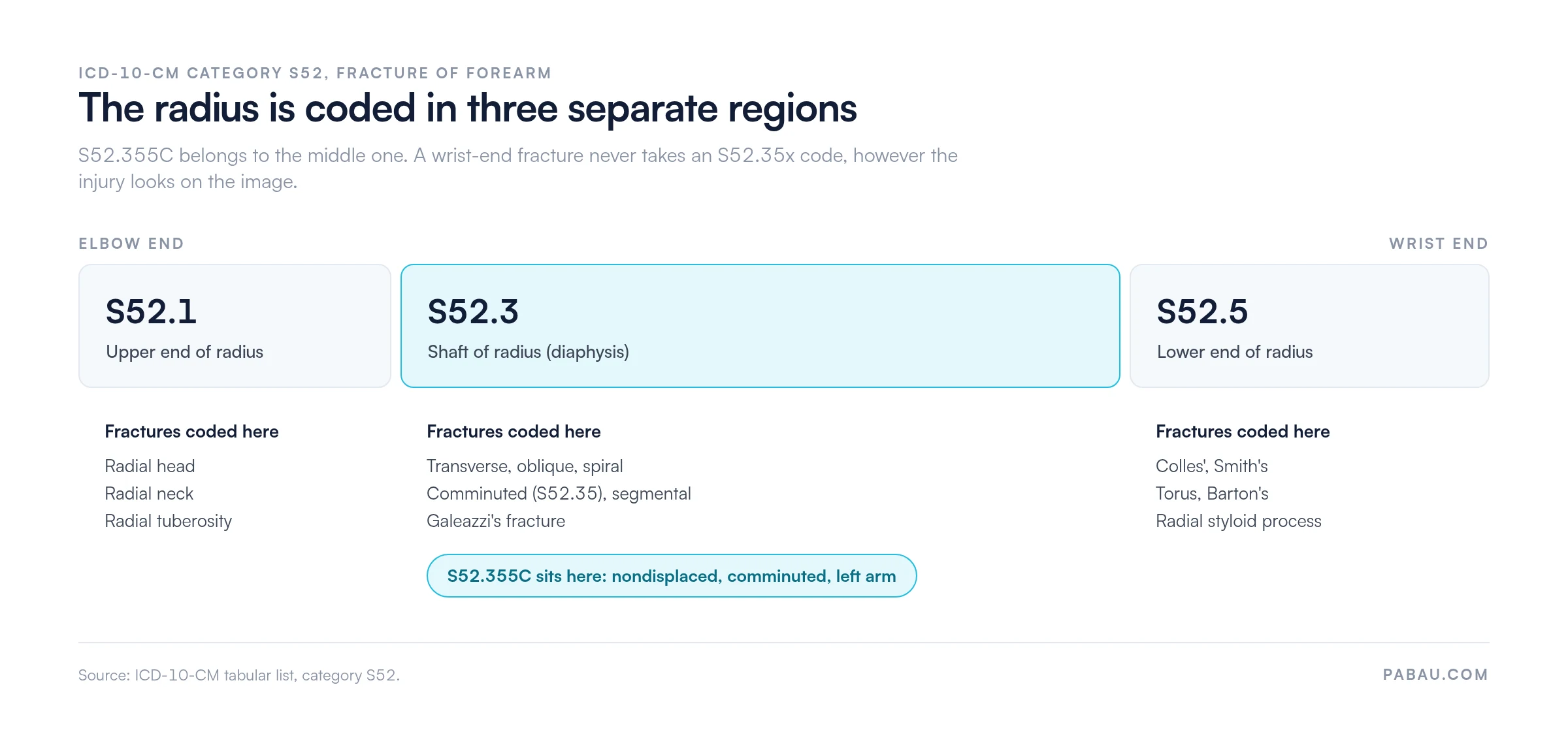
The 4th character is the one that gets miscoded. ICD-10-CM divides the radius into three regions. S52.1 covers the upper end, S52.3 the shaft, and S52.5 the lower end. Colles’, Smith’s, torus, and radial styloid fractures all live in S52.5, and none of them takes an S52.35x code.
If the operative note describes a wrist-end injury, S52.355C is the wrong stem. The map below shows which fractures belong to which region.
A comminuted shaft fracture usually points to high-energy trauma. That same energy drives bone through skin and puts the injury into open fracture territory. It explains why the 7th character carries so much weight on this code.
Most billing errors on this code start at the last character. Per the ICD-10-CM Official Guidelines published by CMS and NCHS, the encounter character is a clinical determination.
Initial encounter applies for the whole active treatment phase, however many appointments that takes. Assign the character from the care being delivered, not from the sequence of visits.
S52.355 accepts sixteen 7th characters. The table below lists all of them, applied to a nondisplaced comminuted fracture of the left radial shaft.
Character C is the one that produces S52.355C. It marks an initial encounter for an open fracture graded Gustilo IIIA, IIIB, or IIIC.
All three subtypes collapse into that single character, because ICD-10-CM does not separate them at code level. One pairing in this table catches people out. N belongs to open type III nonunion, while P belongs to closed malunion.
Take a worked case. A cyclist arrives with the left radius broken into four fragments and a 12 cm wound exposing muscle. The surgeon documents a type IIIB open fracture, and imaging shows no displacement.
That encounter codes to S52.355C. Six weeks later, at a follow-up where the bone is healing normally, the same injury codes to S52.355F.
The Gustilo-Anderson classification is the framework surgeons use to grade open fracture severity. ICD-10-CM builds the open fracture 7th characters for S52 directly on it, so the coder depends on the documented subtype.
Grading a wound as IIIA, IIIB, or IIIC is a clinical judgment. It belongs to the treating orthopedic surgeon, not to the billing team.
Type IIIC carries a very different clinical trajectory from IIIA, including the risk of amputation when vascular repair fails. ICD-10-CM still groups all three under character C, because the classification captures severity rather than the management pathway.
So ask surgeons to write the subtype in full. “Type IIIA open fracture of the left radial shaft” gives the coder what it needs. “High-energy open fracture” does not.
S52.355C sits inside a strict hierarchy, and each level adds one fact. Reading the chain from the top is the fastest way to check your work. Anatomy, fracture pattern, displacement status, and laterality all have to match the record.
There is no S52.359. In the S52.3 shaft family the unspecified-arm code ends in six, not nine. Unspecified laterality is S52.356, and its open type III initial encounter is S52.356C.
Coders who pattern-match from the distal radius codes submit a stem that does not exist, because unspecified laterality does end in nine there. Pull the exact descriptor from our diagnostic code lookup before you commit to a neighboring stem.
Query the surgeon when the side is missing rather than defaulting to the unspecified code. Unspecified laterality loses clinical specificity and invites extra payer scrutiny on a claim that is already expensive.
Flag incomplete laterality at the point of encounter, not at claim submission. A brief addendum from the treating surgeon takes minutes. A payer query after denial can delay reimbursement by 30 to 60 days and forces a corrected claim.
The ICD-10-CM Official Guidelines for Coding and Reporting set the rules for traumatic fractures in section I.C.19.c. Five of them decide whether the record in front of you supports S52.355C.
A clean claim on an open fracture depends on five documented facts. The record has to show the site, the pattern, the displacement status, the laterality, and the encounter type.
S52.355C is a diagnosis code, so the procedure side of the claim is coded separately. Radial shaft fractures are treated under CPT 25500 through 25526. The distal radius codes in the 25600 series do not apply here. That pairing error follows naturally once the anatomy has been misread.
Three codes in the range cover a Galeazzi injury, where the shaft fracture comes with a distal radioulnar joint dislocation. 25520 treats both closed, 25525 opens the shaft only, and 25526 opens both.
An open type III wound usually generates a debridement code alongside the fracture repair. CPT 11010 covers skin and subcutaneous tissue, CPT 11011 adds muscle fascia and muscle, and 11012 adds bone. Select by the deepest tissue debrided, and check the AMA CPT manual for the current code year before you bill.
Payer policies on diagnosis-to-procedure pairing vary, so confirm the payer’s own rules ahead of submission.
Open fracture codes generate a disproportionate share of orthopedic denials. Five errors account for most rejections on S52.355C, and a billing team works faster once it can name them.
An open fracture claim passes through four hands before a payer sees it. The emergency team records the injury. The surgeon grades the wound and repairs the bone. A coder builds the diagnosis and procedure lines, and a biller sends the claim on to the clearinghouse.
Every handoff is a chance for the 7th character to drift away from the operative note. So run this check before the claim leaves the practice.
A missing item on that list is a query for the surgeon, not a judgment call for the coder.
Type III open shaft fractures often need months of follow-up, and the 7th character moves as the clinical picture changes. The stem stays S52.355 for the left radial shaft, and only the last character changes.
Nonunion (character N) and malunion (character R) both need explicit surgeon documentation. Delayed healing on its own does not establish nonunion, so character N applies only when the record states that union has failed.
Character S is reserved for a late effect of the original fracture, never for the fracture itself. Lost forearm rotation after the shaft has united is the kind of residual condition it captures.
A fracture claim usually breaks down at the handoffs. The surgeon dictates the Gustilo grade in one system. The coder looks up the stem in another, and someone retypes both onto the claim form.
Practice management software like Pabau keeps the record and the claim in one place. The operative note, the encounter diagnosis, and the charge line all sit against the same patient record. Pabau’s built-in claims management pre-fills the claim form from that record instead of asking anyone to rekey it.
Searchable ICD-10-CM and CPT lookup libraries let a coder check the S52.3 family without leaving the claim. Before the claim can go, Pabau confirms that the fields the payer requires are populated.
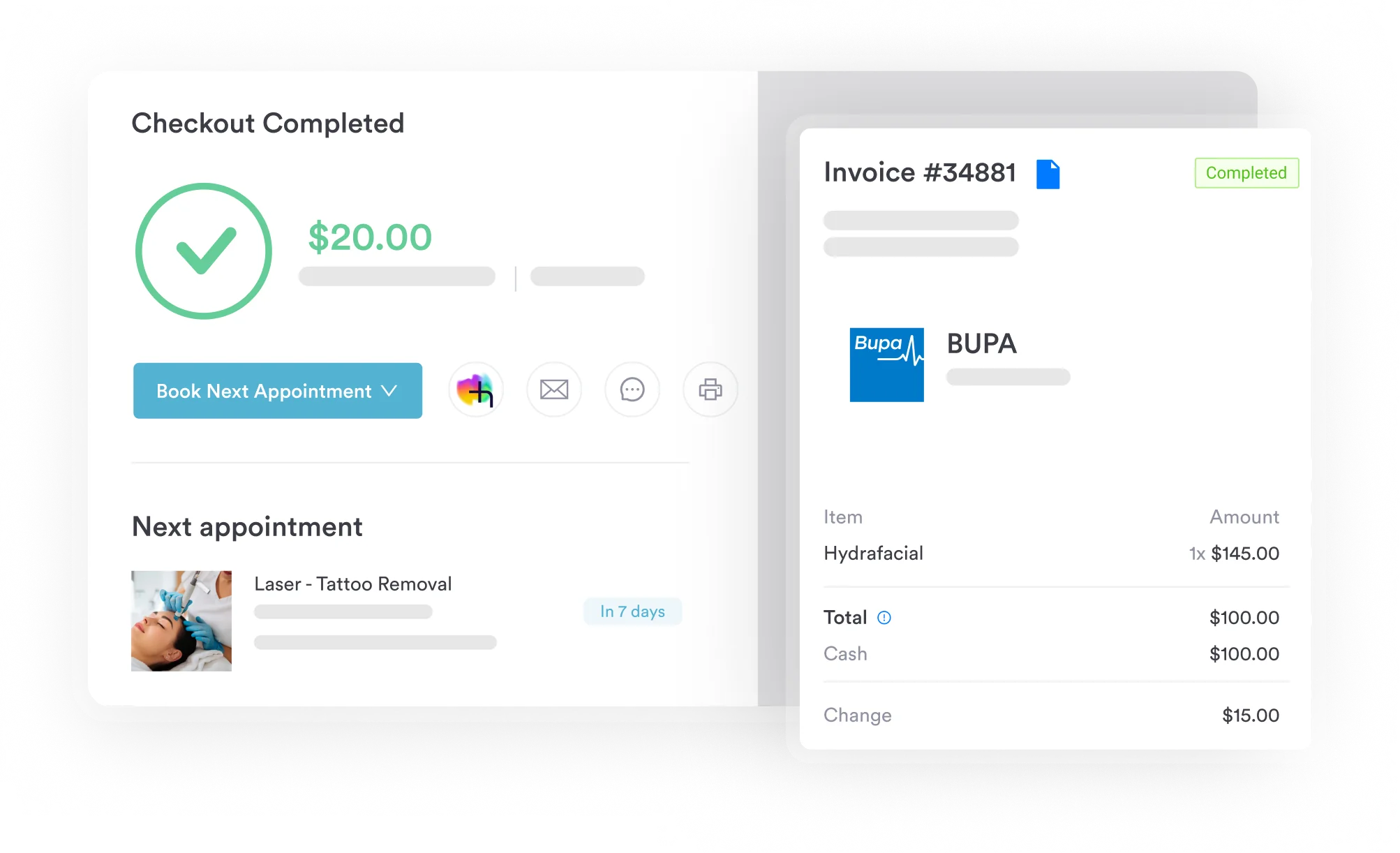
Submission then runs through the connected clearinghouse, which is Claim.MD in the US. Eligibility checks, claim status tracking, and remittance posting sit on that same pipeline. Your coders still make the coding call, and Pabau takes the clerical work off them.

Pabau pre-fills claim forms from the patient record, gives coders ICD-10-CM and CPT lookup libraries, and checks required claim fields before submission. See how orthopedic and surgical billing teams use Pabau to cut rework and get paid faster.

Check the region before you check the rest of this code. S52.3 and S52.5 read alike at a glance. A wrist-end fracture coded into the shaft family fails on medical necessity, however careful the rest of the coding was.
After the region, the wound grade decides the claim. Character C stands or falls on the words IIIA, IIIB, or IIIC appearing in the operative note. Ask for them at the encounter, while the surgeon still has the case in mind.
Get those two right and an S52.355C claim usually goes out clean the first time. Book a demo to see how Pabau pre-fills fracture claims, checks the required fields, and sends them to your clearinghouse.

Need to see how electronic claim validation works? Claim.MD clearinghouse overview covers claim submission, payer edits, and remittance posting on the US pipeline.
Want to understand denial patterns for orthopedic claims? Medical billing compliance guide explains the regulatory framework and audit triggers behind open fracture and surgical claims.
Coding a different fracture pattern in the same family? ICD-10 code S52.333C covers a displaced oblique fracture of the radial shaft with the same open type III 7th character.
The record never names the side? ICD-10 code S52.356C sets out the unspecified-arm version of this fracture and when it holds up.
Both forearm bones broken? CPT code 25565 covers closed treatment of radial and ulnar shaft fractures together.
Not by national rule. ICD-10-CM sets no mandatory external cause reporting requirement. Add a Chapter 20 code for the cause, the place, and the activity when a state mandate or a payer policy asks for it. Trauma registries and workers’ compensation carriers usually do.
No. Character C already reports the fracture as open, so you do not add an open wound code for the same site. ICD-10-CM says so directly. Category S51 excludes an open forearm fracture that is carried on an S52 code.
Code the ulna separately. A both-bone forearm fracture takes S52.355C plus the matching ulnar shaft code from S52.2, each with its own 7th character. One code cannot describe two bones.
No. S52.355C is a traumatic fracture code. A fracture caused by disease codes from M80 or M84.4, and a stress fracture from M84.3. Check the mechanism in the record first.
Code each encounter from the documentation that supports it. If the operative note downgrades the wound to type II, that encounter takes character B. Earlier encounters keep the character their own records supported.