HCPCS Code G0163: Skilled nursing observation and assessment
What is HCPCS Code G0163? HCPCS Code G0163 is a deleted Level II code for skille...

Last Updated: Oct 15, 2026

CPT code 64635 describes destruction by neurolytic agent of the paravertebral facet joint nerve at the lumbar or sacral level, first level.
Always pair 64635 with add-on code CPT 64636 for each additional level treated in the same session.
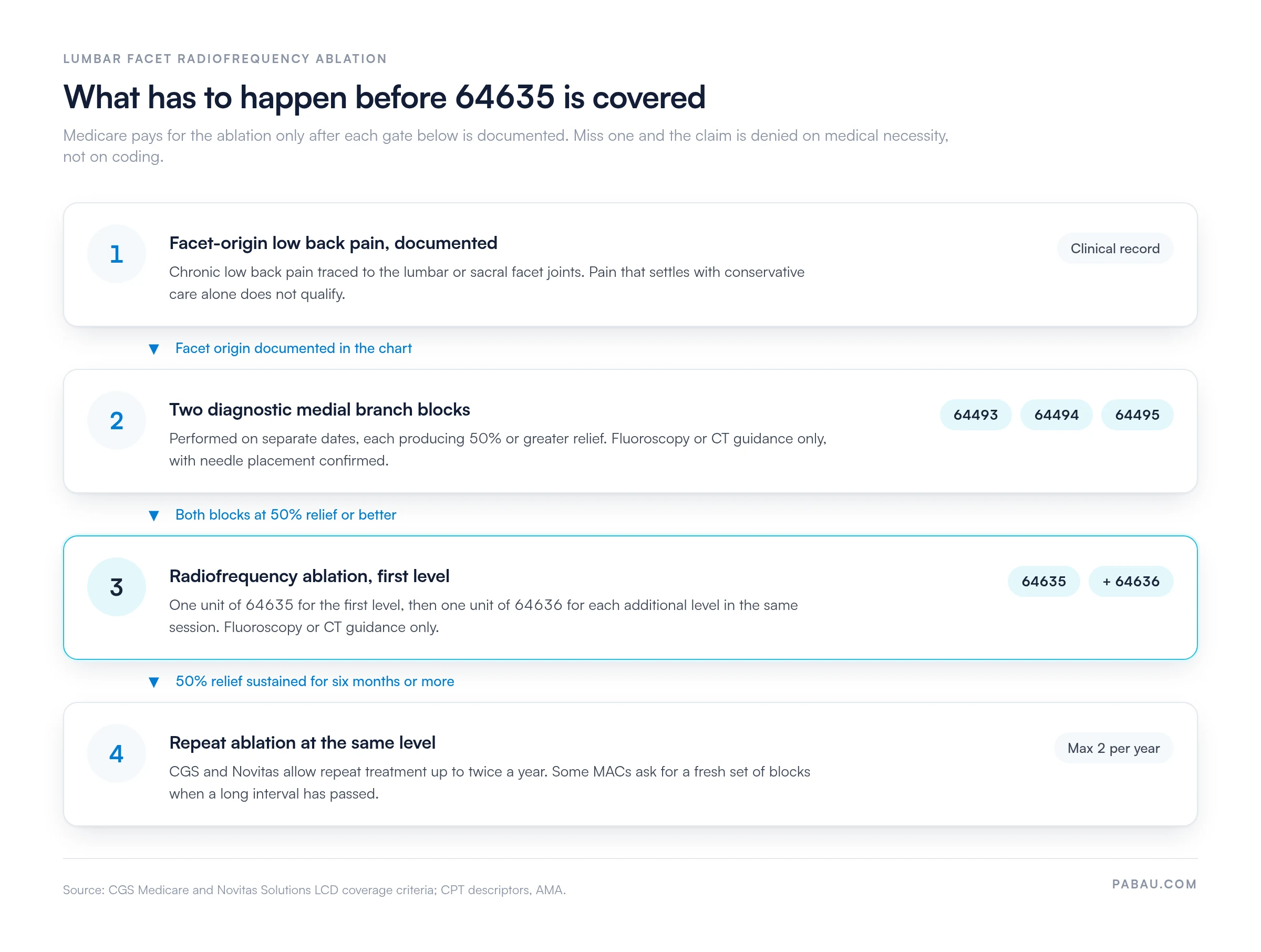
Medicare requires at least two prior diagnostic medial branch blocks with 50% or greater pain relief before 64635 is covered.
Imaging guidance for 64635 must be fluoroscopy or CT, so an ultrasound-guided ablation is not billable under this code.
Pabau’s claims management software supports accurate coding, documentation, and electronic claim submission for pain management practices.
CPT code 64635 is the primary code for destruction by neurolytic agent of the paravertebral facet joint nerve. It covers the lumbar or sacral level, first level. In clinical practice, that means radiofrequency ablation (RFA) of the medial branch nerves supplying the lumbar or sacral facet joints. The American Medical Association maintains the CPT code set and the official descriptor for 64635 has remained consistent across recent code cycles.
The procedure targets the medial branch nerve, not the facet joint capsule itself. A radiofrequency probe delivers thermal energy to coagulate the nerve, interrupting pain signals from the joint. The “first level” language in the descriptor is critical: 64635 covers only one spinal level in one session. Every additional level requires a separate add-on code.
Key clinical facts for coders:
CPT 64636 is the add-on code for each additional lumbar or sacral level of facet joint nerve destruction beyond the first. It is never billed alone. 64635 is always the base code, and 64636 appends once for each level beyond the first treated in the same session.
Practical example: A provider treats L3-L4 and L4-L5 facet joints in one session. That is two levels. Bill 64635 for the first level and 64636 once for the second. If L5-S1 is also treated, add a second unit of 64636. The resulting claim: 64635 x1, 64636 x2.
Add-on codes are generally exempt from the multiple procedure payment reduction (MPPR), and 64636 carries its own RVU value and reimbursement rate. Never combine two levels into a single unit of 64635.
Level counting is where most RFA billing errors originate. A “level” in the context of CPT code 64635 refers to one spinal joint level on one side. Left L4-L5 and right L4-L5 are two separate levels for billing purposes when treated in the same session.
For bilateral procedures, many MACs accept modifier 50 on CPT code 64635. That single unit covers both sides of the first level. Additional levels are then reported with 64636, using LT and RT to distinguish the sides. Some payers prefer two separate line items with LT and RT on 64635 itself, so verify the preference with your MAC before submitting. Modifier 59 may be required when billing 64636 units alongside 64635 to override bundling edits.
Medicare reimbursement for CPT code 64635 varies by setting and geography. The CMS Medicare Physician Fee Schedule publishes national rates annually. For 2026, verify your locality-specific rate with the CMS MPFS lookup tool. Geographic Practice Cost Index (GPCI) adjustments shift the final payment by region. Use FastRVU’s 2026 RVU lookup to calculate your practice’s expected reimbursement based on local GPCI values.
Reimbursement also depends on whether the procedure is performed in a facility or non-facility setting. Pain management practices billing from their own offices typically receive the non-facility rate, which includes a practice expense component.
Hospital outpatient departments and ambulatory surgery centers (ASCs) receive the lower facility rate because the facility bills separately for overhead costs. The difference can be significant for high-RVU procedures like RFA.
The Multiple Procedure Payment Reduction (MPPR) applies when several separately payable procedures are performed in the same session by the same provider. Under MPPR, the second and subsequent procedures lose 50% of their practice expense (PE) component.
Add-on codes such as 64636 are generally exempt, so a multi-level RFA session is not usually reduced on that basis. Expect MPPR when 64635 is billed alongside a different separately payable procedure on the same day. The adjustment shows up on the 835 remittance, so reconcile it there against the expected payment.
Use the CMS MPFS lookup tool filtered to your MAC locality before quoting patients on expected Medicare cost-sharing. National averages can understate or overstate the payment by 10-25%, depending on the GPCI values in your region. Check again each January, when the new fee schedule takes effect.
Medicare does not cover CPT code 64635 without documented medical necessity. Coverage is governed by Local Coverage Determinations (LCDs) issued by each Medicare Administrative Contractor (MAC). The CGS Medicare and Novitas Solutions LCDs are among the most frequently cited, though providers must verify the LCD in effect for their specific jurisdiction.
Strong medical billing compliance starts with knowing your MAC’s exact LCD article number before submitting any 64635 claim. The article number tells you which relief threshold, block count, and imaging modality that jurisdiction will accept.
Most MACs share the same core coverage requirement. The patient must have chronic low back pain originating from the lumbar or sacral facet joints. A positive response to diagnostic medial branch blocks (MBBs) has to confirm it. Cervical and thoracic ablation falls under 64633, not 64635, so the neck is outside this code’s scope. Pain that responds to conservative treatment alone, or pain without documented facet joint origin, does not meet medical necessity standards.
Low back pain from damaged vertebral endplates is vertebrogenic rather than facetogenic, and basivertebral nerve ablation under CPT code 64628 treats it. Imaging and the procedure note decide which pain generator the record supports.
Most MAC LCDs require two prior diagnostic medial branch blocks before CPT code 64635 will be covered. Each block must produce 50% or greater pain relief. The blocks must be performed on separate dates. A single positive MBB is generally insufficient. Document the following for each diagnostic block:
Check the patient’s benefits before the diagnostic blocks are scheduled. Confirming active coverage for the prerequisite procedures heads off an authorization problem later in the episode. Once both MBBs are documented with 50% or greater relief, the clinical record supports the RFA authorization request.
Frequency limits also apply. The CGS and Novitas LCDs named above allow repeat ablation at the same level up to twice a year, roughly every six months. A repeat is covered only once at least 50% relief from the prior treatment has lasted six months or more.
Some MACs ask for a fresh set of diagnostic blocks before authorizing a repeat when a long interval has passed. Always consult your MAC’s current LCD, since frequency limits are jurisdiction-specific and get updated periodically. The whole coverage path, from the first documented complaint through to a repeat ablation, is worth holding in one view.
Modifier errors on CPT code 64635 are a leading cause of claim denials and post-payment audits in pain management billing. Four modifiers do almost all the work on this code, and each one has a predictable way of going wrong.
Modifier 50 on CPT code 64635 typically pays 150% of the single-side rate. That is 100% for the first side and 50% for the contralateral side. Some commercial payers require two separate line items with LT and RT rather than modifier 50. Confirm the preference with each payer before submission. Per AAPC coding guidance, incorrect modifier use on bilateral RFA claims is one of the most frequent audit triggers for this code family.
CPT code 64635 sits within a broader family of facet joint intervention codes. Understanding the full code set helps coders select the right code for diagnostic vs. therapeutic procedures and cervical vs. lumbar anatomy. The AAPC Codify lookup tool provides searchable access to the full code family with descriptor text.
The diagnostic injection codes (64493, 64494, 64495) are the clinical and billing predecessors to CPT code 64635. Those prior MBBs are billed separately when performed, using their own code family with their own modifier and documentation rules. Never use 64635 to describe a diagnostic medial branch block; the CPT descriptors for injection vs. destruction are distinct and not interchangeable.
Destruction codes for the cervical and thoracic spine sit outside this table. 64633 covers a single facet joint there, and CPT 64634 each additional joint.
The recurring errors on CPT code 64635 claims come from three misunderstandings. Coders misread what a “level” means, underestimate how much documentation the LCD wants, or apply the modifier logic the payer does not use. These five produce the highest denial volumes in pain management RCM departments.
Structured denial code tracking lets billing staff see which error categories drive the denials on 64635. From there the team can correct the upstream documentation or the modifier assignment. Grouping denials by reason across the whole facet code family also surfaces patterns that case-by-case review tends to miss.
Audit your last 30 CPT 64635 claims before the next payer review cycle. Check three items. Look for documented MBB dates with relief percentages, the correct modifier on the primary code, and the guidance modality named in the note. Most RFA audit findings trace back to one of those three.
Pain management billing carries a heavy documentation load. Every CPT code 64635 encounter needs four records on file:
Holding that chain together across several visits, often months apart, is where practices lose claims.
Practice management software like Pabau ties the clinical record to the billing workflow. Pabau’s claims management software keeps each medial branch block note in the same system that later produces the RFA claim. The supporting documentation is retrievable from that encounter record instead of a separate filing system. When a payer asks for the prerequisites, the claim and its evidence are already sitting together.
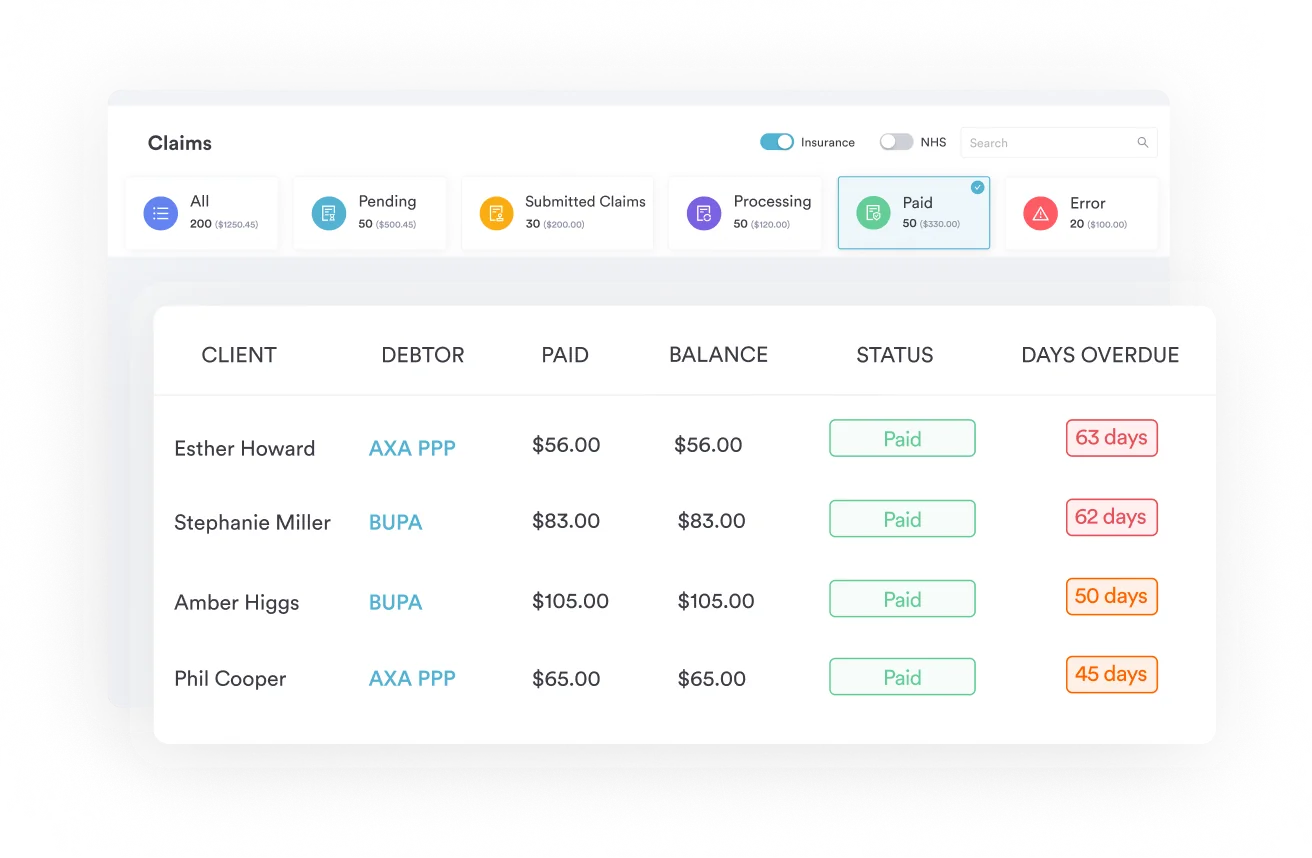
Claims go out electronically through a connected clearinghouse, so eligibility can be checked before a high-value RFA appointment. The connection handles 837P claims, 835 remittance files, and secondary submissions. That covers a 64635 encounter from the authorization check through to payment posting.
Built-in CPT and ICD-10 catalogs support code selection at the point of billing, and a validation layer catches common errors before transmission. Practices with low denial rates treat the revenue cycle as one connected workflow rather than a run of separate billing tasks. For a code like 64635, that means the authorization check, the clinical note, and the claim all draw on the same record.

Pain management practices use Pabau to document medial branch block prerequisites, track prior authorization status, and submit 64635 claims through a connected clearinghouse. See how the billing workflow holds together in one system.

CPT code 64635 rewards precision on four points: the level count, the add-on code, the documented block prerequisites, and the modifier the payer expects. Get those right and the claim generally pays on the first pass.
The billing side is easier to fix than it looks, because the evidence Medicare wants is created months earlier at the medial branch block visits. A practice that captures the dates, the relief percentages, and the imaging modality at that point rarely has to reconstruct the trail at claim time. The alternative is chasing a chart trail after the denial has already landed.
Book a demo to see how Pabau keeps pain management documentation and 64635 claim submission in a single workflow.

Need guidance on medical billing compliance for pain management? Medical billing compliance requirements covers the documentation and audit standards practices must meet for interventional pain procedures.
Want to understand how clearinghouse claim submission works? Understanding the 837 file format explains how electronic claims are structured and transmitted to Medicare and commercial payers.
Looking to reduce claim denials across your practice? Best medical billing software in the US reviews the key features that help practices reduce denials and accelerate reimbursement.
Billing the diagnostic blocks that come first? 64493 covers the lumbar medial branch block that has to be documented before 64635 is payable.
CPT code 64635 is the billing code for destruction by neurolytic agent of the paravertebral facet joint nerve. It covers the lumbar or sacral level, first level. In clinical practice, this describes radiofrequency ablation (RFA) of the medial branch nerves supplying the lumbar or sacral facet joints. The code covers one spinal level on one side per unit reported.
CPT 64635 is the primary code for the first level of lumbar or sacral facet joint nerve destruction. CPT 64636 is the add-on code reported for each additional level treated in the same session. 64636 can never be billed without 64635 as the parent code on the same claim.
Yes, Medicare covers CPT code 64635 when medical necessity is documented under the applicable Local Coverage Determination (LCD) for your MAC jurisdiction. Coverage requires at least two prior diagnostic medial branch blocks with documented 50% or greater pain relief, performed on separate dates. The CGS and Novitas LCDs allow repeat ablation at the same level up to twice a year. A repeat is covered once 50% relief from the prior treatment has lasted at least six months.
Yes, bilateral lumbar RFA can be billed in a single session. Most MACs accept modifier 50 on the primary CPT code 64635 to indicate bilateral treatment at the same level. That typically reimburses at approximately 150% of the unilateral rate. Some commercial payers require two separate line items with LT and RT modifiers instead. Verify your payer’s preferred billing method before submission.
A medial branch block (CPT 64493) is a diagnostic injection of local anesthetic. It temporarily numbs the medial branch nerve to confirm it as the pain source. Radiofrequency ablation (CPT code 64635) is the therapeutic follow-up that destroys the nerve with heat energy, giving longer-duration relief until the nerve regenerates. The MBB must be performed first and documented with adequate pain relief before RFA is covered.
Facet joint denervation refers to procedures that interrupt pain signals from the facet joints by destroying the medial branch nerves supplying them. CPT code 64635 is the primary facet joint denervation code for the lumbar and sacral spine. The equivalent cervical and thoracic denervation procedures use different CPT codes from the 64630 series, not 64635.