CPT code 21011: Excision of soft tissue tumor of the face
CPT code 21011: Official descriptor and procedure overview CPT code 21011, as pu...

Last Updated: Oct 8, 2026
33264 is the CPT code for removal of an implantable defibrillator pulse generator with replacement of the generator; multiple lead system. It applies when the new generator connects to leads in at least three chambers. In practice, that means a CRT-D battery change with right atrial, right ventricular and left ventricular leads in place.
The code covers the generator swap only, so lead work is billed separately. The lead count in the operative note decides between 33262, 33263 and 33264. The sections below follow the claim from note to payment, including modifiers, ICD-10 pairings and the most common denials.
Let Pabau's smart automation suggest the right codes, reduce claim denials, and keep your practice compliant—effortlessly.
Automate repetitive tasks and focus on what matters most—your patients.
Reduce coding errors and ensure compliance with the latest regulations.
Clean claims, fewer denials, and faster reimbursements.
Powerful insights and reporting to help your practice thrive.
HIPAA compliant SOC 2 certified GDPR-compliant Trusted by 4,000+ clinics worldwide

CPT code 33264 covers generator-only replacement on a multiple lead system, typically a CRT-D with right atrial, right ventricular and left ventricular leads.
Choose the code by counting the leads connected to the new generator at surgery, not the leads in the original implant record.
Document battery depletion with a programmer printout showing ERI or EOL status. A missing printout is the most common denial trigger.
Lead repositioning, repair, new electrodes and lead removal are reported with their own codes on top of 33264.
Pabau pre-fills claims from the patient record, checks required fields, and tracks submission, claim status and ERA posting through Claim.MD.
CPT code 33264 has one official descriptor, set by the American Medical Association. It reads: removal of implantable defibrillator pulse generator with replacement of implantable defibrillator pulse generator; multiple lead system.
A multiple lead system has leads in three or more chambers. In practice, that is typically a CRT-D, a cardiac resynchronization defibrillator. It carries right atrial (RA), right ventricular (RV) and left ventricular (LV) leads. Single-lead systems take 33262, and dual-lead systems take 33263.
The code covers the generator only. Lead repositioning, repair and replacement carry their own codes and are reported separately when performed. Most replacements follow battery depletion, shown as elective replacement indicator (ERI) or end-of-life (EOL) status on a device programmer report. Generator recalls and device malfunction are also valid reasons.
Knowing the steps tells you what the operative note should show. The electrophysiologist typically works through this sequence:
The note must name all three leads as active and connected to the new generator. If it lists only two, even when a third was placed at the original implant, the correct code becomes 33263.
Overbilling and audit exposure usually start with a misread of what 33264 already includes. Use the table below to separate bundled work from separately reportable services.
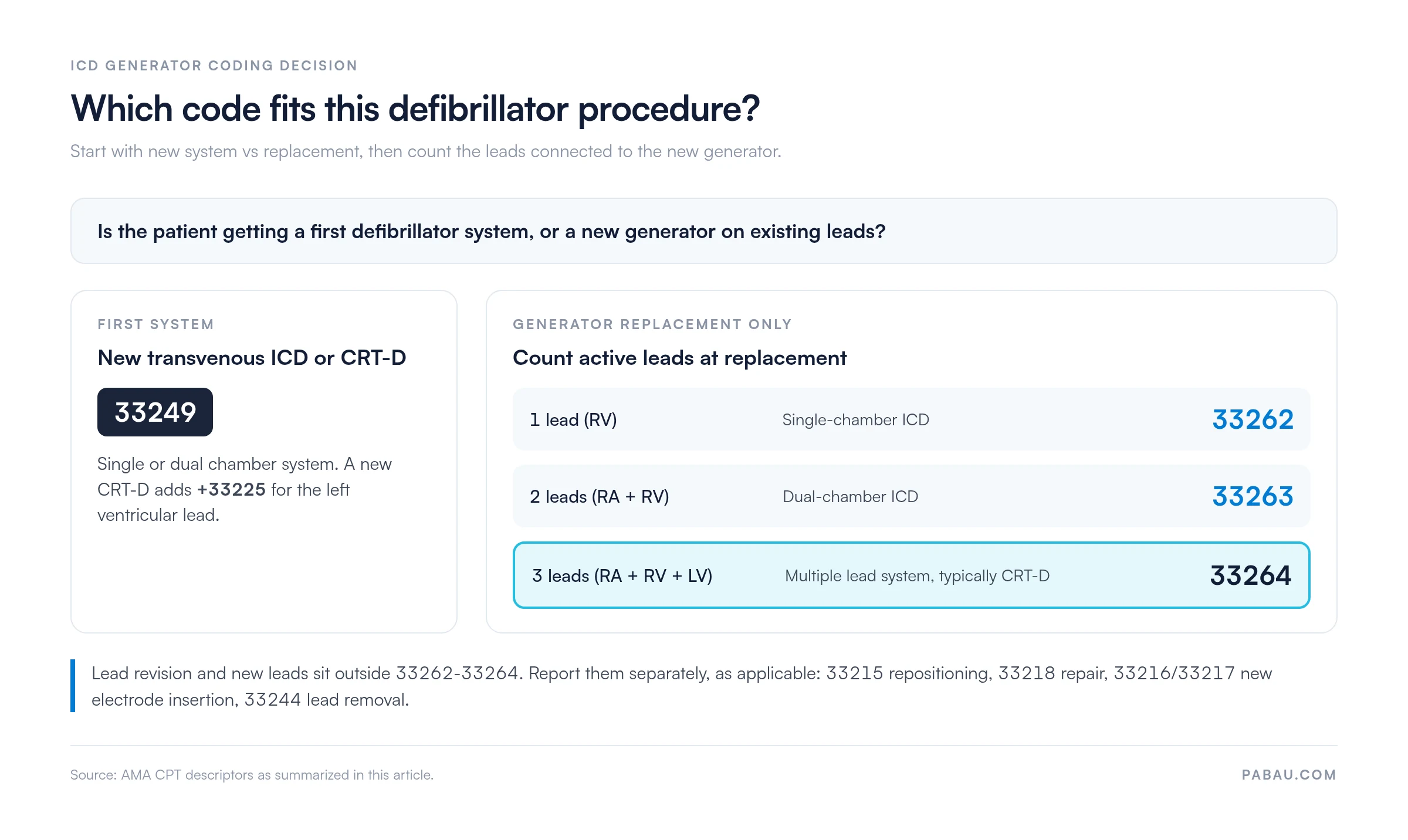
The 33262-33264 family covers ICD generator replacement only, and lead count is what separates the three codes. Count the active leads connected to the new generator during the procedure. The number implanted years earlier doesn’t matter.
CPT 33249 is often confused with 33264, but it describes a different job. Its descriptor is insertion or replacement of permanent implantable defibrillator system, with transvenous lead(s), single or dual chamber.
A first-time CRT-D is coded as 33249 plus add-on 33225 for the LV lead. CPT code 33264 is a replacement code only, so using it for a new system creates upcoding exposure.
Here’s how the rule plays out. A patient’s CRT-D reaches ERI six years after implant. The note records RA, RV and LV leads tested and reconnected to the new generator, so the claim is 33264.
If the LV lead had been capped and left unconnected, the same visit would code as 33263. The decision runs in two steps, as the diagram below shows.
Every 33264 claim needs at least one ICD-10-CM code that establishes medical necessity under CMS NCD 20.4 for implantable cardioverter defibrillators. On most elective replacements, the primary diagnosis is Z45.02. Supporting codes record the condition that justified the original implant.
Z45.02 alone is usually enough for an elective ERI or EOL replacement, provided the programmer printout is on file. Adding the underlying condition, such as I25.10 for coronary artery disease, helps with payers that ask for evidence of ongoing need.
Medicare pays for a 33264 procedure through three separate components, and mixing them up is a compliance risk. Rates change with each annual Medicare rule. Check current figures in the CMS Physician Fee Schedule look-up tool before quoting them.
The CRT-D device itself isn’t part of the 33264 professional fee. In a facility setting, the device goes on the facility claim with the applicable HCPCS C-code. C-codes are device-specific and change annually. Leaving the C-code off, or folding device cost into the professional fee, puts both claims in error.
Modifier choice for 33264 depends on staffing and on whether the case ran unusually complex. The AAPC codebook gives modifier guidance, but the operative note must support whatever you append.
Medicare doesn’t currently require prior authorization for ICD generator replacement when the patient has an established device indication. The CMS prior authorization program list changes periodically, so confirm it before each case. Run an eligibility check before the procedure date as well.
Many commercial payers do require prior authorization for 33264. The documentation package typically includes:
A request sent without the battery status report is the most common reason commercial payers pend or deny it. That happens before a claim even exists.
Most 33264 denials fall into five predictable categories. A solid denial management workflow catches each one before submission, not after the rejection arrives.
When a denial does arrive, the claim adjustment reason code tells you where to start. Our guide to medical billing denial codes maps the common ones to their fixes.
A clean claim for 33264 comes down to a few checks before it leaves the practice. Each takes a couple of minutes, and each miss costs days of resubmission.
Audit your last 20 CPT 33264 claims. Check whether each operative note names all three leads (RA, RV, LV) as active and connected to the new generator. Where a note omits a lead that was in fact connected, the claim drops to 33263 and underpays the work. Fix the note template, not just the claim.
An operative note that supports 33264 must contain each element below. Missing even one gives a payer grounds to downcode to 33263 or deny outright. Good medical billing compliance habits include a pre-billing documentation check for every cardiac device case.
Copy device serial numbers from the procedure record onto the superbill rather than retyping them. That keeps the claim data identical to the operative note.
CPT 33264 carries a 90-day global surgical period under Medicare. Knowing what falls inside it decides which follow-up services you can bill. Review the remittances on post-op claims to see which services payers bundled and which they paid.
Adding a new LV lead at the time of generator replacement means billing 33225 alongside 33264. Check the current NCCI edit table first, because this pairing is subject to periodic edit updates. The note must show the LV lead work as separate and distinct from routine generator connection.
On many EP billing teams, coders retype device details from the operative note into the claim. Then they chase status on payer portals and post remittances by hand. Each handoff is a chance to drop a lead count or a C-code.
Pabau, the practice management platform we build, handles that work in its claims management software. It pre-fills claims from the patient record, with CPT and ICD-10 lookup libraries built in. Required-field validation stops an incomplete claim before it goes out.
For US practices, Pabau submits claims through Claim.MD. The same integration runs eligibility checks, tracks claim status, and posts electronic remittance advice (ERA) back to the patient record. Your team spends less time reconciling and more time on the few claims that need attention.
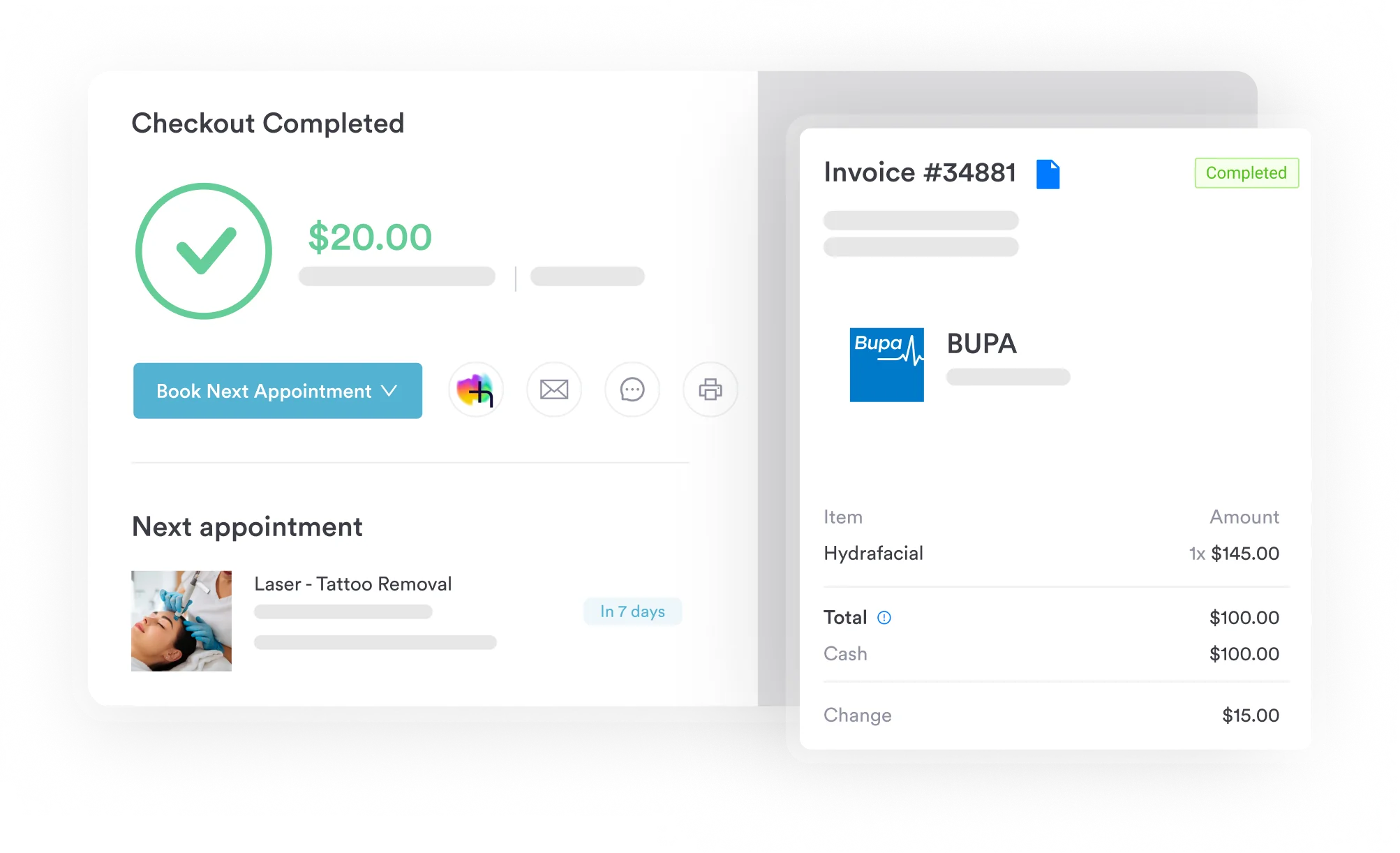

Pabau pre-fills each claim from the patient record and checks required fields before submission. Claim.MD status tracking and ERA posting keep every 33264 claim visible until it’s paid.

CPT code 33264 rewards a precise operative note more than coding skill. Once the note names three connected leads and the printout shows ERI or EOL, the code choice is settled.
So fix the inputs, not the claims. Build lead count, battery status and prior authorization into the pre-op workflow, and most of the denials above never happen. The cost is a few minutes of chart review per case, which is cheap next to a resubmission cycle.
If your team still retypes device data into claims, book a demo to see how Pabau pre-fills them and tracks each one to payment.

Need to understand how claims move from submission to payment? How Pabau’s Claim.MD clearinghouse works explains the 837P submission path, real-time eligibility checks, and ERA reconciliation for US practices.
Preparing a commercial prior authorization request? The prior authorization process walks through each step from request to approval, and what payers expect in the packet.
Reconciling post-op payments? Electronic remittance advice explained shows how to read an ERA and spot bundled or underpaid lines.
Looking for CARC denial code definitions? Denial codes in medical billing maps the most common claim adjustment reason codes to their root causes and appeal strategies.
Want the bigger picture on the revenue cycle? What is medical billing covers the full cycle from charge capture through payment posting, with guidance on avoiding common claim errors.
It covers removal and replacement of an implantable defibrillator pulse generator on a multiple lead system. That means leads to at least three chambers, typically a CRT-D with RA, RV and LV leads. It covers the generator only, so lead replacement, revision and new lead insertion are reported separately.
Usually, yes. The battery is sealed inside the pulse generator, so a battery change is a generator replacement. Use 33264 when three leads connect to the new generator, and 33263 if only two do.
CPT 33263 is generator replacement on a dual lead system, with RA and RV leads. CPT 33264 is replacement on a multiple lead system, which adds an LV lead. The lead count in the operative note decides which one applies.
A first-time transvenous CRT-D is coded with 33249 plus add-on code 33225 for the LV lead. CPT 33264 never applies to a new system, because it describes replacement only.
Z45.02, encounter for adjustment and management of an automatic implantable cardiac defibrillator, is the usual primary code for elective replacements. Add the underlying condition, such as heart failure or cardiomyopathy, as a supporting code.
It’s 90 days. Routine wound checks and uncomplicated programming in that window are bundled. Bill an unrelated E/M with -24, a significant E/M on the procedure day with -25, and an unrelated procedure with -79.