CPT code 19370: Revision of peri-implant capsule billing guide
CPT code 19370: Official description and procedure overview CPT code 19370 is de...

Last Updated: Oct 8, 2026
21011 is the CPT code for excision, tumor, soft tissue of face or scalp, subcutaneous; less than 2 cm. It covers a tumor removed from the fatty layer below the dermis and above the deep fascia.
Coders often confuse it with the 11440-series (face) and 11420-series (scalp) benign lesion codes, and with the adjacent 21012. That confusion is a frequent cause of claim denials for facial soft tissue excisions. Correct assignment depends on two documented facts: tissue depth (subcutaneous, not dermal or subfascial) and a measured specimen diameter under 2 cm.
Let Pabau's smart automation suggest the right codes, reduce claim denials, and keep your practice compliant—effortlessly.
Automate repetitive tasks and focus on what matters most—your patients.
Reduce coding errors and ensure compliance with the latest regulations.
Clean claims, fewer denials, and faster reimbursements.
Powerful insights and reporting to help your practice thrive.
HIPAA compliant SOC 2 certified GDPR-compliant Trusted by 4,000+ clinics worldwide

CPT code 21011 covers subcutaneous soft tissue tumor excision of the face or scalp under 2 cm. The operative note must record both tissue depth and size.
Size determines code selection within the 210xx family: use 21012 at 2 cm or greater, and 21013 or 21014 for deep, subfascial tumors.
Cosmetic exclusion is the top denial reason, so the operative report must document medical necessity, not just the procedure performed.
Pabau, the practice management software we build, keeps op notes, procedure codes, and claims in one workflow. Coders can check depth and size before a 21011 claim goes out.
CPT code 21011, as published by the American Medical Association, describes: Excision, tumor, soft tissue of face or scalp, subcutaneous; less than 2 cm. It sits in the Musculoskeletal System subsection of the CPT Surgery section, under the head codes (21010-21499). Plastic surgeons, oral and maxillofacial surgeons, dermatologists, and ENT specialists bill it most often.
The code applies only when all three of these conditions are met:
If any one of those conditions fails, a different code applies.
Subcutaneous means the tumor lies within the fatty layer beneath the skin but has not invaded the deep fascia or muscle. The surgeon’s documentation must explicitly state the tissue plane encountered. A tumor described as “dermal” may instead fall under the 11440-series (face) or 11420-series (scalp) skin lesion codes. A tumor extending below the fascia belongs to 21013 (less than 2 cm) or 21014 (2 cm or greater).
The 210xx code family covers soft tissue tumors of the face and scalp across six depth-and-size combinations. The 11440-series and 11420-series benign lesion codes cover lesions confined to the skin. Picking the wrong family changes the code, the payment, and the global period that follows the procedure.
Key decision rule: CPT code 21011 is correct when the specimen measures under 2 cm and the surgeon documented the depth. The note has to show the dissection entered the subcutaneous fat layer and stayed above the deep fascia. If the operative report says “dermal cyst” or pathology confirms the lesion sat entirely within the dermis, the 11440-series (11440-11446) applies instead. On the scalp, that becomes the 11420-series.
Read the grid below by depth first, then by size, to land on the right code.
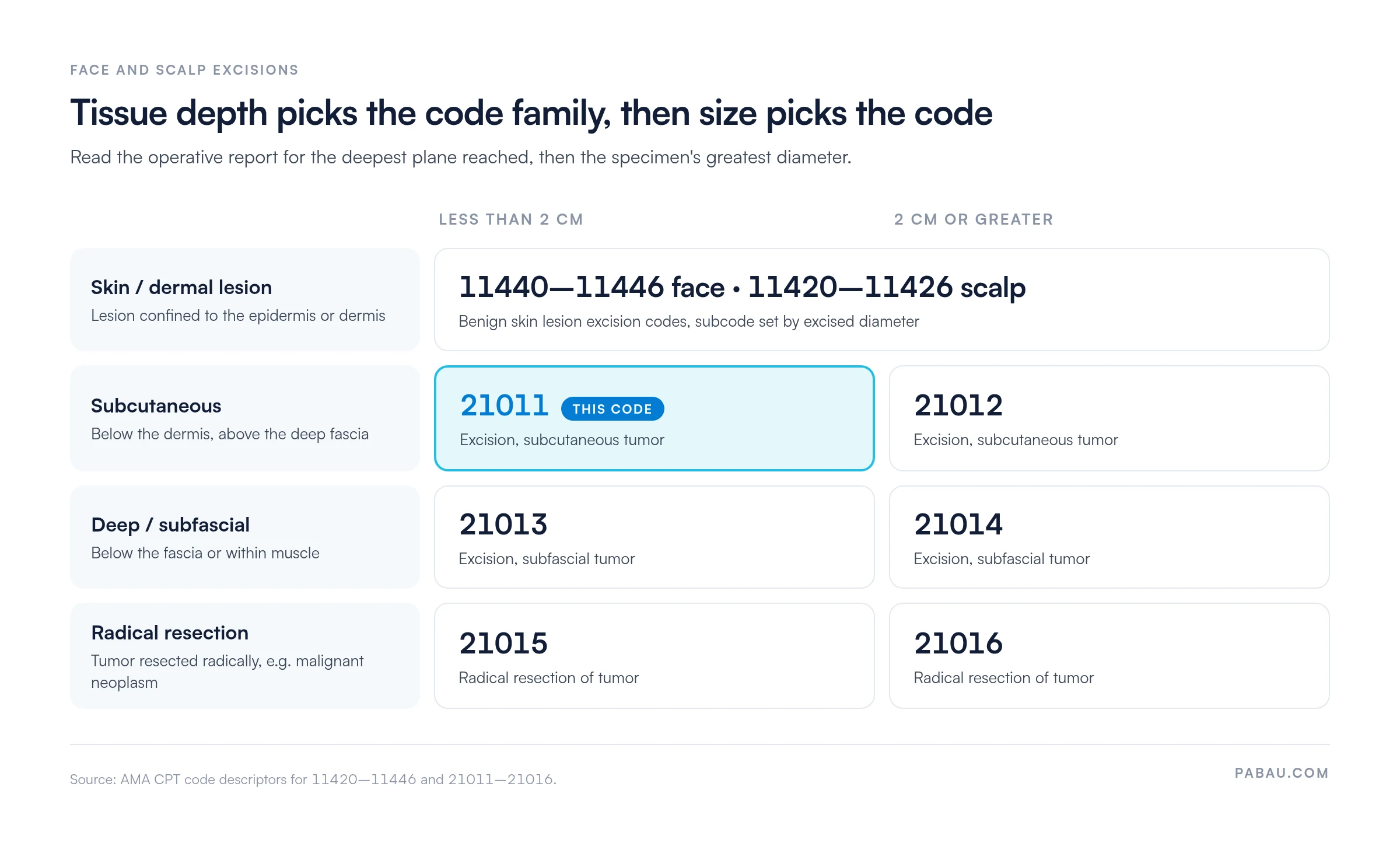
When payers audit 21011 claims, they check two details first: whether the note states the tissue depth, and whether it records a measured specimen size. Both must be in the operative report before the claim is submitted.
Request the operative report before billing, not after. A note that reads ‘excised small facial mass’ gives a coder nothing to work with. Set a practice protocol requiring the surgeon to dictate depth, size, and medical indication before the claim is generated.
The ICD-10-CM diagnosis code must establish medical necessity for the excision. Coders should select the most specific code supported by the clinical documentation, not the broadest category available.
If intraoperative or pathology findings reveal malignancy, the ICD-10 code must be updated to the correct malignant neoplasm category. Do not bill 21011 with a benign diagnosis when the confirmed histology is malignant. A different CPT code family may also apply, depending on the resection type.
Modifier selection for CPT code 21011 depends on the clinical circumstances of the encounter and the payer’s specific edits. Review billing compliance requirements for your payer mix before applying any modifier routinely.
Medicare reimburses CPT code 21011 under the Medicare Physician Fee Schedule (MPFS). Payment amounts change annually with each CMS fee schedule update. Always verify current rates using the CMS Physician Fee Schedule lookup tool. The FastRVU 2026 RVU lookup shows the current-year work, practice expense, and malpractice relative value units (RVUs).
Medicare does not require prior authorization for CPT code 21011 as a routine rule. However, many commercial payers and Medicare Advantage plans do, particularly when the diagnosis code suggests a potentially cosmetic indication. Prior authorization is one step in the wider medical billing workflow, and it has to be finished before the procedure date.
The central challenge is the line between cosmetic and medically necessary. A payer reviewing a pre-auth request for a facial subcutaneous mass excision may default to cosmetic exclusion. That happens unless the clinical documentation clearly establishes why the excision is medically necessary.
Functional impairment, documented growth, pain on palpation, concern for malignant transformation, or a prior inconclusive biopsy all support medical necessity.
Most 21011 denials are preventable. Effective denial management workflows start with identifying the pattern, not just working individual claims. The most common denial reasons and their appeals are below, with relevant denial codes in medical billing referenced for each category.
Track 21011 denial reasons by payer over a rolling 90-day period. If one payer generates repeated cosmetic exclusion denials, request a provider relations call to clarify their medical necessity criteria. Patterns are easier to fix at the contract level than claim by claim.
A disciplined pre-submission checklist reduces first-pass denial rates for CPT code 21011 claims. Using claims management software that integrates documentation and coding cuts the time spent on each step. It also supports submitting a clean claim on the first pass. Complete the checklist below before every 21011 claim leaves the practice.

In many practices, the coder reads a dictated op note and keys the code into a separate billing system. A missing measurement only surfaces when the denial arrives. By then, the surgeon has moved on and the addendum takes weeks.
Pabau links the procedure code, the operative documentation fields, and the ICD-10 selection in a single workflow. Coding staff can check tissue depth, lesion size, and diagnosis linkage while the case is still fresh.
Claims then go out through Claim.MD, Pabau’s integrated US clearinghouse partner, which submits electronic claims to thousands of US payers. It also supports real-time eligibility verification and electronic remittance advice (ERA) posting for surgical codes.

Pabau connects operative documentation to claim submission in one workflow. Coding staff can verify tissue depth, lesion size, and ICD-10 linkage before a claim leaves the practice.

Treat 21011 as a documentation decision before it becomes a coding decision. An op note that names the tissue plane and a measured diameter under 2 cm makes the code defensible on audit. If either detail is missing, query the surgeon before the claim goes out.
That query costs a few minutes today. Skipping it costs a denial, an addendum, and an appeal later, on a code whose 90-day global period also governs every follow-up visit. Book a demo to see how Pabau links the op note, the code, and the claim for surgical excisions.

Coding a deeper tumor? CPT code 21013 covers subfascial soft tissue tumors of the face or scalp under 2 cm.
Managing denial patterns across your practice? Denial management in healthcare covers the workflow steps that turn repeated denials into a correctable process.
Want to understand how clearinghouse validation works? Pabau’s Claim.MD clearinghouse integration explains how real-time payer edits reduce first-pass rejections on surgical codes.
Want the bigger picture on getting paid? Revenue cycle management fundamentals covers how diagnosis-to-procedure code linkage affects claim acceptance rates.
CPT code 21011 covers the excision of a subcutaneous soft tissue tumor of the face or scalp measuring less than 2 cm. The tumor must sit in the subcutaneous layer, below the dermis and above the deep fascia. The surgeon must document both the tissue depth and the specimen’s measured diameter in the operative report.
The only difference is lesion size. CPT 21011 applies when the subcutaneous tumor of the face or scalp measures less than 2 cm. CPT 21012 applies when it measures 2 cm or greater. Tissue depth (subcutaneous) and anatomical site (face or scalp) are the same for both codes. The measured specimen diameter in the operative report is the sole determinant.
Yes, if the cyst is subcutaneous and measures less than 2 cm. If the cyst is truly intradermal or epidermal (not extending into the subcutaneous fat), the 11440-series codes (11440-11446) may be more appropriate. The operative report must document the tissue plane to distinguish between the code families. Coders should not default to 21011 for any facial cyst without confirming subcutaneous depth in the documentation.
Medicare fee-for-service generally does not require prior authorization for CPT 21011. Many commercial payers and Medicare Advantage plans do, especially when the diagnosis may be read as cosmetic. Check each payer’s current authorization requirements before scheduling the procedure. Obtaining authorization retroactively is rarely successful.
The most commonly paired codes are D21.0 (benign neoplasm of connective and other soft tissue of head, face and neck) and D17.0. D17.0 is benign lipomatous neoplasm of skin and subcutaneous tissue of head, face, and neck. L72.0 (epidermal cyst) and L72.11 (pilar cyst) are also common. Use D48.1 (neoplasm of uncertain behavior of connective and other soft tissue) when the tumor’s nature is not established before excision. Select the most specific code the documentation supports.
CPT 21011 carries a 90-day global period, which you should confirm in the current CMS Medicare Physician Fee Schedule data file each year. Post-operative services within the global period cannot be billed separately. An E/M visit that led to the decision for surgery takes modifier 57.