CPT code 21011: Excision of soft tissue tumor of the face
CPT code 21011: Official descriptor and procedure overview CPT code 21011, as pu...

Last Updated: Oct 8, 2026
Q4112 is the HCPCS Level II code for cymetra, injectable, 1 cc.
On January 1, 2026, Medicare stopped paying it as a biological at ASP+6%. It now pays the product as an incident-to supply, at a flat rate per square centimeter.
That one change rewrote the unit math, the application code, and the modifier rules on every Q4112 claim. Billing from last year's playbook now buys a denial and a rework cycle.
Practices that bill skin substitutes routinely lean on cleaner claims management software to catch these issues before submission. It runs from the code description and the payment math through place-of-service rules, modifiers, documentation, and crosswalk codes.
Because Q4112 is a Q-series code, it is temporary by classification. CMS maintains HCPCS Level II codes and can revise, delete, or convert Q codes to permanent status without broad advance notice. Billing teams should verify the code's active status each fiscal year before submitting claims.
Let Pabau's smart automation suggest the right codes, reduce claim denials, and keep your practice compliant—effortlessly.
Automate repetitive tasks and focus on what matters most—your patients.
Reduce coding errors and ensure compliance with the latest regulations.
Clean claims, fewer denials, and faster reimbursements.
Powerful insights and reporting to help your practice thrive.
HIPAA compliant SOC 2 certified GDPR-compliant Trusted by 4,000+ clinics worldwide

HCPCS code Q4112 describes Cymetra, injectable, 1 cc, a micronized acellular dermal matrix made from human donor tissue.
From January 1, 2026, Medicare pays Q4112 as an incident-to supply at roughly $127 per square centimeter, replacing ASP+6%.
Payable units now follow the documented wound surface area in square centimeters, not the volume drawn from the vial.
The claim must carry a non-sheet application code from the G0681 to G0684 range, and JW and JZ no longer belong on it.
Practice management software like Pabau keeps the wound measurement, the product usage record, and the billed units in one place.
Cymetra is a micronized injectable acellular dermal matrix (ADM) derived from processed human donor tissue. It was developed by LifeCell Corporation, now part of Allergan Aesthetics. Sheet-form skin substitutes are placed over wounds. Cymetra is delivered by injection instead, which makes it useful for soft-tissue augmentation where a sheet graft cannot be applied.
Clinical applications include correction of soft-tissue defects, lip augmentation in reconstructive contexts, and vocal fold augmentation for glottic insufficiency. Payer coverage criteria for tissue products differ from the criteria for soft-tissue fillers billed under other codes. Read the policy written for the product, not the one written for the procedure it resembles.
Because Cymetra is derived from human tissue rather than synthesized as a drug, it is regulated differently from biologic drugs. That distinction now drives payment as well as coverage. Products outside the Section 351 biologic pathway moved onto a new Medicare payment methodology on January 1, 2026.
Medicare Part B may cover HCPCS code Q4112 when medical necessity is documented and when the product is furnished in an eligible place of service. Coverage is not automatic.
Your Medicare Administrative Contractor (MAC) decides which diagnoses make Q4112 reimbursable. That decision sits in the applicable Local Coverage Determination (LCD) or National Coverage Determination (NCD).
Verify eligibility before the procedure date. Confirming that a patient’s plan covers non-sheet skin substitutes prevents a denial after the product has already been applied.
The MACs revised their skin substitute coverage policies for 2026. Work from the current version of your jurisdiction’s LCD rather than a copy saved last year.
CMS retired the high-cost and low-cost skin substitute classification on January 1, 2026. In its place, these products are paid as incident-to supplies under the Physician Fee Schedule. The rule covers any skin substitute not licensed as a biologic under Section 351 of the Public Health Service Act.
Cymetra is a 361 HCT/P regulated under 21 CFR Part 1271, so Q4112 sits inside that new methodology. CMS sorted products into three FDA pathway groups, PMA, 510(k), and 361 HCT/P, then set one rate across all three for CY2026.
The low-cost application codes C5271 through C5278 were deleted at the same time. A claim that still carries one of them is rejected outright.
Check each row against your own MAC’s current guidance before you submit. Jurisdictions differ on claim edits and documentation timing. CMS has also said it may set separate rates for the three FDA groups in a later year.
Medicare assigns 3.81 practice expense RVUs per square centimeter to the non-sheet skin substitute product codes, Q4112 included. No work RVUs and no malpractice RVUs attach to the code.
Multiply those 3.81 RVUs by your locality’s practice expense GPCI and by the 2026 conversion factor of $33.4009 to reach the allowed amount. That lands at roughly $127 per square centimeter nationally.
CMS published $127.14 per square centimeter in its November 2025 correction notice, which aligned the office rate with the hospital outpatient rate. Geographic adjustment moves the figure above and below that number. Treat the national rate as a planning figure, not as what your MAC will pay.
The chain below shows where each factor enters the calculation.
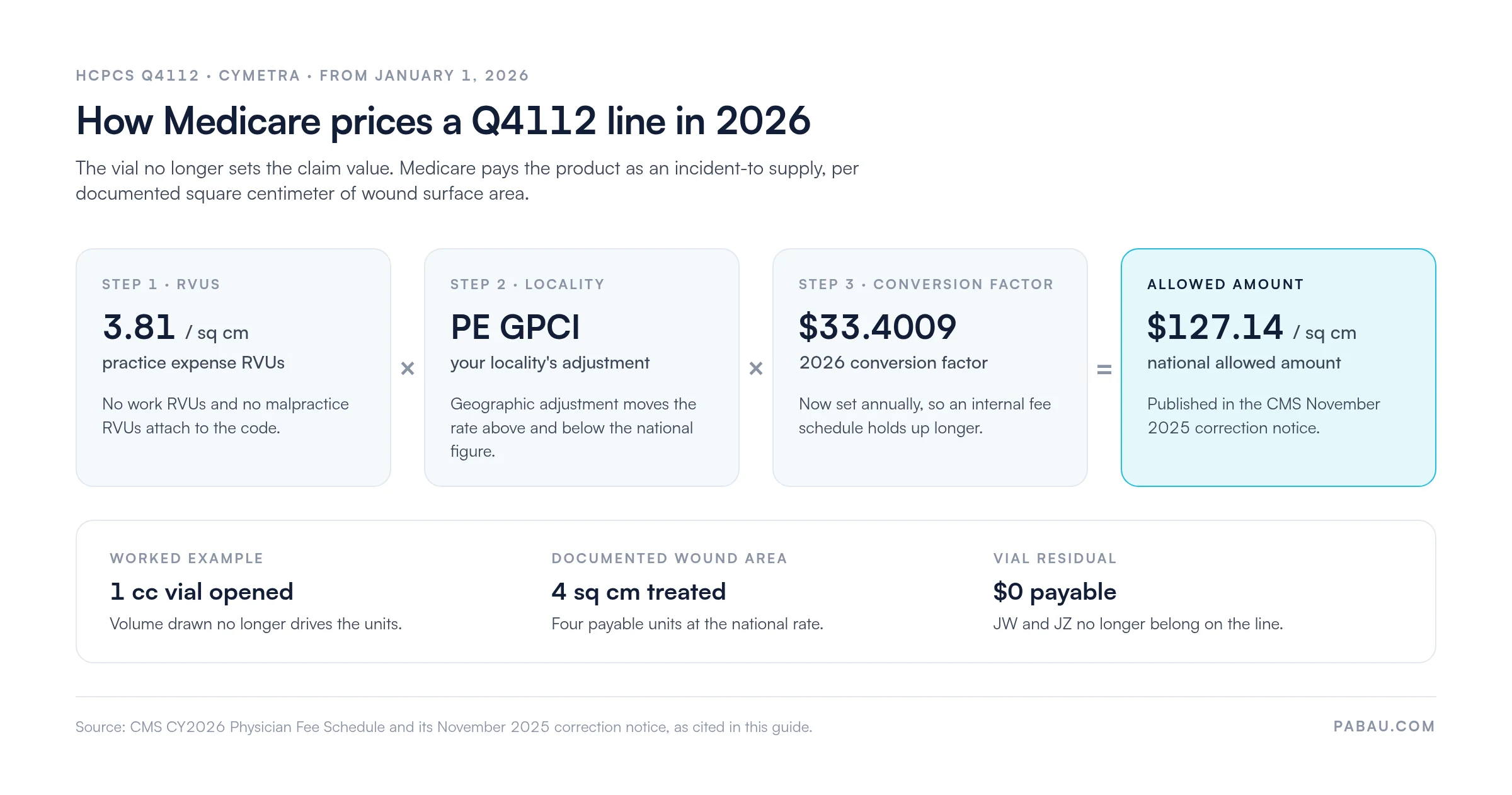
The size of the vial no longer decides the claim value. A 1 cc vial applied to a 4 sq cm wound pays for four square centimeters, and whatever is left in the vial pays nothing.
Because the rate is now set annually rather than repriced quarterly, an internal fee schedule holds up longer than it used to. Still confirm your own locality’s amount with the CMS Physician Fee Schedule lookup tool before each billing cycle.
Where you administer Cymetra decides who gets paid for the product. The physician office is the only setting in which the practice is paid for Q4112 itself. In a facility, the product is paid to the facility instead.
The hospital outpatient side changed in 2026 as well, though not in a way that helps Q4112. CMS unpackaged sheet-form products into three new APCs: 6000 for PMA products, 6001 for 510(k) products, and 6002 for 361 HCT/Ps. Each of those pays $127.14 per square centimeter.
Non-sheet products such as Cymetra stayed packaged into the procedure APC. So the split that decides whether a hospital sees separate payment is now sheet versus non-sheet, not high cost versus low cost.
An incorrect POS code on a Q4112 claim is one of the most common reasons skin substitute claims are returned for correction. Capture the place of service at scheduling, rather than correcting it after the claim comes back.
Measure and record the wound before you open the vial. From 2026, the documented wound surface area in square centimeters sets the payable units on a Q4112 line. An unmeasured wound caps the claim at whatever you can prove afterward. Record the measurement, the method used, and the date in the procedure note.
Billing Q4112 now turns on the wound measurement, the application code, and the modifiers you leave off. Submitting the product code without a non-sheet application code is a common reason for denial. According to AAPC’s HCPCS code lookup, Q4112 is reported separately from the procedure code that describes the application.
Wound size decides which pair of G codes belongs on the claim.
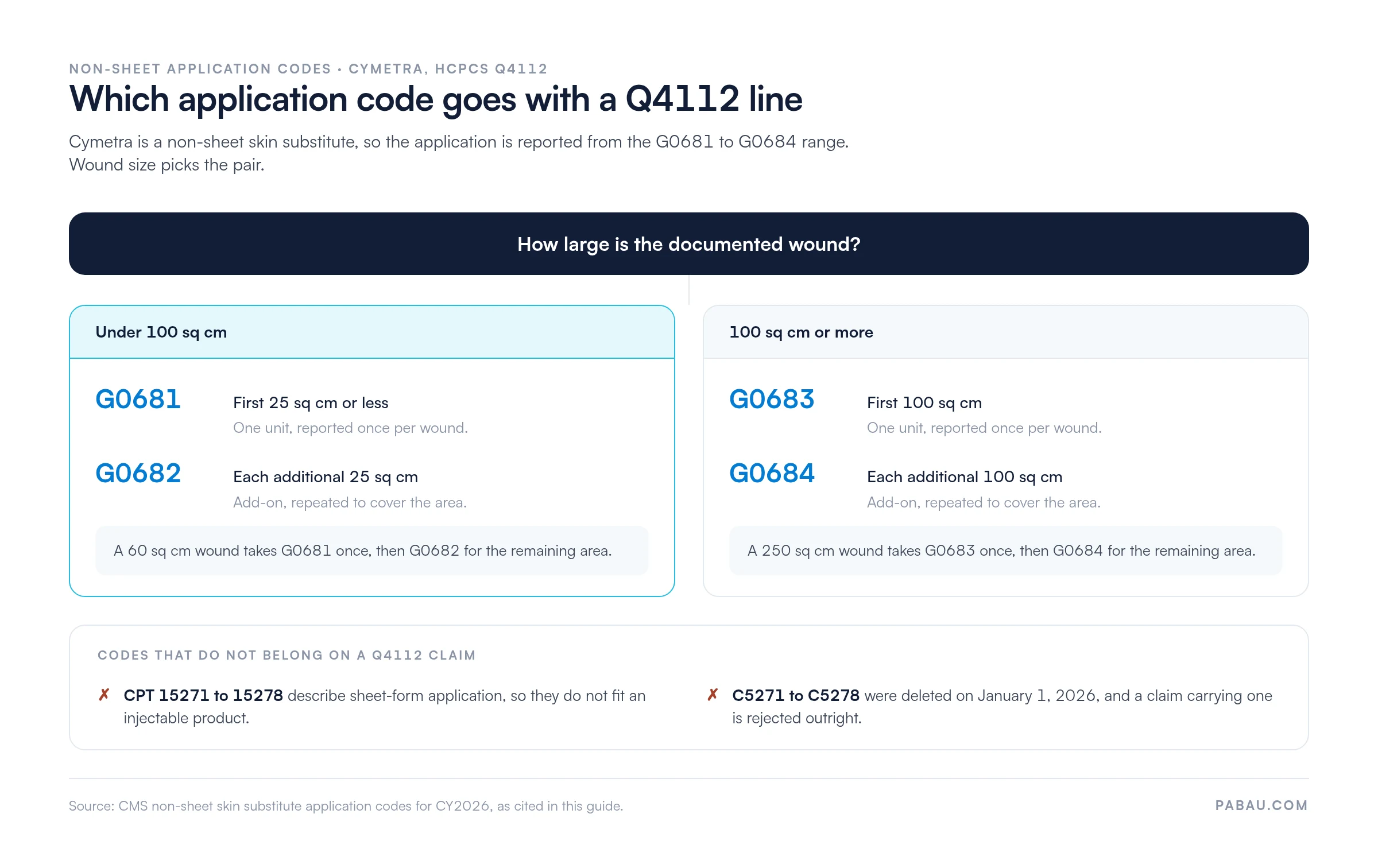
Modifier selection on a Q4112 line changed with the payment methodology. The two waste modifiers that used to belong on a skin substitute line are now wrong. Charge templates built before 2026 still carry them.
Anatomic modifiers such as LT and RT belong on the application code rather than the product code, where the LCD asks for them. Modifier requirements vary by jurisdiction, so confirm the current list with your own MAC before you update a charge template.
No diagnosis code guarantees payment for Q4112. Coverage comes from your MAC’s skin substitute policy. That policy lists the covered indications and the documentation that has to support them. Check every candidate against the current ICD-10-CM code set before you submit.
Cymetra appears on claims from two different clinical worlds. One is chronic wound care, where the 2026 square centimeter rule fits naturally. The other is soft-tissue and vocal fold augmentation, where there may be no wound to measure at all.
The augmentation indications are where 2026 gets awkward. Medicare pays Q4112 per square centimeter of documented wound surface area. A vocal fold or a lip contour defect gives you no wound surface area to document.
Ask your MAC how it wants those cases reported before you treat the patient. If the indication is not covered, issue an advance beneficiary notice and append a GA modifier. That beats a denial you cannot bill to anyone.
Documentation failures are the leading cause of denied Q4112 claims. Medicare’s First Coast Service Options (FCSO) guidance for non-sheet skin substitutes sets two duties.
Providers must show the clinical rationale for the product. They must also prove the product was used on the patient billed. Miss either one and the claim denies, with recoupment possible in an audit.
Documentation for tissue products like Cymetra goes beyond a standard wound care note. The checklist below reflects typical Medicare requirements. Verify the specifics with your own MAC before submitting.
Digital forms for intake and procedure documentation capture these data points at the point of care. That reduces the risk of missing records later. Reading each remittance after a claims cycle also surfaces recurring documentation denials before they compound.
Medicare Part B does not require prior authorization for Q4112, but commercial plans and Medicaid managed care often do. Several commercial policies also treat injectable acellular dermal matrix as investigational for cosmetic soft-tissue augmentation.
Read each plan’s own medical policy rather than assuming Medicare’s rules carry across. Four questions settle most of it before the patient is scheduled.
That last question matters more than it sounds. A payer that has not adopted the G codes will reject them, and a payer that has will reject the CPT codes they replaced.
Choosing the wrong skin substitute code is one of the most common coding errors in this category. The Q4100-Q4265 range covers skin substitute products, with each code specific to a named product and unit of measure. When a provider uses a different skin substitute product, a different HCPCS code must be reported. Submitting Q4112 for a product other than Cymetra is an improper billing practice.
The table below shows a selection of adjacent non-sheet injectable and allograft skin substitute codes. For a full current list, consult the CMS HCPCS quarterly update or your MAC’s applicable skin substitute LCD.
The codes above are for reference only. Always verify that your selected code matches the product name and formulation in the HCPCS descriptor. A mismatch there is what turns a payable claim into an improper one.
Other injectable skin substitutes follow the same non-sheet rules. EpiFix injectable carries its own code, Q4145, and takes the G0681 to G0684 application range rather than CPT 15271 through 15278.
The skin substitute code family is one of the most frequently miscoded HCPCS categories. The key differentiating factor is always the specific product used. Providers cannot substitute a related code simply because the reimbursement rate is more favorable or because Q4112 is more familiar to their billing team.
Three factors determine the correct code:
Form factor is where most mismatches start. Cymetra is injectable, but Gammagraft is a human skin allograft applied to the wound surface and coded Q4111.
Practices that bill skin substitute codes regularly should fold product selection into the clinical documentation workflow. Leaving the coding decision to post-encounter review is where mismatches start. Software that links product usage records to billing fields reduces code mismatches at the claim level.
Q codes are temporary HCPCS Level II codes assigned by CMS. They cover items, drugs, and services that do not yet have a permanent code designation. CMS reviews them periodically. A code may be made permanent, deleted, or replaced based on utilization patterns and coding maturity.
For billing teams, the temporary status of Q codes has practical implications. A code active in one fiscal year may not be active in the next. Practices should check the HCPCS annual update at the start of each calendar year and again at mid-year for any interim updates.
Knowing where Q codes fit in the HCPCS Level II hierarchy helps billing staff anticipate annual code changes. It also gives them a reason to put a code review on the billing calendar.
Denial management workflows should include a check for retired or replaced Q codes whenever denials spike at the start of a new calendar year.
Run a year-end audit of every active Q code in your charge master before January 1. Cross-reference your list against the CMS HCPCS annual update file to identify codes that have been deleted, replaced, or reclassified. One missed update can cause every claim using that code to deny until the error is corrected.
Denial patterns for skin substitute codes follow predictable paths. Most Q4112 denials fall into six categories, and most are avoidable with procedural controls at the documentation and submission stages.
Practices billing skin substitute codes regularly benefit from a pre-submission checklist built into their billing process. Catching these errors before submission costs far less than working an appeal.
Software that ties product inventory to billing records automates part of this verification. When product usage is tracked against the treatment record, the wound measurement and the billed units come from one place. That removes a common source of calculation error.
A Q4112 claim usually gets assembled after the fact. The wound measurement sits in a paper note, the vial invoice sits in a supplier email, and the coder reconstructs the units from both. That is how a 2026 claim ends up billed on the 2025 unit rule.
Practice management software like Pabau keeps those pieces in one patient record instead. Wound measurements captured in the treatment note carry through to the coded line items. Product usage is tracked against inventory, and the superbill is built from what the clinician recorded. So the square centimeters on the claim match the square centimeters in the chart.
Every Pabau subscription includes the full feature set, so documentation templates, inventory records, and claims tracking are all there from the start. Onboarding is structured rather than self-serve, which means your team is billing skin substitute codes to the 2026 rules before the first claim goes out.

Pabau’s claims management software helps aesthetic and reconstructive practices track product usage, generate accurate superbills, and submit cleaner HCPCS claims. See how it works for your specialty.

Q4112 is now a measurement problem more than a coding problem. Document the wound in square centimeters and the rest of the line follows from it, including the G code you pair with it.
A practice still billing it the old way is generating denials on product it has already paid for. Update the charge template, the documentation template, and the coder’s reference sheet together, then check your MAC’s current guidance before the next claim goes out.
Pabau’s claims management software helps specialty practices build the controls that reduce skin substitute billing errors. That runs from product usage tracking to superbill generation and claim review. To see how it fits your practice’s billing workflow, book a demo.

Need to understand how claim denials work? Denial management in healthcare explains the most common denial patterns and how to build a recovery workflow.
Want the documentation to hold up in an audit? Medical billing compliance covers the records payers ask for and the controls that keep them complete.
Looking to improve your revenue cycle? What is revenue cycle management covers the full RCM lifecycle from eligibility to payment posting.
Not sure what belongs on the superbill? Superbill lists every field a payer expects, and where each one comes from.
Working through a remittance you cannot read? Electronic remittance advice explains each segment of the file and what it tells you about a denial.
HCPCS code Q4112 is a temporary HCPCS Level II code that describes Cymetra, injectable, 1 cc. You report it when a provider administers Cymetra as a skin substitute. Cymetra is a micronized injectable acellular dermal matrix derived from human donor tissue.
Medicare Part B may cover Q4112 when medical necessity is documented. The product also has to be used for an indication the applicable Local Coverage Determination covers. Coverage is not automatic. The MACs revised their skin substitute policies for 2026, so check the current version before you treat the patient.
From January 1, 2026, report one unit for each square centimeter of documented wound surface area treated. The code descriptor still reads 1 cc, but the volume in the vial no longer sets the units. Product left over is not payable.
Medicare typically wants a medical necessity statement and a procedure note recording the wound measurement, volume, and site. It also wants product purchase documentation, such as an invoice or a packing slip. The ICD-10-CM diagnosis codes must match covered indications. Verify the specifics with your own MAC.
Q4112 was active as a 2026 HCPCS code when this article was last reviewed, and it is paid under the new incident-to supply methodology. Q codes are temporary and reviewed annually, so verify current status against the CMS HCPCS annual update file each year.
J codes are permanent HCPCS Level II codes primarily used for injectable drugs and biologicals. Q codes are temporary codes assigned by CMS for items and services without a permanent code, including many skin substitute products. Q codes may be converted to permanent status, deleted, or replaced; J codes are stable year to year unless a drug is discontinued.
CMS eliminated the high-cost and low-cost skin substitute classification on January 1, 2026. Q4112 is now paid as an incident-to supply at roughly $127 per square centimeter of documented wound surface area, rather than at ASP plus 6%. Discarded product is no longer payable.
Cymetra is a non-sheet product, so the application is reported with G0681, G0682, G0683 or G0684 depending on wound size. CPT 15271 through 15278 describe sheet-form application and do not fit Q4112. Some MACs reject claims that substitute an injection code.