



CCSD code G5100: Bypass of duodenum billing guide
CCSD code G5100 bills a bypass that leaves the duodenum in place CCSD code G5100...

Last Updated: Oct 16, 2026

CPT Code 70498 describes computed tomographic angiography (CTA) of the neck with contrast, including noncontrast images if performed and image postprocessing.
Effective January 1, 2026, CPT 70471 is the combined CTA head-and-neck code that replaces 70496 and 70498 billed together.
The AMA’s CPT Editorial Panel introduces new codes such as 70471, and CMS then sets the payment amount and the RVUs.
Missing contrast documentation or a skipped postprocessing notation are the two most common reasons 70498 claims are denied.
Pabau’s claims management software integrates with Claim.MD to streamline CTA claim submission, eligibility checks, and denial tracking.
CPT Code 70498 is the billing code for computed tomographic angiography of the neck with contrast. It covers the contrast study, any noncontrast images taken in the same session, and image postprocessing. Radiologists and imaging centers use it to report neck CTA studies of the carotid and vertebral arteries.
This guide covers the official descriptor, 2026 Medicare fee schedule mechanics, applicable modifiers, supporting ICD-10 diagnosis codes, bundling rules, and documentation requirements.
It also explains CPT 70471, the combined head-and-neck code that took effect on January 1, 2026. Later sections cover the four denial patterns that generate the most rework.
Official descriptor (AMA): CPT Code 70498 describes “Computed tomographic angiography, neck; with contrast material(s), including noncontrast images, if performed, and image postprocessing.”
It falls under Diagnostic Radiology (Diagnostic Imaging) in the AMA’s CPT code set, which the American Medical Association maintains and updates annually.
In clinical practice, 70498 reports CTA neck studies ordered to evaluate the carotid and vertebral arteries. Common indications include suspected carotid stenosis, transient ischemic attack (TIA) workup, ischemic stroke evaluation, vascular aneurysm, and arteriovenous malformation.
The code covers the whole acquisition as a single billable unit. Contrast administration, any noncontrast sequences obtained in the same session, and image postprocessing all sit inside 70498. Three technical inclusions define it:
The most common coding mistake with CPT Code 70498 is confusing it with CPT 70496, the head CTA code. Anatomy drives the distinction, not the contrast protocol. The table below clarifies when each code applies.
Until the end of 2025, a study covering both territories was billed as 70496 and 70498 on the same claim. That pattern no longer holds. The next section covers the code that replaced it.
Effective January 1, 2026, combined head-and-neck CTA studies are reported with a single code. CPT 70471 covers an acquisition that captures both the intracranial and the cervical vasculature in one session. It replaces 70496 and 70498 billed together.
The AMA’s CPT Editorial Panel introduced 70471, so the descriptor and the code number come from the AMA. CMS then sets the payment amount and the RVUs. Three outcomes now exist, and the anatomy in the acquisition decides which one you bill.
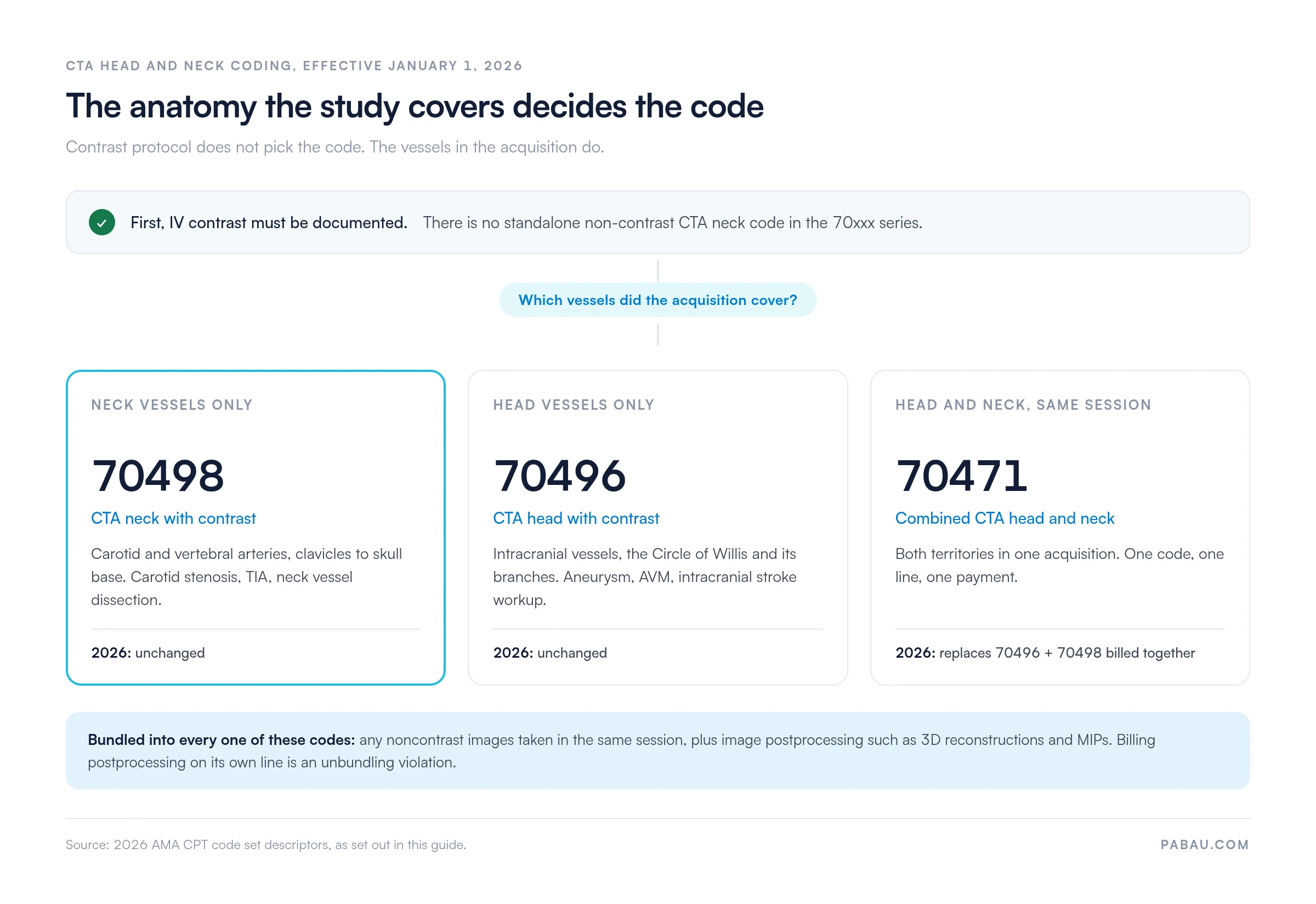
The combined-study scenario is where practices must update their charge capture. Billing 70496 and 70498 together for a combined study generates NCCI edit denials under 2026 payer policies. Add 70471 to the charge master and retire the paired entry before the next combined study goes out.
Run a charge master audit before you submit any combined head-and-neck CTA claim in 2026. Pull every 2025 encounter where 70496 and 70498 were billed together, then flag those charge templates for recode against 70471. Catching this at the charge level is faster than appealing denials after submission.
Medicare reimburses CPT Code 70498 through the Medicare Physician Fee Schedule (MPFS), administered by CMS. Rates vary by geographic locality, place of service, and how the claim is billed. The three billing forms are global, professional component only, and technical component only.
Practices billing 70498 under the global service, with both components in-house, receive the combined rate. Hospital-employed radiologists billing the professional component only use modifier 26. Imaging centers billing the technical component only append modifier TC. For current 2026 rates in your locality, pull the figure from the MPFS lookup tool.
CMS sets reimbursement using Relative Value Units (RVUs). Three RVU components combine with the annual conversion factor to calculate the payment amount.
CMS updates RVU values and the conversion factor every year, so pull current figures from the MPFS rather than a prior-year table. Geographic adjustment is part of that calculation. A practice in Manhattan and one in rural Alabama are paid materially different amounts for the identical claim.
Practices submitting CTA neck claims electronically can route them through the Claim.MD clearinghouse, which reaches thousands of US payers. It also supports real-time eligibility verification before the patient arrives for imaging.
Modifier selection for CPT Code 70498 depends on who owns the equipment and who interprets the study. Using the wrong modifier, or omitting one when it is required, is a direct path to a denial or an overpayment audit.
Never append both modifier 26 and modifier TC to the same claim line, because the two are mutually exclusive. Billing both on a single line signals a system entry error and will generate a rejection.
Also confirm with your Medicare Administrative Contractor (MAC) whether LT/RT modifiers are required for neck CTA before adding them routinely.
Payers require a supported ICD-10-CM diagnosis code to establish medical necessity for CPT Code 70498. The table below lists commonly accepted diagnosis codes. Coverage determinations vary by MAC and by payer policy, so cross-reference the applicable Local Coverage Determination (LCD) for your region before submitting.
Specificity matters. Reporting G45.9 for an unspecified TIA when the record documents which vessel is involved invites payer scrutiny. Code to the highest specificity the clinical documentation supports, and no further.
Inadequate documentation is the root cause of most CPT Code 70498 denials. The radiology report and the ordering provider’s clinical note must together satisfy the payer’s medical necessity standard. Compliance work starts at the point of documentation, not at the clearinghouse.
Required documentation checklist:
The four most common denial reasons for CPT Code 70498:
Catching a missing postprocessing notation at charge entry costs seconds. Appealing the same denial costs days. When a 70498 claim does come back, read the CARC and RARC values on the remittance first. Each one maps to a specific fix in our reference on denial reason codes.
Build a pre-submission checklist into the imaging workflow. For 70498, four fields should be confirmed before the claim releases. Those are the contrast agent, any noncontrast sequences, the postprocessing notation, and ICD-10 specificity against the ordering note. Run a 30-day sample audit each quarter to catch drift.
CPT Code 70498 sits within a family of diagnostic imaging codes. Coders in radiology billing meet these codes in the same session, or as alternatives when the ordered anatomy or modality changes.
The MRA alternatives (70547, 70548, 70549) cover the same cervical anatomy as 70498 but sit in a different modality. Choosing between CTA and MRA is a clinical decision. Choosing the correct code inside each modality is a documentation and anatomy decision, and mixing the two up is its own denial pattern.
A soft tissue neck CT is a separate service, read for the thyroid, salivary glands and lymph nodes rather than as an angiogram. When the report documents an unenhanced series before the contrast series, the claim is CPT Code 70492.
Watch the cervical spine pair as well. 72125 is the without-contrast code, and 72126 is the one that carries contrast. A chest study ordered in the same encounter is coded 71275 and billed on its own line. See the AAPC CPT code lookup for full descriptor details on each related code.
Denial risk in radiology billing accumulates at two points. Documentation is captured at the time of imaging, and claim errors slip through unnoticed at submission. Practice management software like Pabau covers both through its claims management software, which joins clinical documentation to claim submission in one platform.
Today a biller often reads the code descriptor on one site, then re-enters the charge in a separate billing system. That hand-off is where a modifier goes missing. In Pabau the imaging encounter, the note, and the claim sit on the same record. The charge is built from what the radiologist wrote.

For CPT Code 70498 and related radiology claims, the workflow looks like this in practice:
The 2026 CTA change makes this a good year to review charge templates and clearinghouse workflows together. Clean documentation does not rescue a claim that carries the wrong code pair.

Pabau connects clinical documentation, claim scrubbing, and clearinghouse submission in one workflow. Your billing team spends less time chasing denials and more time closing claims.

CPT Code 70498 is a dependable revenue code, and almost all of its denials are preventable at charge entry rather than on appeal. The arrival of 70471 adds one more decision to a claim that was already sensitive to modifiers.
Two changes carry most of the benefit. Update the charge master so a combined head-and-neck study bills 70471 instead of the old pair. Then hold every 70498 claim until the contrast record and the postprocessing notation are both in the report.
That is upfront work traded against a lower denial rate, and the upfront work is by far the smaller cost. Book a demo to see how Pabau handles eligibility, claim scrubbing, and ERA retrieval for a radiology billing team.

Need to understand electronic claim submission for radiology codes? How 837 electronic claim files work explains the standard transaction format used when submitting CPT 70498 and related imaging claims to Medicare and commercial payers.
Want to review the clearinghouse submission process end to end? Medical claims clearinghouse guide covers how claims are validated, scrubbed, and routed before reaching a payer.
Looking for a clean claim checklist before submission? Clean claim requirements outlines the fields and documentation standards that prevent technical rejections on radiology claims.
Tracking eligibility before high-cost imaging procedures? Insurance eligibility verification explains how to confirm a patient’s coverage before a CTA appointment.
CPT Code 70498 is the billing code for computed tomographic angiography (CTA) of the neck with contrast material. It also covers noncontrast images if performed, plus image postprocessing. The American Medical Association maintains it. Radiologists and imaging centers use it to report neck CTA studies that evaluate carotid and vertebral artery anatomy.
Medicare reimbursement for CPT 70498 varies by geographic locality and by how the claim is billed. The three forms are global, professional component only with modifier 26, and technical component only with modifier TC. Use the CMS Physician Fee Schedule lookup tool at cms.gov to retrieve the current 2026 rate for your locality and place of service.
CPT 70496 covers CTA of the head, meaning the intracranial vessels. CPT 70498 covers CTA of the neck, meaning the carotid and vertebral arteries from the clavicles to the skull base. The distinction is anatomical. When both regions are studied in a single session, bill CPT 70471 instead. That combined head-and-neck code took effect on January 1, 2026, and it replaces the old pair.
Effective January 1, 2026, a combined head-and-neck CTA study is billed as CPT 70471 instead of CPT 70496 plus CPT 70498. Billing the old pair together for a combined study generates NCCI edit denials. CPT 70498 itself is unchanged for a neck-only study. The AMA’s CPT Editorial Panel introduced 70471, and CMS sets its payment amount and RVUs.
Modifier 26 reports the professional component, used when the radiologist bills the interpretation separately. Modifier TC reports the technical component, used when the facility bills equipment and staff costs separately. Modifier 59 marks a distinct procedural service and bypasses specific NCCI edits. Modifier 52 reports reduced services when the study was not fully completed. Modifiers 26 and TC are mutually exclusive on the same claim line.
Six items are required. The ordering physician’s clinical note must state the indication and the anatomic region. The contrast administration record must cover the agent, the route and the volume. Any noncontrast sequences performed need a notation. The radiology report must confirm that image postprocessing was completed. Finally, the radiologist signs and dates the final interpretation. The ICD-10 diagnosis code on the claim must match the clinical indication in the ordering note.
Yes, Medicare covers CPT Code 70498 when medical necessity is established through a supported ICD-10-CM diagnosis code and the clinical documentation meets payer standards. Coverage criteria are defined by Local Coverage Determinations (LCDs) issued by each Medicare Administrative Contractor (MAC). Coverage may vary by MAC region, so verify the applicable LCD for your geographic area.



