CPT code 96450: Intrathecal chemotherapy billing guide
CPT code 96450: Official descriptor and procedure overview CPT code 96450 is the...

Last Updated: Oct 9, 2026
F5010 is the CCSD code for transposition of parotid duct (including bilateral). The surgeon moves the opening of the duct that drains the parotid gland. It's usually done to control chronic drooling or to repair an injured duct.
The most important fact sits in the descriptor. One F5010 covers one or both sides, so a bilateral operation is billed once. Billing it twice, or picking a neighboring duct code, gets the claim queried or rejected. Below, we cover what the fee includes, the codes that clash with it, the paperwork insurers expect and a pre-submission checklist.
Let Pabau's smart automation suggest the right codes, reduce claim denials, and keep your practice compliant—effortlessly.
Automate repetitive tasks and focus on what matters most—your patients.
Reduce coding errors and ensure compliance with the latest regulations.
Clean claims, fewer denials, and faster reimbursements.
Powerful insights and reporting to help your practice thrive.
HIPAA compliant SOC 2 certified GDPR-compliant Trusted by 4,000+ clinics worldwide

CCSD code F5010 covers transposition of parotid duct (including bilateral), in section 6.6.0 Salivary Glands of the CCSD schedule.
One F5010 covers one or both sides, so a bilateral operation is billed once.
Most UK private insurers expect written pre-authorization for planned surgery, and the reference number belongs on the claim.
The operative note should name the parotid duct, the side or sides treated, and the diagnosis behind the procedure.
The CCSD schedule lists F5110 and F5610 as unacceptable combinations with F5010, so check before adding a second duct code.
CCSD code F5010 is the code UK private medical insurers use for transposition of parotid duct (including bilateral). The parotid duct carries saliva from the parotid gland into the cheek. In a transposition, the surgeon moves its opening to a new position in the mouth.
The words “including bilateral” matter most for billing. Whether the surgeon treats one duct or both in the same session, you bill F5010 once. The code sits in chapter 6 (Face, mouth, salivary and thyroid), under section 6.6.0 Salivary Glands.
CCSD stands for Clinical Coding and Schedule Development, the group behind the schedule of CCSD codes. Its members are Aviva, AXA Health, Bupa and Vitality. The group sets the codes and their descriptors, while each insurer sets its own fees.
CCSD codes are used across UK private insurers, so confirm F5010 acceptance with each payer. Check the current descriptor in the CCSD schedule too, since entries are reviewed over time.
Over-coding and under-coding both cause trouble. Claiming services the code doesn’t include invites audit scrutiny. Missing a billable component leaves money uncollected.
The CCSD technical guide (October 2025) explains the schedule’s general coding principles. Read it alongside the F5010 entry before you split any component out of the claim.
Coders don’t perform the procedure, but they do have to match the note to the code. In drooling surgery, the surgeon usually reroutes the duct opening further back, near the tonsil. After an injury, transposition can bring a damaged duct or fistula back inside the mouth.
Before you assign F5010, confirm three points in the note:
If any of the three is missing, send the note back to the consultant before you submit. Fixing it now takes minutes. Fixing it after an insurer query means a resubmission and a longer wait for payment.
The salivary duct codes sit close together in the schedule, and their descriptors often differ by one word. Two questions settle the code: which duct was treated, and what the surgeon did to it.
When stone removal is the main procedure, the code is F5120 for the submandibular duct or F5110 for the parotid duct. Check each entry in the schedule before you submit, as descriptors change with updates.
Insurers check the paperwork before they release payment. A claim without it gets queried or denied, even when the surgery went perfectly.
Store these records in line with UK GDPR and ICO guidance. That keeps them secure and easy to pull up when a payer asks for them.
Pre-authorization rules vary by insurer. The table shows the typical approach of five major UK insurers for CCSD-coded surgery. Payer-specific rules always override this general guidance, so check before treatment.
This reflects general industry practice, not a published policy for F5010 itself. Get written approval and note the reference number before the procedure goes ahead. Our guide to Bupa CCSD codes shows how one insurer applies the schedule.
Each denial cause in the next section traces back to one stage of the claim’s path. Here’s where every check belongs.
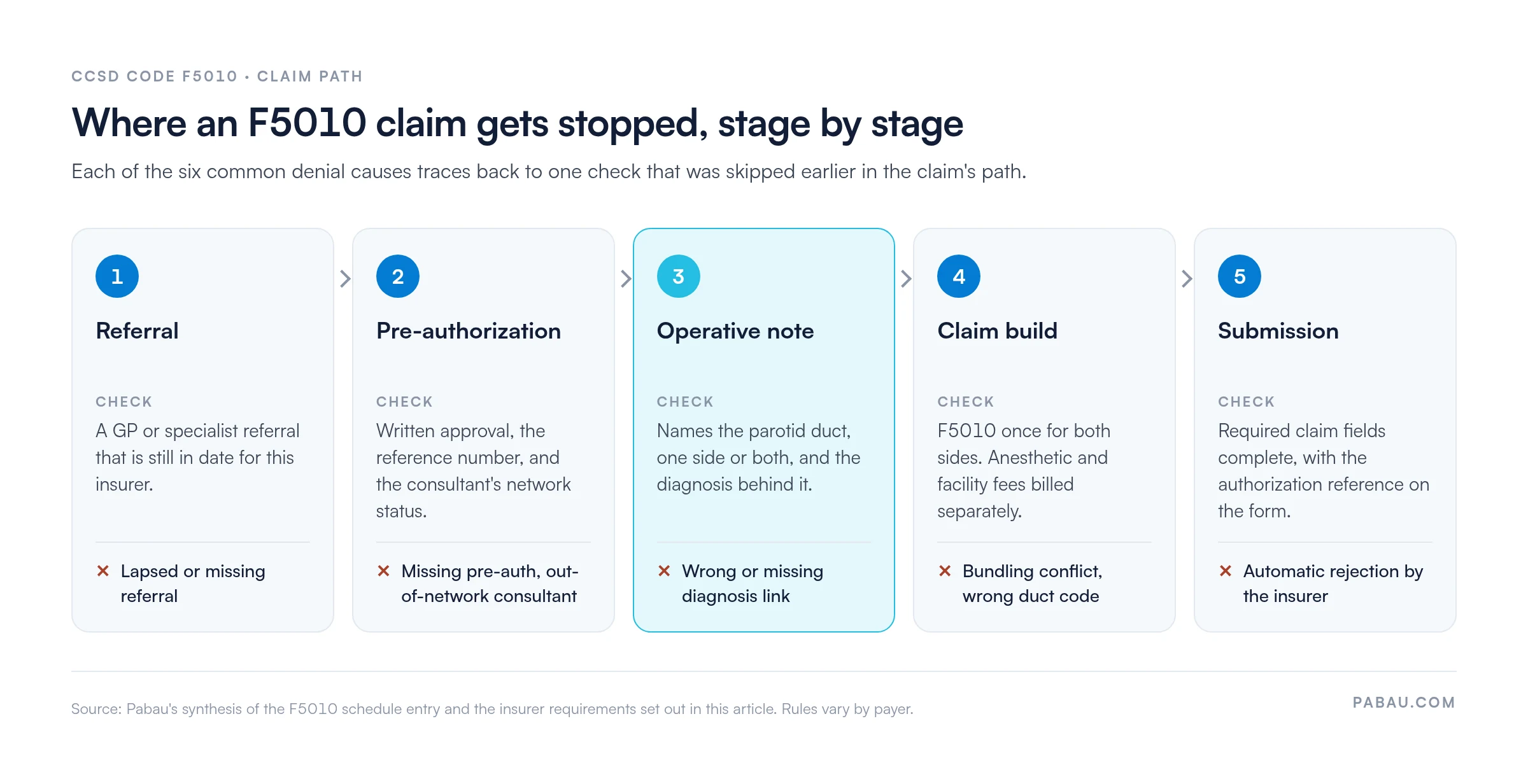
Worked example: A consultant transposes both parotid ducts in one session to treat chronic drooling. The claim carries F5010 once, with the diagnosis code and the pre-authorization reference. The anesthetist and the hospital bill their own codes.
Now say the surgeon also frees a small stone from one duct during the same operation. Adding F5610 would clash with the schedule’s combination rules, so the claim carries F5010 alone unless the schedule entry says otherwise.
Most F5010 denials are preventable. These six causes come up most often, each with its fix.
Log each denial by its cause. The pattern shows whether the problem sits in documentation, pre-authorization or coding, so you fix the step instead of resubmitting the same claim.
Most F5010 operations involve more than one bill. Knowing which codes can sit alongside it prevents both lost income and denials.
Billing F5010 with other codes on the same date? Add a short cover note that explains the clinical reason for each extra code. Insurers can follow a multiple-procedure claim more easily when the logic is clear upfront.
Run through these eight points on every F5010 claim. It takes about a minute.
In many practices, the authorization reference lives in an email, the referral in a scanned file and the claim in a portal. Each hand-off is a chance to lose a detail the insurer later queries.
Pabau, the practice management platform we build, keeps those pieces on the patient record. You store the insurer’s authorization reference against the patient and attach the referral, consent form and operative note. Pabau’s claims management software then pre-fills the claim from the record.
Before the claim goes to Healthcode, Pabau flags missing required claim fields, such as the membership number or authorization reference. The claim leaves the practice complete, so your team answers fewer insurer queries. Coding decisions, like choosing F5010 over F5020, stay with your coder.
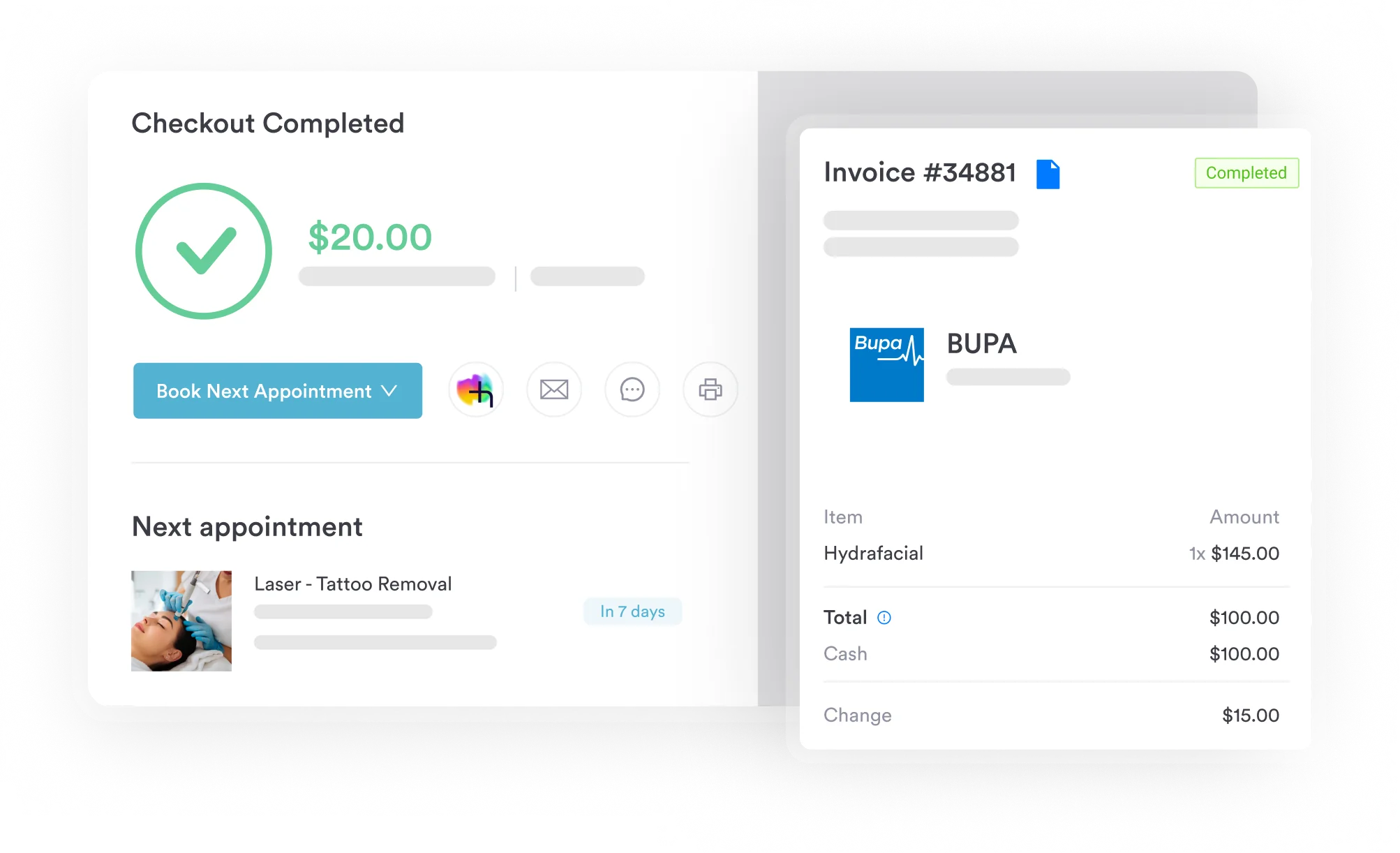

Pabau stores the insurer’s authorization reference on the patient record, pre-fills the claim and flags missing required fields before it goes to Healthcode. See how it fits your practice.

F5010 is a narrow code with a clear descriptor, so it rarely fails on coding alone. It fails when a reference, a referral date or a diagnosis link goes missing between consultation and claim.
So build the checks into the booking, not the billing. Confirm the referral and pre-authorization when you schedule the procedure. Then get the operative note right before the patient leaves theater. A few minutes of admin up front costs far less than a resubmission.
Book a demo to see how Pabau keeps authorization references and claim fields together for your CCSD billing.

Want the insurer’s view of the schedule? Bupa CCSD codes explains how Bupa applies CCSD codes and what it expects on a clean claim.
Billing a salivary stone removal instead? CCSD code F5120 covers open extraction of calculus from the submandibular duct, a close neighbor of F5010.
Checking what Bupa pays for a procedure? Bupa procedure codes and fee schedule walks through how Bupa’s fee schedule works and where to look up rates.
CCSD codes are used across UK private insurers, so confirm F5010 acceptance with each payer. Each insurer also applies its own pre-authorization rules and fee schedule on top of the code.
The most common reason is chronic drooling. Moving the duct openings further back sends saliva toward the throat, and it’s often done on both sides. Surgeons also use it to repair a parotid duct damaged by injury or a fistula.
No. The descriptor says “including bilateral”, so one F5010 covers one or both parotid ducts in the same session. A second line for the other side is likely to be rejected as a duplicate.
The six usual causes are missing pre-authorization, an absent or mismatched diagnosis code, bundling errors, a lapsed referral, an out-of-network consultant and incorrect code selection. Checking all six before submission prevents most denials.
Each insurer sets its own fee. The CCSD group maintains the codes and their descriptors, not the prices. Check Bupa’s code search, Aviva’s fee schedule or Vitality’s fee finder for current rates.
CCSD codes are a private-sector standard for claims to UK private medical insurers. NHS activity is paid through Healthcare Resource Groups (HRGs), a separate tariff system. The two aren’t interchangeable, so never submit CCSD codes to NHS commissioners.