CCSD code F5010: Parotid duct transposition billing guide
CCSD code F5010 covers parotid duct transposition, one side or both CCSD code F5...

Last Updated: Oct 9, 2026
Billable Code Specific Code
96450 is the CPT code for chemotherapy administration, into CNS (e.g., intrathecal), requiring and including spinal puncture. The spinal puncture is part of the code, which is reported once per session, with the drug billed separately under its own J-code.
Claim denials on this code most often trace back to five causes. Those are a missing physician order, an unsupported ICD-10 diagnosis, wrong unit reporting, bundling with an IV infusion code, or missing prior authorization.
Let Pabau's smart automation suggest the right codes, reduce claim denials, and keep your practice compliant—effortlessly.
Automate repetitive tasks and focus on what matters most—your patients.
Reduce coding errors and ensure compliance with the latest regulations.
Clean claims, fewer denials, and faster reimbursements.
Powerful insights and reporting to help your practice thrive.
HIPAA compliant SOC 2 certified GDPR-compliant Trusted by 4,000+ clinics worldwide

CPT code 96450 covers chemotherapy injected into the CNS through a spinal puncture, and the puncture itself is part of the code.
Chemotherapy injected through an implanted Ommaya reservoir matches CPT 96542 more closely than 96450, so confirm the payer’s policy before you bill.
Report 96450 once per administration session, however many chemotherapeutic agents are given intrathecally in that session.
Drug supply is billed separately with HCPCS Level II J-codes, because 96450 covers only the administration service.
Pabau’s claims management software builds the superbill from the physician order and flags incomplete documentation before a claim goes out.
CPT code 96450 is the code for injecting chemotherapy into the central nervous system (CNS) through a spinal puncture. The American Medical Association’s CPT code set defines it as “Chemotherapy administration, into CNS (e.g., intrathecal), requiring and including spinal puncture.” It sits in the 96401-96549 chemotherapy administration family.
Because the descriptor names a spinal puncture, 96450 fits a lumbar puncture (spinal tap) into the subarachnoid space. The puncture is part of the code, so it is not billed again for the same injection.
An Ommaya reservoir works differently. It is a surgically implanted device under the scalp that gives direct access to the ventricles. Some coders still report 96450 for reservoir injections, but CPT 96542 describes chemotherapy injected through a subcutaneous reservoir. Reservoir puncture for aspiration or injection can also be reported with 61070 where payer policy allows, so confirm the payer’s rules first.
Intrathecal chemotherapy delivers antineoplastic agents directly into the cerebrospinal fluid. That bypasses the blood-brain barrier, which limits how well systemic IV agents reach CNS malignancies. The procedure involves physician supervision, patient monitoring and drug delivery, and each must be documented for the claim to survive audit.
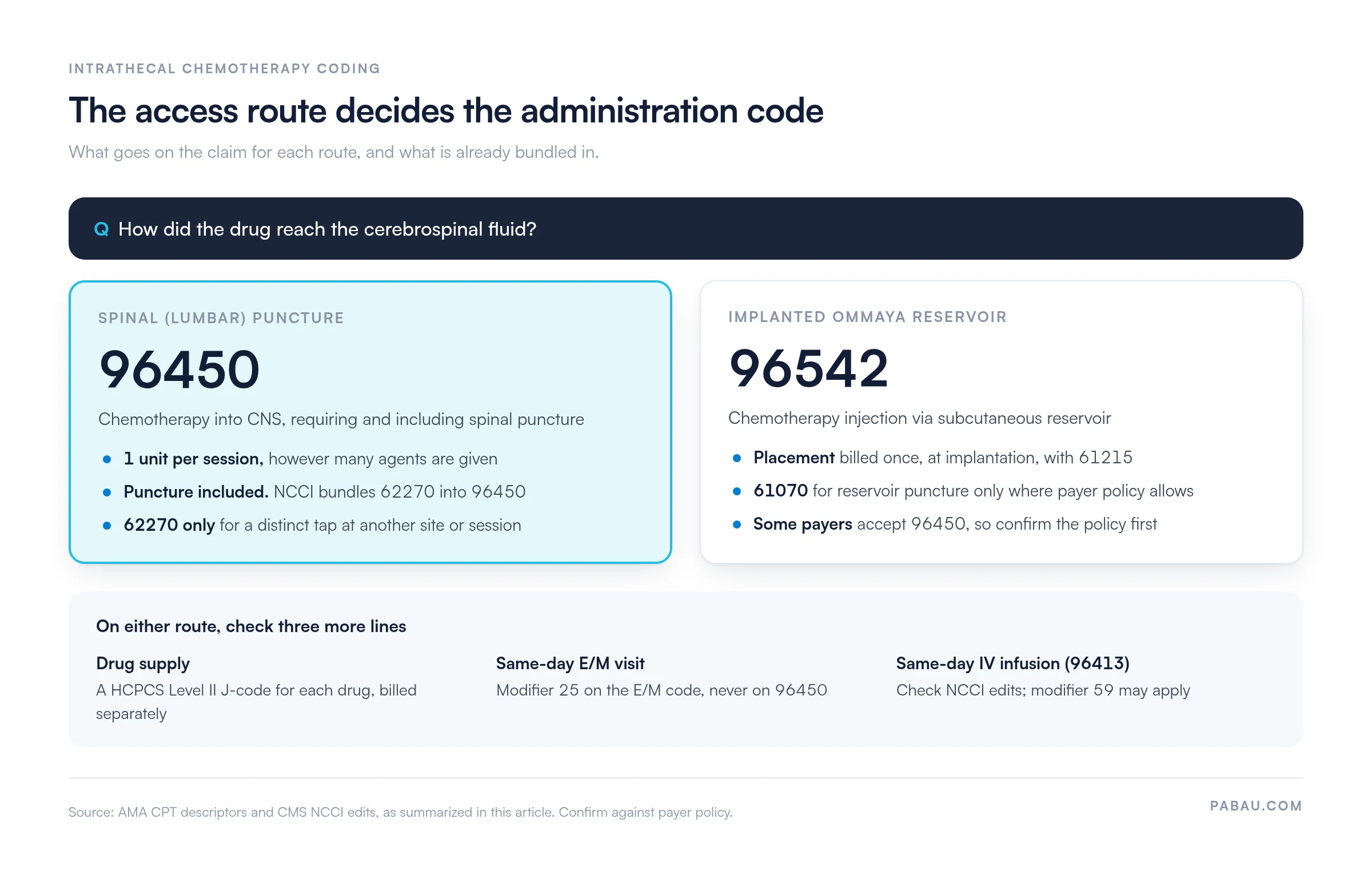
The access route decides the administration code. A lumbar puncture leads to 96450, and the spinal puncture is part of that code. National Correct Coding Initiative (NCCI) edits bundle 62270 into 96450. Report 62270 only for a distinct puncture, such as a diagnostic tap at a different site or at a different session.
An Ommaya reservoir is placed in a separate surgery, reported at implantation with 61215. Later injections through the reservoir match 96542. The diagram below maps each route to its codes, plus the three lines every claim needs.
According to CMS Medicare Claims Processing Manual Chapter 12, the medical record must support the claim at the time of service. It can’t be reconstructed afterward. For CPT 96450, five documentation elements are non-negotiable. They apply the same medical billing rules as any insurance claim, with an intrathecal twist.
A superbill generation workflow pre-populates the drug name, route and administration code from the physician order. That cuts transcription errors, so the claim matches the record on the first submission.
Route of administration is the main differentiator within the 96401-96549 family. Coders often confuse 96450 with 96401 and 96402 because all three involve antineoplastic agents, but the delivery site is entirely different.
Confusion between 96450 and 96402 tends to arise in oncology practices that administer hormonal agents. 96402 covers subcutaneous or intramuscular hormonal administration (leuprolide, for example). 96450 is reserved for intrathecal delivery by spinal puncture, regardless of drug class. Using 96402 when the drug was given intrathecally is a route mismatch and will be denied on audit.
CPT code 96450 is reported once per administration session. If two chemotherapeutic agents are given intrathecally in the same session, the code is still billed as one unit. There is no add-on code within the 96450 family for sequential or concurrent intrathecal drugs.
Audit your 96450 claims quarterly for unit count. A single session should always show 1 unit on the claim line. Two units billed for one intrathecal session is the fastest path to a medical necessity audit. Payers see no clinical basis for two administrations in one sitting unless a split-session protocol was documented in advance.
Two scenarios drive most modifier decisions for CPT 96450. The first is billing it on the same day as another administration code. The second is the same provider repeating the procedure on the same date.
Medicare reimburses CPT 96450 under the Medicare Physician Fee Schedule (MPFS), at different rates for facility and non-facility settings. The non-facility rate is higher because it includes practice expense that a hospital or outpatient facility absorbs in the facility setting. Use the CMS Physician Fee Schedule lookup tool to retrieve the current year’s payment amounts by locality.
Work RVU values and geographic cost-of-practice indices for 96450 are free to search in FastRVU’s 2026 RVU lookup tool. It pulls from the current CMS MPFS data file.
A structured denial management workflow starts with knowing which denial types are specific to CPT 96450 rather than generic billing errors. These five patterns come up most often on 96450 claims.
Reviewing the most frequent denial codes alongside these 96450-specific patterns shows billing teams where corrective action is needed. A clean claim protocol that verifies each element before submission catches these errors before the payer does.
The ICD-10-CM diagnosis on a 96450 claim must reflect a malignancy with documented CNS involvement or risk. That supports the clinical rationale for intrathecal administration specifically. A systemic cancer diagnosis without CNS documentation is a common reason payers deny the claim as not medically necessary for this route.
MAC Local Coverage Determinations define which ICD-10-CM codes are covered for intrathecal administration in each region. Always cross-reference the primary diagnosis against the applicable LCD before submitting. Where the LCD lists covered diagnoses by code range (C91.x, C92.x), confirm the specific 5th or 6th character matches the patient’s documented disease status.
When billing 96450 for CNS prophylaxis in leukemia protocols, name the treatment protocol in the medical record. Examples include the Berlin-Frankfurt-Münster protocol or CALGB 10403. Protocol documentation shows payers and auditors that intrathecal administration is part of a recognized, evidence-based regimen, reducing the likelihood of a medical necessity denial.
On paper, a 96450 claim depends on someone copying the physician order, the nursing record and the J-code onto a superbill by hand. Each copy is a chance to drop the route, double the units or miss the prior authorization number.
Pabau, the practice management platform we build, links those records instead. Its claims management software builds the superbill from the physician order and flags a missing order or route before the claim leaves the practice.
Through its Claim.MD clearinghouse integration, Pabau turns the invoice into an electronic CMS-1500 claim for thousands of US payers. It checks patient eligibility in real time and brings electronic remittance advice (ERA) back. Your billing team sees a failed eligibility check before the injection is scheduled, not weeks later as a denial.

Pabau’s claims management software generates superbills, flags incomplete physician orders before submission, and routes claims through the Claim.MD clearinghouse to thousands of US payers. See how oncology and infusion practices cut denials with automated documentation workflows.

Settle the access route before anyone touches the claim. A lumbar puncture means 96450 with the puncture included, and a reservoir injection points to 96542.
After that, a 96450 claim stands or falls on two habits. Bill one unit per session. Then make sure the physician order, the nursing record and the diagnosis match the claim line. A practice that checks those before submission fixes errors on its own schedule rather than the payer’s.
Book a demo to see how Pabau links the physician order, administration record and superbill for intrathecal chemotherapy claims.

Need to understand how clearinghouse routing affects your 96450 claims? How Claim.MD clearinghouse works explains the claim validation and routing steps between your practice and the payer.
Looking for a complete billing workflow guide? What is revenue cycle management covers the end-to-end process from patient encounter to payment posting.
Want to compare clearinghouse options before committing? Claim.MD vs Office Ally walks through the key differences for outpatient billing practices.
CPT code 96450 covers chemotherapy injected into the central nervous system through a spinal puncture, such as a lumbar puncture. The puncture is included in the code. 96450 covers the administration service only, and drug supply is billed separately with HCPCS Level II J-codes.
96450 is reported once per administration session, not once per drug. If two agents are given intrathecally in one session, the code is still 1 unit. A second session on the same day is rare but may be reported with modifier 76, supported by documented clinical rationale.
96450 covers intrathecal (CNS) administration of any antineoplastic agent through a spinal puncture. 96402 covers subcutaneous or intramuscular injection of hormonal antineoplastic agents only. Route of administration is the deciding factor, so intrathecal delivery by spinal puncture uses 96450 regardless of drug class.
No, a separate E/M is not required. If a separately identifiable evaluation and management service is documented on the same date, it may be billed too. Append modifier 25 to the E/M code in that case. The E/M must reflect a decision distinct from the administration visit itself.
A spinal puncture is required, because the 96450 descriptor reads “requiring and including spinal puncture.” That puncture is usually a lumbar puncture, and it is part of the code. Some coders report 96450 for Ommaya reservoir injections, but 96542 describes injection through a subcutaneous reservoir. Reservoir puncture can also be reported with 61070 where payer policy allows, so confirm the payer’s policy first.
Five patterns cause most 96450 denials. Three are a missing or incomplete physician order, an ICD-10 diagnosis the applicable LCD doesn’t cover, and more than 1 unit billed for one session. The other two are same-day bundling with an IV infusion code without modifier 59, and missing commercial payer prior authorization.