Free printable botox face chart
A free printable botox face chart maps injection sites and records unit dosages ...

73
Last Updated: Sep 22, 2026

PIRP stands for Problem, Intervention, Response, and Plan. The four sections turn a session into a record another clinician can pick up.
Each section answers a different question, which is what makes the note read as clinical reasoning rather than a session summary.
Therapists, counselors, psychologists, and social workers use the format because payers accept problem-focused notes that show medical necessity.
Practice management software like Pabau keeps note templates inside the client record, so the note is written and filed in one place.
A structured progress note template for mental health and therapy practices. It carries a labeled field for each of the four sections, plus prompts for what to record in every one.
Download templateA PIRP note is a structured progress note that therapists, counselors, and social workers use to document a client session. PIRP stands for Problem, Intervention, Response, and Plan. The same note-writing best practices apply here as anywhere else in clinical documentation: clarity, objectivity, and measurable outcomes.
Those four sections cover what the client brought to the session, what you did about it, how they reacted, and what happens next. The format is problem-focused, so it stays on the specific issue the client is working to resolve rather than the wider diagnostic picture.
That makes it a strong fit for therapy and behavioral health, where progress is tracked session by session. It also gives payers the detail they look for when they review whether treatment was medically necessary.
A well-written PIRP note does three jobs at once:
Each section answers a different question, and knowing which question is which is what makes the note fast to write. Here is what belongs where.
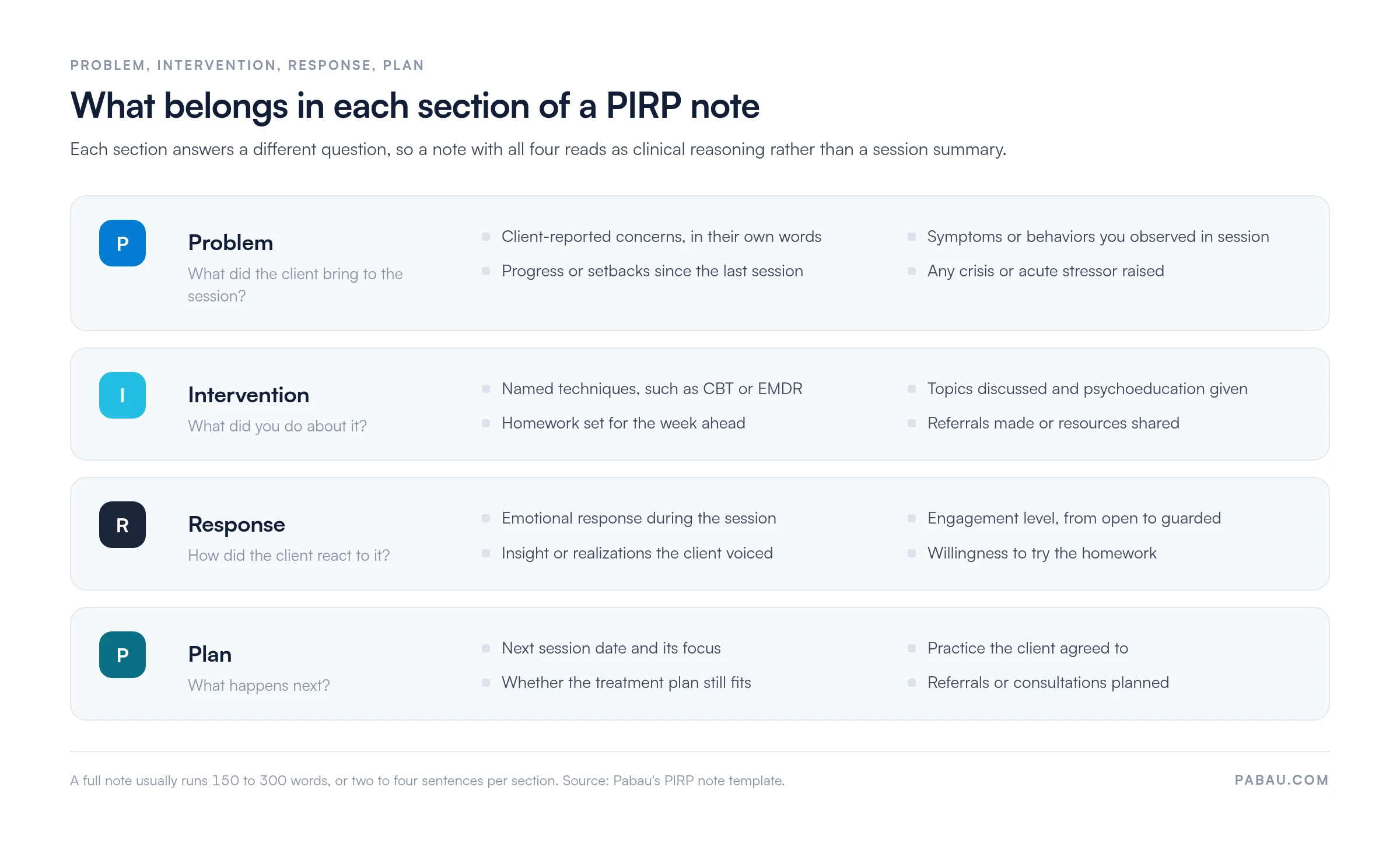
The Problem section captures the presenting issue the client brought to the session. Record the specific concern, symptom, or life challenge they are dealing with right now.
Use the client’s own words wherever you can. For example: “Client reports increased anxiety about returning to work after medical leave. States sleep has been disrupted for two weeks and concentration is difficult.”
Where a client discloses risk, note it here and keep the response itself in its own document. A written safety plan is easier for a colleague to find in a hurry than a line buried mid-note.
The Intervention section documents the techniques, modalities, and actions you used in the session to address that problem.
Name the modality rather than describing the mood of the room. If you work across several approaches, a counseling theories chart is a quick way to keep the wording consistent between clinicians.
Example: “Taught grounding exercise (5-4-3-2-1 sensory technique) and practiced twice in session. Discussed sleep hygiene strategies. Assigned daily 10-minute meditation practice via app.”
The Response section describes how the client reacted to your intervention. This is where engagement, emotional shifts, insight, or resistance get recorded.
Example: “Client successfully completed grounding exercise and reported feeling calmer immediately after. Expressed relief that concrete tools were offered. Agreed to practice daily meditation and return with log next week.”
The Plan section sets out the next steps, treatment goals, and follow-up actions for both of you.
Example: “Continue weekly sessions focusing on anxiety management. Client will practice grounding and meditation daily, track sleep patterns, and report back. If sleep does not improve in two weeks, will discuss sleep evaluation referral.”
Keep the Plan short and check it against the longer-term goals you agreed at intake. A treatment plan template holds those goals in one place, so each note only has to record what moved.
Here is a completed note for a single therapy session. It shows how the four sections flow, and how much detail is enough.
Notice the specific client statements, the named intervention, and the observable responses. That is the level of detail that supports continuity of care and holds up in an audit. If you want to build the habit, start from a blank progress note template and fill the four sections in the same order every time.
Store your practice’s preferred note format in your EMR and customize the field labels to match your clinical approach. When every clinician writes into the same fields, notes stay consistent, audits get easier, and nobody has to remember the running order.
Therapists run into several note formats that look almost identical. The difference sits in the first letter, which decides what the note is organized around.
PIRP zeros in on the presenting problem and your direct clinical response, which makes it quick to write in a busy therapy practice. BIRP notes swap that problem for observable behavior, which is why residential and ABA teams tend to prefer them. A DAP note is the shorter option again, folding assessment and response into one section.
Any of these formats can sit inside HIPAA-compliant documentation. What matters to an auditor is that your practice picked one structure and applied it consistently.
The structure is simple, so the trouble usually starts with how each section gets filled in. These are the errors that come up in audits and peer reviews.
One more worth flagging: a safeguarding or medication incident needs its own record, not a line inside a progress note. Log it on an incident form so the clinical record and the incident record can both be produced on their own.
A quick test catches most of this. Read the note back and ask whether a colleague could run next week’s session from it alone. If they couldn’t, a progress notes cheat sheet pinned near your desk is usually enough to fix the habit.
In plenty of therapy practices, the note lives in one place and everything it relates to lives somewhere else. The appointment sits in a calendar, the treatment plan sits in a folder, and the claim sits with whoever does the billing. Writing the note is the quick part. Finding what it connects to later is not.
Practice management software like Pabau keeps the note template inside the client record itself. Once a PIRP note is written in Pabau, it is linked to the appointment, the client file, the treatment plan, and the billing record.
So a therapist can pull up the last three notes in seconds before a session starts. A biller can see what supports a claim without asking anyone. In a group practice, a mental health EMR holds all of it in one client record. No note is left behind in one clinician’s spreadsheet.
Every subscription includes the full platform. Note templates, scheduling, and billing get set up together during onboarding, alongside the rest of your therapy practice management. If you are weighing up clinical documentation software, that is the question worth asking of any option on your list.

Pabau keeps progress note templates, appointments, treatment plans, and billing in one client record. So the note you write after a session is filed, linked, and ready for review without a second system.

PIRP earns its place by being quick to write and easy to defend. The four prompts carry the structure for you, so the note still comes out consistent at the end of a long day of sessions.
The trade-off is worth remembering. A problem-focused note follows the presenting issue rather than the whole clinical picture. If your work is goal-driven, or you need a fuller assessment on the page, GIRP or a longer evaluation format will serve you better.
Pick one format, apply it across the practice, and the next audit largely takes care of itself. Book a demo to see how Pabau keeps progress notes, appointments, and billing in a single client record.

Looking at the client’s wider life instead? Life audit template scores every area of life against what matters most to reveal priorities.
Talking through relationship communication instead? Love languages chart covers all five love languages with definitions and a compatibility matrix.
Adding a compassion practice to sessions? Loving kindness meditation script offers a structured framework for guiding patients through compassion-focused mindfulness.
Screening a toddler for autism risk? M-CHAT-R screening tool flags autism risk in toddlers with cutoffs and reverse-scored items included.
Measuring a client’s sense of purpose? Meaning in life questionnaire scores presence and search for meaning with a free 10-item template.
PIRP stands for Problem, Intervention, Response, and Plan. It is a structured documentation format used by mental health professionals to record the key elements of a therapy session in a standardized way.
PIRP focuses on the client’s presenting problem and the therapist’s clinical intervention. BIRP (Behavior, Intervention, Response, Plan) emphasizes observable client behaviors and behavioral outcomes instead. BIRP is more common in behavioral health and ABA therapy, while PIRP is standard in talk therapy and counseling.
Therapists, counselors, psychologists, social workers, and other mental health professionals use them. You will find the format in private practices, community mental health centers, hospitals, schools, and employee assistance programs (EAPs).
The format itself is neither compliant nor non-compliant with HIPAA. Compliance depends on how and where you store the notes. As long as they sit in a HIPAA-compliant system that is encrypted, access-controlled, and backed up securely, they meet regulatory requirements.
A note for a 50-minute therapy session usually runs 150 to 300 words. Each of the four sections takes two to four sentences of specific, clinically relevant detail. Longer is not better, because concise notes are faster to write and far easier to review.
Yes. Insurance companies accept PIRP notes as valid progress notes for mental health and behavioral health billing. The note has to demonstrate the medical necessity of the treatment, which means showing why the intervention was chosen and how the client responded.