Antipsychotic medication list
An antipsychotic medication list is a structured reference that organizes psychi...

2
Last Updated: Oct 13, 2026

A mental status examination (MSE) is a structured clinical tool covering 11 domains, from appearance and speech through to insight and judgment.
The MSE is observational and interview-based, not a standalone diagnostic instrument, so findings must be interpreted alongside the full psychiatric history.
Documenting suicidal or homicidal ideation in the MSE does not replace a formal risk assessment protocol. Even so, both are required.
Practice management software like Pabau gives mental health practices structured note templates, so MSE notes stay consistent between clinicians.
A mental status examination (MSE) is the psychiatric equivalent of a physical exam. In other words, it is a structured, real-time snapshot of a patient’s mental state. So you capture it through observation and direct questioning during the clinical interview.
According to NCBI StatPearls, the MSE covers domains including appearance, behavior, speech, mood, affect, thought process, thought content, perceptual disturbances, cognition, insight, and judgment.
The MSE is not a diagnosis. Instead, it captures what is happening right now and leaves the why to the wider assessment. So that distinction matters for your notes, for handovers to colleagues, and for defending clinical decisions under scrutiny.
Psychiatrists, psychologists, psychiatric nurses, social workers, and other licensed mental health providers all conduct MSEs as part of a broader psychiatric evaluation. The format is standardized enough to be consistent across disciplines, but flexible enough to adapt to each patient encounter.
Clinicians who skip or rush the MSE lose their most reliable cross-sectional record of patient mental state. In short, that record does four things nothing else can replace.
Overall, every mental status examination covers the same 11 domains. Still, what varies is the terminology clinicians use to describe findings. The table below gives you the domain, what you observe, and the key descriptors to know.
Two pairs of domains are worth spelling out, because it’s easy to mix them up when you document.
Mood is what the patient reports, while affect is what you observe. For example, a patient may say “I feel fine” while sitting motionless with a flat expression. That mismatch between stated mood and observed affect matters in practice, so document both and note whether they are congruent or incongruent.
Thought process describes how a patient thinks, while thought content describes what they think. For instance, flight of ideas is an abnormal thought process, often linked to mania, describing rapid, loosely connected topic-jumping. In contrast, paranoid delusions are abnormal thought content. So you can have disorganized process with intact content, or organized process with delusional content. Therapy sessions build a picture over months, and the record is what makes that picture readable.
When documenting suicidal or homicidal ideation under thought content, record ideation, intent, plan, means access, and protective factors. However, that entry does not replace a formal structured risk assessment.
Either way, both are required, and they serve different clinical and legal functions. If your practice needs clearer protocols for crisis documentation, these crisis intervention strategies offer a framework worth reviewing.
The MSE runs at the same time as the clinical interview. In other words, you are not pausing to run a separate test. Instead, you are observing and recording throughout.
In fact, three errors show up often in MSE notes across clinical settings.
Below is a sample write-up for a fictional patient. In practice, this is how the domains appear as narrative documentation in a clinical note.
Flight of ideas, elevated and labile affect, impaired judgment, and grandiose thought content line up here. Overall, they point to a manic or hypomanic episode.
The MSE does not make the diagnosis. Instead, it gathers the observational data the clinician maps to DSM-5-TR criteria.
In fact, clinicians regularly confuse these two tools. However, they are not interchangeable. UK clinicians documenting the same assessment can follow our mental state examination guide, which uses British terminology and conventions.
The “When to use” row is where the choice actually gets made. Use the MSE when you need a complete clinical picture, but use the MMSE when you need a consistent, scored result, such as tracking suspected Alzheimer’s disease. Either way, our MMSE template sets out the scored tasks in order.
First, good note-writing practice for the MSE starts with one rule. Instead of judging, describe what you observe. Then, here is how that principle applies across common note formats.
For instance, in a SOAP note, MSE findings belong primarily in the Objective (O) section. That covers appearance, behavior, speech, affect, and any thought process you directly observed. Meanwhile, patient-reported mood sits in the Subjective (S) section. The same goes for a DAP note, where MSE findings split between Data and Assessment.
For a fuller breakdown of how note formats handle MSE content, this SOAP notes guide walks through the structure in detail.
The most common note-writing error is slipping into interpretation before the MSE data supports it. Compare these two entries for the same patient:
The second version gives any clinician reading the note enough data to form their own clinical impression. In contrast, the first version tells them nothing useful and creates liability if the interpretation is later challenged.
Review your last five MSE write-ups and count how many contain opinions (‘patient was psychotic’, ‘clearly depressed’) instead of observable facts. If the ratio is more than 1 in 5, build a structured MSE template with domain-specific descriptor fields to anchor your note-writing language.
Generally speaking, most mental health practices document MSEs in one of three ways.
Of those, the first two carry the most risk.
In particular, copy-pasting notes is a real hazard. For example, a clinician copies last session’s MSE and changes only the date. Then, two visits later, the note still says “no suicidal ideation” for a patient who disclosed SI at the most recent session. As a result, that is a patient safety failure.
Indeed, the documentation burden in healthcare weighs on every clinician. Even so, it cannot justify shortcuts that hide what happened in the room.
Still, structured templates in mental health EMR platforms fix this. Clinicians have to select descriptors for each domain, every session, and you cannot copy-paste a checkbox.
For instance, Pabau’s digital intake forms include customizable clinical note templates. Practices can build an MSE template with dropdown fields per domain and a required field for thought content, including SI and HI.
So, the benefit compounds across a team. Every clinician documents MSE findings in the same structure, so handoffs and cross-provider comparisons mean something. That also makes clinical forms workflows far easier to audit.
For example, Pabau Scribe, our AI scribe, drafts the narrative parts of the note from the visit itself. Clinicians check and adjust the MSE descriptors instead of typing them from memory hours later.
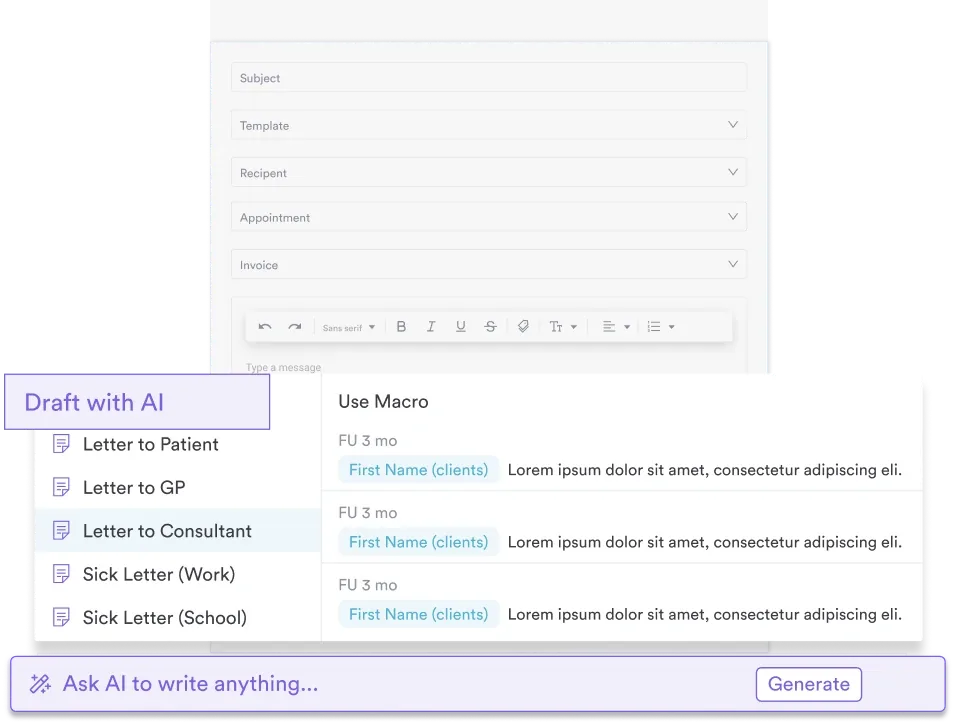
Practices running psychiatry EMR software with built-in MSE templates also cut the paperwork behind clinician burnout. As a result, nobody is rebuilding the same note from scratch every session.
In short, structured fields shorten average note time and free up attention for the patient in front of you. They also leave a cleaner audit trail for CMS documentation reviews.

Pabau’s clinical note templates and required fields keep every MSE complete. Book a demo to see it set up for a mental health practice.

The MSE is only as good as the words you put in the note. Specific descriptors, all 11 domains covered, and observation kept separate from interpretation are what make it hold up later.
If your notes rely on memory and habit, the fix is structural rather than personal. Give every clinician the same fields to fill, and the variation between them mostly disappears.
Pabau’s MSE template fields and required-field digital forms make that consistency the default. Book a demo to see how it works in a mental health or psychiatry setting.

Want a structured way to open the interview? Motivational interviewing script gives you prompts that surface mood and thought content early.
Working on your interview technique? Reflective listening worksheet helps you check what the patient said before you write it down.
Need a note format for coordinated care? Case management note covers the fields a handover note has to carry.
Looking for a client self-reflection tool? design your life worksheet This free template guides clients through values, life balance, and goal-setting exercises.
A mental status examination is a structured clinical assessment of a patient’s current psychological state, conducted through observation and interview. In fact, it covers 11 standardized domains: appearance, behavior, speech, mood, affect, thought process, thought content, perception, cognition, insight, and judgment. It is not a standalone diagnostic tool. Instead, findings are interpreted alongside the full psychiatric history and information from other sources.
The 11 components are appearance, behavior, speech, mood, affect, thought process, thought content, perception, cognition, insight, and judgment. Mood is the patient’s own report and affect is what you observe. In addition, cognition covers orientation, memory, attention, and abstraction. Each domain is assessed through observation and targeted questioning during the clinical interview.
Licensed mental health professionals conduct the MSE, including psychiatrists, psychologists, psychiatric nurses, licensed clinical social workers, and other licensed behavioral health clinicians. Scope of practice varies by jurisdiction and qualification, so non-licensed staff should not run or interpret MSEs without proper supervision.
A brief MSE embedded in a routine follow-up visit takes about 5 to 10 minutes. A formal psychiatric intake MSE takes longer, because it runs throughout the full clinical interview rather than as a standalone segment. Overall, exact duration depends on clinical context and patient complexity.