

CPT code 48152: Whipple procedure without pancreatojejunostomy
CPT code 48152: Official description and procedure overview CPT code 48152 descr...

Last Updated: Nov 13, 2026
93283 is the CPT code for an in-person programming device evaluation of a dual lead transvenous implantable defibrillator (ICD) system. The practitioner tests the device by adjusting its parameters step by step, then selects the permanent programmed values and reports the analysis. The device has two transvenous leads, usually one atrial and one ventricular.
A dual lead pacemaker is reported with 93280, and a subcutaneous ICD with 93260. Most 93283 denials start with a device type the record does not support.
Let Pabau's smart automation suggest the right codes, reduce claim denials, and keep your practice compliant—effortlessly.
Automate repetitive tasks and focus on what matters most—your patients.
Reduce coding errors and ensure compliance with the latest regulations.
Clean claims, fewer denials, and faster reimbursements.
Powerful insights and reporting to help your practice thrive.
HIPAA compliant SOC 2 certified GDPR-compliant Trusted by 4,000+ clinics worldwide

CPT Code 93283 reports an in-person programming evaluation of a dual lead transvenous implantable defibrillator (ICD), not a pacemaker.
The 2026 national Medicare rate is about $97 in the office, and the professional component (modifier 26) pays about $54.
CPT bars reporting 93283 with 93287 or 93289, while a dual lead pacemaker is reported with 93280 instead.
Z45.02 is the device encounter code for an ICD visit, listed alongside the cardiac condition that drives it.
CPT Code 93283 describes an in-person programming device evaluation of a dual lead transvenous implantable defibrillator system. AAPC Codify lists 93283 as the evaluation and adjustment of a previously implanted dual lead transvenous ICD, in a direct encounter with the patient.
The AMA descriptor for the code reads in full:
Programming device evaluation (in person) with iterative adjustment of the implantable device to test the function of the device and select optimal permanent programmed values with analysis, review and report by a physician or other qualified health care professional; dual lead transvenous implantable defibrillator system.
Two details in that descriptor decide the code. The device is a defibrillator, so it can deliver shock therapy as well as pacing. It is also transvenous with two leads, usually one in the right atrium and one in the right ventricle.
The “iterative adjustment” wording is what separates programming from interrogation. The practitioner changes parameters step by step to test thresholds and sensing, then selects the permanent values. A visit that only reads stored data is an interrogation, reported with 93289 for an ICD.
Medicare pays about $97 nationally for the global CPT Code 93283 in a physician office in 2026. That figure comes from the 2026 Physician Fee Schedule final rule, at the non-APM conversion factor of $33.4009. Your payment then moves with your locality’s geographic practice cost index (GPCI).
Unlike some cardiac device codes, 93283 splits into a professional and a technical component. The global code is payable only in the office. In a hospital setting, the physician bills the professional component and the hospital bills its own facility payment.
Figures are from the Medtronic 2026 CIED reimbursement guide, which draws on the CMS 2026 final rule. Confirm your locality-adjusted amount in the CMS Physician Fee Schedule lookup tool each January.
When the evaluation happens in a hospital outpatient department, the hospital reports 93283 under the Outpatient Prospective Payment System. It maps to APC 5741, Level 1 Electronic Analysis of Devices, with status indicator Q1. The final 2026 national average OPPS payment is about $38.
Modifiers on a 93283 claim mostly answer one question: who supplied the technical work. The table covers the modifiers that come up with in-person ICD programming.
Medtronic’s guide recommends billing only the professional component with modifier 26 when an industry representative performs the technical part. Billing the global code in that case claims technical work the practice did not provide. Payers and auditors read that as overbilling.
Documentation is where most 93283 claims fail review. The record has to show an ICD, two transvenous leads, and the iterative testing that makes this a programming visit. A note reading “ICD checked, functioning normally” supports an interrogation at most.
Notes often leave out the shock-lead impedance and the tachyarrhythmia settings. Without them, the note reads like a pacemaker check, which is how 93283 claims get questioned. A strong note also supports clean claim submission on the first pass.
The encounter code for an ICD programming visit is Z45.02. The pacemaker codes Z45.010 and Z45.018 describe a different device and do not fit a defibrillator encounter. Add the cardiac condition that requires ongoing ICD management, so medical necessity is clear.
Our ICD-10-CM code library carries the full descriptor for each code. Some MAC local coverage determinations (LCDs) list the diagnoses they accept for device checks, so confirm your contractor’s list.
The in-person programming family runs from 93279 to 93285. CPT 93260, for the subcutaneous ICD, became a Category I code effective January 1, 2015. Each code maps to one device type and lead count, so choosing correctly starts with the implant record, not the visit note. The chart below walks through that choice in two steps.
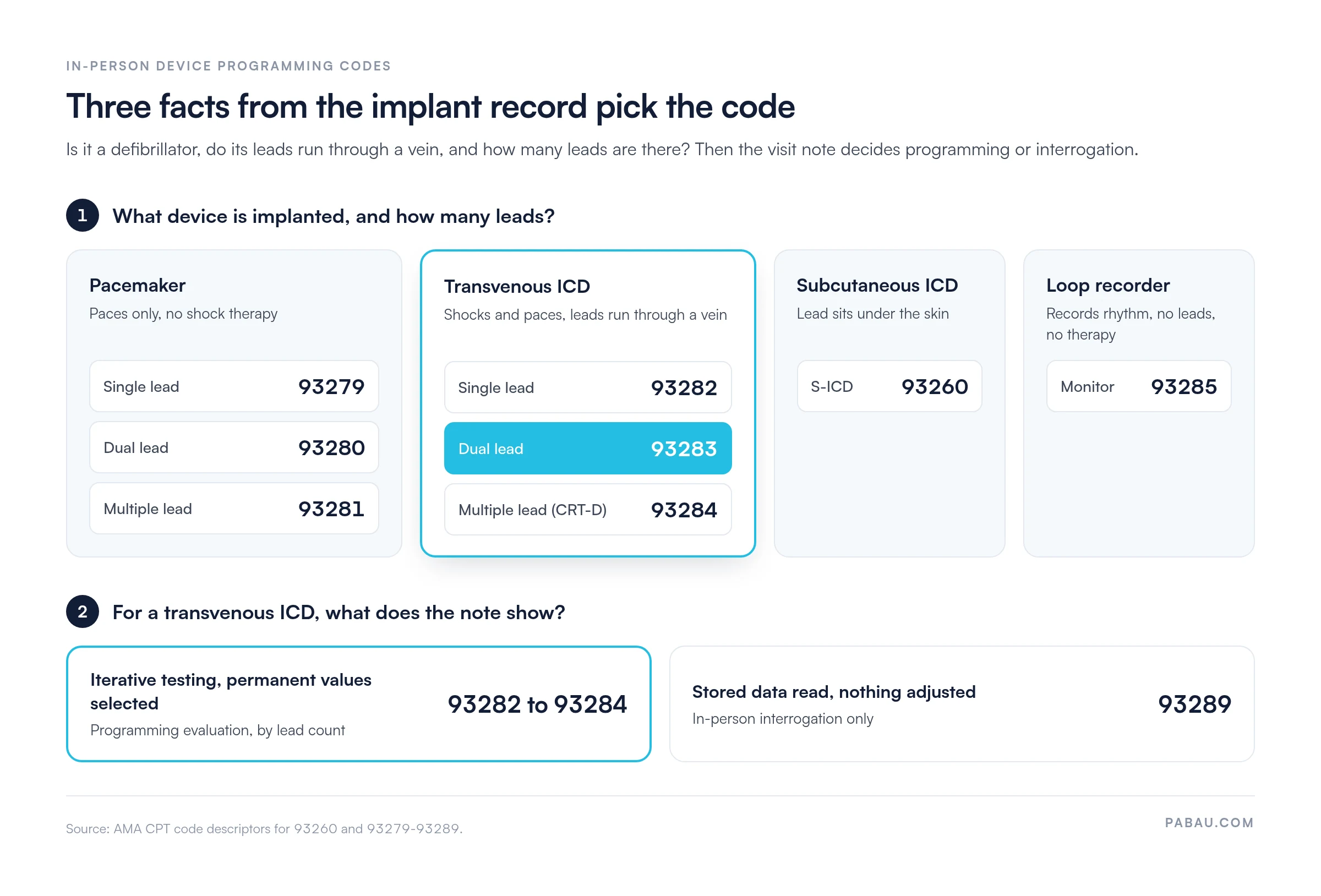
These two codes describe the same service on devices with the same lead count. CPT 93280 covers a dual lead pacemaker, while 93283 covers a dual lead ICD. An ICD can also pace, so “it paces” does not settle the question. The model number in the implant record does.
CPT 93285 is not a defibrillator code at all. It covers programming of a subcutaneous cardiac rhythm monitor, the implantable loop recorder that records rhythm but delivers no therapy. A loop recorder has no leads, so a mix-up with 93283 usually means the wrong row on a charge sheet.
The same care applies to a subcutaneous ICD. It is a defibrillator, but its lead sits under the skin rather than in a vein. Its programming goes to 93260, never to the transvenous codes 93282-93284.
CPT itself lists the codes that cannot be reported with 93283. These are parenthetical instructions in the code set, so a modifier does not override them.
NCCI edits change quarterly, so check the current tables before billing 93283 with any other cardiac code. Using modifier 59 without a documented distinct service is a known audit target, and it does not belong on superbill templates by default.
Medicare has no national coverage determination for ICD device evaluation. The pacemaker evaluation NCD does not apply to defibrillators. Coverage rests on medical necessity, and some MACs publish LCDs with their own criteria.
Check each payer’s policy before the visit, not after the denial. Our guide to medical billing compliance covers how to build those checks into the schedule.
Denials on CPT Code 93283 cluster around a few predictable errors. Most start with the device record, so the fix belongs at documentation, not at appeal.
Tracking denial reasons by code over a rolling 90 days shows which of these errors repeats. Structured denial management workflows then turn that pattern into a fix at the front of the process.
Most 93283 errors happen between the device note and the claim. The coder needs the device type, lead count, and test results carried onto the claim without retyping. When the note and the claim live in separate systems, the device type is the detail that slips.
Pabau, a practice management and billing platform, keeps the clinical note and the claim in one record. Our claims software for cardiologists builds the claim from the visit, so the coder works from the note itself.
Through its Claim.MD clearinghouse integration, Pabau submits CMS-1500 and 837P claims and runs eligibility checks. It also posts ERA remittances and sends secondary claims. A denial on a 93283 claim lands next to the note that has to support the appeal.
Put the implanted device model and lead count at the top of every device-check template. The coder then picks 93282, 93283 or 93284 from the record, not from memory. That one field prevents the pacemaker and ICD mix-up behind most 93283 denials.

Pabau keeps the device note and the claim in one record. Submit CMS-1500 and 837P claims through Claim.MD, check eligibility, and post ERA remittances for codes like 93283 without switching systems.

CPT Code 93283 is decided before the visit starts. The implant record says whether the device is a defibrillator, how many leads it has, and whether they sit in a vein. Those three facts pick the code, and no modifier rescues a wrong pick.
The visit note then has to prove the programming happened. It needs the tests run, the values chosen, and the shock-lead data a pacemaker note lacks. A practice that captures both pieces in one record bills 93283 once. Book a demo to see how Pabau carries device documentation straight onto the claim.

Need to understand how claims reach payers? Medical claims clearinghouse guide explains how 837P files move from practice to payer and what happens at each step.
Building a denial recovery process for your cardiology billing team? Denial codes in medical billing covers CARC and RARC code interpretation with resolution steps.
Want to understand how electronic remittance works after a 93283 claim pays? Electronic remittance advice (ERA) guide walks through 835 transaction reading, payment posting, and secondary claim workflows.
CPT code 93283 covers an in-person programming device evaluation of a dual lead transvenous implantable defibrillator (ICD) system. The practitioner tests the device through iterative adjustment, selects the permanent programmed values, and writes the analysis and report. It does not cover pacemakers, which have their own codes.
CPT 93283 is for a defibrillator. It covers a dual lead transvenous ICD. The matching dual lead pacemaker code is 93280, and the two describe the same service on different devices. The implant record, not the visit note, should decide between them.
CPT 93283 covers programming of a dual lead transvenous ICD. CPT 93285 covers programming of a subcutaneous cardiac rhythm monitor, also called an implantable loop recorder. A loop recorder records the heart rhythm but delivers no pacing or shock therapy.
The 2026 national Medicare rate for the global 93283 is about $97 in the office. The professional component, billed with modifier 26, pays about $54 in any setting, and the technical component about $42. Hospital outpatient departments receive about $38 under APC 5741.
Z45.02, encounter for adjustment and management of automatic implantable cardiac defibrillator, is the device encounter code. List it with the condition that drives ICD management, such as ventricular tachycardia, cardiomyopathy, or heart failure. The pacemaker codes Z45.010 and Z45.018 do not apply.
No. CPT instructs not to report 93283 with 93289, because the programming evaluation includes the interrogation. The same rule applies to the peri-procedural code 93287. Report the single service that matches the documented work.
A subcutaneous lead ICD (S-ICD) is programmed under CPT 93260, a Category I code since January 1, 2015. The transvenous codes 93282, 93283 and 93284 apply only when the leads run through a vein. Check the implant record before choosing between them.



