HCPCS code J3471: Hyaluronidase ovine injection billing guide
HCPCS code J3471: Descriptor, code type, and quick-reference data HCPCS code J34...

Last Updated: Oct 14, 2026
93280 is the CPT code for a programming device evaluation performed in person on a dual lead pacemaker system.
A dual lead system paces both the atrium and the ventricle, so the record must document parameters for both leads. Claims that show only one channel are the ones payers send back.
Let Pabau's smart automation suggest the right codes, reduce claim denials, and keep your practice compliant—effortlessly.
Automate repetitive tasks and focus on what matters most—your patients.
Reduce coding errors and ensure compliance with the latest regulations.
Clean claims, fewer denials, and faster reimbursements.
Powerful insights and reporting to help your practice thrive.
HIPAA compliant SOC 2 certified GDPR-compliant Trusted by 4,000+ clinics worldwide

CPT Code 93280 reports an in-person programming evaluation for a dual lead pacemaker, not a single lead or ICD system.
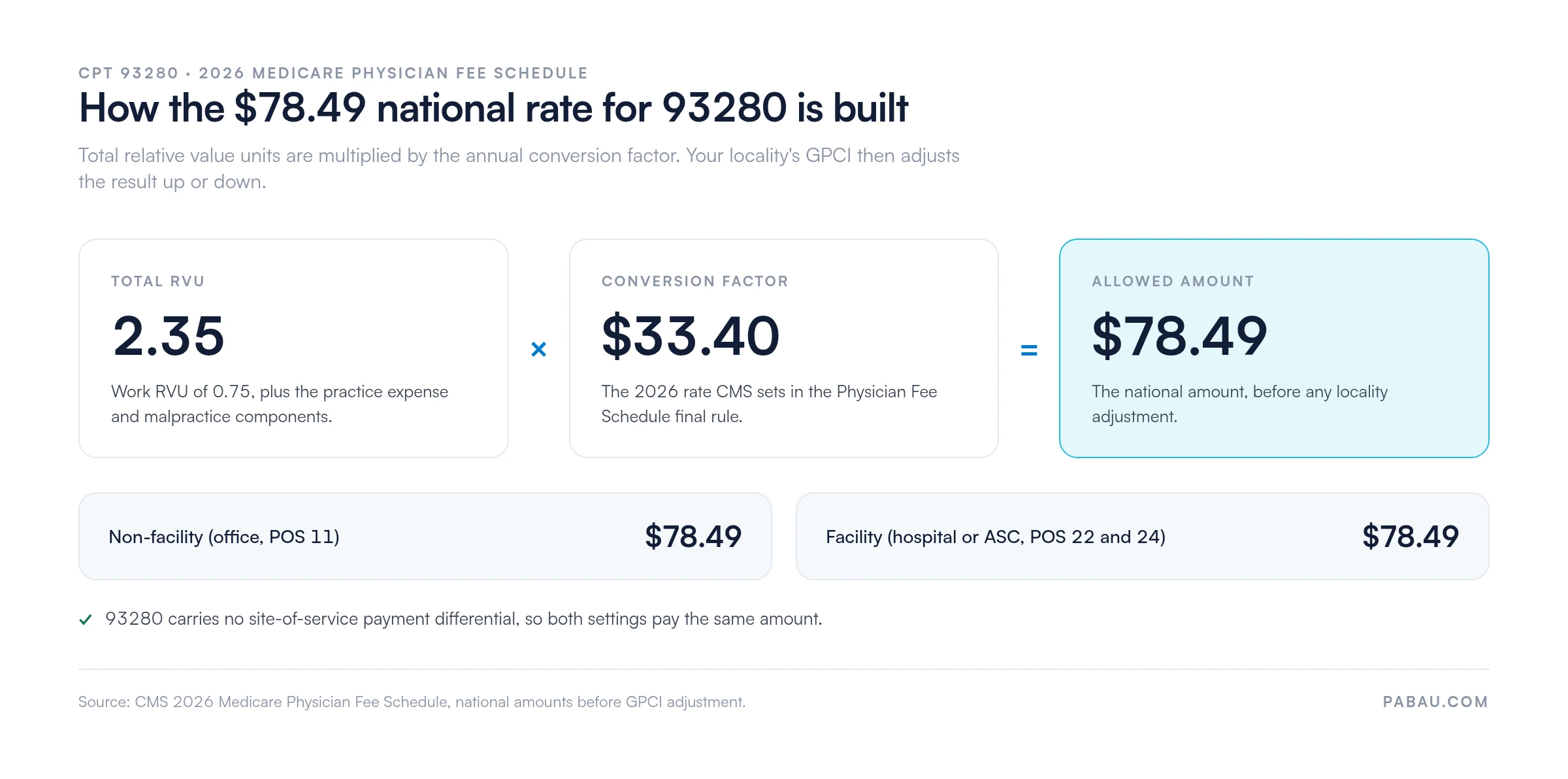
The 2026 national Medicare rate is approximately $78.49, and it is the same in facility and non-facility settings.
Documentation must capture battery status, lead parameters for both chambers, programmed settings, and any changes made during the visit.
Pabau connects cardiac device documentation to billing codes in one workflow, which cuts coding errors downstream.
CPT Code 93280 describes a programming device evaluation performed in person on a dual lead pacemaker system. The American Medical Association defines the service as an interrogation of all device functions, with an assessment of battery status and longevity.
It also covers lead parameters in the atrial and ventricular channels, a review of programmed settings, and programming changes where these are clinically indicated. The code arrived in the CPT 2009 code set and took effect on January 1, 2009.
Lead count is the clinical distinction that decides the code. A dual lead system has both an atrial and a ventricular lead, and 93280 covers the function and pacing thresholds of each. A single lead pacemaker system uses CPT 93279 instead. Choosing the wrong lead count is one of the most common denial triggers in this code family.
Medicare pays approximately $78.49 nationally for CPT Code 93280 in 2026, and the amount does not change with the place of service. Your actual payment depends on your MAC locality’s geographic practice cost index (GPCI) adjustment. Verify current rates against the CMS Physician Fee Schedule lookup tool before billing.
Most office-based procedure codes carry two rates, because the practice absorbs overhead that a hospital would otherwise be paid for separately. CPT Code 93280 is not one of them.
Medicare assigns it a single practice expense value. A physician office (POS 11), a hospital outpatient department (POS 22) and an ambulatory surgery center (POS 24) all produce the same allowed amount.
The place of service code still has to match where the service happened, because a mismatch is an audit finding on its own.
Geographic adjustments still move the number. High-cost localities such as Manhattan or San Francisco typically pay above the national average, while rural MAC jurisdictions may pay below it. Confirm your locality-adjusted rate before quoting reimbursement to your revenue cycle team.
The relative value unit (RVU) structure is what produces the fee schedule amount. The work RVU for 93280 is 0.75, reflecting the clinical time and complexity of the in-person programming evaluation.
Practice expense and malpractice RVUs bring the total to 2.35. That total is multiplied by the 2026 conversion factor of $33.40 and by your GPCI to give the final allowed amount. CMS updates RVUs annually in the Physician Fee Schedule final rule, so re-check them each January.
Run a fee schedule verification at the start of each calendar year. CMS releases the final PFS rule in November for the following January. Rates for 93280 can shift even when the code descriptor has not changed. Pull your MAC’s locality-adjusted rates, not just national averages, before updating your chargemaster.
Modifiers refine how a claim for CPT Code 93280 is read by the payer. Using the wrong modifier, or omitting a required one, is a top cause of payment delays and post-payment audits. The table below covers the modifiers most relevant to cardiac device programming evaluations.
Modifier 59 requires particular care. National Correct Coding Initiative (NCCI) edits bundle certain cardiac codes. If 93280 is billed alongside a remote interrogation code such as 93294 on the same date, you need documented clinical rationale before appending modifier 59. Verify current NCCI edits through the AAPC Codify CPT lookup before billing.
Same-date bundling also comes up with generator replacement. NCCI edits often bundle 93280 with a dual-lead replacement billed under CPT code 33228, so check the current tables before reporting both.
Documentation is where 93280 claims most commonly fail audit review. The medical record must support both the decision to perform the evaluation and every component of the evaluation itself.
A note reading “pacemaker check performed, patient doing well” does not meet the standard. The clinical note and the charge it generates must each capture the elements below.
Missing atrial or ventricular lead parameter documentation is the most audited element. Because 93280 is a dual lead code, the record must show that both channels were evaluated. Pulling device parameters straight into the clinical note at the point of care keeps incomplete documentation from reaching claim submission.
Medical necessity for CPT Code 93280 has to be supported by an appropriate diagnosis code. The diagnoses below are the ones most commonly paired with dual lead pacemaker programming evaluations.
The primary code should reflect the cardiac condition that requires ongoing device management, not just the presence of the device. Our ICD-10-CM code library carries the full descriptor and billable status for each one.
Avoid using Z45.010 alone when an active cardiac condition is driving the visit. Payers increasingly audit claims whose only diagnosis is a device-encounter Z code with no underlying condition code attached.
Specificity in ICD-10 coding is what protects against medical necessity denials. The AAPC CPT-to-ICD-10 crosswalk maps cardiac procedure codes to appropriate diagnosis codes.
CPT Code 93280 sits in the programming device evaluation family, which runs from 93279 to 93285. Each code maps to a specific device type and lead configuration.
Codes 93286 and 93287 are a separate peri-procedural device evaluation family and do not belong to this group. Choosing correctly means knowing the implanted device type and the number of leads, both of which belong in the patient’s device record.
CPT 93279 is the single lead pacemaker programming evaluation, and CPT Code 93280 is its dual lead counterpart. The only clinical distinction is lead count. Code 93279 applies when one lead is present, whether atrial or ventricular, while 93280 applies when both are implanted. Submitting the wrong one is an upcoding or downcoding error that triggers a denial or a post-payment audit.
The programming evaluation codes differ from the interrogation codes by scope of service. A programming evaluation includes assessment plus programming changes. An interrogation evaluation covers data retrieval and review without any programming. Codes 93294 to 93296 cover remote interrogation, so bill only the service that was actually performed.
Medicare covers CPT Code 93280 when a qualified physician or other qualified health care professional performs it. CMS Article 56602 sets out the coverage rules for cardiac rhythm device evaluation services.
Nurse practitioners, physician assistants and clinical nurse specialists may bill under their own NPI. They have to stay within their state scope of practice and the Medicare rules for their provider type. Keep documentation of provider qualifications on file, because auditors check it.
Key Medicare coverage criteria for 93280:
CPT Code 93280 denials cluster around five predictable mistakes. Catching each one at the point of documentation, rather than at the claims editing stage, cuts rework and protects the practice from avoidable write-offs.
Denial management for cardiac device codes starts with a clean-claim checklist at the practice level. Track denial reasons by code across a rolling 90 days, so patterns surface before they cost the practice money.
Submitting clean claims for 93280 takes device identification, dual-channel parameter documentation, and a POS code that matches the encounter.
Most 93280 billing problems start between the device evaluation note and the claim. Coders need the device type, lead parameters for both channels, programmed settings and any changes made, carried accurately into the claim. When those elements live in separate systems, transcription errors and omissions pile up.
Practice management software like Pabau connects clinical documentation to billing codes in a single workflow. Our claims management software takes the device parameters captured during the appointment and carries them into the billing record. That removes the manual transfer that creates most coding errors downstream.
Pabau submits 837P electronic claims to Medicare and private payers, returns real-time eligibility responses, and posts 835 electronic remittance advice automatically. Denial reasons from those remittance codes land in the same system as the original note, so preparing an appeal does not mean reconciling two systems.
Build a 93280 documentation template in your EHR that pre-populates the dual lead fields. Those are atrial and ventricular lead impedance, atrial and ventricular sensing thresholds, battery voltage, and programmed mode. Coders then verify a complete note instead of assembling one, which cuts both documentation time and the denial rate.

Pabau connects clinical documentation to billing codes in a single workflow. Capture device parameters, generate clean claims, and track reimbursement for CPT 93280 without switching between systems.

CPT Code 93280 claims fail on documentation far more often than on code choice. The record has to carry dual-channel lead parameters, device identification, programmed settings, and a clear account of any changes made. Getting those into the note at the point of care is the whole fix.
The 2026 rate is the same wherever the evaluation happens, so there is no revenue argument for choosing one setting over another. What moves the number is your locality’s GPCI, and what protects it is a note that survives audit. Book a demo to see how Pabau captures cardiac device parameters and turns them into clean 93280 claims.

Need to understand how claims reach payers? Medical claims clearinghouse guide explains how 837 files move from practice to payer and what happens at each step.
Want to verify eligibility before the appointment? Insurance eligibility verification covers how real-time eligibility checks prevent coverage-related denials before a claim is even submitted.
Looking for a full billing software comparison? Best medical billing software in the US reviews the leading platforms for practices managing Medicare and private payer claims.
CPT Code 93280 reports an in-person programming device evaluation of a dual lead pacemaker system. The service covers interrogation of all device functions, battery status, and lead parameters for both the atrial and ventricular channels. It also covers a review of programmed settings and any programming changes made during the visit. Remote monitoring services are reported with separate codes.
The 2026 national Medicare rate for CPT 93280 is approximately $78.49, and it is the same in facility and non-facility settings. This code carries no site-of-service payment differential. Your actual rate is adjusted by your MAC locality’s GPCI, so check the CMS Physician Fee Schedule lookup tool each January. Rates change annually with the Physician Fee Schedule final rule.
CPT 93279 covers an in-person programming device evaluation for a single lead pacemaker system. CPT Code 93280 covers the same service for a dual lead system. The distinction is lead count. Code 93279 applies when one lead is present, and 93280 applies when both an atrial and a ventricular lead are implanted. Submitting the wrong code for the implanted device is a common denial trigger.
Four modifiers come up most often with 93280. Modifier 26 reports the professional component when the physician bills separately from the facility, and modifier TC reports the technical component. Modifier 52 covers reduced services, where the full evaluation was not completed. Modifier 59 marks a distinct procedural service, used when 93280 is billed on the same date as another cardiac code that NCCI edits would bundle. Verify current NCCI edits before appending modifier 59.
The record must name the device manufacturer, model, and serial number, and report battery voltage with estimated longevity. It must give atrial and ventricular lead parameters, meaning pacing threshold, sensing amplitude, and impedance for each. It must also list the programmed settings reviewed, including pacing mode, lower and upper rates, and AV interval. Finally it needs the specific programming changes made, the clinical rationale for each, and a qualified provider attestation. Both channels are required, because 93280 is a dual lead code.
Yes, and the payment is the same in both. Unlike most office-based procedure codes, 93280 has no site-of-service differential, so a hospital outpatient department and a physician office produce the same allowed amount. The place of service code on the claim still has to reflect where the service happened. Reporting POS 11 for a service delivered in a hospital outpatient department is a common audit finding.