HCPCS code J3471: Hyaluronidase ovine injection billing guide
HCPCS code J3471: Descriptor, code type, and quick-reference data HCPCS code J34...

Last Updated: Oct 14, 2026
93296 is the CPT code for the technical component of remote cardiac device interrogation, across a period of up to 90 days. It covers remote data acquisition, receipt of transmissions, technician review, technical support, and distribution of results. The devices are pacemaker, leadless pacemaker, and implantable defibrillator systems. No physician analysis, review, or report is included.
The physician work is billed separately under 93294 for pacemaker systems and 93295 for implantable defibrillator systems. Medicare pays 93296 once per device per 90-day period, and requires general supervision of the technical service by a physician.
Let Pabau's smart automation suggest the right codes, reduce claim denials, and keep your practice compliant—effortlessly.
Automate repetitive tasks and focus on what matters most—your patients.
Reduce coding errors and ensure compliance with the latest regulations.
Clean claims, fewer denials, and faster reimbursements.
Powerful insights and reporting to help your practice thrive.
HIPAA compliant SOC 2 certified GDPR-compliant Trusted by 4,000+ clinics worldwide

CPT Code 93296 is the technical component code for remote interrogation of pacemaker, leadless pacemaker, and implantable defibrillator systems.
It covers remote data acquisition, receipt of transmissions, technician review, technical support, and distribution of results, over a period of up to 90 days.
The physician work is billed separately: 93294 is the professional component for pacemaker systems, and 93295 is the professional component for implantable defibrillator systems.
Modifier 26 does not apply to 93296, because a separate professional component code already exists for each device family.
Medicare pays 93296 once per device per 90-day period and requires general supervision of the technical service by a physician.
CPT Code 93296 is the technical component code for remote interrogation of implanted cardiac devices, as defined by the American Medical Association’s CPT code set. It pays the entity that runs the monitoring service and collects the transmissions. No physician analysis, review, or report is bundled into it.
The official AMA descriptor for CPT Code 93296 reads as follows, set out here on its own punctuation:
Two details in that descriptor decide whether the claim pays. First, the code covers a monitoring period of up to 90 days, not a single transmission event. Second, every element it names is technical, from acquiring the data through to distributing the results.
Physician work lives in a different code. For a pacemaker or leadless pacemaker system, the professional component is 93294. For an implantable defibrillator system, it is 93295. A device clinic that owns the monitoring platform and employs the reading physician bills two codes, not one.
CPT Code 93296 applies to a defined list of implanted cardiac devices. Stretching it to cover any implanted cardiac monitor is the fastest route to a denial. The monitor codes sit in a separate family, on a shorter period.
Every eligible device must hold FDA clearance for remote monitoring transmission. Manufacturer platforms include Medtronic’s CareLink, Abbott’s Merlin.net, Boston Scientific’s LATITUDE, and Biotronik’s Home Monitoring. Some devices are implanted without the manufacturer’s remote monitoring service ever being activated. There is then no monitoring service to bill, and the 93296 claim is denied.
The 93290s family trips up experienced coders because it splits one service into two codes. One code carries the professional component, the other carries the technical component, and 93296 is always the technical one.
93296 is the only technical code in the pacemaker and defibrillator group, so it partners with two different professional codes. Pair it with 93294 for a pacemaker and with 93295 for a defibrillator. Billing 93294 against a defibrillator transmission is a device mismatch, and it is easy to avoid. Confirm the implanted device first, then read the codes and the period off the grid below.
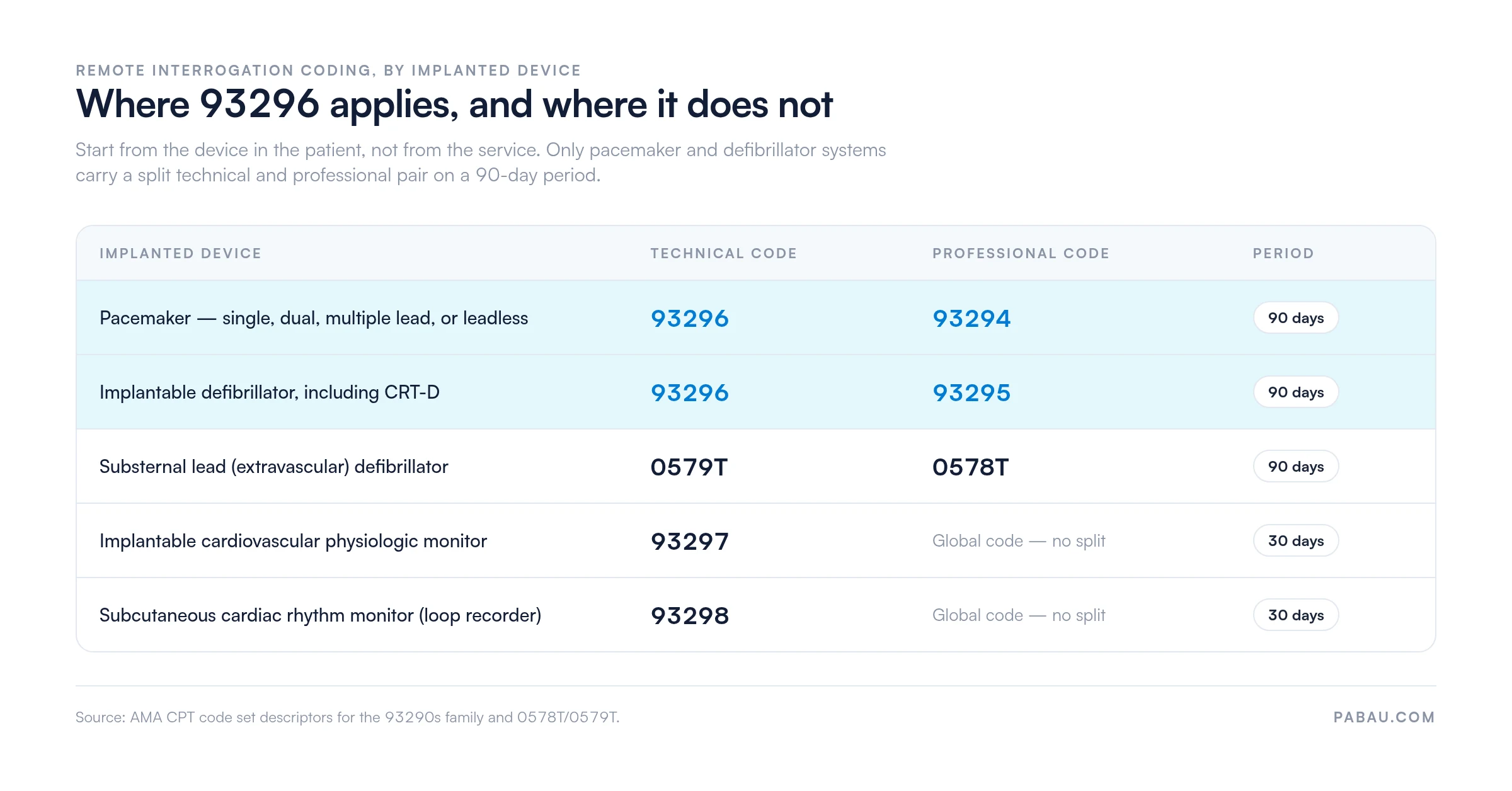
CPT Code 93296 is already a component code, so it does not split any further. The AMA published a separate professional code for each device family, which removes the reason a practice would append a component modifier at all.
Medtronic’s device monitoring procedure code guide states the rule directly. The -26 modifier is not applicable when there is a separate professional component code, as with CPT 93294 and 93295.
The confusion has a traceable source. In-person device evaluation codes such as 93288 and 93289 are configured as global codes. Modifier -26 is appended to those when the evaluation happens in a facility and the physician reports the professional component separately. Remote monitoring works the other way around, because the split is already built into the code set.
The same structure shows up in external cardiac monitoring. Holter recording bills as 93225, with separate codes for the scanning analysis and the interpretation, so -TC does not belong there either.
Hospital outpatient device clinics split the bill across two claim forms. The hospital reports 93296 on a UB-04 as the facility charge. The reading physician reports 93294 or 93295 on a CMS-1500. Neither claim carries a component modifier.
Documentation for remote cardiac device monitoring splits across the same two claims as the codes. The technical record supports 93296. The interpretive note supports 93294 or 93295. A payer auditing the technical claim is looking for proof the monitoring service ran, not for a physician’s opinion.
The professional claim needs a note of its own. The reading physician records the interpretation, the clinical decision, and any programming recommendation, including “no change indicated” where that is the finding. That note supports 93294 or 93295. It does not support 93296.
Documentation checklists built into the billing system stop an incomplete note reaching the payer. Thin documentation remains one of the top denial drivers for this code family. A practice that wants cleaner claims management starts by fixing the note, not the claim form.
Keep two note templates rather than one. The technical template records device identifiers, transmission dates, technician review, and the supervising physician for the period. The interpretive template records the physician’s findings and decision. A coder can then confirm which claim each note supports before the claim is submitted.
Medicare coverage for remote defibrillator surveillance is set out in CMS Article A53018, Surveillance of Implantable or Wearable Cardioverter Defibrillators. It confirms that 93295 and 93296 are 90-day services, reportable once per period however many interrogations are performed. Coverage is not automatic.
MAC jurisdiction decides which version of the policy applies to your claims. Novitas Solutions, CGS Administrators, Palmetto GBA, NGS, and WPS each administer their own region. Confirm your MAC assignment and check for jurisdiction-specific articles before submitting.
Strong insurance eligibility verification workflows catch inactive coverage and unenrolled patients before a claim leaves the practice. That single check prevents a meaningful share of 93296 denials at source.
Medicare payment for CPT Code 93296 comes from the Medicare Physician Fee Schedule (MPFS) and is updated each January 1. Rates vary by geographic practice cost index, so the national amount is a starting point rather than a guaranteed local payment.
Because 93296 carries no physician work, its payment is built from practice expense and malpractice relative value units. Those cover the monitoring equipment, the technician’s time, and the office overhead behind the service. The work RVUs sit on the professional code instead.
CMS updates the conversion factor annually, so quoting a dollar rate in a reference article risks misstating the current year. Use the FastRVU RVU lookup tool or the official CMS MPFS search to retrieve the current national rate for your locality. The RVU components stay stable between major descriptor revisions, while the dollar rate moves each year.
CPT Code 93296 is billable once per 90-day period per device under Medicare. The window opens with the first day of the monitoring period, not with the first transmission or the date a physician read the data.
Tracking 90-day windows across a large device panel by hand is error-prone. A practice that connects its billing calendar to the monitoring platform catches duplicate periods before the claim is built. That removes most frequency-violation denials.
Place of service on a 93296 claim follows the technical service rather than the reading physician. The question to answer is where the monitoring equipment and the technicians sit. The professional claim answers a different question, and mixing the two produces avoidable denials.
A frequent error is a hospital-based arrangement billed as though it were an office service. Where the hospital owns the monitoring platform, the technical charge belongs on the hospital’s claim. The physician practice then bills only the professional code, and facility versus non-facility pricing follows from that split.
Medicare treats cardiac device monitoring as a diagnostic service, which brings physician supervision requirements with it. Those requirements attach to the technical component of the electronic analysis, so they attach to 93296.
Remote interrogation services require general supervision. The service is furnished under the physician’s overall direction and control, but the physician does not need to be present while it is performed. Training the technician and maintaining the equipment stay the physician’s responsibility.
Direct supervision is the stricter standard, and it applies to in-person cardiac device evaluations performed at an office place of service. Applying it to remote monitoring overstates what Medicare asks for. It also holds up claims that were payable all along.
Medicare’s diagnostic testing rules state that the supervisor must be a physician. A nurse practitioner or physician assistant cannot supervise the technical service, except in states where the law and scope of practice permit it. Confirm your state’s position before assigning supervision to an NPP.
Incident-to and shared-visit questions belong to the professional claim instead of this one. Where a technician screens a transmission and a physician then interprets it, that interpretation is what 93294 or 93295 pays for. The physician must perform the review personally and sign the note.
Practices managing supervision across several providers benefit from a workflow that flags a note before its claim is released. The device, the period, the place of service, and the supervising physician all need confirming up front.
Most CPT Code 93296 denials trace back to a short list of causes. Each one has a root cause and a practical fix.
Of those triggers, the code family error is the simplest to prevent. An implantable cardiovascular monitor belongs under 93297, a global code that bills a monitoring period of up to 30 days.
Practice management software like Pabau integrates with Claim.MD, our US clearinghouse partner, to run eligibility verification and claim scrubbing before submission. Several of the triggers above surface while the claim is still being built rather than weeks later as a rejection.
Billing staff can map denial reason codes against the triggers above. That mapping becomes an appeals library for this code family. The AAPC Codify CPT lookup carries the parenthetical notes and cross-code guidance for the 93290s family.
Run a quarterly audit of every 93296 line submitted in the prior 90 days, sorted by denial reason code. Frequency-exceeded denials cluster where monitoring enrollment was set up without a matching billing calendar. One afternoon of audit work usually explains the bulk of the repeat rejections.
A device clinic billing 93296 has to track two separate facts at once. It needs to know which devices sit inside an open 90-day window, and whether each technical claim has a matching professional claim. That tracking usually lives in a spreadsheet parked beside the monitoring platform, and the spreadsheet is where frequency-exceeded denials begin.
Pabau keeps the billing record in the same system as the patient record. Device details, transmission dates, and the supervising physician sit on the patient’s chart, so the claim is built from what the practice already documented. Staff never re-key device details from a monitoring portal into a billing screen.
The Claim.MD connection then runs eligibility checks and claim scrubbing before the claim is released. Errors that would otherwise return weeks later as a denial surface while the claim is still on screen. That shortens the time from transmission to payment, and it keeps appeal work off the billing team’s desk.

Pabau connects to Claim.MD to scrub cardiac device monitoring claims as they are built. Catch frequency violations, component modifier errors, and missing documentation before the claim reaches the payer.

CPT Code 93296 pays for the monitoring service, not for the medicine. Once a billing team holds on to that distinction, most of the code’s denial profile dissolves. The modifier questions stop, pairing with 93294 or 93295 becomes routine, and the 90-day calendar is all that is left to manage.
The trade-off worth remembering is that two correct claims are still two claims. A device clinic that reports 93296 and never reports the matching professional code leaves the physician’s work unpaid. Audit a quarter of submitted lines and check that both halves went out for every monitoring period.
Pabau’s claims management software, connected to the Claim.MD clearinghouse, runs eligibility and scrubbing checks before submission. Book a demo to see how a cardiac device clinic runs that workflow from transmission through to payment.

Need to understand the full billing workflow before the claim is built? What is medical billing covers the end-to-end process from service delivery to payment posting.
Handling electronic claims and remittance for cardiac services? Electronic remittance advice explains how 835 ERA files map denial reason codes back to specific claim lines.
Want to reduce the administrative burden of device clinic billing? Best medical billing software in the US reviews the platforms that handle high-volume specialty billing workflows.
Managing revenue across a multi-provider cardiac practice? Superbill documentation explains how superbills capture CPT codes, modifiers, and diagnosis codes before submission.
CPT Code 93296 covers the technical component of remote cardiac device interrogation across a period of up to 90 days. It pays for remote data acquisition, receipt of transmissions, technician review, technical support, and distribution of results. It applies to pacemaker, leadless pacemaker, and implantable defibrillator systems. No physician analysis, review, or report is included in it.
They are the two halves of the same pacemaker monitoring service. CPT 93294 is the professional component and covers the physician or QHP analysis, review, and report. CPT 93296 is the technical component and covers data acquisition, technician review, and distribution of results. For an implantable defibrillator, the professional partner code is 93295 instead.
Once per 90-day period per device under Medicare. Multiple transmissions inside the 90-day window do not create multiple billable events. Commercial payers may apply different frequency limits, so verify each payer’s policy separately.
None of the component modifiers apply. Modifier 26 is not used, because a separate professional component code already exists: 93294 for pacemaker systems and 93295 for implantable defibrillator systems. Modifier TC is redundant, since 93296 is already the technical component. A practice performing both parts bills two codes rather than one global line.
No. CPT Code 93296 carries a CMS global period indicator of “XXX,” meaning the global period concept does not apply. It is not a surgical procedure code, so there is no 10-day or 90-day post-procedure global period in the surgical sense.
Place of service follows the technical service rather than the reading physician. Use POS 11 where the practice owns the monitoring platform and its technicians screen transmissions in the office. A hospital device clinic reports the technical charge on its own facility claim instead. Telehealth place-of-service codes do not apply, because remote interrogation is a diagnostic test.
Generally no. CMS Article A53018 states that a provider may not bill a remote service and a face-to-face service on the same day. Check the device clinic calendar against the in-person schedule before releasing the claim, and verify current NCCI edits for any combination you intend to submit.
Medicare requires general supervision of remote interrogation services, meaning the physician directs and controls the service without needing to be present. Medicare’s diagnostic testing rules also require the supervisor to be a physician. A nurse practitioner or physician assistant may supervise only where state law and scope of practice allow it.