

HCPCS Code Q4175: Billing, coverage, and documentation guide
HCPCS Code Q4175: Code Description and Product Identity HCPCS Code Q4175 is the ...

Last Updated: Nov 20, 2026
93282 is the CPT code for programming device evaluation (in person) with iterative adjustment of the implantable device to test the function of the device and select optimal permanent programmed values with analysis, review and report by a physician or other qualified health care professional; single lead implantable cardioverter-defibrillator system.
It is a common source of errors in the 93279-93284 family. Coders confuse lead count, mix up programming evaluations with remote interrogation, or misidentify the device type. Getting it right requires knowing exactly what the in-person session must include, how to document it, and which adjacent codes interact through NCCI edits.
Let Pabau's smart automation suggest the right codes, reduce claim denials, and keep your practice compliant—effortlessly.
Automate repetitive tasks and focus on what matters most—your patients.
Reduce coding errors and ensure compliance with the latest regulations.
Clean claims, fewer denials, and faster reimbursements.
Powerful insights and reporting to help your practice thrive.
HIPAA compliant SOC 2 certified GDPR-compliant Trusted by 4,000+ clinics worldwide

CPT code 93282 covers an in-person programming evaluation of a single-lead ICD, with iterative adjustment and a physician or QHP report.
Lead count and device type pick the code: single-lead ICD 93282, dual-lead ICD 93283, multiple-lead ICD 93284, subcutaneous ICD 93260.
If the device is read and reviewed but not reprogrammed, the in-person interrogation code 93289 fits better than 93282.
Remote monitoring bills separately, under 93295 for the physician’s review and 93296 for technical support.
Pabau, a practice management platform, fills claims from the patient record and tracks each 837P claim through Claim.MD in the US.
CPT code 93282 is the code for an in-person programming evaluation of a single-lead implantable cardioverter-defibrillator (ICD) system. Boston Scientific’s device monitoring coding guide reproduces the AMA wording for the whole family, with 93283 and 93284 covering dual-lead and multiple-lead ICDs. The full descriptor for 93282 reads:
Programming device evaluation (in person) with iterative adjustment of the implantable device to test the function of the device and select optimal permanent programmed values with analysis, review and report by a physician or other qualified health care professional; single lead implantable cardioverter-defibrillator system.
AMA CPT descriptor for 93282
Each phrase in that descriptor is a condition the visit has to meet. The table breaks them down.
The American Medical Association owns the CPT code set and publishes the official descriptors. The AMA’s CPT code set overview explains how the codes are maintained and updated.
A 93282 visit is a structured device clinic session, longer than a quick read-out. Walking through it step by step shows the coder what the note should prove.
Here’s the judgment call coders meet every week. If the device was read and reviewed but no parameter was tested and adjusted, the visit fits the in-person interrogation code 93289 better than 93282. Ask the device clinic to state in the note whether programming changed, so the coder doesn’t have to guess.
The 93279-93284 family covers in-person programming evaluations for pacemakers and ICDs, split by device type and lead count. Picking the wrong lead count is a common cause of wrong-code denials.
The grid below shows where 93282 sits among its neighbors.
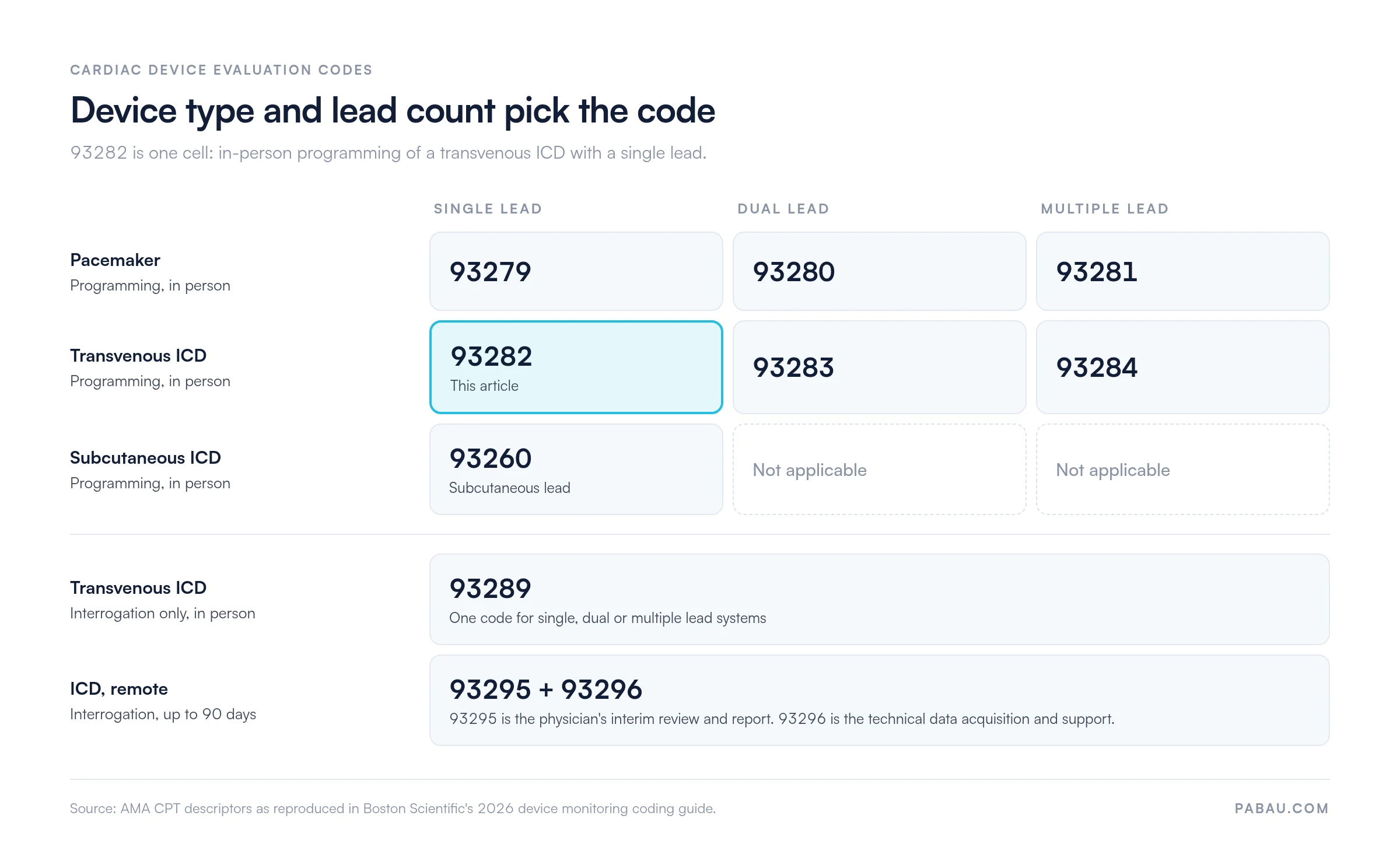
Two neighbors sit outside this table and still catch coders out. A subcutaneous ICD has one lead, but it isn’t transvenous, so its programming evaluation bills under 93260. When the check happens around a surgery, procedure or test, the peri-procedural code 93287 describes it instead of 93282.
Confirm lead count from the 33249 implant operative report and the current device clinic record before every claim. An upgrade can add leads, so a device implanted as single-lead may now bill as 93283.
93296 covers remote interrogation for single, dual or multiple lead pacemaker or ICD systems, up to 90 days. It pays for the technical side: data acquisition, receipt of transmissions, technician review and support. The physician’s interim review and report bills separately, under 93294 for a pacemaker and 93295 for an ICD.
A patient on remote monitoring often comes in for an in-person programming visit inside the same 90-day window. Before billing 93296 alongside 93282, check the current NCCI procedure-to-procedure edits and your payer’s policy. Don’t assume either code absorbs the other.
The phrase “analysis, review and report” sets the documentation bar. Payers, including Medicare Administrative Contractors (MACs), look for each element when they review a 93282 claim, and thin notes are a common cause of denials. A complete note carries these items.
Some MACs publish coverage articles or billing guidance that touch cardiac device evaluations. Check your MAC’s site for anything active in your jurisdiction before you set a billing protocol.
93282 has a professional and a technical component. The modifier depends on where the service happens and who owns the programmer and pays the staff.
Don’t append modifier 26 when the practice bills a 93282 performed in its own office. The global rate already covers both components, so a 26 underpays the claim and can draw an audit.
Medicare covers CPT code 93282 when the service is medically necessary and the ICD was implanted for a covered indication. Payment follows the Medicare Physician Fee Schedule (MPFS), with separate facility and non-facility rates.
Use the CMS Physician Fee Schedule lookup tool to pull current RVUs and payment rates for 93282 by locality. Rates change every calendar year, so never quote last year’s figure to a patient or a payer.
MAC reviewers tend to look at four things on a 93282 claim:
Denials for CPT code 93282 cluster around five root causes. Each one can be caught with a check before the claim goes out.
When a claim comes back denied, the medical billing denial codes on the ERA name the reason. A steady denial management process tracks those reasons by code, so a repeat pattern gets fixed at the documentation stage.
The National Correct Coding Initiative (NCCI) controls which codes can be billed together on the same date. For 93282, the pairs to watch involve interrogation, remote monitoring and same-day visits.
CMS updates NCCI edit pairs every quarter. Check them with the AAPC’s CPT code lookup tool or the CMS tables before you lock in a billing protocol. Building each charge to clean claim standards keeps a bundling slip from reaching the payer.
Most 93282 problems start upstream of billing, in the device clinic. This is the usual path from visit to payment.
Before you submit, run through this list.
In many device clinics, the coder retypes the device check into a separate billing system. Codes get keyed twice, and a missing field only surfaces when the clearinghouse rejects the claim.
Pabau’s claims management software builds the claim from the patient record instead. The CPT code attached to the service lands on the charge line, and ICD-10 codes come from the patient’s recorded problem list. Required fields are checked before the claim can be sent.
US practices submit through Claim.MD, with eligibility checks before the visit and ERA posting after payment. Claim status is tracked from submission to payment, so your team sees a denied 93282 the day the remittance arrives.

Pabau fills claims from the patient record, checks required fields before they’re sent, and tracks each one through to payment. Your device clinic spends less time rekeying and chasing remittances.

Most 93282 errors are settled before anyone opens the billing screen. If the device clinic records the device type, the current lead count and whether programming changed, the code picks itself.
So put the effort into the note template, not the appeal letter. A report that lists tested parameters and final values defends the claim on first submission. The trade-off is a minute more per visit, which costs far less than reworking a denial.
Book a demo to see how Pabau carries the device visit straight onto a clean claim and tracks it to payment.

Need to understand how claims move through the system after submission? Medical claims clearinghouse guide explains how clearinghouses validate and route 837P claims to payers.
Seeing ERA remittances with unfamiliar denial codes? Electronic remittance advice explained breaks down ERA file formats, CARC codes, and how to read an 835 transaction.
Want to benchmark your practice’s claim submission quality? Best medical billing software for US practices covers the features that reduce first-pass denial rates across cardiology and specialty practices.
Z45.02, encounter for adjustment and management of an automatic implantable cardiac defibrillator, is the usual primary code for a programming visit. Add the condition that explains why the patient has the device, such as a ventricular tachycardia code.
No. A wearable cardioverter-defibrillator has no implanted lead, so 93282 doesn’t apply. Initial set-up and programming of a wearable device bills under 93745.
CPT sets no fixed interval, so each in-person programming session that meets the descriptor can be reported. Payers may question repeat sessions close together, so record the reason for each one, such as shocks, a medication change or a lead alert.
Report one unit per programming session for the whole device. The single lead is part of the descriptor, so you never add units per lead or per parameter tested.





