HCPCS Code E0272: Foam rubber mattress billing guide
HCPCS Code E0272: official descriptor and code overview HCPCS Code E0272 is the ...

Last Updated: Nov 6, 2026
93750 is the CPT code for interrogating a ventricular assist device (VAD) in person, with analysis by a physician or other qualified health care professional. The service covers device parameters, device function, any programming performed, and a written report. One unit covers the whole LVAD check.
The code sits in the cardiovascular subsection of the Medicine section, under noninvasive physiologic studies and procedures (93701-93790). A remote or telephone VAD review is not reportable as 93750. Medicare pays it as a whole service, with no professional/technical split.
Let Pabau's smart automation suggest the right codes, reduce claim denials, and keep your practice compliant—effortlessly.
Automate repetitive tasks and focus on what matters most—your patients.
Reduce coding errors and ensure compliance with the latest regulations.
Clean claims, fewer denials, and faster reimbursements.
Powerful insights and reporting to help your practice thrive.
HIPAA compliant SOC 2 certified GDPR-compliant Trusted by 4,000+ clinics worldwide

CPT code 93750 reports an in-person interrogation of a ventricular assist device, with analysis, any programming, and a written report.
A remote or telephone VAD review is not reportable as 93750, and CPT has no remote VAD interrogation code to use instead.
Programming done during the session is part of 93750, so it never goes on the claim as a separate line.
A same-day E/M visit needs its own documented reason, with modifier 25 appended to the E/M code.
Medicare pays 93750 as a whole service with no 26/TC split, at 1.59 RVUs in the office and 1.02 in a facility for 2026.
CPT code 93750 reports an in-person interrogation of a ventricular assist device (VAD), with analysis by a physician or other qualified health care professional. The key phrase is in person. The clinician reviews device parameters and function with the patient present, programs the device if needed, and writes a report.
One unit of 93750 covers the whole encounter. That includes analysis of device parameters such as drivelines, alarms, and power surges. It also includes review of device function, such as flow and volume status, septum status, and recovery. Programming is part of the code when it happens, so a separate programming charge for the same session duplicates the service.
The official AMA descriptor is long, so the table below breaks it into its parts, word for word.
Coders sometimes bill 93750 for remote monitoring sessions, or for E/M visits where a brief device check happened to occur. Both create audit exposure. The table below separates what the code covers from what needs a different code or no separate billing at all.
Documentation is where most 93750 claims fail on audit. A clean claim submission for this code rests on a written interrogation report that covers each item below, whether or not a parameter changed.
The report does not need to be a separate paper form. A structured note in the patient record that covers every item above satisfies the requirement. What fails audit is a note that records only the final pump speed, with no reference to the other parameters reviewed. Generating a superbill only after the full report is complete keeps the claim from going out early.
Run a quarterly documentation audit on a random sample of 93750 claims. Pull the interrogation reports and check that every required parameter appears. Look hardest at pulsatility index and battery status entries, which are easy to skip when the values have not changed.
Modifier choice for CPT code 93750 is narrower than for most cardiology codes. The code has no professional/technical split, so the decisions sit with a same-day E/M visit and with NCCI edits.
CMS treats XE, XS, XP, and XU as more specific versions of modifier 59, and some Medicare Administrative Contractors expect them. Check your MAC’s guidance before you default to 59. Keep both off the E/M line, where modifier 25 does the job.
LVAD teams bill across a cluster of codes, depending on the device and the setting. Confusing in-person with remote interrogation is a frequent audit finding, and the map below sorts each encounter to the code it takes.
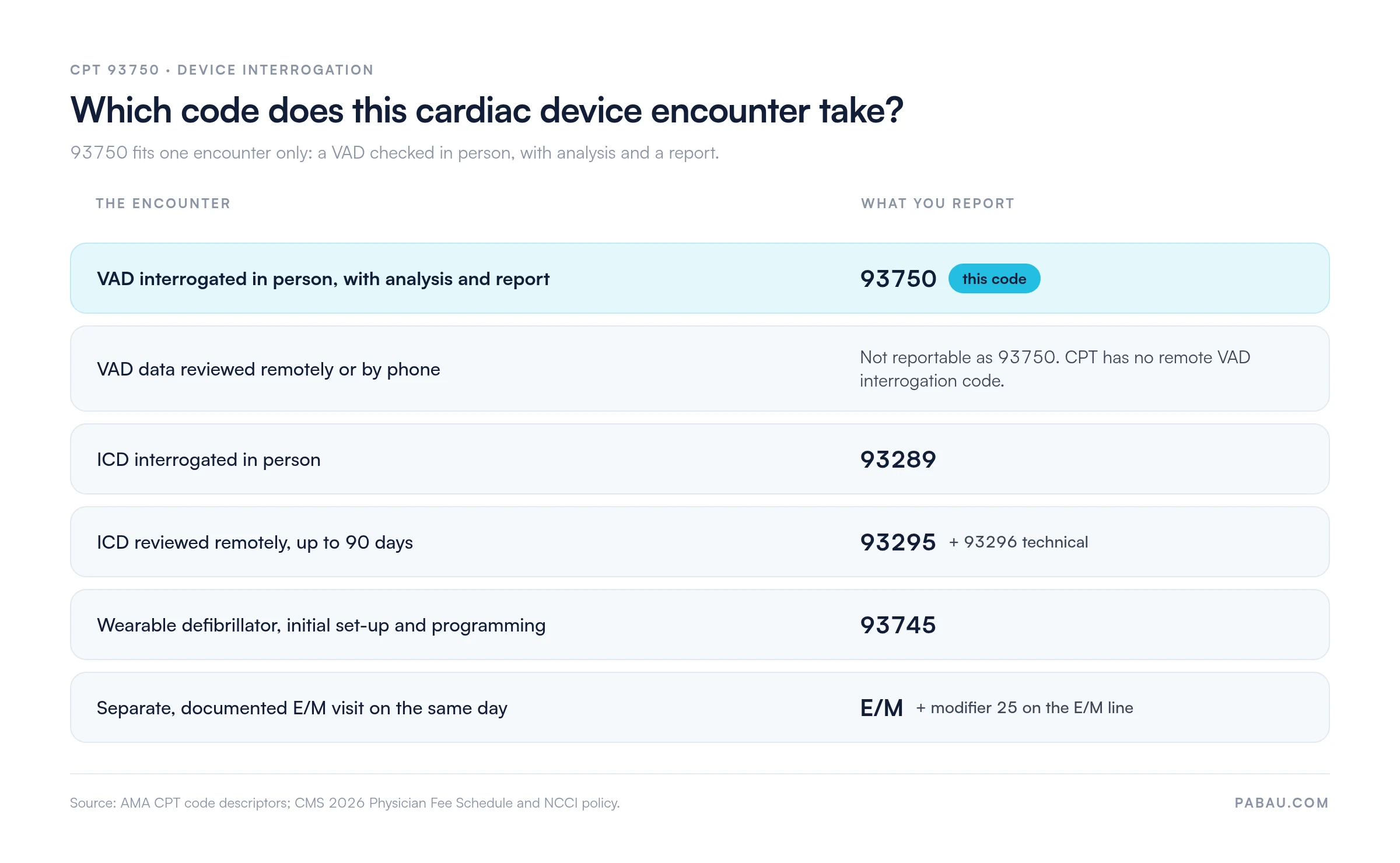
Remote ICD follow-up runs on a 90-day reporting period under 93295, a structure VAD follow-up does not have. Every code in the map has its full descriptor in the CPT code library, so check the wording before you switch codes.
Medicare pays CPT code 93750 under the CMS Physician Fee Schedule. The 2026 national relative value units (RVUs) below come from the October 2026 PFS relative value file. Local payment then shifts with the Geographic Practice Cost Index (GPCI) for your locality.
93750 carries PC/TC indicator 0. It is a physician service with no professional/technical split, so modifiers 26 and TC do not apply. The practitioner bills the whole code in either setting, and the place of service decides which rate applies.
Two conversion factors apply in 2026. Qualifying APM participants are paid at $33.5675 per RVU and other clinicians at $33.4009, which explains the paired dollar figures. The facility rate is lower because the hospital bills its own practice costs to Medicare separately.
Medicare does not currently require prior authorization for CPT code 93750 as a routine billing condition, though annual rule updates can change that. Commercial payers vary considerably. Some treat the interrogation as a standard cardiology service with no pre-auth requirement. Others require authorization above a set number of visits per year, or when the encounter happens in a hospital outpatient setting.
Running insurance eligibility verification at each visit catches payer-specific authorization rules before the claim is submitted. The common pre-auth triggers to watch for across commercial payers include:
Document the specific reason for each interrogation visit in the medical record. When a payer requests records for a prior authorization decision, “post-speed-adjustment follow-up” is more defensible than a generic “routine LVAD check.” Clear visit reasons also support medical billing compliance and cut the number of authorization appeals your team handles.
LVAD interrogation claims fail for a narrow set of repeatable reasons. The table below maps each denial type for CPT code 93750 to its root cause and the fix that stops it recurring.
Structured denial management workflows sort each 93750 denial by root cause. Your team can then fix the documentation or workflow problem behind a pattern, instead of reworking each denial one at a time.
Create a 93750-specific denial tracker in your billing system and tag each denial with a root cause from the table above. If documentation problems lead the tracker, fix the interrogation report template before you appeal claims one by one.
LVAD programs hit a timing problem with this code. The interrogation report must be complete before the claim goes out, but clinicians often finish it after the patient leaves. Claims sent early go out with missing parameters, the wrong place of service, or no modifier on the E/M line.
Pabau, the practice management platform we build, keeps the interrogation note and the claim on the same patient record. Its claims management software connects to the Claim.MD clearinghouse for US practices. Your team can check eligibility, submit 837P claims, track claim status, and post ERA remittances without leaving the record.
The practical rule is to hold the 93750 charge until the clinician signs the interrogation note. A claim built from a signed, complete report is far less likely to come back for missing documentation. You also know whether it cleared before the patient’s next interrogation visit.

Pabau’s claims management connects to the Claim.MD clearinghouse to submit CPT claims, check eligibility, and track claim status from the patient record. Book a demo to see how cardiology billing teams use it.

Treat 93750 as a narrow code and build the workflow around that. Bill it only when someone checked the device face to face and wrote a report, and keep remote reviews off the claim.
The biggest payoff sits in the interrogation template. A template that forces every parameter field, unchanged ones included, prevents most documentation denials. Pair it with a place-of-service check at charge entry, and the office-versus-facility rate takes care of itself.
Book a demo to see how Pabau keeps the interrogation note and the 93750 claim on one patient record.

Need a clearinghouse for electronic CPT claims? Pabau’s Claim.MD clearinghouse guide explains how the integration handles 837P submission and ERA remittance for US practices.
Want to reduce denials across your billing operation? Denial codes in medical billing covers CARC reason codes and how to map them to root-cause fixes in your workflow.
Billing the VAD insertion as well? CPT code 33990 covers percutaneous ventricular assist device insertion, the procedure that often comes before ongoing interrogations.
Billing cardiac procedures alongside other services? Revenue cycle management for practices outlines how to build a clean-claim process from eligibility through payment posting.
CPT code 93750 covers an in-person interrogation of a ventricular assist device (VAD or LVAD). A physician or other qualified health care professional analyzes device parameters, reviews device function, programs the device if needed, and writes a report. One unit covers the whole encounter.
The interrogation report must document every device parameter reviewed, not only those adjusted. That includes pump speed, power consumption, pulsatility index, flow estimate, alarm settings, driveline condition, battery status, and controller integrity. It must also carry the clinician’s interpretation and the date of the face-to-face encounter. A note that records only final settings will not support the claim on audit.
No. CPT code 93750 requires an in-person encounter. CPT has no code for remote VAD interrogation, so a remote or telephone review is not reportable as 93750. Billing 93750 for a session where no clinician saw the patient misstates the service and is a common audit finding.
The most common reasons are incomplete documentation and place-of-service errors, such as POS 11 on a hospital outpatient service. Others are a separate programming charge for the same session and a same-day E/M billed without modifier 25. Missing prior authorization with commercial payers is also a frequent trigger.