



CCSD code G5100: Bypass of duodenum billing guide
CCSD code G5100 bills a bypass that leaves the duodenum in place CCSD code G5100...

Last Updated: Oct 16, 2026

CPT code 22830 describes exploration of a spinal fusion site, with no instrumentation removal or revision.
Documented operative intent, not intraoperative findings, decides whether 22830 or a removal code such as 22852 applies.
CCI edits block a separate 22830 charge when a more comprehensive spinal procedure runs in the same session.
Facility and non-facility payment differ by roughly $490, driven entirely by the practice expense RVU.
Practice management software like Pabau tracks the modifier, diagnosis, and place of service on every 22830 claim.
CPT code 22830 covers exploration of a spinal fusion site to assess whether bony union has occurred. The code carries one hard restriction. No instrumentation may be removed or revised during that same operative session. That line is where spine practices lose 22830 claims in medical billing.
What follows is the AMA descriptor, 2026 RVU and Medicare figures, the modifiers that apply, the ICD-10 crosswalk, and the CCI restrictions. It closes with the 22830 versus 22852 decision, which sets the payment on every hardware case.
CPT code 22830 is the only code under the Exploration heading in the Spine section. The next family is spinal instrumentation, 22840 through 22865, which covers placement, reinsertion, and removal.
Because the short and long descriptors are identical, the operative report is the only document separating a compliant 22830 claim from a removal code.
CPT code 22830 applies when a surgeon reopens a prior fusion site to assess its integrity. Preoperative intent supports the code, not what the surgeon finds once inside. Three clinical scenarios most commonly justify it.
Key rule: the choice between 22830 and a more comprehensive spinal code belongs in the preoperative plan. Intraoperative findings do not move it. If the surgeon sets out to explore and then removes instrumentation, the removal code governs the claim. 22830 is not separately reportable for that level.
Relative Value Units determine how CMS calculates the Medicare payment for 22830. The work RVU reflects physician time and intensity, while the practice expense RVU differs between facility and non-facility settings.
The values below reflect CMS 2026 data. Verify them against the CMS Physician Fee Schedule and FastRVU’s lookup for your MAC locality before submitting claims.
The difference between facility and non-facility practice expense RVUs reflects the cost-of-care split. In a hospital outpatient department or ASC, the facility bills separately for overhead, so the physician’s practice expense RVU is lower. In a physician office the practice absorbs equipment and staffing costs, so that RVU more than doubles.
Medicare reimbursement for 22830 starts with total RVUs multiplied by the annual CMS conversion factor. That figure is then adjusted for your MAC locality’s geographic practice cost index. Rates vary by locality, so the figures below are 2026 national averages. Verify the exact rate for your jurisdiction before submitting claims.
Spine practices using Pabau’s claims management software record the place of service on every 22830 encounter. The correct facility or non-facility rate is then applied before the claim goes out. Pabau’s Claim.MD integration handles electronic submission, eligibility checks, claim status tracking, and ERA posting for thousands of US payers.
Always confirm the 2026 conversion factor with your MAC before calculating expected reimbursement. CMS typically publishes the final rule in November for the following January 1 effective date. A mid-year correction can shift total payment by several percentage points, which moves the revenue projection on every high-volume spinal exploration code.
Modifiers clarify the circumstances around 22830 without changing the code itself. The wrong modifier, or a missing one, is a common trigger for downcoding and denial on spinal surgery claims. The table below lists modifiers with published CMS or AMA support. Verify the current modifier indicators before each billing cycle.
Cross-check every modifier against the current year’s CMS modifier indicator table. Modifier 62 is only allowable when CMS has designated the code as co-surgery eligible. Confirm that in the fee schedule before billing two surgeons on one 22830 claim.
Pairing 22830 with a supported ICD-10 code establishes medical necessity for the exploration. The codes below are the ones commonly crosswalked with 22830, per FindACode and AAPC’s code lookup.
Verify each pairing against your payer’s Local Coverage Determination before submitting. ICD-10 crosswalks are reference tools rather than CMS mandates, and payer policies vary. CrossCoder’s crosswalk tool confirms medical necessity pairings for a specific payer.
The codes above are starting points rather than an exhaustive list. Codes tied to pseudarthrosis, adjacent segment disease, or post-laminectomy syndrome may also support 22830. Which one leads depends on the clinical scenario and the payer’s LCD.
The National Correct Coding Initiative, administered by CMS, restricts when 22830 can be billed separately. NCCI Policy Manual Chapter 4 treats an exploration code as part of a more comprehensive procedure. That applies when both are performed in the same anatomical area during the same operative session.
What this means in practice: a surgeon who explores and then revises or removes instrumentation has performed one comprehensive service. The exploration is part of it and is not billed separately. Doing so is unbundling, and it carries audit risk.
Which code the claim carries turns on one fact, whether any hardware came out. The five outcomes below cover what a spine operative report can document at a single level.
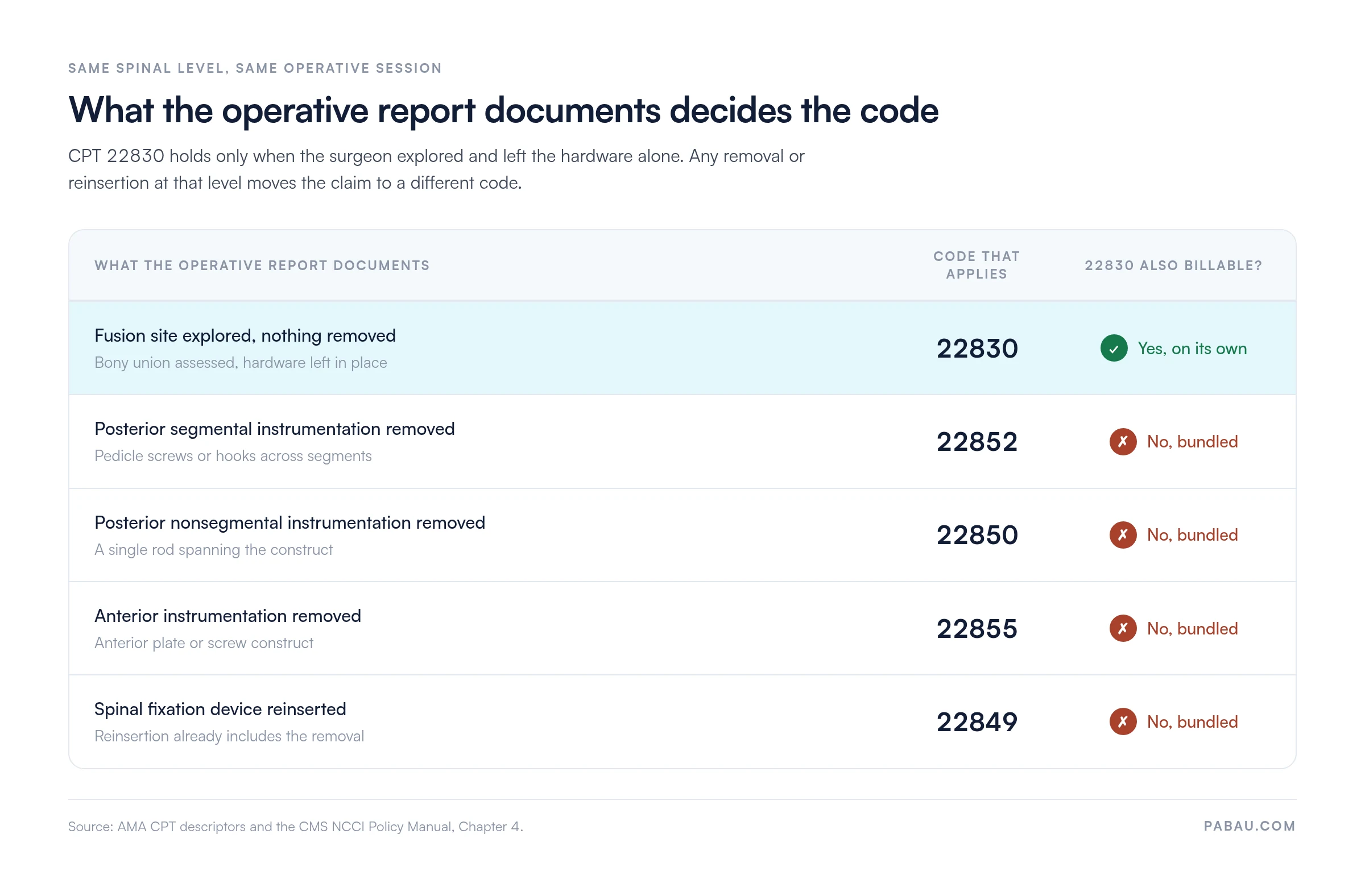
Medical billing compliance on spinal codes needs a CCI edit check inside the claim workflow, not after the denial. Pabau’s Claim.MD connection covers eligibility checks, claim status tracking, and ERA posting, so a rejected pair surfaces early rather than at month end.
Denial management covers the appeal route when a bundling edit does fire. Submitting a clean claim up front is what keeps CCI rejections off spinal procedure codes.
The spinal instrumentation family sits directly next to 22830, and each code in it has a narrow scope. Knowing where the boundaries fall prevents both errors. Undercoding reports 22830 when a removal code was warranted. Upcoding reports a removal code when only exploration happened.
Long constructs shift the code again. 22844 covers posterior segmental instrumentation across 13 or more vertebral segments, and 22830 has no role once that hardware goes in.
The 22830 versus 22852 choice decides the payment on every hardware case. Reporting 22852 when no hardware came out is upcoding. That exposes the practice to payer audits, overpayment demands, and False Claims Act liability.
NCCI guidance ties code selection to operative intent rather than intraoperative findings. A surgeon who plans to explore and then hits a hardware failure that forces removal bills the removal code. 22830 is no longer separately reportable at that spinal level.
Payer reviewers auditing a 22830 claim check two points in the operative report. Did the surgeon state that the intent was exploratory? Does the report confirm that no instrumentation was removed or revised? Without both, the clinical rationale will not save the claim.
A superbill for spinal exploration should prompt the surgeon to attest to each element above. Pabau’s superbill tools build procedure-specific templates for that. Each one captures the ICD-10 diagnosis, the code, the modifier, and the place of service.
Four errors account for most 22830 claim problems, and all four are preventable. The fix is a documentation habit plus a revenue cycle management workflow that checks the pair before submission.
A pre-submission check inside the billing workflow catches most of these before the payer sees them. Pabau’s Claim.MD connection returns eligibility results, claim status, and ERA data. A rejected 22830 pair shows up the same week rather than a month later.
Run a quarterly internal audit on your 22830 claims. Pull operative reports for a random sample of 10 to 15 claims. Check that each one documents exploratory intent, lists the intraoperative findings, and confirms no removal or revision. Finding a pattern yourself is cheaper than having a payer find it.
In most spine practices the operative report lives in the EHR and the claim is built somewhere else. A coder reads the note, decides between 22830 and a removal code, then retypes the diagnosis, modifier, and place of service. Every retype is a chance for the pair to drift.
Practice management software like Pabau keeps both on the same record. Spine, orthopedic, and sports medicine groups write the operative note, attach the code and modifier, and submit through Claim.MD without leaving the patient file.
The practical result is fewer 22830 claims sitting in a denial queue. Eligibility checks run before the encounter, claim status comes back into the same record, and ERA posting closes the loop without a second system.

Pabau’s claims management tools hold the code, modifier, diagnosis, and place of service on the same patient record. Claims go out through Claim.MD, with eligibility, status, and ERA handled in one workflow.

22830 is a narrow code, and the narrowness is the whole job. Write the operative report so a reviewer can see that the surgeon explored and left the hardware alone, and the claim holds. Leave that ambiguous and the payer will read it as the removal code.
The trade-off worth remembering is that the safeguard costs one sentence. A line confirming no removal, no refusion, and no additional procedure takes less time to write than an appeal takes to file.
Standardize that line across every spinal exploration your practice bills. Then check whether your billing software can hold the code, modifier, and diagnosis on one record. Book a demo to see how Pabau handles 22830 documentation and claim submission in one workflow.

Need the halo hardware add-on codes? L0859 covers MRI-compatible rings and pins added to a halo procedure.
Billing an orthopedic autograft case? 24115 walks through the documentation and reimbursement for excision with autograft.
Coding a free fascia graft? 20922 sets out the descriptor, the RVUs, and the modifiers that apply.
Still chasing the patient balance after surgery? Patient payment plans covers setting up, automating, and collecting installments.
CPT code 22830 reports the surgical exploration of a prior spinal fusion site. The surgeon assesses whether bony fusion has occurred, checks hardware integrity, or investigates persistent post-fusion pain. No instrumentation is removed or revised during that operative session.
The 2026 national average is roughly $806 in a facility setting and roughly $1,298 in a physician office. Payment varies by MAC locality. Verify the exact rate for your jurisdiction in the CMS Physician Fee Schedule lookup before billing.
22830 covers exploration only, with no hardware removed. 22852 covers removal of posterior segmental instrumentation. Operative intent is the distinction. A surgeon who planned to explore and removed no hardware bills 22830. If posterior hardware came out, 22852 applies and 22830 is not separately billable at that level.
Modifiers 22, 51, 59, 62, and 80 may apply to 22830, depending on the circumstances. They cover increased complexity, multiple procedures, a distinct service, two surgeons, and an assistant surgeon. Modifier 59 is most commonly used when 22830 is performed at a distinctly separate spinal level from another same-day procedure. Verify modifier eligibility against the current CMS modifier indicator table before applying.
Yes. CCI edits prohibit reporting 22830 separately when a more comprehensive spinal procedure runs at the same level and session. The exploration is inherent to the comprehensive service. Modifier 59 may allow separate billing at a distinctly different spinal level. That requires a separate incision, documented on its own in the operative report. Edits are updated quarterly, so verify the current pairs before billing.
The operative report states the preoperative diagnosis and documents exploratory intent explicitly. It describes the surgical approach and the spinal levels accessed. It records the intraoperative findings on fusion status and hardware. It closes by confirming that no instrumentation was removed or revised. That closing confirmation is the strongest element on a clean 22830 claim.



